The computer industry has an acronym: G.I.G.O which stands for:
GARBAGE IN = GARBAGE OUT
It refers to the idea that if your input data/information is inaccurate (GARBAGE IN), then any computations, using that inaccurate data/information can't be anything other than GARBAGE OUT.
Over the years I've come to believe that you should carefully consider G.I.G.O as it could apply to the Heart Rate & Power training you offer in your classes.
Spinning® Master Instructor Danielle Foster alerted me to this article: Three Reasons To Rethink Heart-Rate Training from running.competitor.com. While they don't identify G.I.G.O by name as the cause of their concerns, a quick read through their list shows, and I'm confident you'll agree, that's the case…
1. Fluctuations Do Not Correspond To Effort Levels
Perhaps the biggest limitation to heart-rate training is that many changes in your heart rate do not correlate to your fitness level. Sleep, stress, and dehydration can all raise or lower heart rate on any given day. As normal people with jobs, families, and otherwise busy lives, these outside influencers are common and can have a drastic affect on your heart rate readings.
“Sleep, stress, and dehydration can all raise or lower heart rate on any given day.” I don't know about you, but if I don't get enough sleep I can feel like >>> GARBAGE. So anything my HR Monitor or Power Meter shows me will be potentially inaccurate. Same goes for; stress, hydration levels, illness, training frequency / amount and also if you're in the doghouse… because you forgot your wedding anniversary.
2. Lack Of Concrete Data Needed To Establish Training Zones
Another inherent drawback to heart-rate training is how difficult it is to establish your max heart rate and the accurate training zones that result from that figure. While a quick Google search reveals a myriad of formulas to help you find your max heart rate, the problem with formulas is that they are based on an average. What if you’re not average? Not only that, but is maximum heart rate really the best predictor of training zones?
Sally Edwards says using shoe size would be as accurate a predictor of maximum heart rate as any age predicted formulas. So what should you use to determine your training zones? If you're really serious, I'd take a graded exercise metabolic assessment. Yes they're expensive and you might have to travel a ways to find a provider.
What about a the 20 minute threshold field tests other's promote? They may work for the true endurance athletes in your classes. It's only after hours and hours of training that most have the fitness, and have learned to tolerate (and enjoy) the pain, that is working at threshold continuously for 20 minutes. Without either, your riders are probably not really finding their actual threshold HR or watts = G.I.G.O. Any zones they build from GARBAGE will be… GARBAGE.
Were always adding new members, so in case you missed (or haven't found) my series of posts from 2011. They describe why I don't feel long threshold field tests get the results we intend.
Thank You to the 354 of you who have completed our survey!
It is greatly appreciated. Because I chose to keep the survey anonymous, if you asked me to contact you I don't know who's who. Please contact me directly.
My goal is to collect 1,000 responses. If you haven't yet, so please take two minutes to share your experiences. Click here to take the survey
This jumped out at me right away. 61% of respondents are reporting that the primary reason people aren't riding and training with heart rate monitors is that they don't see or understand the value.
Click image to enlarge
Which begs the questions; why not? and as Instructors and Studio Owners is there anything we can do to correct or effect this in a positive way?
My Grandfather loved this quote from Albert Einstein: The significant problems we have cannot be solved at the same level of thinking with which we created them. John Sr. (I'm actually the third John in my family) would typically remind me of this concept when I would come to him with some problem I had identified. I was interested in his ideas for creating an “Invention” that would be seen as the ultimate solution.
Back in the 90s I was coaching my daughters youth soccer teams. I, like most of the other dad-coaches, was going crazy trying to coordinate which player on the team played when, at what position and for how long. The basic requirement was each kid get equal playing time. With some help from another Dad, I had devised a rather complicated spread sheet at home. I was so proud of my solution 🙂 Now I'm prepared I thought. But when I would get to the game, someone would always be late, or wouldn't show up at all, messing up spreadsheet to the point of being useless. I then resorted to just randomly assigning players during the game. Inevitably some player (or parent) would feel that they weren't treated fairly… not good. I needed a solution and went to John Sr. looking for help.
After discussing and brainstorming solutions, we applied Einstein's thinking; where was my current thinking possibly preventing me from finding a solution to this problem? My desire to treat all the kids on my team fairly made sense and it was the leagues policy that each player receive equal playing time. So we decided that wasn't it. Maybe I could demand that parents have their kids there on time? I'd already tried that without success. How about my need to be prepared before the game? What if I could find a way to create the spread sheet a few minutes before the game actually started? No way. This was years before laptops were popular. What we decided I needed was some type of chart, where I could add the names of the players who were there on time, right before game time. It would also be necessary for me to adjust for players who showed up late or needed to leave early. The end result was the FairTurn Coaching Tool U.S Patent #6,260,845 which I have since sold to another company.
My goal with this survey was to begin applying this process of creative problem solving to the issue of why our students don't see the value of wearing a Heart Rate Monitor. The first step is understanding what we and our club's are doing now. Then we can step back to see if there is anything we are or are not doing currently, that could be contributing to this problem. The next step will be to think differently, in search of some potential solutions. Stay tuned.
Recommended by ACE – The American Council on Exercise
In Part 1 and Part 2 of Is a 20 Minute Threshold Field Test realistic for your class? I was trying to make the point that although completely appropriate for Endurance Athletes, these 20 minute assessments aren't really appropriate for the typical students in our Indoor Cycling classes.
So if the old 220 – your age is a waste of time, Metabolic Testing is unavailable / too expensive, RPE scales are too subjective and a 20 Minute Field Test isn't practical, what should we use to establish a students Heart Rate Training Zones? And then how do we communicate training intensities in our classes?
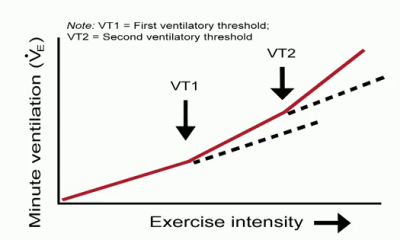
I suggest that WE look very strongly at what The American Council on Exercise (ACE) is now recommending with their ACE Integrated Fitness TrainingTM (ACE IFTTM) Model. Follow that link to an exhaustive article on the Two Threshold / Three Zone ACE IFT Model for Cardiorespiratory Training.
Watch this video and then let me know what you think.
A few things that I feel are important to note:
– After watching the video, do you see how you could be conducting a VT1 (Low Threshold) assessment as part of every class you teach?
– This Two Threshold / Three Zone system and the Talk Test method of determining VT1 & VT2 is based on research by Dr. Carl Foster who is presenting at this years conference. Dr. Foster is lecturing on this exact subject 🙂
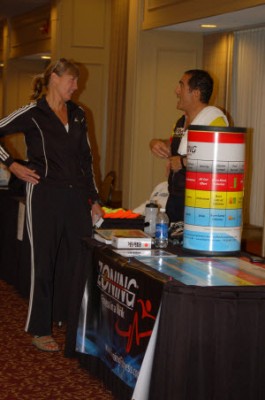
– The Zoning Blink Heart Rate monitor, with it's Blue – Yellow – Red lights, is based on this same Two Threshold / Three Zone system.
Can the sounds of breathing identify the metabolic changes during exercise that are described as VT1 aerobic threshold & VT2 anaerobic threshold?
There's promising research conducted by Breath Research and Dr. Carl Foster at UW Lacrosse. Here's your chance to support this cutting edge technology that could potentially replace conventional metabolic testing, for the purposes of determining Heart Rate training zones.
In an earlier post I asked the question; “Could Breath Acoustics be our answer?” I also promised you an interview with Nirinjan Yee, the CEO and Founder of BreathResearch. Nirinjan's early work in Breath Acoustics (literally recording and analyzing the sounds of breathing) has lead to her Indiegogo crowd-sourcing campaign. Its purpose is to raise the funds needed to fully develop and build the headset microphone worn during exercise.
It's important that Nirinjan reaches her goal of $30,000 by September 29th – not the end date listed of October 29 – because there's a second contest she could win. Phillips Electronics is hosting the “Innovation Fellows” competition and are calling for innovators to submit their #BIGIDEA to address the current innovation gap in the areas of living well, being healthy and enjoying life. With its constant commitment to people-focused innovation, Philips aims to make a difference in people’s everyday lives, and is offering $100,000 of its own money, plus mentoring from Philips leaders, to help the best ideas come to market faster.
This help from Phillips will be huge. So while you are listening to my Interview with Nirinjan, please go to the project page and help her meet her funding goal 🙂
The debate over cardio vs. high-intensity interval training (HIIT) usually assumes that the issue is an either/or choice. In that debate, HIIT is usually compared to absurdly low levels of cardio exercise — not to the kinds of classes ICI-PRO instructors probably teach.
This post explores the evolutionary value of combining cardio and HIIT.
In his book Born To Run, Christopher McDougall reveals the blend of morphology, paleontology, anthropology, physics, and math that led to understanding how humans became the greatest distance runners in the animal kingdom.
There’s no way this short article could do justice to McDougall’s fascinating and detailed description of the emergence of homo sapiens over Neanderthals (they were parallel species), and the evolution of humans as supreme hunters — hundreds of thousands of years before the creation of the tools we associate with hunting (spearheads, bows and arrows).
A few of the evolutionary changes include:
– upright posture to allow deeper breathing and limit retention of sun heat
– the ability to release body heat through sweat, rather than panting like other mammals until they must rest or die of hyperthermia
– the ability to accelerate when the pursued animal has been run to exhaustion.
So human “persistence hunting” combined endurance running primarily, with some sprints. Humans evolved to run in conditions that no other animals can match, and it’s easier for us.
Good At Endurance, and For a Long Time
Endurance athletes can typically continue into what would be considered old age in other sports. In many cases, such as distance running, they can still out-perform teenagers or 20-year-olds until their mid-60s.
At his first double-marathon, the most notable thing my then-35-year-old coach, Jim Karanas, saw was the age of most of the runners, who were 45 to 55. He said it told him immediately that the ultra-run was more of a mental than a physical challenge.
When workouts are always high-intensity, over-training is likely. So are failure to recover fully and a high incidence of injury.
It’s also likely that someone will burn out after constant high-intensity work, making it feel like drudgery, instead of something to look forward to each day. Why not work out in a way that you’d enjoy making part of your schedule long-term? Why not create classes like that to bring your participants back over and over again?
Matt Fitzgerald, noted marathon runner and author, suggests endurance training primarily with 2 to 3 high-intensity trainings per week.
McDougall quotes researcher Dr. Dennis Bramble, who said, “If you don’t think you were born to run, you’re not only denying history. You’re denying who you are.”
But let’s not limit this to running. Endurance athletes of other types display similar results. Countless stories describe master’s cyclists in their 50s and up outperforming younger cyclists.
In his 50s, my coach raced against the cyclists in the 30-year-old category — because he found he could perform better against them than against the experienced racers his own age! Those guys kicked his butt when he was first starting to race.
He was also one of the few (and the oldest that weekend) to ride the notorious Furnace Creek 508 fast enough to qualify for RAAM.
So the choice isn’t really between short, intense intervals and long, slow cardio with a magazine. The right kind of training is not either/or, but both.
(The cardio, of course, should be hard enough to cause a training effect, not help you catch up on your reading.)
This perfect combination is effective, enjoyable, sustainable over the long haul, and entirely in sync with our evolutionary nature.
So what's the potential ROI on the Zoning program?
If you teach “Club Athletes”, what many of us see as the majority of the student in our classes, and want to educate your students / clients on Heart Rate training program, I highly recommend you look into Zoning Fitness. In the video below, Chuck Cali and Sally Edwards present the Zoning Can – a complete 6 week heart rate training program that actually comes in a can.
I'm aware of two ICI/PRO Member Instructors who are part of the initial Beta review of this new 6 week program. They will be taking their class through the complete 6 week Introduction to Heart Rate Training.
“What's the purpose behind a 6 week program?” and “Why not just introduce these concepts during a normal class?” were common questions I heard at the conference. The purpose of a separate program (actually 6 classes) is so you can focus on a small group of students who are truly interested in learning how to use Zone based Heart Rate training, over a six week period of time – so they really learn and understand the core concepts.
If you operate a studio or club and are looking to add Heart Rate training to a multi-week Boot Camp or Weight Loss program, I suggest looking into Zoning Fitness.