
by John | Feb 17, 2021 | Zone based Heart Rate Training
 I became a huge fan of New Leaf Fitness Metabolic Testing a few years ago after I had my first Metabolic Assessment. Before that I was convinced that my AT (Anaerobic Threshold) was 155 BPM, only to learn it was actually 162 BPM.
If you can stand the poor audio quality of one my earlier Podcasts I have a very informative discussion with Jessica Christiansen, the Education and Training Manager for New Leaf Fitness.
Pro Cycling Team Garmin Transitions has just announced that they are using New Leaf Metabolic Testing as a part of their training.
(more…)
Originally posted 2010-03-19 06:27:30.
by Jim Karanas | Dec 30, 2020 | Instructor Training, Master Instructor Blog, Zone based Heart Rate Training

By Team ICG® Master Trainer Jim Karanas
Now that more of your students wear heart-rate monitors (HRM) (see previous post “How To Get Your Students To Wear a HRM”), you must teach them how to use one.
An important first step is sometimes lost when introducing HRMs. Instructors immediately start estimating maximum heart rate and discussing zones. But the first measurement of intensity, how hard the students are exercising, must always be perception.
Relating perceived exertion to heart rate is a fascinating personal discovery for the indoor-cycling student. If it’s done correctly, the student will immediately ask at what heart rate he/she should be training. Then a discussion of training zone estimates makes perfect sense.
The following protocol, developed by Team ICG®, provides a template for a “first HRM experience” that the student won’t forget. Initially, you want the HRM to help the student link a given heart rate with a perception, which enhances awareness. The student feels his/her body go through changes in perceived exertion, along with a visible numerical progression.
Resting HR — 2 minutes
Once the students are wearing their HRMs, have them sit quietly on the bike. No pedaling, no talking, just sitting still. Tell them to breathe deeply, relax and see how low they can drop their HRs. This is not a true resting value, but shows them how relaxation and breathing affect their HR. It also gives them a numeric indication of how prepared the body is to receive training. It may well dictate an alteration of their plan for the day.
Warm-Up — 15 minutes
Roll the legs with no resistance on the bike. Feel the ease of motion, the momentum. Get into a rhythm with it: no effort, just smooth, continuous, even circles. Before taking the HR up, we want to accomplish two things. First, we must shunt blood to the leg muscles. Fifteen minutes of easy spinning will do that. Second, we want the students to sense what’s happening in the body as they get warm.
For the first 5 minutes, set the cadence at 90-100 rpm. Have the students increase the resistance just enough to feel as if their legs are working, without changing cadence. This isn’t much effort. Just bring the HR up slightly.
The first change in perceived exertion is an increase in body temperature. Assuming the room is appropriately cooled, the air temperature initially felt cool or cold. Ask them to notice the change — the air no longer feels cold — and note at what heart rate that occurred. Was it 5 beats up from resting? 10 beats?
For the second 5 minutes, have them make another small increase in the resistance. The second sensation in perceived exertion is awareness of breath. Their breathing pattern has not really changed. Their breathing is not hard or labored. They’ve just become aware that they’re breathing, something we’re unconscious of most of the time. At what HR did they become aware of their breathing?
For the third 5 minutes, bring on a little more resistance without changing cadence and raise the HR again slightly. Two things must happen here. They must notice that all momentum is gone from their pedaling. There’s a distinct point, especially on chain-driven bikes, where the sensation of momentum is replaced by effort. This is very visible to the instructor — the “looseness” is gone from the pedaling — however, it’s still not hard.
The other thing they need to notice is a sudden spike in body temperature. They now feel hot. We experience discomfort just before we begin to sweat because the cooling of evaporation hasn’t begun. What’s the heart rate when this happens?
Settle the cadence down to 90 rpm as they continue to work and begin to sweat. This is the next level of perceived exertion. At what HR did they begin to sweat? They’ll notice the hot feeling leave, then a cool sensation against their skin. They might feel perspiration on the brow, under the arms, or elsewhere.
Their warm-up is done.
As you can see, this isn’t an elaborate or complicated warm-up, just a gradual awareness process for the students. The next step is a heart rate ladder, again to connect the students with their perception of the effort.
Heart-Rate Ladder — 20 minutes
Now that the students are warmed-up, it’s time to take them through levels of greater exertion, while connecting their perception of the effort with the HR at which it occurs. Most of this work takes place seated, so give them periodic breaks from the saddle.
Level 1
Level 1 continues the intensity that they reached by the end of the warm-up. All feeling of momentum has been replaced by a feeling of effort. They’re aware of their breathing and have cracked a sweat.
Their HRs should be consistent. Tell them the first lesson of heart-rate training is stabilization. They should be at a HR that they could maintain for hours. Forget about mechanical difficulties, how the saddle feels, whether they need water, fuel, etc. Ask them to settle into a HR that — in terms of the effort level — they could hold for hours.
Maintain that intensity for 5 minutes.
It’s not uncommon for them to be unsure about whether they’re at the right level of effort. Tell them to check their HR, sense their effort level and ask themselves, “Could I maintain this for 1 hour? 2 hours? 3 hours?” If the effort is too high, they’ll have an internal reaction to the question and should adjust as necessary.
Keep the cadence at 90 rpm; this is important. Let them know that the HR they’re training at is called a target HR. Their job is to maintain that target at 90 rpm.
At this point, it’s helpful to explain what’s going on metabolically. Discuss aerobic vs. anaerobic metabolism and changes in the use of fat and carbohydrate as fuel.
As mentioned above, Level 1 is of the same intensity as the final part of the warm-up. From here, the progression builds to greater levels of effort, which will be covered in the next post.
Originally posted 2012-09-24 05:39:49.
by John | Nov 3, 2020 | Zone based Heart Rate Training
 This came in the mail yesterday and all I could think was, “this has to be for my dad. It can't be for me.” 🙁
No, I'm not going to apply…
I guess it just one more predictable thing that comes with reaching the half-way-point. (I'm 50 at the end of the month and I've taken to telling people that it will be me turning the corner for the other half of the race.)
The hardest thing for me about this age is now needing to wear reading glasses, after ~48.5 years without. Many of us are around this same age and I'm guessing you may have similar problems.
I have about 30 pairs of Dollar Store readers scattered around my house… and yet I'm constantly searching for a pair to wear. What a hassle. I can feel for those of you who wear glasses or contacts.
But what do you do while you are teaching, when you can't see the small numbers on your watch?
I'm one who prefers to ride at the same intensity as my class, but found my trusty Polar's display was no longer readable (by me) once the lights dimmed. Do I really need a heart rate monitor to know my intensity? Not really. 15 years of training has me knowing the feeling of both my T1 and T2 with a pretty high rate of accuracy. But I like to set a good example for everyone else… so I faked it.
Really I did. For about a year I would make a display of lifting my jersey and strapping on my chest belt. Then I would raise my monitor and ask; “how many of you are wearing your monitors?”
I don't have to fake it anymore. No, I don't bring my $1.00 readers into class. I'm using a Blink Heart Rate Monitor. 🙂
If you haven't (forgive the pun) seen this new Blink Heart Rate monitor yet, here's the link to their site. Very simple: it blinks BLUE below T1, YELLOW between T1 and T2, and then RED when you are above T2. T1 is your aerobic threshold and T2 is your anaerobic threshold / LT.
Chuck Cali manages ZONING, which is the educational program that sells the Blink. Chuck sent me one a few months ago to try and I'm in love with it. Now not only can I see what zone I'm in, but my class sees the little blinking light as well. 🙂 I have a new model that's a little different from what they show on their web site. The Blink I have has only one button, and it takes all of about a minute to program.
I love the simplicity of the Three Zone system and feel it will work well for the majority of the students in my class. It may also go a long way toward my desire for a standardized method of describing HR training zones. More about this in the future.
Originally posted 2011-05-10 16:20:17.
by John | Oct 16, 2020 | Engage Your Students, Instructor Training, Master Instructor Blog, Training With Power, Zone based Heart Rate Training
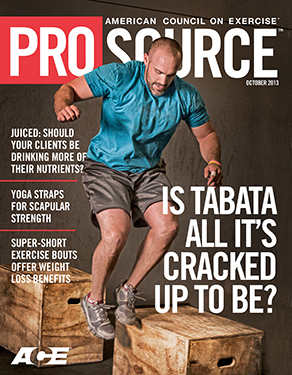
Image from http://www.acefitness.org/prosource/71/
I just read a press release and accompanying article from the ACE – The American Console on Exercise PRO SOURCE magazine about their study to gauge the effectiveness of High Intensity Training (HIT).
Is Tabata All It's Cracked Up To Be?
“It seems like everything high-intensity is now called Tabata Training,” says John Porcari, Ph.D., head of the Clinical Exercise Physiology Program at the University of Wisconsin, La Crosse. “The original Tabata study was done on a bicycle, but people are now doing that 20-second/10-second format with resistance training, plyometrics, calisthenics…with almost anything.”
Because of all of this recent interest in Tabata-style workouts, the American Council on Exercise enlisted Porcari and his research team to gauge just how effective a Tabata-style workout really is.
THE BOTTOM LINE
“The great thing about Tabata is it’s a short workout–only 20 minutes–and it incorporates your total body, so it’s working every muscle group that you possibly can,” says Embert, referring specifically to the Tabata-style workout she designed.
You can download the article for printing here.
But what to do during the remainder of your 60 minute class?
There was a trainer at Life Time who told me years ago something I've never forgotten; First give them (your class) what they WANT… and then give them what they NEED.
The WANT he was referring to are very intense/anaerobic intervals. There's no secret sauce IMO at SoulCycle > they're just teaching very intense classes because they know that's what people WANT.
The NEED is for solid aerobic training. Not necessarily base building, but solid work below threshold HR / FTP.
There are a lot of serendipity going on here at ICI/PRO. A quick check back to our latest Audio PROfile is another – Bad A*s Intervals Audio Class PROfile from Schwinn Master Trainer Rachel Buschert Vaziralli could be a perfect work set you could add to an existing profile.
Instructor Kathy Palkaninec was a past winner of our profile contest and her profile follows a similar WANT & NEED format.
You may want to announce your intentions to crush them (WANT) during a 20 minute Tabata round that will start fifteen minutes into class. Don't worry about telling them what follows. Keep everyone focused on doing their best effort during the Tabatas.
Give everyone a full 5 minutes or more of complete recovery. It's during this time that I talk about the “Golden Hour” and how most of us have 90 minutes where we can really perform well, before fatigue really limits our performance. The Golden Hour doesn't begin for most of us until ~30 minutes in. At the end of the recovery we're only @ the 40 minute mark of a 60 minute class and I explain how we're only 10 minutes into our Golden Hour – just now ready to perform. It's here where you can coach them through a 10 or more minute sub-threshold effort (NEED) to conclude the class. Here's where you can put that stage button to work if you have one – encourage everyone to ramp up to a big number, Stage Button, now maintain it by keeping your instantaneous wattage at or above the average 🙂
Make sense?
Originally posted 2013-10-10 08:28:16.
by Joan Kent | Oct 1, 2020 | Master Instructor Blog, Zone based Heart Rate Training
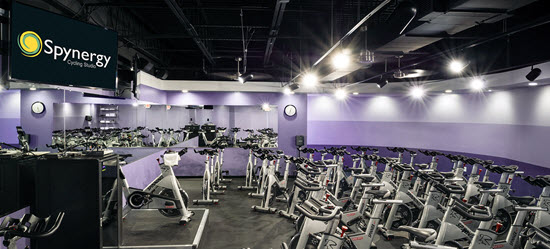
Bill Pryor's Spynergy Studio
By Joan Kent
Indoor cycling classes have become inextricably linked with dim lighting, and I’ve never understood why. Personally, I’m not crazy about training in the dark and will tell you why in a moment.
Studio lighting is one of the factors involved in creating the best class environment, along with music, video, voice, tone, cueing and more. Here are two scenarios from my teaching experience, in which the lighting differences span the spectrum.
In Studio A, the lights are always on and always bright. There’s no on/off switch in the studio because the lights go on when the club is opened. The master switch controls all.
In Studio B, the lights can be brought all the way up to a bright level, but the previous instructor, who had a huge following (okay, it was Jim Karanas), liked to keep the lights dim by flipping only the middle switch on the 3-switch panel. Needless to say, whenever I subbed for him, I made sure the lighting matched what everyone was accustomed to in his class.
The dimmer lighting was okay, but periodically one bank of lights, often on the far side of the room, would burn out, leaving everything on that side of the room just plain dark. It wouldn’t affect the participants close to the door because light outside the studio shines in on the near side of the studio.
We’d notify the front desk staff about the burned-out bulbs, and a short time later, we’d have lights — until they burned out once more.
By my last observation, though, that infamous bank of lights was out again and had/has been for a long time. It made me think about this topic. Apparently, no instructors have reported it to the desk. Apparently, no one has complained.
That last fact amazes me. Because of Jim’s teachings, everyone in the class uses a heart rate monitor (see How to Get Your Students to Wear Heart Rate Monitors). I always train with a HR monitor, mainly because of what I learned from both Johnny G and Jim.
So here’s the thing. In this studio, the bikes don’t have computers that light up and display HR. It’s virtually impossible to see a HR monitor on the far side of the partially lit studio. I’ve seen riders hold up their HR monitors, twist them around to catch available light, and keep track of their heart rates that way. What’s wrong with this picture?
Now I happen to find it difficult to train extremely hard in the dark. For a club anniversary one year, the theme involved decorating the studio like a spooky forest and turning out almost all the lights. Several people did complain that they felt nauseated. Guess I tend to feel that whenever I’m training really hard in the dark.
I had hoped the current instructors might take notice (read ‘take the hint’) when I started bringing a small flashlight to class with me to light my HR monitor on days that I ride on the far side. No such luck.
I have a feeling I’m in the vast minority on this — indoor cycling is almost always taught in dark rooms. Of course, in studios with bike computers that light up, much of this is solved. Still, if I had to choose between the glaring lights of Studio A and the darkness of Studio B, I’d go for the glare. I can monitor my HR easily and definitely feel better physically.
How do the rest of you feel about lighting? Which is most important to you — the atmosphere that goes with dimmer lighting, tracking heart rates, other factors? Please let us know, and thanks.
Originally posted 2014-02-13 10:09:37.
by John | Jul 30, 2020 | Instructor Training, Zone based Heart Rate Training

A common theme in conversations I am having these days is; “today we we find ourselves right here… what do we need to do differently if we want to end up somewhere else next year?”
I have created a short survey (it should only take about 2 minutes) to learn where you are with Heart Rate training at your club or studio. My hope is that your answers will help guide us in the future, so we all end up where we want to be next year 🙂
The complete survey should display below. If you don't see it you can Click here to take survey
Originally posted 2011-05-22 10:03:17.
