“This weeks ride is from Amy! – This is a copy of one of the rides that Amy does during the Cycling Fusion Certifications to show the new instructors a sampling of various drills that they can use to build their rider’s skills.” Joey
“Why do I make less power (fewer watts) standing, then when I'm seated?”
This a a great question that we get often. I loved John's answer, and so I have done a few edits and present it here….. Joey
A great questions from one of the riders in a Performance Cycle class. An observation that shows he's paying attention plus it gives me the chance to clear this up, so you can properly explain this anomaly to your participants.
The short answer is you don't* If resistance and cadence remains the same, in or out of the saddle doesn't matter. The amount of power/watts you are creating doesn't change… because it can't.
The bike decides the right amount of power
You know that Power = Force x Cadence. So let's assume this participant is riding seated and pedaling @80RPM. Their resistance is set to a level that results in the console display showing 150 watts.
Our legs create the perfect amount of force required to get the job done, which in this instance is overcoming the resistance to pedal @ 80RPM. If your resistance setting on the cycle requires “X” amount of force to push down the pedal, your muscles will create exactly “X” – no extra force is created and no less. The combination of that force, multiplied by a cadence of 80 RPM results in the power meter showing 150 watts.
In fact there's an actual law of physics that says that it's impossible to get the same amount of power out of a machine with a reduced amount of power added into it – which is why I'm saying the amount of power/watts you are creating stays exactly the same, if you make no change other than to stand and ride out of the saddle.
“But then why does the power meter show my watts lower, when I'm standing.”
My response was; “you're right it does and there's a simple answer why…
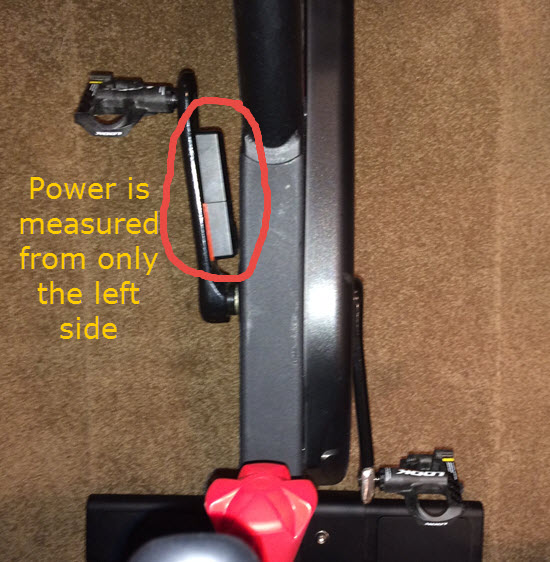
Let me begin with the basics. I teach at a Life Time Fitness Athletic Club and we ride FreeMotion S11.9 with the Carbon Drive belts. FreeMotion's measure power only through the left crankarm as you can see here.
This is my personal S11.0 (the home version) which is why it's black and not the normal silver color. The electronics are identical across all models.
Yes, the meter shows a drop in power…
Many of us who teach or ride on this Indoor Cycle have noticed that the power meter will show a lower wattage number when you transition out of the saddle, without giving any thought as to why. As I explained above, it shouldn't > the wattage number should remain the same. Again; Power is equal to force times cadence. If you didn't change the resistance setting, and you're maintaining the same cadence, the power meter should continue to show the same wattage… but it doesn't because >>>> your legs aren't the same strength.
Your dominate (stronger) leg does more work
The force required to pedal is divided between your two legs – but not equally. Because many (if not all) of us have one leg that's stronger than the other, our brains automatically proportion the amount of force from each. Remember: our legs only create exactly what's needed. Unless you consciously choose otherwise > more force is unconsciously asked from the stronger leg and the opposite leg adds what's left, equaling the total required.
Some quick research showed me that it's very common for one leg to be stronger in most people. Your dominant/stronger leg is typically the same as your writing hand. Since ~90% of people are right handed, the majority of your class will be seeing lower wattages when the come out of the saddle > because they are doing more work with their right leg. The FreeMotion's left hand power meter sensors are seeing a lower amount, of the total amount of work, as coming from your left leg.
Because this IC can only sense force on the left side, when you stand your stronger leg carries a greater percentage of your body weight = the wattages appear lower.
So standing or seated at the same cadence, you continue to create the exact same amount of power. It's just that the power meter doesn't see all of it and displays the reduced amount = the misperception that we create less power standing… which you now understand isn't true 🙂
Make this a feature (not a bug) in your class
Since the Freemotion can show leg strength disparity, why not use it as a training tool?
Novel idea, right?
Start by teaching everyone which leg is their stronger/dominate leg. The simplest way I know is by doing Step-Ups on a box or step raised to the proper level as shown in this short video.
This exercise was eye opening to me, when we did them in Boot Camp. Learning that my right leg is considerably stronger, I'm now really focusing on making my left leg do more work. Hopefully over time, a stronger left leg will result in me having a higher FTP and greater overall muscular endurance.
I suggest having your riders do this as an after class activity > or you could bring a box into your studio and have everyone take a turn.
Using a pair of reasonably sized dumbbells, perform 8-12 reps all on one side and then the other. It should be quickly apparent which (or if) they have a leg strength disparity.
We'll explore drills to exploit this feature and help riders train their weaker leg in future posts! [/wlm_private]
* I'm not referring to pedaling efficiency here, which is a completely different subject.
** Please let me know if this isn't clear, if I've confused you or you have an alternate method of explaining this.
“For all intents and purposes, your body works exactly like the engine in the car that brought you to the studio today.” I like to use that line, especially when I sense I have a bunch of gear heads in the class. First to get their attention by saying something profound and secondly, because it's (grant me a little leeway here) technically true; your body powers a bicycle exactly like an internal combustion engine powers a car.
Now at the risk of one of my daughters admonishing me with “Dad, your class doesn't want another science lesson”, let me explain;[wlm_private ‘PRO-Platinum|PRO-Monthly|PRO-Gratis|PRO-Seasonal|Platinum-trial|Monthly-trial|PRO-Military|30-Days-of-PRO|90 Day PRO|Stages-Instructor|Schwinn-Instructor|Instructor-Bonus|28 Day Challenge']
Your students and their cars use a Carbon based fuel sources that contain essentially “Stored Sun Light” derived from plant photosynthesis.
Both have a system to ingest air (more importantly the Oxygen it contains)
Both have a process to chemically combine fuel and Oxygen which creates heat and pressure
Both use this pressure to create linear motion
Both use an offset crankshaft to convert linear motion to rotary motion.
Both have a system to expel the waste byproducts of combustion
What brought this to mind was last night in my class I had a number of students who rode most of the class looking straight down, instead of the “Head up – Look at your self in the mirror and smile :)” posture we all want. But why do we want it?
I remember listening to the commentators during the China Olympics talking about how you could tell who was strong and who wasn't on the big climbs by how each rider held their head.
Head up = Strong … Head dropped = weak. But beyond the body language, why is head position indicative of performance?
And then I thought of this:
Modern engine designers understand that best power and efficiency is dependent on moving the maximum amount of air into and out of the engine. For that to occur the path the air takes, as it flows into the engine, needs to be as straight as possible.
Here is a diagram of the Intake Track in an older, much less efficient engine, circa; 1940
Now compare that to the Intake Track of one of your students.
Here is a cyclist demonstrating good form with “Head Up – Eyes Forward” posture. Notice how the Intake Track becomes straighter?
Does it then follow that;
Head up = Efficient Breathing (Strong) … Head dropped = Inefficient Breathing (Weak)[/wlm_private]
My understanding is that these are the best – just tough to turn off.
I actually needed to get help from Amy to figure this out – so I could completely relate to this question I received via email today.
Hi John,
I think I read you teach for lifetime. Do you use the micpacks with the flip open battery compartments that covers the on button? This may sound silly, but I can't figure out how to turn the darn thing off. Shouldn't the on and off button turn it on and off? I tried removing the batteries when you put them back it goes right back to on. Any ideas?
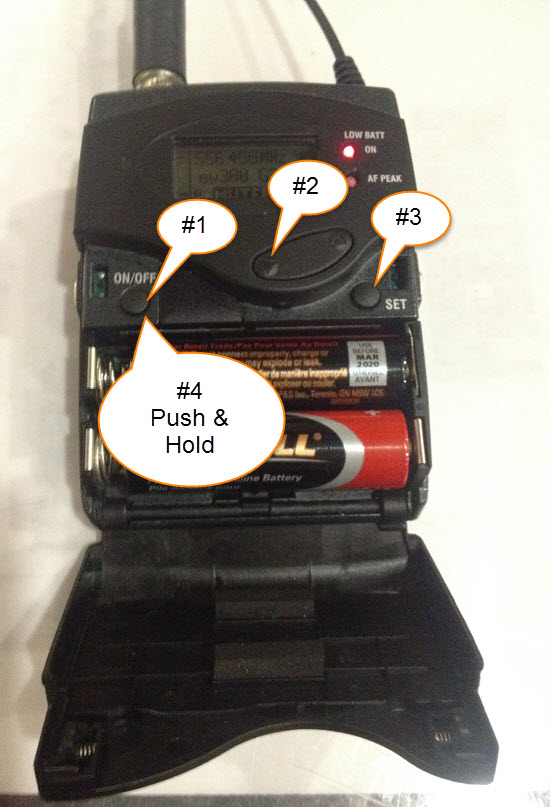
I'm pretty sure this instructor is talking about a Sennheiser wireless microphone pictured above – it's what we have at our club and I found it as confusing to turn off, even after re-reading the email instructions multiple times.
After Amy was able to educate me, rather than try to explain the process in just words, I felt it might be easier to follow with a picture like this.
The steps to turn this off are:
Press the on/off button
Press the button shown
Press the Set button
Press and hold the on/off button until it turns off
In preparations for this Sunday's LIVE online training I was doing some prep work with Amy's Android phone. Note to self, when it's time to upgrade, stick with a new iPhone 4g if at all possible.
Maybe my frustrations were non-typical, but I found trying to switch worlds from iPhone > Android difficult and a bit frustrating. I got sucked into the the VCast world where Verizon wireless will show me the path to App enlightenment… except it didn't lead me to the place where I could download the stinking Spotify App. I had asked Amy (it's her phone) “how do I get to the Apps store?” I don't know… let's take a look.” Which lead us to the “special” store that Verizon has set up that is missing the most important App under the “Music” heading, which as far as I'm concerned is Spotify.
It's important to note here that I'm a PC guy, but I am slowly understanding the whole MAC thing…
“Abby, can you help me find the Spotify App on your mom's phone?” was very productive. She (Abby is under 25, so she understands both worlds) quickly took me to the Android Marketplace (you'll find it, you just need to scroll down below the deceptive Vcast App World icon) to the “Market Place” where you can search for the Spotify download.
Once (or if) you find it you can down load the Spotify App for your Droid phone.
Once I had the Spotify App installed I was asked to log in… but before I could, I had to approve a somewhat sinister message; Steaming or syncing playlists over your 3g or 4g connection can consume large amounts of data and potentially cost you a king's ransom in digital download fees 🙁
OK, I added that last part about the King myself. But this is important; your Smart Phone (doesn't matter which type) needs to be set properly so any transfers occur via wireless Internet, not a cellular connection. The screen shot I have above shows my iPhone (still trying to learn how to do this with Amy's Android) has syncing over 3g turned off, so I have no fears of going broke paying excessive download fees for syncing music to my iPhone.
This Sunday's LIVE training is over full so I will be scheduling a second very soon. You can click here to join the notification list for future Spotify, iTunes and MixMeister LIVE online training sessions.
Strategies for protecting the health of your Mac or PC computer, from the malware know as CryptoLocker, isn't really much different from what you do to protect your personal health; you're careful with what you consume and have some insurance in place for when you get sick. As a fitness professional, you depend on your body to earn some or all of your income. If it breaks you're screwed. Your Dept Head will only except you teaching off the bike for so long, before deciding to replace you.
You are also very dependent on your computer for managing your music and communicating through email and social media – so if it fails you have a similar problem.
In case you haven't heard, CryptoLocker is a nasty piece of malware (virus) that can infect your computer – YES, Mac users are just as susceptible as PC owners. CryptoLocker encrypts (scrambles) your files so they can't be opened… ever…by even the NSA… unless you send the hacker $300.00 for the key to unlock the encrypt files.
However, there are trojans out there that have surprising and nasty behaviours like encrypting your files with a password you don’t have and demanding money to unlock them. This kind of malware is not new but over the past 18 months it has become significantly more prevalent and the malware authors have written significantly more clever and scary versions.
This kind of malware is now all over the web and your chances of running in to it and being exploited are uncomfortably high. Some of the more widespread examples such as CryptoLocker even include a count down timer which claims if you don’t pay them $300 in 72 hours they will delete the key file so that your data is lost forever. Malware like this is growing more scary day by day including the ability to encrypt all your data but also to spread over the network and hit other systems.
You can search in vain for a solution, but there is no know remedy to recover your encrypted files if you get infected. Well except bypaying the ransom demanded by the hacker – yes, believe it or not, these are honest hackers. Most do send you the encryption key after they receive your $300.00.
Preventing CryptoLocker – don't click that link!
As scary as it sounds, any link you click could install the CryptoLocker virus (or other malware) on your computer. The trick is not clicking that infection link in the first place. The primary places you find those links is in SPAM email and garbage websites offering free nonsense; games, software and (wait for it) FREE MUSIC DOWNLOADS. Don't go there and you're 50% guaranteed that you won't have to send that $300.00 to recover your 10,000 songs in iTunes.
Long time readers have heard me implore you to use strong passwords for your email accounts. NOTE: you must have listened because I'm seeing far fewer SPAM emails, sent from hacked accounts. CryptoLocker doesn't get installed in your computer by hacking your email, no, but the SPAM emails going to all your friends in your contact list. Most people have learned to ignore an email that says; “Hi there. I saw your picture on facebook and think you're cute. Click this link to see pictures of me!” But a few haven't.
But what if I am infected?
Beyond sending the $300.00, the only known option is to completely wipe your computer clean / restore to factory settings and restore from a backup that predates the infection. If your last manual backup was two years ago – then that's what you'll have to work from. Sorry, there is no other solution 🙁
If you're using an automatic backup service to the cloud; Carbonite, TimeMachine, Windows Backup, etc… you're in luck. All of those services have multiple restore points – you can go back in time to before you were infected, and recover those old, encrypted files. But only after you've first wiped your computer clean so the files you re-import aren't reinfected.
I copied this from Carbonite's help page that explains:
Restoring a previous version of a file lets you correct any accidental changes.
Each day a file is backed up, Carbonite maintains a version of that file.
You can view up to 12 versions of a file to restore (depending on how many times the file was backed up and how long ago it was backed up).
You can restore a file you have deleted from your computer hard drive (as long as the file was deleted within the last 30 days).