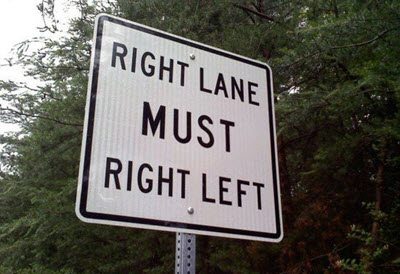
We were waiting for a long traffic light to change yesterday, when one of our group asked me a question; why do you unclip your left foot? I always unclip my right… personal preference, or is one way better/more correct?
The women who asked this question is a relatively new rider. This is her second year road riding with our outdoor group. Like many who've become passionate cyclists, she has become a student of all the little details involved in cycling. So she's often curious, questioning us about things we do on the road. I remember her asking last year why I would always stop in the center of the righthand lane, rather than staying on the shoulder. She quickly understood when I explained that by claiming the lane, it would hopefully prevent a car from squeezing us into the right hand curb, as we cross the intersection 🙂
Seeing that there are a bunch of Instructors riding outdoors, I thought I would share this with you. For your benefit, and possibly some new rider you have the opportunity to mentor someday.
My view is that unclipping should always be done with your left foot, regardless of which footed you are, because it's safer.
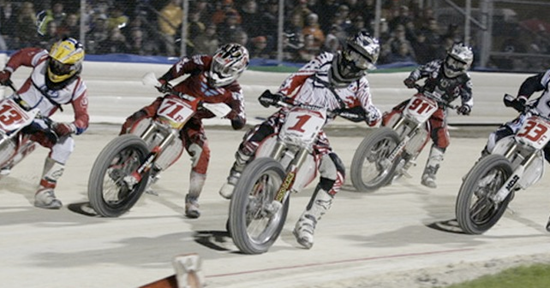
Regular or Goofy Foot?
Lead foot choice on board sports like; Slalom Water Skiing, Wakeboarding, Skateboarding and Snowboarding are designated as;
Left foot forward = Regular Footed
Right foot forward = Goofy Footed
I have no idea when I first heard the term Goofy Foot, but I do know it was waterskiing. I always had my right (Goofy) foot in the forward binding of the ski. I just felt more natural for me, even though all my friends did the opposite. With these sports it's a matter of personal preference.
Why does it matter which foot on a bicycle?
Here are a few reasons I feel it's safer unclipping your left foot during a controlled stop. NOTE: road cyclists should be comfortable unclipping either foot in case of emergency.
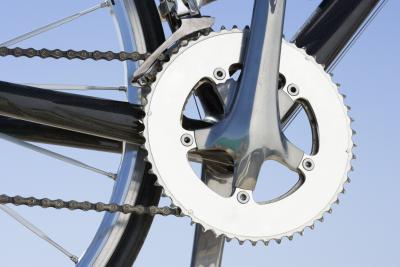
#1 That front chain ring is really sharp!
Like a stationary saw blade… ready to slice open your calf!
I didn't want to post the actual picture, but this link shows what can happen when your foot slips off the pedal when you aren't successful clipping in and you're in your small chainring. Ride long enough with slippery road pedals and there'll be a time when you put pressure on an unclipped pedal. Your body weight quickly carries your sliding foot across, and then off, the front of the pedal. Do it with your left foot and you'll just be embarrassed. With your right and there's a chance you'll need stitches from your right calf scraping across those sharp teeth and a tetanus shot – those teeth are not only like little razor blades, they're also really dirty.
This actually happened to my buddy Randy Erwin a few years ago. He had been following Amy and me on our tandem. Amy looked back and saw him stopped, hunched over his bike. Once we rode back we saw all the blood – he did too and nearly passed out from it.
#2 Your right leg is probably stronger
Watch a child or new rider leave from a stop and you'll normally see them repeatedly pushing/pawing off with the unclipped foot – often with the clipped-in pedal in it's lowest position.
Experienced riders start with the clipped in pedal positioned around 2 o'clock. This allows you to power away by driving the clipped foot down, using a normal pedaling motion. The unclipped foot can help push off a little, but it's mainly for balance. This first pedal stroke needs to be powerful – so use your strongest leg! With 90%+ people being righthand dominate, your right leg is typically stronger.
You might need to complete multiple rotations with just one leg, before pausing long enough to get the second foot secured. Another reason you need as much strength as possible.
NOTE: for you “lefties” I still feel the potential danger listed in #1 should have you unclipping your left foot.
#3 Keep your down foot on the high side
This might not apply where you live – and it will be contraindicated (a new use for that term) for our friends in the UK, Oz and other British territories. Roads are often constructed with a “crown” = the center of the road is higher than the shoulders. They do this to speed rainwater runoff and it will naturally cause an initiative/sleeping driver to steer away from oncoming traffic. So for us who drive on the right/correct side, your left foot will be on the “high side” = you may have better balance than reaching down to the low side.
NOTE: for you who drive on the left/wrong side, I still feel the potential danger listed in #1 should have you unclipping your left foot.
#4 Don't get confused
Err… not sure?
After leading group rides for 20 years, it's not uncommon to see a rider who appears confused at a stop – they aren't sure which foot to unclip. As you know, confusion can lead to indecision and indecision on a stopped bicycle frequently leads to someone tipping over. Embarrassing and often painful 🙁 Not to mention any names, but I have a guy… Lee, in the “C” group I lead (my community service) with this problem. More than once a ride I'm seeing him jump out of both pedals and then slide on both feet until he stops!
Decide what you're going to do in advance. Make a conscience decision; “I'm going to go Goofy and unclip my left foot!” as you roll to the stop with your right foot at the bottom.
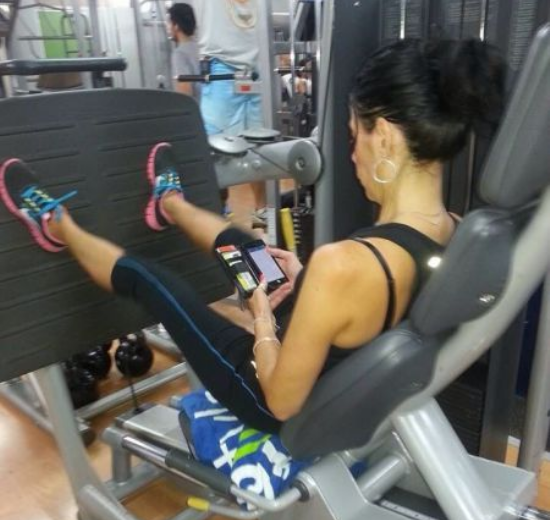
Texting during exercise could prevent weight loss: Study
Kent State University researchers Jacob Barkley, Ph.D., and Andrew Lepp, Ph.D., as well as Kent State alumni Michael Rebold, Ph.D., and Gabe Sanders, Ph.D., assessed how common smartphone uses — texting and talking — interfere with treadmill exercise.
The researchers, from Kent State’s College of Education, Health and Human Services, found that when individuals use their smartphones during exercise for texting or talking, it causes a reduction in exercise intensity.
“Exercising at a lower intensity has been found to reduce the health benefits of exercise and fitness improvements over time,” Barkley said.
The results of the study and the widespread use of smartphones during exercise help explain the results of a previous study conducted at Kent State by the same researchers, which found a negative relationship between smartphone use and cardiorespiratory fitness.
“These findings are important because poor cardiorespiratory fitness is associated with an increased prevalence of cardiovascular disease risk factors, such as higher cholesterol and blood pressure levels, which could potentially lead to premature mortality,” said Rebold, who worked on the study while at Kent State and now serves as an assistant professor of exercise science at Bloomsburg University of Pennsylvania.
Of course you already knew this – nice to know it's supported by science.
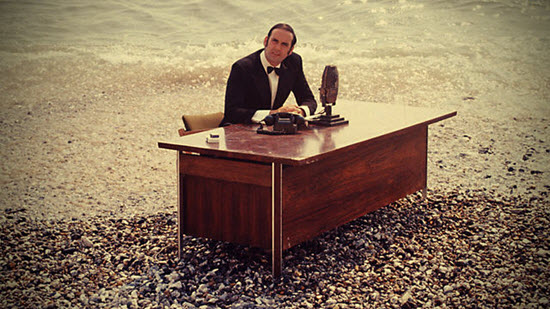
I loved watching Monty Python as a kid. One of my favorite bits was during the introduction when they cut to John Cleese, sitting at his desk, in a wholly improbable location – typically in the middle of a field, the ocean shore or behind bars.
On occasion, I enjoy offering up music that's completely different. Often it comes in the form of a unique/interesting remix.[wlm_private ‘PRO-Platinum|PRO-Monthly|PRO-Gratis|PRO-Seasonal|Platinum-trial|Monthly-trial|PRO-Military|30-Days-of-PRO|90 Day PRO|Stages-Instructor|Schwinn-Instructor|Instructor-Bonus|28 Day Challenge']
I follow DJ Henry Krinkle on soundcloud and this track (no name, just the symbol å…) could make for a fun 72RPM climb. Let me know if you agree 🙂
https://soundcloud.com/henry-krinkle/fobrmdt9raly
Not only is å… “different”, it's constructed like a short story that would allow you to narrate. Give a listen and with each change, consider what changes in terrain or intensity you'd cue.
And as a bonus free track – this remix of Ellie Goulding's How Long Will I Love You would make for a fun and “different” intro or closing track.
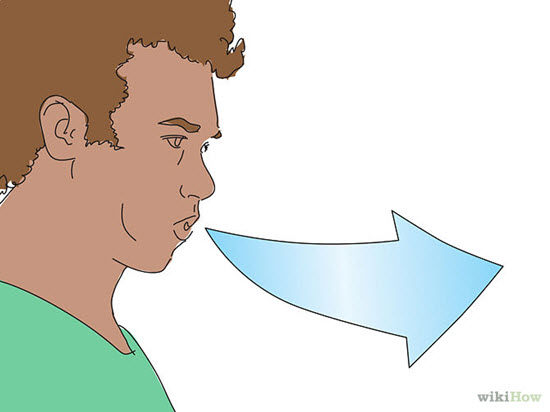
You need to exhale all those fat calories away! Image credit www.wikihow.com/
I'm constantly on the hunt for clever ways to encourage my class to focus (a polite way of saying SHUT UP) and work hard. Over the years my best success has come from equating the work we're doing to weight loss. After all, interest in burning calories is universal – doesn't matter who it is (cyclist, club athlete, new mother, etc..) everyone in my class is interested in either reducing or maintaining their body fat percentage.
I've learned a new one today and can't wait to give it a try:
OK – you two talking in the back. Do you realise you're preventing fat from escaping your body?
It might sound crazy, but it's true. Science has shown that when you burn body fat, after giving up it's energy, fat is converted to CO2 (carbon dioxide) and H2O (Water) and leaves your body when you exhale.
We talk a lot about dieting and burning off fat, but we actually have a lot of misconceptions about weight loss. Some people think fat is converted into energy or heat–a violation of the law of conservation of mass–while others think that the fat is somehow excreted or even converted to muscle. I was told early on that you can never lose your fat cells (adipose) once you gain them…they just shrink if you work it off.
Well, according to Andrew Brown from the University of New South Wales and Australian TV personality (slash former physicist) Ruben Meerman, when you lose weight, you exhale your fat. Their new calculations, based on existing knowledge about biochemistry, were published in the British Medical Journal this week.
A little research on the subject lead me to this excellent video from ABC.net.AU that describes the process of converting Fat to energy in a way that you'll be able to share with your class.
So I might be taking some technical liberties here, by saying that talking is preventing fat calories from escaping. I'm willing to distort the science a little if it gets the larger point across… which is:
If you're talking you're not working as hard as you should and not burning the calories you could!
I'm not a Snoop Dogg fan – but there's some awesome tracks this week on Spotify.
This has become an almost regular habit for me. I'll cue up the New Music Tuesday playlist published by Spotify and then drag promising tracks into my Future To Use folder. Some weeks are near complete washouts. This week has what could be a complete class of songs… Oh, what the heck. Here's a playlist of just songs from today (no Snoop you'll notice) that follows my typical Life Time Fitness 45 minute Evolution Class Format – times are approximate and vary dependent on song length:
5 min Warmup – 90+ RPM
5 min Openers – 4-5 accelerations pushing above threshold (your Edge in Life Time speak)
3 min Reset – fun change of pace, but not a full recovery
4 min Best Effort = maximum sustainable Watts / HR
4 min @ VT1 (Aerobic Threshold or top of zone #2) / Base Watts
7 min Challenge #1
2 min Reset
7 min Challenge #2
2 min Reset
4 min Big Finish = a Best Effort / slightly above threshold final effort
5 min Dedication, cool down & stretch[wlm_private ‘PRO-Platinum|PRO-Monthly|PRO-Gratis|PRO-Seasonal|Platinum-trial|Monthly-trial|PRO-Military|30-Days-of-PRO|90 Day PRO|Stages-Instructor|Schwinn-Instructor|Instructor-Bonus|28 Day Challenge']
Why do I choose to follow a templated class profile?
Lots of reasons actually:
The Life Time Fitness 45 minute Evolution Class profile is supposed to follow this template format. One of the rare times in my life that I choose to willfully follow directions 🙂
15+ years of experience has me believing my participants enjoy a consistent, predictable class profile. This is especially true for my early AM “A” types. They need to see that I have a plan and purpose for the class. Sticking to a familiar pattern (they know what to expect) appears to be comforting to them + knowing what's coming has them working harder throughout the class.
It helps keep me creative. Knowing WHAT profile I'm planning frees me to play with music that determines HOW I'll lead each segment. The Best Efforts and Challenges are “open” – meaning, if I want to use a big climb for the first Best Effort I can. Just pick a powerful track with a slower tempo and I'm done with that segment. Challenge #1 and #2 can be speed, endurance, strength, etc… and typically a pair of songs.
Knowing in advance, what I'm doing this week, makes life less stressful. Less stress allows me to concentrate on delivering a better class presentation.
Simplifies creating fresh playlists. Because I already know the profile, I can quickly assemble a playlist. Contrast that with not knowing either the profile or playlist. I would have twice the work. No thanks.
[/wlm_private]I'll be using this playlist and profile on Thursday. I'll let you know what their response is!
Glamour Magazine recently published an articleThe 6 Secrets to Burning Major Calories in Spin[sic] Class written by Faith Cummings. Four of the points raised are solid. One is iffy and another is IMO boarding on BS.
Their suggestions; Don't stop moving, Make sure you have enough resistance, Push yourself and Prep your body before class (that last one is my favorite and I'll expand on the idea below) are all solid and sound advice.
These other two, not so much:
Turn up the heat.
We're going to sweat while we workout anyway, so why not turn the temperature up a bit and really get it going? “Riding in a heated room torches calories,” says The Sweat Shoppe co-owner Mimi Benz. “You can burn up to 1,000 calories in 55 minutes.”
While technically accurate (yes your body expends additional calories staying cool… actually more than staying warm) what's missing is how our body's ability to create work decreases, as our core temperature increases. So if you can't work as hard because you're overheating, I find it hard to believe that a hot room has a positive effect on calories burned. I'll respond to the 1000 calories in 55 minutes BS below.
Remove the bounce.
“Bouncing stresses our joints and actually takes away from the calorie burn,” says Flywheel cofounder and creative director Ruth Zukerman. “When riding out of the saddle, hovering closer to the saddle relies on the use of your muscles more, resulting in more calories burned.”
I've love to see an actual study showing this – it's actually the first time I've ever heard it. My perception is bouncing out of the saddle is the result of improper pedaling technique – so technically she could be right > better technique could result in more muscle recruitment = more work accomplished / calories burned… or it could go the other way > better technique = more efficient, which could result in less work/calories expended. Either way I have a hard time believing that hovering will contribute to you being swimsuit ready anytime sooner.
My six secrets to Burning Major Calories in Indoor Cycling class.
[wlm_private ‘PRO-Platinum|PRO-Monthly|PRO-Gratis|PRO-Seasonal|Platinum-trial|Monthly-trial|PRO-Military|30-Days-of-PRO|90 Day PRO|Stages-Instructor|Schwinn-Instructor|Instructor-Bonus|28 Day Challenge']
#1 Dump the assumptions, they're unhelpful and potentailly destructive
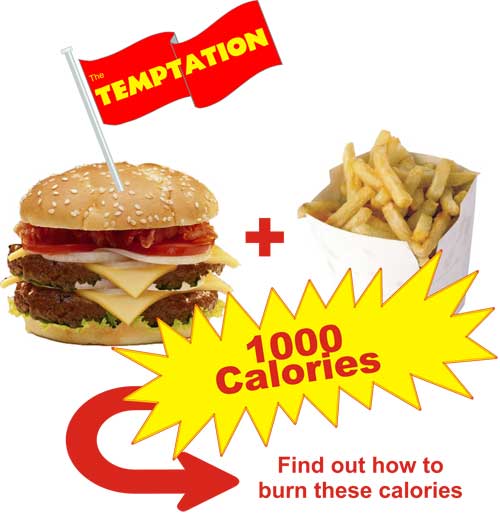
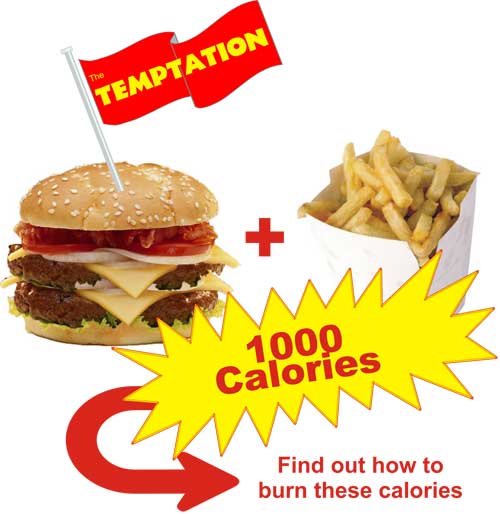
No, Ms. Benz, the typical participant in one of your Indoor Cycling classes CAN NOT BURN 1,000 calories in 55 minutes. Yes there may be a few in your classes who can. But unless you're looking at a room full of very fit 200lb men in every class, burning even half that amount (500 calories) will be a huge result for most participants.
Knowingly setting unrealistic expectations (BURN up to 1,000 Calories!) for riders in a class is unethical and is sleazy marketing of the worst type.
So what happens when a rider thinks they will burn 1,000 calories (no one hears the “up to” part) in a 55 minute class? Lots of things and none of them good:
They'll feel free to eat more post-class as a reward. This post describes what's called hedonic snacks which are those little treats we use to reward ourselves for a job well done. “I just burned 1,000 calories!” “Say, doesn't the blueberry muffin look like the perfect reward?” Congratulating folks for expending way more calories than they really did, sets up a destructive cycle of behavior that results in weight gain, not weight loss.
They won't work as hard in class, so their actual caloric expenditure will be even less than it could be. “I'll be happy with just 600 calories today, so I'll take it easy and chat with my new friend riding next to me.”
They're set up for failure. Consider a studio equipped with Indoor Cycles with power indication. The studio's marketing materials tell riders they can burn 700/800/1,000 calories a class. At the end of the 60 minute ride the customer hits the avg/end button and sees; ‘Total Calories = 287'. How do you think they'll feel? “What happened to 1,000 calories?” “I must be a failure” “I'm never coming back here”🙁
OR – consider a studio without power who tells their customers; today we burned 700/800/1,000 calories! And then one day they ride a competitor's Indoor Cycle with power and learn the truth. Whoever lied to them will have lost a customer…
Image from http://www.wired.com/2012/08/fitness-trackers/
#2 Find some technology
I'm not talking about a wearable fitness tracker or heart rate monitor that offers estimated calories – they've been shown to display wildly optimistic calorie counts > Instead find a club or studio where you can ride an Indoor Cycle with Power/Watts indication – so you can observe a real measurement of how much work you're actually doing in class.
Indoor cycle power meters
At the risk of losing you here, there's a Law of Physics that can be applied to exercise and calorie expenditure. In layman's terms, the law; Conservation of Energy says you can't get more energy out of a machine… than what you put into it. Makes sense, right?
The power meter on an Indoor Cycle will record the the amount of energy your body expends turning the pedals x the amount of time you're working. Through some fancy math, any brand's power meter will display a reasonably accurate estimate of the amount of energy that went into powering your ride, expressed as Kilocalories (kcal), kilojoules (kJ) or both.
There are still a number of unknowns with these estimates of calories expended. The cycle doesn't know your gender, body weight or fitness level. My understanding is that the estimates used by manufacturers are based on a reasonably fit, 160 lb male.
Don't let these minor variables trip you up. The most important benefit of riding an Indoor Cycle with power/watts is how you can see today what you burned during the total class. Your next ride you'll have the chance to work a little harder and then you'll get to see your actual success!
#3 Stick with water
Nothing drives me crazier than seeing a participant, who I know is in class for weight management, with two bottles of energy drinks on her/his bike. 12 ounces of Gatorade has about 80 calories > the typical water bottle holds 20/24 = 160 calories for one and 340 calories for two bottles or more. So there's the potential to replace every calorie you've burned, and then some.
Depending on the time of your class, participants and instructors should be consuming a small meal of ~200 calories, that consists of a blend of carbs/fats and proteins. My favorite is a slice of whole wheat peanut butter toast.
Side note: Dr. Joan Kent, who's our resident nutritionist here at ICI/PRO, has been battling the addictive properties of sugar for years. She's written extensively about how you don't need sugar before, during or after exercise of any form. Endurance Nutrition Coach Ben Greenfield offers his own similar suggestions here.
Don't be left at the start
#4 Get there early… and get after it
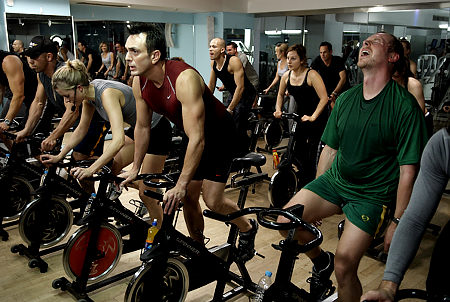
Fitness can be expensive and if you're anything like me – you hate to waste your hard earned dollars. So with popular boutique studios charging $30 or more per class, what's the secret to ensuring youget your money's worth + maximizing your calorie burn? Don't waste your pre-class time! Instead of sitting there, slowly pedaling and chatting with your neighbor, take yourself through a purposeful, self directed warm up. The objective is to be warm and aerobic by the time class begins.
Find a comfortable pedal cadence around 80-90 RPM and quickly add resistance until you're feeling productive. Wait until you feel the workload get easier (as you warm up you'll feel stronger) and add another gear. Ride there for a few minutes and then recover until you can breath easily. That's your cue to start the process again. This isn't anything crazy. Unless this is your first class, you know what you can (and need) to do to raise your body temp and elevate your heart rate to the point where you'd rather breath, than talk. I call this working above the Chatty Zone – that's the training zone you want to stay above to burn the greatest number of calories.
Again your goal is to be warm and ready to work the moment the music starts. You'll be burning major calories, while your neighbor is still organizing her towel.
Shut up
People who chat constantly during class burn 50% fewer calories than those who don't. OK, I made that statistic up out of thin air. As far as I know it's actually closer to 80% for the simple fact that burning calories requires a lot of Oxygen (O2) and talking can only occur when you don't need the O2 in the air you're breathing for anything else.
Just how much O2? The chemical conversion of the stored fuel in your body (fats & sugars) to usable muscular energy is around 3 to 1. So to burn 1 pound of body fat, you need to consume (breath in) 3 pounds of O2. Think about that for a moment. Oxygen is a gas that's only ~14% of the air you breath. O2 doesn't really appear to weigh anything and yet you need huge amounts of it absorbed into your bloodstream, to support the chemical reactions that turn stored body fat into energy.
Anything you do, that limits your ability to breath, will reduce the amount of calories you can burn. Choosing to talk during a workout subconsciously tells your body not to work hard = you might have had fun catching up with your friend, but you just wasted 60 minutes of calorie burning time – plus you probably irritated those riding around you 🙁
Here's a fun fact: do you know how those burned calories leave your body? Through your mouth! Fats and Sugars that have been “burned” (a more accurate description would be oxidized) are long chain carbon molecules that are broken up – one carbon atom combines with two oxygen atoms, to form CO2 carbon dioxide. So that toast you had for breakfast this morning leaves your body, a little bit at a time, with each exhale.
Stay down
I call it, “bailing out” – the act of sitting up, to recover completely after an interval. If your objective is to burn the maximum # of calories, then you need to work at your highest sustainable level for as much of the class as possible. Killing yourself in a short burst, only to back way off has a negative affect on your total work accomplished during the class. Instead, to expend a larger amount of calories, try working not so hard > but for a longer period of time. Physical endurance will come over time, so stick with it. Stay down in the riding position for as long as possible, while managing your workload to you can complete each interval segment. If you need another reason to stay down… consider that everyone watching you bail out, is secretly chuckling at your lack of stamina 🙁
Come consistently
A focus on “burning calories” kind of misses the point. The objective is to reduce stored body fat, right? Just as you can't effectively train for a marathon, by randomly running across the street – reaching your weight loss and/or fitness goals requires a lot more than riding in a cycling class where you burning major calories. Weight loss will only come to those who attend fitness classes consistently.
If you're a little weak in self-discipline, I suggest finding a friend with a similar schedule and fitness objectives. Plan to meet together at a few specific classes, so someone will miss you if you're not there.[/wlm_private]
I'll often tell new riders:
The most important class you'll ever take… will be the next one.