As a training tool – running a PTP test/assessment is invaluable!
We had some excellent questions from Studio Owners this past weekend during our Full Psycle/PRO PIQ workshop. Paul Harmeling addressed these two related questions during the Q&A – I wanted to offer my thoughts on it here:
When, or how often, should we be using using the PTP (Personal Threshold Power) mode screen?
What exactly should we have our riders doing, during the PTP (Calc) test/assessment?
First, for those currently not using a Display System in your studio, let me explain what we're talking about. NOTE: I'll focus on Performance IQ because I know it much better – all of this has similar application with Spivi.
On a related note, I learned a little known trick that could potentially save a new studio enough money to pay for PIQ or Spivi – contact me if you're interested in learning more.
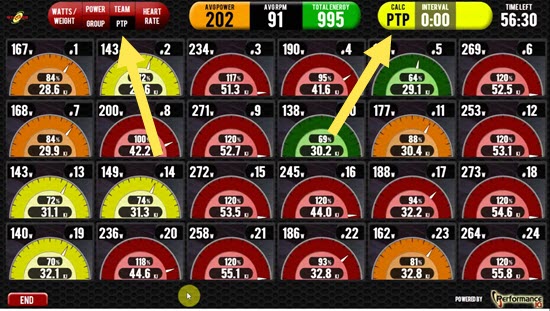
The PTP (Personal Threshold Power) mode screen in PIQ offers a quick (just three minutes) and simple tool to give your riders an approximate understanding of their maximum sustainable power wattage. Then through the wonders of technology, PIQ creates 5 power zones and displays them as different colors. The system calculates PTP as 90% of the highest sustainable power each rider can sustain for the length of the three minute test.
Is PTP as accurate as a 20 Threshold assessment? It doesn't matter to ~98.5% of your riders. What is important is that PTP answers the question that I've heard over and over the past 3 years I've been teaching with power: how hard should I be working… when you ask me to work hard?
So on to the questions:
When, or how often, should we be using using the PTP (Personal Threshold Power) mode screen?
Paul and I are in agreement here – we both feel you should be including PTP in most, if not all classes. There are of course exceptions. You may have a teams challenge scheduled or focus on a class that's directed toward handicapping everyone based on watts/pound.
What exactly should we have our riders doing, during the PTP (Calc) test/assessment?
Here's where Paul and I diverge in our thinking. I see this as a time for a focused effort in the saddle with a consistent cadence, where Paul was saying (and he demonstrated during the Master Class) that he's open to varying position and/or cadence. So who's right? I feel we both are 🙂
You see we each teach very different classes. Mine are typically focused efforts in the saddle = how I would run my PTP tests. Paul's classes are much more frenetic, with frequent changes = that's how he conducts his PTP segments.
Here's mine:
Running a PTP test isn't any different from the Best Effort intervals we suggest you use in a power class that doesn't have a Display Training system. Here's one I included in a recent Performance Cycle class.
Track #2 — the first PTP track is important. We’ll use this average wattage for each of the four PTP efforts to follow. Everyone seemed to enjoy Billy Idol — Rebel Yell — 1999 — Remaster — maybe suffered a bit as well. At 4:47 there’s plenty of time to explore PTP.
We use the Stage button to reset the averages at the beginning of what I describe as; Your Best Sustainable Effort. It’s normal for riders to miss-judge where they should be, so I’ll often have everyone make needed adjustments and hit the Stage button again to reset the averages.
My experience is that everyone will benefit from from a few mini (30-60 secs) PTP efforts to figure out where you should be. On any of the magnetic bikes I like to have find a reasonably challenging climb at around 65 RPM and then have riders accelerate to over 80RPM and observe what it feels like (RPE) and the wattage.
Two or three of these short intervals should give your peeps a watts window they can shoot for during the actual 3 minute PTP test.
I ask everyone to stand and walk, without touching the resistance, for a minute recovery.
To start the PTP test, I'll cue up a track like 83RPM Billy Idol — Rebel Yell and cue finding the cadence. Ten seconds to get everyone there and I will click Calc PTP. Encourage everyone to do whatever it takes to complete the assessment and let the technology work it's magic, figuring everyone's training zones.
In many of my “The Power of 3” posts I have written about the importance of “anchoring” time and effort. In it's most basic terms this means that the shorter the interval the higher the effort. If you instruct on bikes with power, then a higher effort should also translate to a higher wattage. This “anchoring” concept holds true as long as riders are given appropriate rest or recovery after each interval or hard effort. If riders are not given enough recovery between intervals their effort may still be high but their output or wattage will start to drop as fatigue increases. The ability to see this phenomenon is one of the most “powerful” features of a bike with a wattage meter.
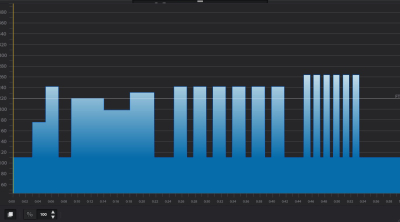
The theme for my Above Threshold classes this month is to show my participants the importance of recovery. Over the last few months I've been using a lot of interval sets where I decrease the interval time from interval to interval and I expect to see a higher average wattage for each interval. For example I may have my participants perform intervals of 5, 4, 3, 2, and 1 minutes, each interval is followed by a 2 minute recovery, with the goal of increasing average wattage for each interval. This month I'll have my riders perform the same intervals, but I plan on reducing the recovery time to as low as 30 seconds between each interval. At the beginning of the month I expect to see wattage drop from interval to interval, as the body fatigues from lack of recovery. In the middle of the month I expect the see wattage held steady from interval to interval and by the end of the month, as the body adapts, I hope to see wattage again increase as the interval time decreases.
The body is truly an amazing organisms and it adapts to the stresses it faces, be patient and enjoy the process.
[wlm_private ‘PRO-Platinum|PRO-Monthly|PRO-Gratis|PRO-Seasonal|Platinum-trial|Monthly-trial|PRO-Military|30-Days-of-PRO|90 Day PRO|Stages-Instructor|Schwinn-Instructor|Instructor-Bonus|28 Day Challenge']
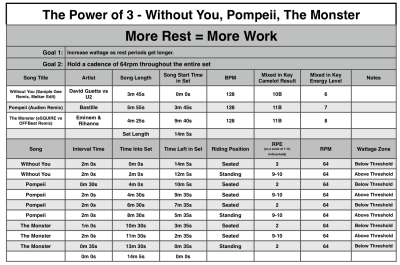
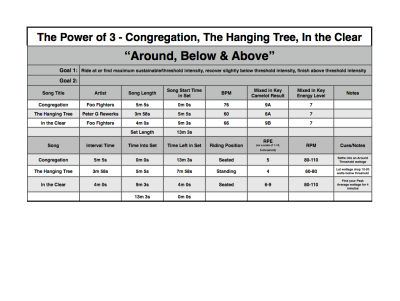
The Power of 3 – “More Rest = More Work”
“Without You (Sample Gee Remix, Melker Edit)” by David Guetta vs U2
“Pompeii (Audien Remix)” by Bastille
“The Monster (eSQUIRE vs OFFBeat Remix)” by Eminem & Rihanna
3 song harmonically mixed track, to download Right Click > Save As / Save Target As to download. Open in iTunes and then you'll see this in your Spotify Local File folder.
Before I was an ICI/Pro Contributor, or Master Educator, before I spent every weekend coaching whatever sport my kids were playing at the time, back in what feels like a different life I was and Ironman triathlete. I spent close to 10 years in pursuit of that coveted Hawaiian Ironman spot, only to see my competition get faster and that spot get farther and farther away. I may not have made it to the finish line in Kona, but the journey I took in pursuit of that dream has made me the person I am today.
People often ask me if I miss Ironman training and racing and I can honestly say I don’t. At that time in my life it was my identity, it was what I lived for. Today I have a wonderful wife and two great 15 year old boys. I would much rather be riding the lifts of Vail, with them, then base training for next year’s races. I may race again some day, but for the next few years I would rather focus on raising my boys, they are my identity, they are what I live for now.
The one thing I miss most about Ironman training are the long training workouts. I loved to train alone. There is no better place to find the answer to any of life’s questions than on a 4000m swim, 5 hour ride or 3 hour run. The rhythm and length of these workouts gave me a chance to quiet my mind and listen. I don’t know where the answers or ideas came from but they just came. Many people call this Flow or being In The Zone.
Flow is a mental state in which a person is fully immersed in a feeling of energized focus, wellbeing and enjoyment in the activity being performed. The hallmark of flow is a feeling of spontaneous joy while.
Many people find the flow accidentally, without thinking about it or trying, all the conditions of a workout magically come together and work feels effortless, time flies by and your body feels like it is working perfectly. This flow state is like a drug, once you have had it once you want more of it. Luckily, finding The Flow can be practiced and perfected.
[wlm_private ‘PRO-Platinum|PRO-Monthly|PRO-Gratis|PRO-Seasonal|Platinum-trial|Monthly-trial|PRO-Military|30-Days-of-PRO|90 Day PRO|Stages-Instructor|Schwinn-Instructor|Instructor-Bonus|28 Day Challenge']
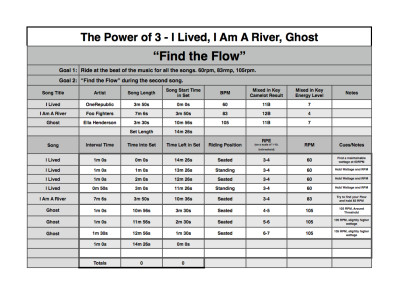
The controlled environment of an indoor cycling studio is the perfect place to practice and perfect finding the flow state. I’ve been incorporating one flow state song per class for the past few months and my riders love it. When cueing a flow state song I ask my riders to focus on the beat of the music, or their cadence or the rhythm of their breathing. They need to focus on something rhythmic and hypnotic. The intensity needs to be below threshold, burning legs and lungs will pull them out of the flow. The most important and probably hardest thing for an instructor to do during a flow state song is to BE QUIET. Your riders need to focus on the rhythm of THIER bodies, the sound of your voice will pull them out of this flow state every time.
I have gotten more positive comments about this addition to my profiles then anything I have ever done. I would recommend you add it in during one of your recovery songs, this way the volume or intensity junkies in your class don’t feel like they are missing out on any of the “quality” of the workout.
If you listen to my recorded classes below, see if you can find any “Soul Cycle” influence, no I have not added weights.
3 song harmonically mixed track, , to download Right Click > Save As / Save Target As to download. Open in iTunes and then you'll see this in your Spotify Local File folder.
Over the past few weeks I have been fascinated with the HBO series “Sonic Highways”, which features one of my favorite bands, the Foo Fighters.
“In this new series, Foo Fighters commemorate their 20th anniversary by documenting the eight-city recording odyssey that produced their latest, and eighth, studio album. Foo Fighters founder Dave Grohl directs the series, which taps into the musical heritage and cultural fabric of eight cities: Chicago, Austin, Nashville, Los Angeles, Seattle, New Orleans, Washington D.C. and New York. The band based themselves at a legendary recording studio integral to the unique history and character of each location. One song was recorded in each city, and every track features local legends. Even the lyrics were developed in an experimental, unprecedented way: Grohl held off on writing them until the last day of each session, letting himself be inspired by the experiences, interviews and personalities that became part of the process.” (from: http://www.hbo.com/foo-fighters-sonic-highways#/foo-fighters-sonic-highways/about/index.html)
What fascinated me most about this series was watching the creative process at work. Every person, city, studio and experience had profound effects on the writing of each song.
I have found that the different times, facilities and riders I teach affect the “energy” of each class and though I may have the exact same profile for each class they all “feel” different. This is where I use my music to match the “energy” of the class. I have a much different playlist for my 5:00am classes then I do for my noon classes and my 6:00pm playlist is different as well.
I believe the best instructors can feel this “energy” and use it to connect with their class.[wlm_private ‘PRO-Platinum|PRO-Monthly|PRO-Gratis|PRO-Seasonal|Platinum-trial|Monthly-trial|PRO-Military|30-Days-of-PRO|90 Day PRO|Stages-Instructor|Schwinn-Instructor|Instructor-Bonus|28 Day Challenge']
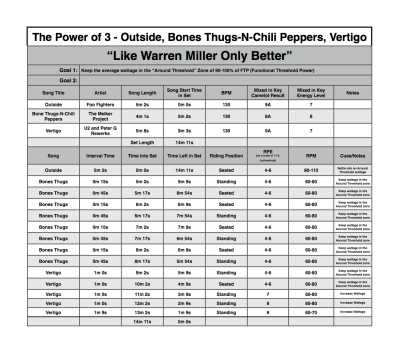
3 song harmonically mixed track, to download Right Click > Save As / Save Target As to download. Open in iTunes and then you'll see this in your Spotify Local File folder.
“Bone Thugs-N-Chili Peppers” by The Melker Project
“Vertigo (Redanka Power Mix” by Peter G ReWerk
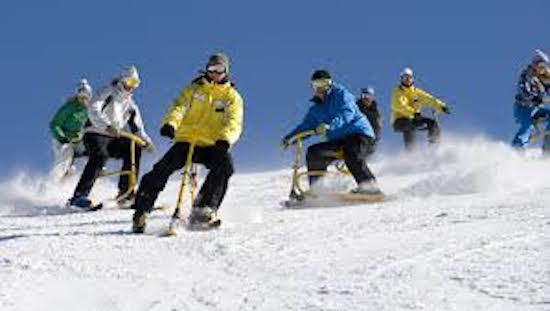
As many of you know, I live in Colorado and skiing is one of my family's favorite winter activities. Every year we used to look forward to the release of the latest Warren Miller ski movie as the unofficial start of ski season. It became a family tradition to get tickets to the Friday or Saturday night showing at the Paramount Theater in downtown Denver. The later the show the rowdier the crowd, everyone was so amped to get the ski season started. I also knew that the new release meant fresh ski footage and music for my video cycling class. Over the years the footage has remained top notch, but the music has gotten worse and worse, it has gotten so bad that we stopped attending the show two years ago. That year the music was so bad that I wished I had brought my ear buds so I could have put together my own playlist, on my phone, while watching the movie.
[wlm_private ‘PRO-Platinum|PRO-Monthly|PRO-Gratis|PRO-Seasonal|Platinum-trial|Monthly-trial|PRO-Military|30-Days-of-PRO|90 Day PRO|Stages-Instructor|Schwinn-Instructor|Instructor-Bonus|28 Day Challenge']
This got my sons, Seth and Christian, and I thinking that we should start using the awesome ski footage that is available on the internet and put it together with music that people actually listen too. Over the years we have created quite a library of ski videos, many that I use in my indoor cycling classes, that we believe is like Warren Miller, only better. I hope you enjoy the work we have done and let me know what you think.
3 song harmonically mixed track, to download Right Click > Save As / Save Target As to download. Open in iTunes and then you'll see this in your Spotify Local File folder.