On April 10th I attended a “Cycle 360” certification workshop at Colorado Athletic Club Monaco in Denver, Colorado. Wellbridge, the parent company of Colorado Athletic Club, has seen the huge success of programs like Soul Cycle, Flywheel and Full Psycle and decided to create a “Rhythm” style class of their own in an attempt to create a boutique cycling studio experience inside a big box club. Cycle 360 is a total-body indoor cycling class that combines cardio and strength conditioning that is meticulously choreographed to the music. This type of class is way out of my comfort zone!
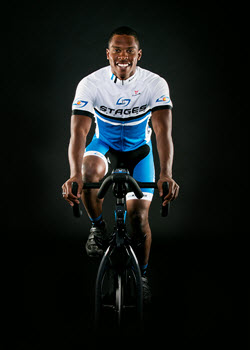
I’m a degreed and certified personal trainer with over 25 years of fitness experience and a Master Educator for Stages Indoor Cycling, I’m the “Power Guy”, the “Technical Instructor”, I choose music for “energy” not choreography. So, I decided to go into this training with an open mind and challenged myself to figure out how I could make this style of class work with my skill set and teaching approach.
When I arrived at CAC Monaco for this 3 hour workshop I was surprised to see it was “sold out”, 35 instructors had given up their Saturday afternoon to be part of this new program. I was also amazed by the “energy” and “buzz” throughout the room, these instructors were excited to be part of something new and cutting edge. I’ve been managing, training and teaching in large “big box” facilities for most of my fitness career and I am always frustrated with their inability to adapt or adopt new fitness trends in a timely manner. I’m so tired of hearing, “It’s not in the budget for this year” or “Our members don’t like change”! I got the feeling that the instructor staff at CAC appreciated the fact that the management saw there was a need to adapt their programming and moved on it quickly.
After some quick introductions we transitioned into a 45 minute Master Class which consisted of a Warmup, Cycle Section, Strength Section (Biceps, Shoulders and Triceps), a second Cycle Section followed by a second Strength Section (Push-ups and Core) and a Cool Down. The cycling sections were choreographed to the music and had a Johnny G feel to them, with some jumps, runs, and music mapping. The strength sections were done with light dumb bells and to my horror to the beat of the music. I’m an indoor cycling instructor, not a Step instructor, a 32 beat count means absolutely nothing to me. This 32 beat count stuff was going to take some getting used to, but it wasn’t too bad. With all the talk about how dangerous weights on the bike are I was expecting CAC to have an ambulance waiting in the parking lot, but all 35 of us made it through the class without dislocating our shoulders, blowing out our backs or needing to schedule ACL surgery and we had a great time using the bike as our exercise tool.
After a short break we got back together and went over how to put together a Cycle 360 class profile. We went over the class design, suggested weight exercises and spent a lot of time on music theory. We were taught that every class should follow the same structure of ; Warmup, Cycle Section 1, Strength Section 1 (Biceps, Shoulders, Triceps), Cycle Section 2, Strength Section 2 (Push-ups and Core) and a Cool- Down. We then went over some strength exercises that can be done on the bike. I’m not a fan of weights on the bike, but I did appreciate that all the exercises taught were very simple and, I felt, safe to be done on the bike. This was followed by a music theory lesson. We discussed the structor of a song ; Introduction, Verse, Chorus and Bridge and how choreograph movements to each part. I found this very informative, most instructors already use music this way but don’t understand the theory behind it.
We then broke up into small groups and each group designed a Cycle Section and Strength Section to be taught to the whole group. Every group did a great job taking what we learned in the last 2 hours and demonstrating it to everyone, it also gave us all some teaching ideas to take to our first class. I was pleasantly surprised to see how many exceptional instructors are working at Colorado Athletic Club. I also realized that there is a whole other world of instruction out there. I use metrics like heart rate, watts and revolutions per minute to motivate and get the most out of my class participants there are many other instructors that use the magic of the music and movement to motivate their classes. I would like to find a way to bridge that gap so participants can have the fun of a Rhythm class and the effectiveness of a power based class, I think we could call it a “Power Party!”
Every workshop I have ever attended has given me new ideas and made me reconsider the way I teach. I’m always looking for ways to improve and change, sometimes things don’t work and I throw them out sometimes things “stick” and they become part of my new teaching style. Ever since the Cycle 360 workshop I have been listening to music in a whole new way, trying to pick out the Introduction, Verse, Chorus and Bridge of every song I hear and methodically putting together a playlist and choreography for my first Cycle 360 class. Then I heard DJ Scott Melker’s, The Melker Project 3 and it all fell into place.
Scott is a world renowned DJ and was Music Director for Flywheel Sports between 2010 and 2014, he knows music AND indoor cycling. Scott has been working on a new project called ADHD Radio where he releases a new 45 minute set every 2 weeks. ADHD is the perfect way to describe Scott’s DJ style, he is constantly mixing and overlaying every known music genre in a style that just works. I have found that Scott’s mixing style works perfectly with the “Rhythm” style indoor cycling classes that are popular today. With a new song being mixed in ever 30-40 seconds it’s easy for instructor and participant to hear and feel the music and energy change.
When I first heard The Melker Project 3 I immediately knew it would work for me. The only problem was there was ALOT of language that would not go over well in the clubs that I teach in. If you work in a club where anything goes then use the original, it’s awesome! I, on the other hand had to use my very limited DJ skills to try to cut out the bad and mix together the good. I think I did an okay job, but you can definitely hear the difference between my mixing ability and Scott’s. I hope Scott isn’t offended that I had to chop up his work, I absolutely respect an artist’s vision, this was a situation where I felt this mix was so good that I wanted to share any part of it that I could with my class.
[wlm_private ‘PRO-Platinum|PRO-Monthly|PRO-Gratis|PRO-Seasonal|Platinum-trial|Monthly-trial|PRO-Military|30-Days-of-PRO|90 Day PRO|Stages-Instructor|Schwinn-Instructor|Instructor-Bonus|28 Day Challenge’]
As you can see I did not put together a profile for this mix because there is no need for one. My recommendation is to come up with 2 or 3 variables and cycle through them with every song change. One example of what I’ve used is to start seated with a RPM of 80-100, then transition to seated with a RPM of 60-80 then transition to standing with an RPM of 60-80 and repeat for as long as you want (the clean version of the song is 23 minutes long), I usually go for about 10 minutes. Another example would be to simply alternate between seated and standing riding with every song change for your chosen interval length. You could also have participants spin up with every song change; start at 80 rpm, increase to 90 rpm, then 110 rpm and start over for the length of the interval. I’m lucky enough to teach with power, I’ll have my class set a wattage goal for each interval and have them keep their wattage in that range throughout the interval no matter what position or cadence.
The Melker Project 3 (Clean), to download Right Click > Save As / Save Target As to download. Open in iTunes and then you’ll see this in your Spotify Local File folder.
The Melker Project 3 (Original), to download Right Click > Save As / Save Target As to download. Open in iTunes and then you’ll see this in your Spotify Local File folder.
Recording of me teaching this ADHD set in a class on a Spinner Blade Ion, Right Click > Save As / Save Target As to download on PC or Download Linked File As on Mac. Open in iTunes and then you’ll see this in your Spotify Local File folder.
I’ve been using this mix and ADHD teaching style for one of my class sets for the last 2 weeks and a very interesting thing has happened. First, people love it and secondly people are able to average a much higher wattage when they are changing positions every 30-40 seconds than when holding a position for 8-10 minutes. Something to think about.[/wlm_private]
Is it possible to create Performance Cycling Classes that are entertaining and compelling, for both endurance athletes and non-cyclists? David McQuillen, with The Sufferfest video series, says you can with entertaining video content – note the emphasis on entertaining 🙂
I’ve been aware of David’s videos for years. Perfect for pounding away in the garage or your basement, but I didn’t consider them suitable for group cycling classes. Turns out I may need to adjust my thinking about this… With more than 45 licensed facilities worldwide (they’re called Sufferfest Embassies) it sounds like there is a group application for these extremely well produced HD videos.
Listen below as David and I discuss his ideas on expanding your studio’s appeal to cyclists through the use of his Sufferfest training videos.
Studio/Club Owners and Managers interested in becoming a licensed Sufferest facility can request a free information package by emailing Kate Patterson Kate@TheSufferfest.com – you’ll want to include your studio’s name and location.
Please tell Kate you heard this interview on ICI/PRO and she’ll send you a pair of these cool Sufferfest Socks, just for saying hello! Limited to responses through June 30th.
Over the past few weeks there have been some questions on the ICI/Pro website that gave me the idea for this week’s post. One question was about music flow and another was asked which comes first, playlist or profile?
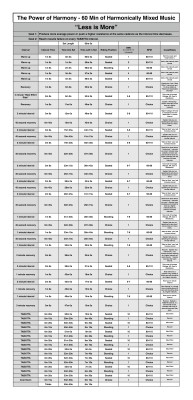
To show one way to make music flow I decided to put together a playlist of songs that are all in the same harmonic key, this is technique is called “Harmonic Mixing” and is used by many of the world’s top DJ’s. I use a software named “Mixed in Key” (http://www.mixedinkey.com) that automatically analyzes all my music files and determines the key and tempo of each song. Mixing harmonically enables you to create smooth transitions between songs and ensure that all songs sound great together. I put this playlist together without any consideration of the profile. I chose popular, high energy, songs and let the Harmonic Mixing create the flow. This is a playlist that can be used with, just about, any interval based profile where the profile, not the music, is the focus.
Next I put together a killer profile using a technique known as “anchoring time and effort”. This is a very simple tactic where riders should be able push higher intensities as interval length gets shorter. Less Time = More Work.
[wlm_private ‘PRO-Platinum|PRO-Monthly|PRO-Gratis|PRO-Seasonal|Platinum-trial|Monthly-trial|PRO-Military|30-Days-of-PRO|90 Day PRO|Stages-Instructor|Schwinn-Instructor|Instructor-Bonus|28 Day Challenge’]
You can join my TrainerRoad Team at : http://www.trainerroad.com/teams/2484-dennis-mellon-s-indoor-cycling-team
60 minute harmonically mixed track, to download Right Click > Save As / Save Target As to download. Open in iTunes and then you’ll see this in your Spotify Local File folder.
This is just one example of how I put together my classes. Other times I try to match the music and profile exactly and let the music dictate the terrain. I would recommend instructors get proficient at both methods. This way you don’t pigeonhole yourself and you keep your participants on their toes. It also keeps things fresh and exciting for you.[/wlm_private]
ICI/PRO contributor and future studio owner Callie Bowling Kelly responded with…
Hey John!
Here’s my reply:
This is a fantastic question! If I may pull from my background in Psychology to get to the root of what may be occurring… this sounds like a case of Blockage to me. Blockage from trusting your unique genius to come through and guide you. You know what made you fall in love with indoor cycling, if you didn’t you never would have gotten certified to teach in the first place, right!? Get back in touch with what it was that you loved most about cycle classes, and then re-create that passion in your own class.
There is no right or wrong way to set up a class… honestly! The industry is evolving so much that all sorts of studios and instructors are coming up with their own way and re-inventing the wheel so fast my head is spinning (pun intended). I give you complete permission to do whatever it is that feels fun and challenging to YOU and then implement that in your classroom, as long as it’s safe of course!
I know all too well the pressure of being up in the front of the room, positioning yourself as a leader, and feeling like you have to perform. It is human nature to want acceptance. We crave it. But, wanting acceptance too badly can literally shut you down artistically, because you second guess every decision you make. We think: how is this going to be received, are they going to like my music, is my class hard enough, what if they think I don’t know what I’m doing? All of those thoughts are counterproductive to getting up there and having a great time and inviting your class participants to do the same.
Here’s a tip of mine on music and choreography for the ride: I pick EPIC music that has a beat and makes me want to move! For the choreography… I like to work intervals, so in my classes we go hard during the chorus and bridge and recover during the verses. It makes the workout follow the energy of the music which creates pure exercise magic in the class!
Hope that helps John!
Callie
You’ll find Callie’s fun and informative articles and interviews here.
Lena Hershey is a Spinning® Instructor & Fitness Blogger @ leanlena.com. She offer these practical tips that I feel are perfect for a new Instructor.
Hi John.
Thank you for including me into this. Here’s what works for me:
1. Profile first – think “terrain”. Where are your wheels taking you after warm up? Hills? Fast flats? Off the road and through the mud? Lay it out on paper – draw! That really helps me visualize and make the class profile realistic and my cues to class “spot on” not just pure technical.
2. Put your profile onto music. Beware of the lyrics – just as it can be incredibly inspiring, it can ruin a perfectly wonderful intent. Listen carefully to the lyrics of the songs and make sure not just the musical but verbal message matches the purpose you’re putting this piece in your class for. Too overwhelming? Go instrumental! Sometimes a non-verbal message of the music can be more powerful than verbal.
3. Ride it. There is nothing wrong in practicing your rides before teaching them – especially when you’re new to teaching. It is not a sign of weakness and seasoned instructors do it, too. Get in that room, turn up the music and teach yourself that class you created. Make sure the music flows nicely piece to piece, and practice cueing your ride.
4. If you can’t ride it, listen to your class playlist with your drawing in front of you and think of or say what you’re going to say in class.
I know how daunting it can be to start putting your class profiles together. Some of them will be worse than others. You will fail before you succeed. Just remember that you’re the only one who will notice the “failure” as you’re the only one who knows what the plan is. If something doesn’t go according to your plan in class, just move on. Your class will follow your lead, so smile and believe in yourself and your profile. Your pack will follow you!
Best regards, Lena Hershey.
Lena and I partnered on the 28 Day Instructor Challenge > what turned out to be a very fun exercise in self development for Instructors, over the course of a month. You can look back the challenge in this series of posts.
The Senior Group Fitness Instructor here Amy, dashed off these thoughts will sitting at the airport.
My quick and dirty response would be:
Categorize music with a beats per minute app on your computer. Climbs = 60 to 80 bpm, Flats = 80 to 100. This helps you ‘hear’ the music and what it works best for. Start a playlist called ‘Climbs’ and ‘Flats’ and add to that playlist as you listen through music….just collect a bunch in each category. This gives you a couple master lists to work from to create classes.
Download ‘Shazam’ on your phone. When you’re out and about and hear a tune you like, you can ‘Shazam’ it and determine the bpm later.
I would highly recommend a Spotify Premium account (approx. $10 a month). That way, you’re not paying for individual tunes, but have a huge library and can maintain your lists there.
I label my profiles/playlists primarily by date. I have a small spiral notebook where I write (by hand) the playlist title, each tune, the bpm and time length. I keep this notebook in my gym bag and use it for every class. That way, there’s no surprises.
I wasn’t sure how to answer this question emailed to me from a new Instructor. So I blasted it out to a bunch of Smart & Talented Instructors I know for their responses.
John:
You and I have exchanged emails before. I am a relatively new instructor (at age 48!)…. Just got my first steady teaching gig (3 classes per week). What I find to be the single biggest challenge as a new instructor is music- music flow, and knowing what drills or activities to do to what music. It is SUPER easy to get a certification…. I am Madd Dogg certified, and will be attending my first WSSC this May. I feel at such a loss though when it comes to setting up a class…. And feel as though I let hours of time evaporate listening to music but not knowing how to incorporate it effectively into what I am doing….
I have a ton of respect for what you do and have been following your facebook page and blog for sometime. I am happy to buy an ICI/pro membership, I am just reluctant at this point to invest in any more resources that I underutilize. Wondering what advice you might have?
Thanks so much for your time!
Irene
Thanks for writing Irene! Here are a few ideas for you…
First from contributor Chris Hawthorne AKA Chrispins – that’s a link to her excellent website. You can find all of Chris’ informative ICI/PRO articles here)
Hi John,
Happy to help. Here’s my answer:
The best way to know what drills or activities to do with your music is to find the BPM (beats per minute) of the songs you would like to use. I use this handy website to help me figure the BPM of new songs : http://www.all8.com/tools/bpm.htm There are also several free apps that will do the same thing.
Once I have the BPM I transfer them into RPM (usually that means dividing by 2). Then I can plug the songs into my profile. Hills are 60-80 RPM’s and Flats are 80-110.
Another helpful tip is to keep song folders so that you can easily have the songs you want to ‘plug in’ to your profiles. I use Spotify, but you can do this in iTunes as well. You can have folders of songs labeled by BPM, or you can label them with titles such as ‘Warmup’, ‘Flats’, ‘Hills’, ‘Cool Down’, etc.
And don’t be afraid to use other people’s profiles and/or music until you get the hang of it. There a a lot of great instructors sharing their profiles and playlists out there on Facebook, blogs, and sites like ICI/PRO and Pedal-On.
In response to her simple, yet complicated questions. Here is my answer:
The most basic way to address this is to think of your class in two parts.
1. The design of your class
2. The music you will play to fit the design
For me, the design comes first. I decide what I want to do in the class. The warm up is first, and the cool down is last. What goes in between? I teach the “newer vertical” of Indoor Cycling or rhythmic style classes. So for me, “everything in between” is usually a combination of drills that move side to side or front to back, climbs and sprints.
When it comes to listening to music, it should clear right from the first listen, “this is a sprint song” or “this is a climb”. If you have to spend a lot of time deciding what type of song it is, it probably isn’t a good song for you to use. Within my iTunes, I create playlists dedicated to different sections of my classes. I have playlists called “Climbs”, “Sprints”, Weights, “Figure 8s”, “Warm Ups”, “Meditations” and “Cool Downs”, for example. When I find a song that fits a category, I add it to the proper playlist.
When building my class, I take the basic design and plug in the songs. This works well for the beginner instructor.
Still having a difficult time? Stop searching for “new” music, and use music that you know and love. Your energy will shine because it’s a song that you feel comfortable playing vs. looking crazy because you are trying to make a song that you don’t know “fit or work”.
Cassie
Cassie is also a Social Media expert – she offers her ideas on tracking the success of your social media campaigns in this episode of the podcast.
I teach either performance-oriented timed interval rides or visualization rides. In the first case, I pick music to accompany the intervals based on rhythm (appropriate cadence, level of aggression) and length. It is definitely simplest to have intervals of fixed length and layer songs on top which motivate riders.
But visualization rides require helping your participant engage with the course. I ride my bike outdoors year-round and I base my visualization rides on routes I’ve been on. I tend to turn to my own feelings during those rides. Over rolling hills on a beautiful day, I can get lost in a smooth electronic track with a steady beat. On sharp, punchy climbs with the wind in my face, I need the hook from an aggressive rap track or a wailing guitar from a punk rock song. From my outdoor experiences, knowing there are multiple climbs or anticipating a hard sprint in a group ride, it is okay for the music to run on a little long, to build up, to create some frantic energy.
To manage musical flow, you have to understand the physical demands of the ride. If it’s going to be a long, hard ride with little rest, don’t be afraid to keep things aggressive – but remember to lighten up at the end of an effort. Every climb eventually ends, every sprint has a finish line, and, at some point, you can always choose to turn out of the wind. Your music should do the same.
Dunte and I had a fun conversation here where you can hear why I instantly added him to the Smart & Talented list 🙂
I’ve got a bunch more responses that you’ll find here. But before you go… how would you have responded?