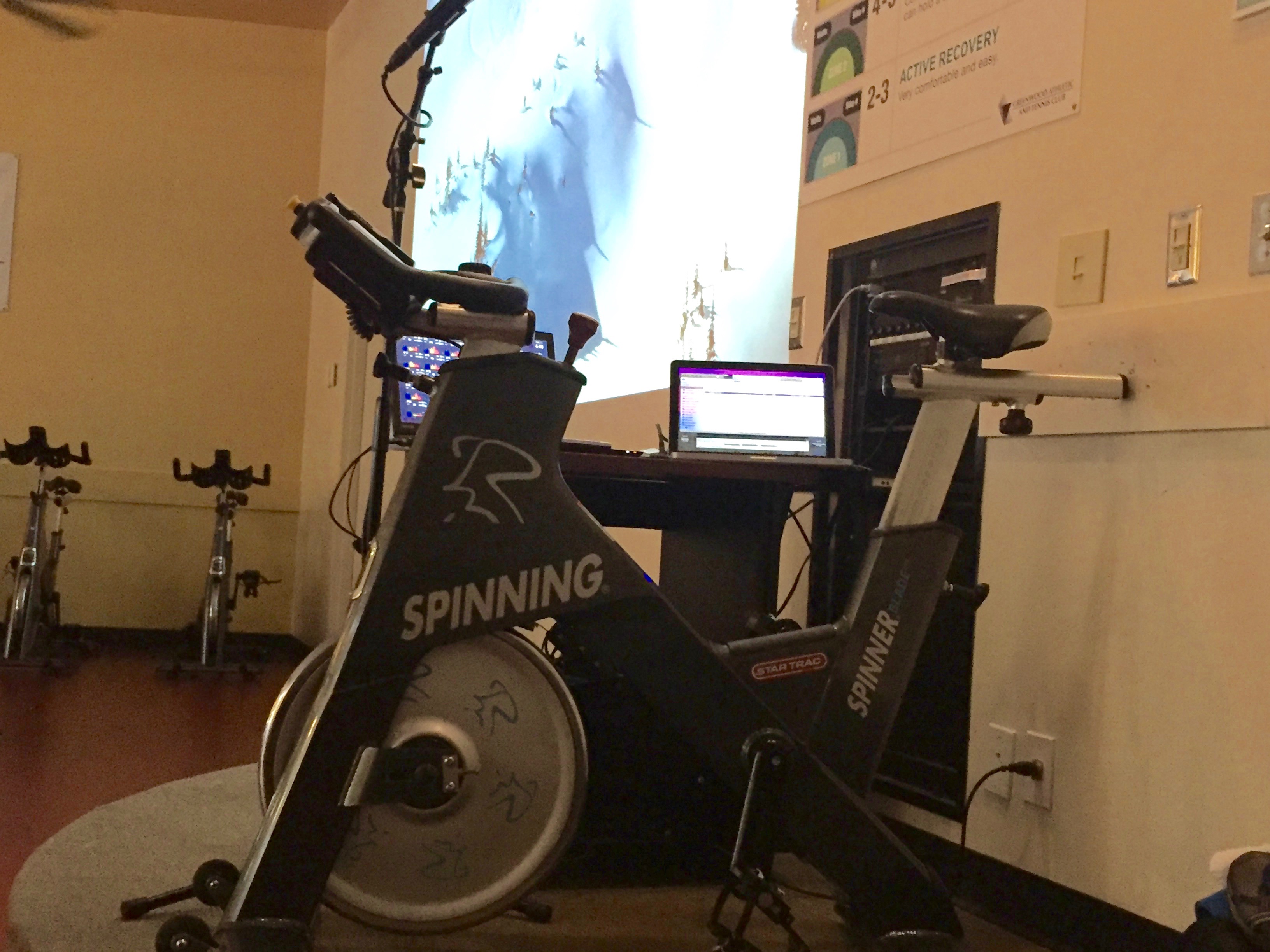
Today I ended a turbulent 3 year relationship with the Spinner Blade Ion. A courtship that began with high aspirations for a long, happy and powerful future has deteriorated into one complication after another and I no longer have the energy to keep the blue light burning.
About 3 years ago management announce that we were going to be the first club in the United States to receive the brand new Spinner Blade Ions, this was Spinning's first foray in the new world of power. Though I personally was hoping for a different choice I was excited to finally be teaching on a bike that would express work output in watts. Now instead of spending so much time cuing how each interval should feel I was going be able to use each rider's personalized power zones. The idea of personalized training zones is not new, the fitness industry has been trying to use them with heart rate for nearly 25 years. The problem with heart rate training is that all participants need to be using heart rate monitors for it to be effective and as any experienced fitness professional knows we are lucky to have 20% of our participants wearing monitors in any class. The beauty of leading a power based indoor cycling class is that ALL participants have a power meter on their bike!
A few weeks before delivery the instructors started receiving various training manuals and information about the features of this new bike. This is when I started getting worried. The first problem I saw was the continued use of a chain. Why would any new bike continue to use a chain when belts, both Poly V and Carbon Drive, have proven to be a much better option. Belts don't stretch or break, they are so strong that many motor cycle manufactures use them. The second flaw I noticed was the continued use of a friction breaking or resistance system. Friction resistance has been the bane of instructors and bike techs since the inception of indoor cycling. I still remember the days of walking around the cycling room with a bottle of silicon lubricant spraying the squeaky brake pads then having to endure the smell of the same burning silicon. There were also the times I would sweat or spill water, from my water bottle, on the flywheel and lose most of my resistance. Why would anyone want to build a new bike with old friction resistance technology when magnetic resistance has been proven to be so much better. I'm not an engineer but the only time I can think that excessive friction is a good thing is when trying to build a fire. The third and final concern I had when looking through these training manuals was the console. The layout was, to be honest, stupid!
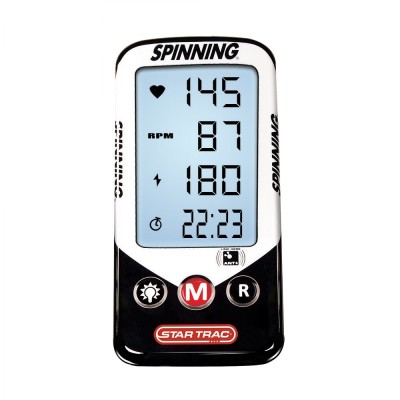
First, why would you not put wattage on the top? The new and special aspect of these bikes was power, why would you hide it in the middle? Why give heart rate the most prominent line on the console when so few people actually wear heart rate monitors? Also, any instructor with 1 month's experience teaching with power understands the importance of seeing real time AND average wattage when performing intervals. Why are they not available on the same screen? The only way to see average wattage on this console is to push the “M” button and scroll through the four different screens, something everyone wants to do when they are working hard. The word “Simple” kept coming up in the literature. Well when it comes to console design, I think Simple=Stupid. After the initial learning period of how to use power, participants and instructors want a console that gives them all the metrics they need to take and teach an effective class not a simple one. Finally, this bike was being released at the beginning of the wearables craze. Everyone wanted to track and log every aspect of their workout. With the Spinner Ion Blade there was no way, beyond taking a picture of the console, to track your workout, no USB port, no phone app, no open protocol that would let the console communicate with the many fitness apps that were available. I teach in Denver Colorado, the riders here are some of the most sophisticated indoor and outdoor riders in the world, they know power and want a way to use it to it's fullest potential. If there isn't a way to track real time wattage throughout a ride there is no way to determine Normalized Power, Intensity Factor or Training Stress Score. Again, Simple=Stupid.
So, the bikes finally arrive and EVERYONE was so excited! We had been riding Spinner NXT bikes and these new Ions felt very familiar but what everyone was psyched about was the power. I had been lucky enough to be teaching with power for a few months on the Keiser M3 and the Freemotion bike. I've also been coaching some athletes who use power meters and I've read Hunter Allen and Andy Coggan's Training and Racing with a Power Meter. So I felt like I had a pretty good understanding of how power works. On my very first ride I noticed something very disturbing, my wattage was 20-40 watts lower on these bikes then the M3 and Freemotion bikes and people who were riding with power on their outdoor bike were noticing the same thing. Then, as I rode different bikes I found huge wattage variations from bike to bike. Understanding that this was a very subjective test a few instructors decided to ride ALL 56 bikes while wearing heart rate monitors. We would work up to a specific heart rate that was in our Aerobic Zone then take note of the wattage. This wasn't the most scientific test, but it was the best we could do without being able to hook the bikes up to a dynamometer. The results were SHOCKING! More than half the bikes weren't even close to each other, they varied by as much as 100 watts. We explained this issue to the bike manufacture and asked if there was a way to recalibrate the bikes in order to assure consistency from bike to bike. The answer we received was even MORE shocking then the amount of bike to bike variation. THERE WAS NO WAY TO RECALIBRATE THE POWER. Are you kidding me? Every indoor cycling bike whether direct power or measured and every outdoor power meter has a way to recalibrate! This was our “Oh Shit” moment and when I started thinking of “work arounds” to this fatal flaw.
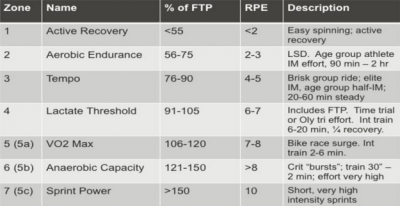
The foundation of training and coaching with power is finding one's FTP, Functional Threshold Power. This is simply the maximum power a rider can average for 1 hour. Since a one hour test would not be practical in most indoor cycling settings the next best test is a 20 minute “best effort” ride where 95% of the 20 minute average wattage is calculated as the FTP. We then use the FTP to determine power training zones.
Since the variation from bike to bike could be as much as 100 watts, unless I could guarantee that every rider would be able to ride the same bike in ever class the FTP test results were useless. So my workaround was to perform a modified FTP test at the beginning of every class. This way we could find an estimated FTP for each rider on each bike for each class. I would cue what threshold was supposed to feel like, have my class ride at that “feeling” and take note of the wattage their bike read when they “felt” like they were at threshold. Unfortunately this was not very scientific but it was the best I could do in the situation we were in. At least this let me speak the language of power and riders could be accountable from interval to interval even if the numbers weren't exactly correct.
As I gained more and more experience teaching with power I realized the importance of Average Wattage when coaching interval based profiles. If riders are told to focus on average wattage for each interval, they are forced to work for the full length of each interval. Riders learn very quickly if they “sandbag” the beginning of an interval they need to work extremely hard at the end of it to reach their goal average wattage. Many of the top indoor cycling bikes with power show real time and average wattage on the same screen, not the Ion. Riders have to cycle through the four available screens to see real time and/or average watts.
The power meter and the console were by far the two biggest mistakes made with the Ion, but there were more. The friction resistance was a problem that was made obvious when combined with the use of a power meter. Friction causes heat and heat causes the brake pad to work less efficiently, so if I asked my riders to find specific wattage and rpm and to hold it for a few minutes over time the brake pad would heat up, work less efficiently and wattage would drop. Riders were constantly forced to adjust their resistance throughout each interval to maintain current or goal power output. Threadless (Morse Taper) pedals became a problem since they were virtually impossible to remove. Chain instead of belt also added to maintenance requirements and the inability to capture workout metrics through a usb storage device or app became very frustrating to our riders who wanted to track their progress.
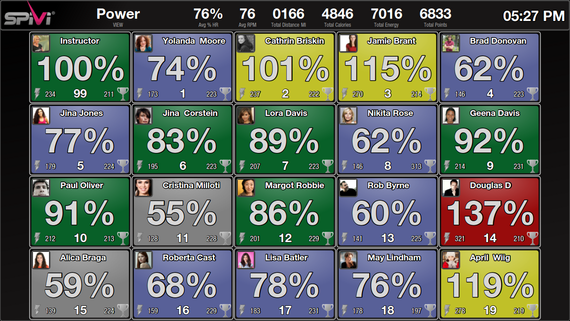
The breaking point came when we added a group display system, Performance IQ. These systems display metrics on a TV or are projected onto a screen. Now every rider's metrics were visible for the world to see. It quickly became obvious that we had to do something about the incredible variation in wattage numbers from bike to bike. Now that we were focused exclusively on wattage we needed to find a bike that was much more accurate and consistent so our leader board, races and zones displayed correct metrics.
I'm happy to report that on March 30th we are receiving a shipment of 46 Stages SC3 indoor cycling bikes and these problems should be a thing of the past.
So, as I bid farewell to my Spinner Blade Ion, a bike that I have sat on for nearly 1000 hours over the past 3 years, I am a bit sad. It's not the Ion's fault that this relationship didn't work out. Maybe it was a rush to market, lack of foresight, not realizing that Simple = Stupid, or just plain ego that let it arrive in my club with all these fatal flaws. I'm thankful that it challenged me to become a better instructor by working through all it's various issues, but eventually it became exhausting and I just don't have the will to keep the blue light burning anymore.
You'll be quicker up Pikes Peak after a winter training indoors with power!
While Performance Enhancement Specialist Dennis Mellon and I were getting warmed up to record his Audio Class PROfile Mashup – HIIT vs. Party on the Bike, we spent a few minutes discussing his thoughts and observations on coaching with power.
Were his participants seeing any improvement after a full winter training indoors with power?
If so, how are they comparing their performance year to year?
Has Star Trac been able to improve the consistence / accuracy of the Blade Ions?
Can we depend on riders bringing their own technology (HR Monitor, iPhone App, ect…) to class for the purpose of tracking performance?
Or is it better to provide rider data/metrics tracking as a service of the studio?
During our conversation Dennis makes an interesting comment about a summer class format, that could be of interest to the cyclists and endurance athletes who abandoned you this Spring. Many training plans call for very specific HIIT (High Intensity Interval Training) – which is difficult to complete on the road, but easy to do indoors. It may make sense to ask one of the local endurance coaches in your area if they would be interested in bringing their athletes indoors once a week to your studio.
You can learn more about Dennis here at his website.
Listen to our discussion below or
If you'd like to learn more about automated rider data/performance tracking from Performance IQ with the Spinner Blade Ion or any of the other Indoor Cycles with power, please contact me and I'll connect you with the right people.
Hey – I just got an email explaining that Spivi has added a FTP (Functional Threshold Power) Test to their display training system. I can't begin to tell you how beneficial these short threshold/best efforts are for engaging participants in your power based classes. That's why I describe these as a Best Practice for anyone teaching with power.
Like PIQ, Spivi offers the option for riders to manually add their FTP / PTP wattage into a user profile. Another option is to enable the Fitness Test option where you can select an 8 or 20 minute FTP test that will record each riders average watts for the period and then add either 90% (8 minute) or 95% (20 minute) of it to their user profile.
To start the FTP tests wizard, press the left analog stick once, just like if it was a button. Now select the requested test from the menu and press the “Start” button to start.
Don't forget to Instruct the group how to ride and what to do during the test. The FTP test lasts as long as the progress bar on the bottom right side of the screens appears.
Two articles, about two different Indoor Cycling Studios, came across my desk today! The fun part for me was how they both featured ICI/PRO members who've hung out their shingle and pursued their dreams of a fitness business!
And Rev Up also takes advantage of technology to help people keep up with their workouts and fitness goals. Each bike has a mechanical device that calculates the amount of work a person does while exercising.
“One of the challenges has been, typically in spinning, is that people get on there for 45 minutes to an hour, and they get all hot and sweaty, and they guess how many calories they might have burned; they don’t really know,” Beane says. “With our system, they have a very accurate (record), as well as a way to track how many calories did you burn, how many watts did you produce. … Since that data all goes into your account, you can track over time, ‘How well am I doing? How am I progressing?’”
A screen shot of Jeff's online reservation page, from his great looking LiveEdit, website is above. By registering for a specific bike, the Performance IQ system knows who's – who in the class and then displays and records the rider's performance data in their user's account.
Jeff's studio is still very new. He'll probably appreciate learning how a bike reservation system has solved some problems at CBCycle Barn, from owner Karen Casler…
How CB CycleBarn Indoor Cycling Studio Used a Bike Reservation System to Cure ‘It's MY Bike Syndrome'
What are your customers saying about your site and the Stations app? (Live Edit's name for their reservation system)
Customers love booking their bikes! It has a trickle down effect of both customer and studio benefits. The Stations app allows me to give the customer what I feel is the most powerful customer service tool there is. The Stations app lets the customer know exactly what to expect!
Aside from knowing what to expect, another bonus is that by booking a bike online, customers are immediately escalated to VIP status. I like to use the analogy of flying American Airlines vs. Southwest Airlines. People are territorial about their space in any GroupX class. Before the Stations app, any territiorial Bike Vultures arrived early and hovered anxiously, waiting to stake claim to “their” bike.
Territory anxiety is now a thing of the past–but that’s something I expected when we added the Stations app. What I didn’t expect was that the Stations app would relax everyone! Some of the greatest feedback I’ve received is from the riders who had simply put up with the Bike Vultures because it’s been that way since the beginning of GroupX time. It never occurred to anyone (myself included) to complain about the “It’s MY Bike Syndrome” riders.
The very day the Stations app launched, the tension that we didn’t even previously acknowledge was instantly gone. Customers shared with me that they had felt so uncomfortable waiting for a class to start because of riders inflicted with IMBS. They had stories of being pushed, accidently hit with gym bags, and shoved aside in the stampede to stake claim to a bike. But that’s not all. Riders from the class before the IMBS stampede had also been made to feel uncomfortable. Their amazing hour of cardiotherapy zen was abruptly disrupted by hovering Bike Vultures before the first rider could wipe down the bike and gather their belongings.
VIP status … Check.
Bike Vulture Extinct … Check.
Performance IQ Compatibility … Check.
Knowing Exactly What To Expect … Check.
As a studio owner, how can it possibly get any better ?
How bout … Parking Lot Congestion Relieved … Check.
One of the most common issues for any dedicated indoor cycling studio is the parking lot crossover between classes. Because it is no longer necessary to arrive early to secure bike real estate (and trust me some people arrive as much as 30+ minutes early,) riders now show up 5 minutes or less before class starts. This allows the first class to make their exit and gives a lil’ breathing room for those coming in for the next class.
Priceless.
And there is one more box to check…
Competitive Advantage … Check.
At the moment, none of the big box gyms around our studio offer a Stations app reservation system. Using the Stations app makes reserving your class and showing up for class easy.
At WSSC I had the opportunity to complete a PST (Personal Spinning® Threshold) test – which is (their words) the key to Spinpower success. I couldn't agree more as knowing your maximum sustainable power or Heart Rate, and then building training zones around a known metric BPM/Watts is crucial to effective training. Here's some notes on this session and the discovery process MI Janet Toussaint lead us through to determine our Personal Spinning® Threshold.
PST is something we can change
Janet's session included a lecture period before we climbed on the Blade Ions for the PST test. During her presentation she made three very profound points that I feel are important for anyone teaching with power, to convey to their participants…
It is possible to change/raise/improve your PST. You maybe familiar with the statement; if you can test it you can improve it. In the past the Spinning program was based on Maximum Heart Rate – a number that doesn't change no matter how hard you train. Yes you can become more efficient at Fat utilization, except that's difficult to measure without a metabolic cart. Sustainable power at threshold (PST) is something you can easily see changing and that can be very motivating.
PST is based on Maximal Efficient Effort – key word being efficient, as in where efficiency drops off during the graded intensity ramp test. This isn't a test where COME HELL OR HIGH WATER I'M GOING TO PUT UP THIS HUGE WATTAGE NUMBER!!! Janet made the point a number of times that you have to be careful not to let these assessments become a competition, where people are trying to prove something.
Your PST is specific to this sport – actually Angie Sturtevant made similar statements. The wattage you see as a PST only applies to a Spinning class – not your road bike with a power meter. I would add that it also only applies to the specific brand of Indoor Cycle.
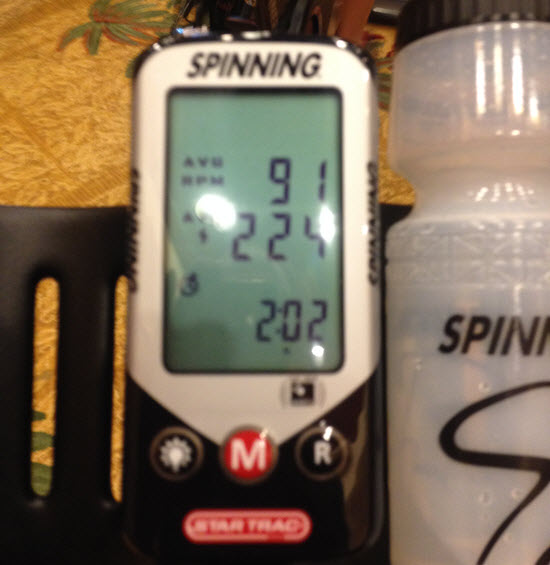
I snapped this picture showing the ramp test protocol used to asses the PST used to create the 6 power zones in the SpinPower program.
Constants and Variables
The constant during this test is cadence/RPM which doesn't change during the test. Janet suggests you not mandate a cadence, instead ask every one find “where they hang out” = natural cadence. What will vary will be the amount of resistance, and the resulting changes in HR and perceived exertion/RPE.
Start everyone warming up in zone one, finding that natural cadence for 10 or more minutes. Include a few brief accelerations – but not too intense or long.
Every two minutes you'll add resistance / ramp up. How much? Janet recommends 10-20 watts from women and 15-30 watts for men.
After you've added the new ramp, push the reset button to record your average for that ramp – remembering the previous ramp's wattage.
When you can't maintain your cadence, for the whole two minutes, you're done. Your PST is the watts from the last fully completed ramp.
How many ramps is the right amount? Janet explained that there is no “right amount”. You need to run the assessment until everyone has completed the test. There were some questions about this and it sounds like you should see at least 4 ramps until failure. Less than that probably means that the rider is adding too many watts with each ramp.
My experience during the test was as I got closer to PST, I wanted to reduce the size of each ramp's increase. I also knew very quickly when I wouldn't be able to finish a ramp. My numbers are in the image above. I couldn't complete my last ramp of 240 watts, which actually isn't that far off what I'm used to seeing as my threshold on the FreeMotion bikes I teach on at Life Time.
Thinking about conducting an assessment like this in your class? I would suggest that you practice on yourself first, so you understand what your riders will be experiencing.
If you are teaching on Spinner Blade Ions I would love to talk to you. Please contact me.




 To start the FTP tests wizard, press the left analog stick once, just like if it was a button. Now select the requested test from the menu and press the “Start” button to start.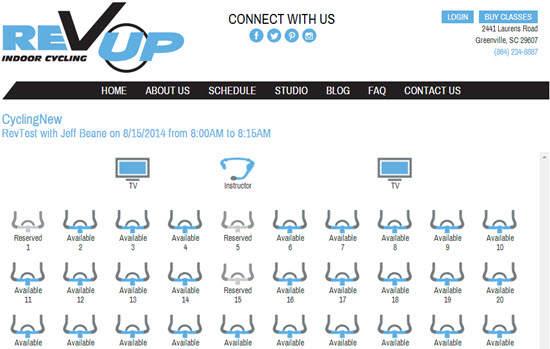
 and hovered anxiously, waiting to stake claim to “their” bike.
 At WSSC I had the opportunity to complete a PST (Personal Spinning® Threshold) test – which is (their words) the key to Spinpower success. I couldn't agree more as knowing your maximum sustainable power or Heart Rate, and then building training zones around a known metric BPM/Watts is crucial to effective training. Here's some notes on this session and the discovery process MI Janet Toussaint lead us through to determine our Personal Spinning® Threshold.