The crew at epicplanet.tv have produced a new DVD you can show in your Indoor Cycling classes. The Virtual Race Across America is a 60 minute (there's also a 45 minute option) DVD or Video that was created using footage shot during the 2013 RAAM Race Across America.
Ride the entire length of the U.S. in one training ride with the Virtual Race Across America (RAAM)!
Based on the actual RAAM race route, The Virtual Race Across America gives you a broad sample of this amazing race with 7 selected segments of the course including:
– Start and San Diego Mountains
– The “Glass Elevator” mammoth descent
– The hot, low desert of Southern California
– The climb into Sedona, Arizona
– Monument Valley in Utah
– Wolf Creek Pass, Colorado – the race's highest point!
– The plains of Kansas
– The killer hills of West Virginia
Both DVD and now Download customers will have three versions of the ride to use: A full version, and Just the Ride 60 minute and 45 minute versions.
PLUS BONUS CONTENT! – This purchase includes our 30 minute documentary “EPIC – One Team's Story of the Race Across America,” A $9.95!
Judging from the ride profile shown above, this video appears to be my kind of class – close to 30 minutes of climbing in the red zone!
I've watched the bonus video you get for free – the cyclists in your class will appreciate seeing how much effort goes into participating in the most grueling bike race in North America.
Created by: Cameron Chinatti / Stagesâ„¢ Indoor Cycling
Training Type: All levels — beginner friendly
Cycling Specificity: Introduction to metrics
Total Class Length: 45 minutes
Note from John: Cameron’s PROfile is specific to the FreeMotion S11 series of indoor cycles. With a little creativity on your part this profile could be used with any brand of Indoor Cycle that displays power.
“Why do I make less power (fewer watts) standing, then when I'm seated?”
This a a great question that we get often. I loved John's answer, and so I have done a few edits and present it here….. Joey
A great questions from one of the riders in a Performance Cycle class. An observation that shows he's paying attention plus it gives me the chance to clear this up, so you can properly explain this anomaly to your participants.
The short answer is you don't* If resistance and cadence remains the same, in or out of the saddle doesn't matter. The amount of power/watts you are creating doesn't change… because it can't.
The bike decides the right amount of power
You know that Power = Force x Cadence. So let's assume this participant is riding seated and pedaling @80RPM. Their resistance is set to a level that results in the console display showing 150 watts.
Our legs create the perfect amount of force required to get the job done, which in this instance is overcoming the resistance to pedal @ 80RPM. If your resistance setting on the cycle requires “X” amount of force to push down the pedal, your muscles will create exactly “X” – no extra force is created and no less. The combination of that force, multiplied by a cadence of 80 RPM results in the power meter showing 150 watts.
In fact there's an actual law of physics that says that it's impossible to get the same amount of power out of a machine with a reduced amount of power added into it – which is why I'm saying the amount of power/watts you are creating stays exactly the same, if you make no change other than to stand and ride out of the saddle.
“But then why does the power meter show my watts lower, when I'm standing.”
My response was; “you're right it does and there's a simple answer why…
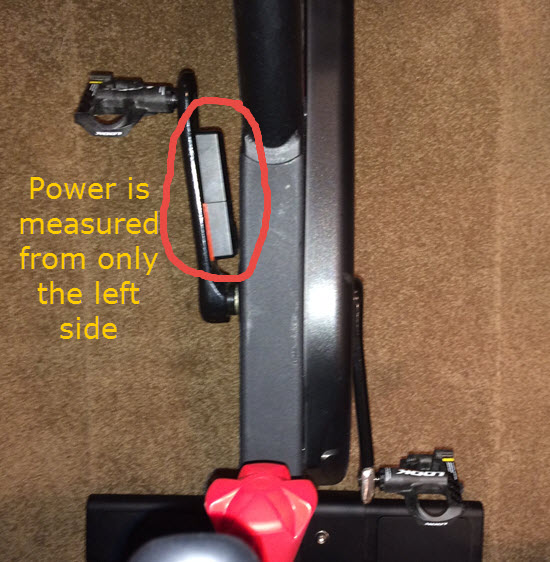
Let me begin with the basics. I teach at a Life Time Fitness Athletic Club and we ride FreeMotion S11.9 with the Carbon Drive belts. FreeMotion's measure power only through the left crankarm as you can see here.
This is my personal S11.0 (the home version) which is why it's black and not the normal silver color. The electronics are identical across all models.
Yes, the meter shows a drop in power…
Many of us who teach or ride on this Indoor Cycle have noticed that the power meter will show a lower wattage number when you transition out of the saddle, without giving any thought as to why. As I explained above, it shouldn't > the wattage number should remain the same. Again; Power is equal to force times cadence. If you didn't change the resistance setting, and you're maintaining the same cadence, the power meter should continue to show the same wattage… but it doesn't because >>>> your legs aren't the same strength.
Your dominate (stronger) leg does more work
The force required to pedal is divided between your two legs – but not equally. Because many (if not all) of us have one leg that's stronger than the other, our brains automatically proportion the amount of force from each. Remember: our legs only create exactly what's needed. Unless you consciously choose otherwise > more force is unconsciously asked from the stronger leg and the opposite leg adds what's left, equaling the total required.
Some quick research showed me that it's very common for one leg to be stronger in most people. Your dominant/stronger leg is typically the same as your writing hand. Since ~90% of people are right handed, the majority of your class will be seeing lower wattages when the come out of the saddle > because they are doing more work with their right leg. The FreeMotion's left hand power meter sensors are seeing a lower amount, of the total amount of work, as coming from your left leg.
Because this IC can only sense force on the left side, when you stand your stronger leg carries a greater percentage of your body weight = the wattages appear lower.
So standing or seated at the same cadence, you continue to create the exact same amount of power. It's just that the power meter doesn't see all of it and displays the reduced amount = the misperception that we create less power standing… which you now understand isn't true 🙂
Make this a feature (not a bug) in your class
Since the Freemotion can show leg strength disparity, why not use it as a training tool?
Novel idea, right?
Start by teaching everyone which leg is their stronger/dominate leg. The simplest way I know is by doing Step-Ups on a box or step raised to the proper level as shown in this short video.
This exercise was eye opening to me, when we did them in Boot Camp. Learning that my right leg is considerably stronger, I'm now really focusing on making my left leg do more work. Hopefully over time, a stronger left leg will result in me having a higher FTP and greater overall muscular endurance.
I suggest having your riders do this as an after class activity > or you could bring a box into your studio and have everyone take a turn.
Using a pair of reasonably sized dumbbells, perform 8-12 reps all on one side and then the other. It should be quickly apparent which (or if) they have a leg strength disparity.
We'll explore drills to exploit this feature and help riders train their weaker leg in future posts! [/wlm_private]
* I'm not referring to pedaling efficiency here, which is a completely different subject.
** Please let me know if this isn't clear, if I've confused you or you have an alternate method of explaining this.
Staying on the cutting edge of Indoor Cycling 2.0 is very exciting… and very demanding! The ICI/PRO Team is continually searching for new and innovative ways to educate our ICI/PRO members about the latest developments in fitness and Indoor Cycling.
The introduction of Power to many of our classes brings with it a number of challenges to delivering our training resources in an audio format. But have no fear! Master Instructor Cameron Chinatti has has created a wonderful two part video presentation of her It's not easy staying green class profile. We will be publishing part two next week.[!private ‘PRO-Platinum|PRO-Monthly|PRO-Gratis|PRO-Seasonal|Platinum-trial|Monthly-trial|PRO-Military|30-Days-of-PRO|90 Day PRO|Stages-Instructor|Schwinn-Instructor|Instructor-Bonus|28 Day Challenge']
Here is Cameron's Spotify Playlist and Deezer – here song choices are noted in the video.
NOTE: this was a previous review from 2013 that continues to remain accurate when applied to any of the magnetic friction Indoor Cycles available today.
Many Indoor Cycle manufacturers claim a connection with cycling outdoors:
100% Authentic – Spinning is authentic. It’s true to its cycling roots, yet refined to a simplicity that makes it the perfect program for any age or ability.
FreeMotion says; Drive System Mimics Outdoor Riding
The Schwinn® Authentic Cyclingâ„¢ Series is based on one simple principle: we believe that riding a bike indoors should feel as much like riding an outdoor bike as possible.
There are of course multiple similarities between riding indoors vs riding outdoors. Beyond the obvious differences, not needing to balance an indoor cycle for one, the claimed connection is that their Indoor Cycle feels like riding a bicycle outdoors.
But what does that mean? A feeling can be pretty subjective after all.
My review of the new Spinner® Blade Ion included a comment that I was a little disappointed that Star Trac continued with a friction resistance system, vs. the magnetic systems used by FreeMotion, Schwinn and Keiser.
I also teased you at the end of the post with:
Later that morning I also tried a little experiment that I’ve wanted to do for years…
What happens to your Power / Wattage when you accelerate from a set point, say; 100 watts @ 60 rpm to 90 rpm on friction based system, as compared to a magnetic system? Do they react the same way?
My apologies for the delay. I'm just getting to this today.
The ” little experiment” I conducted was something that I'd wanted to confirm/quantify for years, actually since I first started teaching on a Schwinn AC in 2010.
My early experiences riding/teaching with magnetic resistance, along with a discussion I had with Keiser's President Dennis Keiser, demonstrated to me that the amount of resistance created by the magnetic (Eddy Current) resistance system increased in lock step with a faster cadence / RPM. The faster you pedaled the harder (more force required) it was to turn the pedals.
Which is pretty much what you experience riding a bicycle outdoors, at speeds over 18mph. As you pedal faster (assuming you stay in the same gear) you and the bike move faster through the air. The faster you go, the more the resistance from the air pushes against you, making it harder and harder to turn the pedals.
There's a handy calculator to compute the amount of work it takes to overcome the resistance of the air here.
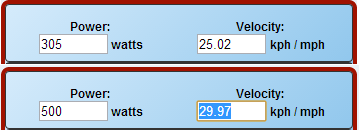
The difference in power needed to ride 25 mph vs 30 mph
So it takes apx. 300 watts to ride at 25 mph. To ride at 30 mph (just a 20% increase) you need to create over 60% more power. You can't make the power with additional leg speed – you're probably near your maximum efficient cadence already at 25 mph. To get to 30 mph you'll need to shift to a lower gear and push harder… A LOT HARDER!
Very different from the conventional friction system on an NXT – which (to me) feels like it gets easier to pedal, the faster I pedaled. In fact most of us can take what is a high level of load (at a slow cadence) and accelerate to the point where our legs spin-out and won't move any faster.
Side note: It's extremely rare to see someone riding with excessively high cadence on a magnetic resistance indoor cycle.
I've discussed this concept here in the past, but I couldn't prove or demonstrate it. I even went so far as contacting LOOK and Garmin to see if they would lend me a set of those new pedals with the built in power meter. They wouldn't and the crank arm from my FreeMotion doesn't fit on a NXT. It remained a mystery until now.
So while I was at the IHRSA convention, I finally had the chance to compare the new Blade Ion and the FreeMotion. With both cycles offering “measured power” I felt it would be a fair comparison; Magnetic vs Friction Resistance. Which best replicates riding outdoors?
Although I wasn't exactly “scientific” in my test protocol, nonetheless the results were very interesting.
Fun with graphs!
Here's what I did
My test was admittedly simple. After completing an early AM ride with Josh Taylor, I spent some time riding both the Spinner Blade Ion and FreeMotion S11.9. I began by establishing a steady 60 rpm cadence. Then I added resistance until the power meter showed 100 watts @ the 60 rpm. Then I accelerated to (and sustained) 90 rpm and took notes on what happened. I rode both cycles twice and the results were consistent. The blue Magnetic Watts line is more squiggly than the red Friction Watts line because I used the actual date set I downloaded directly from the FreeMotion's USB port.
I'd already tested the FreeMotion S11.9, so I knew that the 50% increase in cadence would result in a doubling of power. Perfectly consistent with my understanding of how Eddy Currents increase linearly with speed. A 50% increase in RPM = a 50% increase in resistance. Although math isn't my strong suit, it's easy to see how a 50% increase in Speed multiplied by a 50% increase in the amount of force required to turn the pedals = a 100% doubling in power/wattage. While not the same effect as what you'll find chasing down a breakaway at 27 mph, it is enough to force your students to work hard in a way that will help prepare them to hang with the “A” group.
The Spinner Blade Ion reflects the inherent weakness of using a friction pad with a heavy, perimeter weighted flywheel. The graph above clearly shows how the amount of resistance doesn't increase with additional speed – it actually goes down, validating what I had hoped to demonstrate. If it just stayed the same I should have observed 150 watts @ 90 rpm, I only saw 135 watts. So where did the other 15 watts disappear to? That's a math thing I'll leave to others smarter than me to answer. I will offer a guess that if I had continued on to 120 rpm, I would have seen a progressively lower increase in wattage vs what would be expected from a doubling of speed.
So what's this all mean?
Short answer – it's my opinion that magnetic resistance is superior in every way to a friction system. Besides being zero maintenance, the linear increase in resistance is much closer to what your participants will experience outdoors. Combined with the reduced inertia of the aluminum flywheel, magnetic cycles require more work to ride and force everyone to develop better pedaling technique. IMO the net results is that the members of your club or studio will (if they take advantage of it and you coach them properly) receive a more effective workout, that will translate to them becoming stronger outdoor cyclists.
So does that mean you wouldn't recomend the Spinner Blade Ion?
Not at all… it's an awesome cycle and that battery charger rocks. The purpose of this article was to demonstrate the differences so you can make an informed decision on your own. Besides, if you're a Spinning® studio, what other choice do you have?
P.S. If you're going to be at WSSC – I'd love for you to try and replicate my test on a Blade Ion for yourself. Then report back with what you find 🙂