While there are lots of local races throughout the season, there is only one “in my back yard”. So naturally, I like to do either the MTB race, or the Road race. I did both one year, and well…let’s not go there. Since I took the entire year off my normal MTB schedule, and our Road Team won last year’s team category, it seemed like the right thing to do, even though it was the longest, “experienced” race route of the group.
If you’ve read my previous 2 blogs however, you’ll recall that I am training for the “unrace” – the Dirty Dozen where just finishing will be counted as something I didn’t think possible – thus this new training focus. So the race wouldn’t be consistent with this plan, except for one thing. I am on a mission to raise my Threshold to give me more cieling and expand my VO2 in the process – thereby raising the two biggest limiters of power, and climbing hills that average 18% and higher will be ALL ABOUT power.
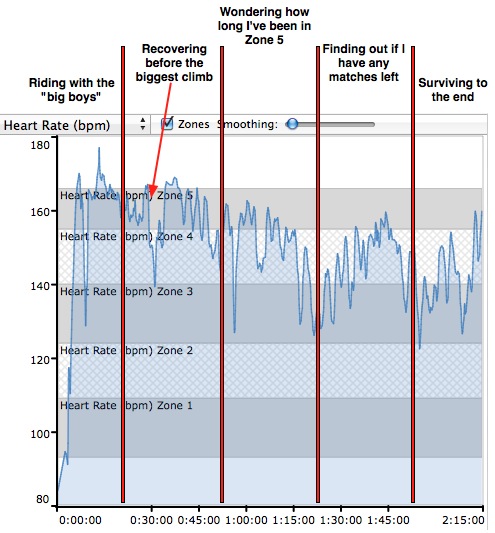
From that perspective, I guess I accomplished my objectives, but I’m just not sure getting all of the required time in Zone 5 (the real work that has to be done to raise ones Threshold) in the first hour of riding was actually the best way to go about it. What WAS I thinking!?!
Before I was an ICI/Pro Contributor, or Master Educator, before I spent every weekend coaching whatever sport my kids were playing at the time, back in what feels like a different life I was and Ironman triathlete. I spent close to 10 years in pursuit of that coveted Hawaiian Ironman spot, only to see my competition get faster and that spot get farther and farther away. I may not have made it to the finish line in Kona, but the journey I took in pursuit of that dream has made me the person I am today.
People often ask me if I miss Ironman training and racing and I can honestly say I don’t. At that time in my life it was my identity, it was what I lived for. Today I have a wonderful wife and two great 15 year old boys. I would much rather be riding the lifts of Vail, with them, then base training for next year’s races. I may race again some day, but for the next few years I would rather focus on raising my boys, they are my identity, they are what I live for now.
The one thing I miss most about Ironman training are the long training workouts. I loved to train alone. There is no better place to find the answer to any of life’s questions than on a 4000m swim, 5 hour ride or 3 hour run. The rhythm and length of these workouts gave me a chance to quiet my mind and listen. I don’t know where the answers or ideas came from but they just came. Many people call this Flow or being In The Zone.
Flow is a mental state in which a person is fully immersed in a feeling of energized focus, wellbeing and enjoyment in the activity being performed. The hallmark of flow is a feeling of spontaneous joy while.
Many people find the flow accidentally, without thinking about it or trying, all the conditions of a workout magically come together and work feels effortless, time flies by and your body feels like it is working perfectly. This flow state is like a drug, once you have had it once you want more of it. Luckily, finding The Flow can be practiced and perfected.
[wlm_private ‘PRO-Platinum|PRO-Monthly|PRO-Gratis|PRO-Seasonal|Platinum-trial|Monthly-trial|PRO-Military|30-Days-of-PRO|90 Day PRO|Stages-Instructor|Schwinn-Instructor|Instructor-Bonus|28 Day Challenge']
The controlled environment of an indoor cycling studio is the perfect place to practice and perfect finding the flow state. I’ve been incorporating one flow state song per class for the past few months and my riders love it. When cueing a flow state song I ask my riders to focus on the beat of the music, or their cadence or the rhythm of their breathing. They need to focus on something rhythmic and hypnotic. The intensity needs to be below threshold, burning legs and lungs will pull them out of the flow. The most important and probably hardest thing for an instructor to do during a flow state song is to BE QUIET. Your riders need to focus on the rhythm of THIER bodies, the sound of your voice will pull them out of this flow state every time.
I have gotten more positive comments about this addition to my profiles then anything I have ever done. I would recommend you add it in during one of your recovery songs, this way the volume or intensity junkies in your class don’t feel like they are missing out on any of the “quality” of the workout.
If you listen to my recorded classes below, see if you can find any “Soul Cycle” influence, no I have not added weights.
3 song harmonically mixed track, , to download Right Click > Save As / Save Target As to download. Open in iTunes and then you'll see this in your Spotify Local File folder.
“Danny, Dakota and the Wishing Well” by A Silent Film
“Can't Hold Us” by Macklemore & Ryan Lewis
“Vertigo” by U2
Last week I wrote about the “Threshold Check” or “Mini-Threshold Test” that I perform at the beginning of every class. This week I want to share how I teach the full 20 minute FTP (Functional Threshold Power) Test. With this post I have also included the playlist and video I use as well as a recording of me teaching an entire FTP class.
[wlm_private ‘PRO-Platinum|PRO-Monthly|PRO-Gratis|PRO-Seasonal|Platinum-trial|Monthly-trial|PRO-Military|30-Days-of-PRO|90 Day PRO|Stages-Instructor|Schwinn-Instructor|Instructor-Bonus|28 Day Challenge']If you are lucky enough to be teaching on bikes with power I believe it's important to use this technology and all the available metrics to their fullest capacity. I find the most powerful use of a power meter is in finding one's maximum sustainable wattage or threshold. Threshold is that state of equilibrium between high intensity exercise and the body's ability to buffer and filter the waste products produced by this intensity. With a power meter we can find a wattage number that correlates with this state of equilibrium or your FTP (Functional Threshold Power).
Exercise physiologists have devised many different ways to find one's threshold, but I have found the simplest and cheapest technique is to perform a 20 minute effort at maximum sustainable intensity. At the end of this 20 minute effort take note of the average wattage and multiply it by 95% and this number is your FTP. I'll go into greater detail on how to use this number in later posts, but now let's go over how to perform the FTP Test.
I like to have my riders warm up for a minimum of 15 minutes. I'll have them slowly increase their intensity for 10 minutes then I like to have them perform 3-4 one minute “pickups” increasing their intensity each interval while recovering for one minute after each. After a short, 3-5 minute, active recovery from the pickups I have the class perform a maximum effort 5 minute interval. This effort ensures that the lactate buffering and clearance systems are turned on and ready for the 20 minutes test that follows. I also have class participants remember their average wattage for this 5 minutes, it's a good number to refer back to when doing above threshold intervals. After another recovery, about 10 minutes long, we are ready for the 20 minute FTP test. Make sure all your participants know how to reset the bike console so they can get a new average for the 20 minute interval to come. Tell them that this is a very simple test, you want them to ride at the highest possible wattage for 20 minutes. Your job as the instructor is to motivate, but not to talk too much. Let your riders “settle in” to their maximum sustainable wattage and their most efficient cadence and just let them ride. At the end of the 20 minutes make sure they remember their average wattage, multiply it by 95% and they have their Functional Threshold Power. This “Benchmark” test is also great to see improvement over time, with proper training FTP should continue to improve.
Let me know how it goes, my classes love FTP days! They work so hard every day and once a month they get to see the payoff for all sweat and suffering.
6 song harmonically mixed FTP track , to download Right Click > Save As / Save Target As to download. Open in iTunes and then you'll see this in your Spotify Local File folder.
Both the FreeMotion S 11 series and Schwinn AC Indoor Cycles have the ability to record your ride data using a USB Thumb Drive.
This past Sunday I asked Alan ******, one of my regular students, if he would be willing to have his class performance data recorded so I could share it with you. Al is a long time cyclist and we first met back in 1998 while I was leading group rides for a local bike shop. He agreed and the process for collecting his information was a simple as plugging a Thumb Drive into the USB port before turning on the FreeMotion computer.
The data that's collected is:
Time – it takes a snapshot every second.
Miles traveled*
MPH*
Watts
Heart Rate BPM
Cadence RPM
My understanding is that Miles traveled and MPH are estimates based on research done by FreeMotion's engineers that measured the amount of power needed to sustain a given speed. As I type this I realize that I need a more comprehensive understanding so I can explain this better. You can download the .xlsx spreadsheet here.
Here's why both FreeMotion and Schwinn use a “Stage” button during class.
There is an enormous amount of data collected during a 90 minute class… Four Thousand, Eight Hundred and Thirty Nine lines of data to be exact.
The reason for only 116 minutes of total time is that we had a 14 minute warm-up, where no data is collected. More on this as I learn and experiment in the future.
Here is Tom Scotto's first post in his official capacity as a Master Instructor here at ICI/PRO –
Indoor cycling instruction keeps progressing and improving and so do the bikes we ride. Today, many of our indoor bikes have more than the ability to add and remove resistance. Bikes are now providing us with cadence, heart rate, power, time and a host of other measurements to guide our rides and training. So I thought it would be good to talk about what these numbers actually mean and get some response from our knowledgeable community about experiences you’ve had or ways you’ve incorporated these tools into your classes and teaching.
“KILLER” Calories
OK, they are really not “Killer” calories but that is how is sounds much of the time when I hear people talk about it. We are referring to kcal. This is a scientific abbreviation for kilogram calories or kilocalories. It is generally used to indicate a “small calorie” or gram calorie. When written properly, it is presented with a lowercase “c” as in “cal”. However, like many things we try to understand these days, the inconsistency of how it is display and how it is calculated can create more confusion. So, by its original definition, kcal is 1000 “small” calories or simply a Calorie (note the uppercase “C”).
Without nose-diving into a verbose science lesson (which I’m not qualified to give), kcal or Calories is simply a measurement of energy needed or required. In science terms a kcal represents the approximate “energy” needed to increase the temperature of 1 gram of water by 1 degree Celsius. So on the bike kcal is simply a measurement of how much “energy” we are generating.
So how does the bike know this? Enter the joule.
Since these bikes are also calculating power output (watts — we’ll talk about that in another post), a joule is the measure of energy from the amount of force (mechanical work) required to move an object. Joules can be converted to calories (1 joule equates to 0.2389 calories or 0.0002388459 kilocalorie) – YIKES!!!!! Let’s just say that with my math skills, I’m glad computers can figure this stuff out.
Enough of that Brain Twisting — Is kcal Useful or Accurate?
In a “very” general sense 1 kcal = 1 calorie, but it is better to think of this as the energy that you produced during your ride rather than how many calories your body burned while riding. Here are some factors that affect the true conversion from 1 kcal to 1 Calorie:
(1) Muscle Mass
A person with a higher percentage or body fat will usually burn LESS calories than a person with more muscle mass. Since body fat percentage affects a person’s metabolism, it will affect how much it will cost them (energy) to do a certain amount of work.
(2) Fitness Level
A person who has a greater fitness level will more likely burn LESS calories than someone who is not as fit for the same amount of work or activity. Hence the benefit of training and adaptation.
(3) Body Weight
A person that has more body weight may require LESS energy to push (move) a certain workload (force) than an smaller, lighter person.
(4) Mechanical Efficiency
A rider with good form, posture and technique will fight the mechanics of the bike LESS and may achieve the same output with LESS effort of energy expended.
Because of all the possible variations and factors, it is best to use kcal as a “personal” benchmark. If you generated 500 kcals during a certain ride or training focus, you can try to replicate this on a future ride or try to exceed it. Use it to measure your progress or gauge how hard you may be working during a given class. Just remember, that different pieces of fitness equipment may not calculate kcal the same. This may be due to the mechanics of the equipment (treadmill vs. bike) or because they may include additional measurements (like body weight) into the calculation. Consider each piece of equipment its own animal and use kcal an estimation of how much energy one workout required compared to another.





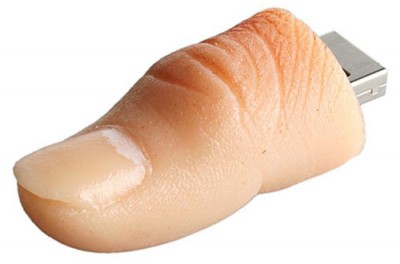 Both the FreeMotion S 11 series and Schwinn AC Indoor Cycles have the ability to record your ride data using a USB Thumb Drive.
