I love the simplicity of the Zoning Heart Rate program. Three zones (Easy-Blue/Moderate-Yellow/Hard-Red) that are created using two thresholds; T1 Aerobic Threshold & T2 Anaerobic Threshold – AKA: AT or LT. Simple to communicate and easy for anyone to understand – perfect IMO for our Indoor Cycling classes.
We've discussed Zoning multiple times here at ICI/PRO. Here are some links where you can learn more about Zoning and how this three zone system is recommended by ACE – the American Council on Exercise as their preferred Heart Rate Training program for our “Club Athletes”. We've also got some excellent class profiles that follow the Zoning format.
Tia Kilpatrick is a Zoning Specialist who works closely with Sally Edwards. You can virtually meet her in the video below where she leads her Falling in Love with the Golden Zone class at the past Heart Zones conference held in conjunction with Cycling Fusion.
Tia has an upcoming ebook; 44 ZONING Rides for the Indoor Cycling Enthusiast. We'll let you know when it's available.
I love knowing what's expected of me and I bet you do as well. It makes life so much easier! When told; “I need you to do X,Y and Z”… I know to do X,Y and Z. But we've all been in the position of being told something was expected of us, but the “something” was never communicated and then the problems begin.
Do you have clear expectations from your club manager or owner?
I do 🙂
It came in the form of a well written, three page document from my new boss, Joe Ducosin. Joe is the owner of Cycle Quest Studio where I recently started teaching. Here's the begining:
CycleQuest Studio Guiding Principles for Instructors
From Joe Ducosin 9/27/11
This document outlines the expectations of CycleQuest Studio instructors and also provides tips and guidelines to follow to create a motivating and enjoyable indoor cycling experience for all customers. Instructor responsibilities
Try and arrive to class at least 15 minutes before the class start time. Remember that not only do you have to change into your workout clothes, get your own music, bike, stereo, and video setup, but there may also be a few new customers that need to be setup on the bike properly, have the bike computer explained to them, and instructed on what their expectation of the class should be. Also before class is the best time to connect with them on a personal level, learn their name, what their fitness goal is and answer questions they may have about the class and the studio. This is the most important aspect of the studio that sets us apart from other indoor cycling studios — that we are customer focused and make sure all beginners are setup properly on the bike and made to feel comfortable in the class.
All classes should start on time and you should not wait for customers that are running late. At the end of class remind them to gently drop their handlebars and seat, and wipe down their bikes and any wet spots/puddles on the floor with the paper towels and anti-bacterial soap on each side of the class….
This was really helpful for me because after 10+ years of teaching I have become a bit set in my ways and some of what Joe is asking from me is very different from what I have done in the past. Joe understands what he wants for his studio and has taken the time to lay it out in a format where I can understand pretty much exactly what he's looking for from me.
The funny thing about communication is it takes two willing participants for there to be any communicating. Each person involved is equally responsible. If I have expectations for you, I need to clearly communicate them. And the opposite is true as well; If you aren't getting clear expectations from you manager you might want to let them know you don't fully understand what's expected of you.
Take a few minutes to read Joe's Guiding Principles for Instructors and decide if having some clear expectations would be helpful where you teach. Feel free to forward this article to your manager or use this to draft your own list of expectations for your instructors.
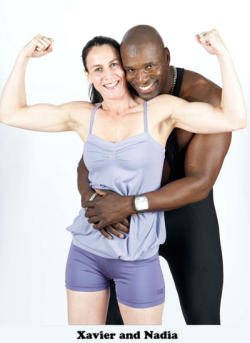
Running a successful fitness studio takes a lot of passion, experience and hard work. The husband and wife team of Xavier and Nadia McClinton who run Body By X Skill Development & Training Center in Marin County California sound like they have all three covered… and more!
Together they have developed a unique fitness offering that combines strength training, along with Indoor cycling and includes the MyRide+ virtual ride video system. Body By X's experiences with MyRide+ were covered in more detail in this case study we published back in February.
Listen to my interview with Xavier and Nadia to get an understanding of how they are able to succeed by creating a real sense of community at their studio and a simple idea you can use to retain members who (for whatever reason) decide not to show up.
You can subscribe to our free Podcast in iTunes by clicking here.
Minimal required maintenance – the belt doesn't stretch and you never need to lube it.
Should last forever
Did I mention that it's very quiet?
Weaknesses
More expensive than a chain drive
It may require the pedal crankarms be spaced further apart = wider “Q-factor”
That's all I can think of.
Disclaimer and perspective: I have taught on the FreeMotion S11.9 for the past year at two Life Time Fitness clubs. I train at home on a S11.0 (the home trainer) that was given to me for evaluation purposes.
My only real complaint with the original chain drive FreeMotion S11 series Indoor Cycles has been the amount of chain noise coming from the drive system. That noise, multiplied by 50 or more cycles in a class (or just one in a basement) can be very distracting/unsettling/frenetic and it requires much more volume of both you and your music.
If you've every experienced how calm/relaxed a class with belt driven cycles is, you'll understand exactly what I'm talking about.
Where does this additional noise comes from? It's from the chain wrapping around very small front sprocket used to rotate the flywheel at a much higher RPM than on a friction IC.
Big drive gear x small driven gear = very fast flywheel RPM
All Indoor Cycles use some form of weighted flywheel to mimic the momentum of riding a bicycle. Cycles with magnetic (Eddy Current) resistance (FreeMotion S11.x, Keiser M3 & Schwinn AC) all use an aluminum (or combination aluminum/steel) flywheel. All steel alone won't work when you're using Eddy Currents to create resistance.
Aluminum is lighter than steel = less mass = less rotating momentum. Also the design of the combination flywheels has the “steel” portion closer to the hub, resulting in less mass around the perimeter of the flywheel. The flywheel needs to rotate quite fast to create enough of these “Eddy Current's” to make the requested resistance, which is good because this additional speed makes up for the aluminum's lack of mass. The gear ratio (big crankshaft gear x small flywheel gear) needed to achieve this flywheel speed = additional chain noise.
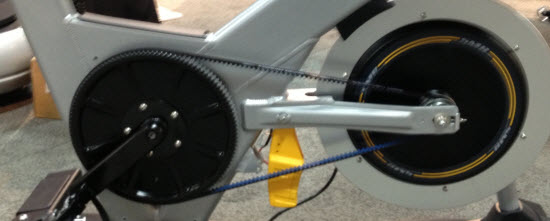
By using a belt, instead of a chain, FreeMotion has eliminated the noise problem… but all belts are not the same…
There are a number of popular Indoor Cycles using a belt drive system; Keiser M3, Livestrong/Tomahawk and the LeMond RevMaster. All of these cycles all use a Kevlar belt – perfect for most people, except for the cyclists in your class. For them, these Kevlar belts feel very foreign. They don't “feel” like a bicycle because chains create a vibration as it rolls across the sprockets and that vibration is missing from a super smooth Kevlar belt.
I'm sure that Gates did a bunch of research and testing when they developed the Carbon Drive system as a replacement for bicycle chains. Their success (I'm presuming here) would be dependent on creating a replacement for a chain that eliminated all the negatives; maintenance, wear, weight, grease and noise – while retaining the familiar feel of riding a bicycle. The “teeth” of the carbon belt, as it rolls across the pulleys, create a similar vibration to a chain = the “feel” of a bicycle, W/O any of the negatives of a chain.