by John | Feb 24, 2018 | Best Practices, Boutique Instructor, Instructor Training, KEEPING IT FUN, Master Instructor Blog, Promote and Build Your Class
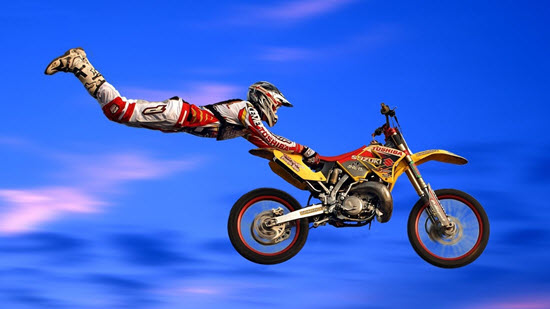
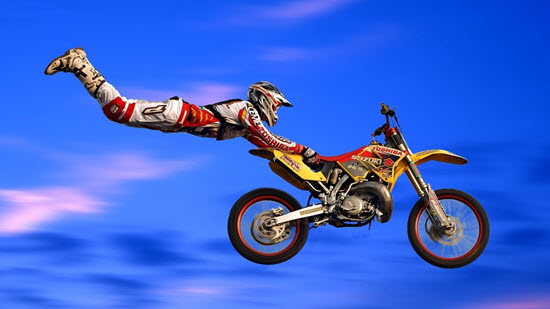
No stunt is too dangerous for extreme motocross competitions.
What caused the SoulCycle phenomenon? Why are their riders so passionate, loyal and willing to spend $34 dollars a class, when clubs and studios had been offering Indoor Cycling classes for 10 or more years – long before SoulCycle's launch in 2007? The research done (and reported here) by future studio owner Callie Bowling finds Cycling Studios that are offering class formats similar SoulCycle's appear to be doing well, but studio startups following traditional / cycling specific formats are struggling. Sadly many have already closed. Why?
One plausible explanation is that for a long time now, Indoor Cycling has been too focused on the negatives, “don't do this [contraindicated] … and don't do that [contraindicated]” while at the same time asserting rules and restrictions on the sport, [if you don't do it outside…]. Now I get that the intent here has been to try and ensure our rider's safety, but could all of these rules/limitations/contraindications be causing unintended consequences?
My theory
So let me throw out a possible theory for you to consider. NOTE: my intent here at ICI/PRO is never to tell you what to think… you're too smart for that. Rather, my hope is that you thoughtfully consider what's written and come to your own conclusions.
Is it possible that people are turning to SoulCycle classes, for reasons similar to the rise in popularity of Extreme Sports?
Growing up in the late 60's and 70's there were no “Extreme Sports” – although I should probably be dead based on how much danger I was exposed to daily. That is, I enjoyed a lot of freedom as a kid – if you're of a similar age, I'll bet this was the same for you. We spent summer days in the suburbs pretty much unsupervised. Neither my mom, summer sitter, or my neighborhood friend's moms, knew where we were most of the day. We did pretty much whatever we wanted and created our own play. We got everyone together for pickup games of all types daily. Yes we got in trouble on occasion. Yes we got hurt a few times, doing dumb things like falling out of trees we shouldn't have climbed, crashing our mini-bikes without wearing a helmet, etc. We survived. Sure we had youth sports (little league baseball and football) but there was very little parental involvement. I rode my bike to practices/games and, with the exception of my grandmother who seemed to attend every game, my parents were rarely involved in my play while I was growing up.
Everything was different for my two daughters and kids across America, growing up in the 1990's. Amy and I parented like every other parent our age. We knew where our kids were pretty much every minute of the day. “Play time” was often initiated, structured and supervised by us. Why? Because we wanted to ensure our kids safety, based on concerns that I now see were really overblown.
Organised youth sports (soccer and later softball) started at age 5. Games and practices were religiously attended by both parents. I coached both my girls until they were teenagers. As a youth sports coach, I had first hand knowledge (very intense phone calls and on-field conversations) of how incredibly involved and controlling some parents were in their daughters lives.
Thankfully, Amy and I recognised the negative impact our actions were/or could have on our girls and we backed way off. For many who didn't, all of that parental supervision and control didn't end well. Multiple friends of my daughters quit sports completely, having been burnt out by excessive amounts of structured practice. These kids just wanted to play and have fun. But their parents never gave them the chance.
What should have been enjoyable, playtime activities with friends, became joyless, purposeful, objective driven work. And a lot of kids grew to hated it.
The problem isn't limited to moms and dads. Schools, for a multitude of reasons*, have imposed restrictions and limitations on “play time” during recess to the point where it's hard to believe you actually could have fun. Don't believe me? Try teaching your five year old to follow all these playground rules I found for an elementary school in California. After reading through the very detailed list of playground rules, I'm thinking I would give up and just instruct my child to sit quietly on his hands 🙁 Here's how the list of rules begins:
Playground Rules
Play Structure
Play with SAFETY in mind at all times. Students are always to walk in the playground equipment area. Those running will be removed from the area. No tag games are allowed in the playground area.
Swings:
* Students sit on swings facing the field area
* Students can swing to a count of 50
(1 swing consists of a forward and backward motion)
* Students wait behind the green pole to take turns on the swing
* Students should never be allowed to jump over the swing seats, twist swings, or
stand on swings
* Students must swing independently. No pushing from a friend!
Enter Extreme Sports
It no secrete that youth have a tendency to rebel against authority. Sociologists have figured out that many young adults are acting out their rebellion at the parental and societal intrusion on their play, by participating in Extreme Sports. Now, instead of climbing trees, doing an oly-under while pushing your friend on a swing and occasionally sneaking out at night as kids, we have people jumping off buildings and doing flips with motocross bikes 🙂
I did some research and I found a book that you can read at this link; The Sociology of Sports: An Introduction. The author makes a compelling argument > Extreme Sports are in fact a response to the excessive structure imposed on children's play.

Excerpt from The Sociology of Sports: An Introduction – page 53
Many sports have become so rule-oriented that people have sought alternatives to “traditional” sports.
So, are people flocking to SoulCycle because it's the alternative to rule intensive Indoor Cycling programs? I believe in part they are. After taking a few SoulCycle classes last fall, I wrote a series of reviews that you can find here, here and here > opens in new tabs. I came away thinking that part of the appeal of SoulCycle is that the class is very challenging physically – and I don't mean just cardiovascularly…
Is there purpose to all of these extraneous movements?
Critics of SoulCycle (and similar) classes point to how non-cycling specific movements; jumps, push ups/rhythm presses, “tap-backs”, figure eights, etc… have no proven training value and/or diminish the potential training value of riding an Indoor Cycle… like an Outdoor Cyclist would. For those reasons, along with perceptions the some of these movements may be potentially dangerous, we’re told we should not include these movements in our classes as they’re “Contraindicated”.
Based on what I saw at SoulCycle (and other similar classes I’ve taken) my feeling is that critics are completely missing the point. IMO these movements are a critical part to the appeal of these classes. It is a thing of beauty, watching a room full of people exactly on the beat and rising and falling in unison. I’ve heard this described as “tribal” behaviour, similar to fans doing the ‘wave’ at a sporting event. It’s a very powerful way to connect a group of people together. And at the same time, these jumps are very challenging to perform correctly — which I feel is another reason for the success of SoulCycle that I explained in this post.
In case you're wondering, what started my thought process here was a provocative post from CB Cycle Barn's Owner Karen Casler. She made a statement, by way of the below image, in this post at the Indoor Cycling Instructors Facebook group. You might be interested in reading the 100+ comments, including mine near the end where this theory first popped into my head.

Are you an independent thinker when it comes to conducting a fun, effective, entertaining and motivating Indoor Cycling class? If so please consider joining us here as an ICI/PRO member where everyone is welcome — no matter where, our how, you choose to teach!
*Yes, I agree that there are a lot of legal liability issues that drive institutional decisions. It's just that I've talked to too many school administrators, who's personal interest in “protecting the children” seemed more important than whether or not the kids will actually have any fun.

by Joey Stabile | Feb 20, 2018 | Best Practices, Class Work-Sets, Creativity Indoor Classes, Instructor Training, KEEPING IT FUN, Master Instructor Blog, Training With Power
Welcome to the The Weekly Ride by Cycling Fusion:
No more hunting for new music or counting out cues. Here is your ready to ride document, that can be displayed from your phone, or printed out onto cue cards. This ride is timed out, down to the second, to make your life as easy as possible!
(more…)
by Joey Stabile | Feb 6, 2018 | Best Practices, Class Work-Sets, Creativity Indoor Classes, Instructor Training, KEEPING IT FUN, Master Instructor Blog, Training With Power
Welcome to the The Weekly Ride by Cycling Fusion:
No more hunting for new music or counting out cues. Here is your ready to ride document, that can be displayed from your phone, or printed out onto cue cards. This ride is timed out, down to the second, to make your life as easy as possible!
(more…)
by John | Jan 31, 2018 | Best Practices, Instructor Training, Latest News
I woke up one morning thinking; the appeal of SoulCycle to women is eerily similar to golf's appeal to men.
Amy and I rode a class at SoulCycle in Santa Monica, CA. I was working on a few posts about our experiences that I hope to have finished by tomorrow. But this observation needed to be in a post all its own… and begins with this question?
Why is SoulCycle so appealing to women?
[wlm_private ‘PRO-Platinum|PRO-Monthly|PRO-Gratis|PRO-Seasonal|Platinum-trial|Monthly-trial|PRO-Military|30-Days-of-PRO|90 Day PRO|Stages-Instructor|Schwinn-Instructor|Instructor-Bonus|28 Day Challenge']
The class I took yesterday had about 60 people in it – I forgot to count the exact number of bikes. I was one of two men (lucky us!) and the age spread of the women there was 18 – 50, heavily biased to 30 and under. Now I get how the demographics of all group fitness classes are primarily women, but there is obviously some extra special attraction between SoulCycle and the women who flock to these classes.
I'm not a “golfer” in the same sense that I am a “cyclist”, but I have played enough to understand the game and the appeal it has with men. I'm also not a women. So please let me know if any of what follows sounds plausible – or if I'm totally out in left field.
SoulCycle is challenging… just like golf.
I was asked a question on Facebook about “did you do all the moves John?” I certainly tried, but keeping my cadence in time with the tempo of the music, while doing 4 & 8 count jumps was really challenging. I left the class thinking; “I can do better than that”… and then considered coming back later in the week to try again.
Golf is exactly the same. If you're not so frustrated by the end of the game that you commit to quitting for life, you are very motivated to return to prove to yourself (and the people you play with) that you can do better.
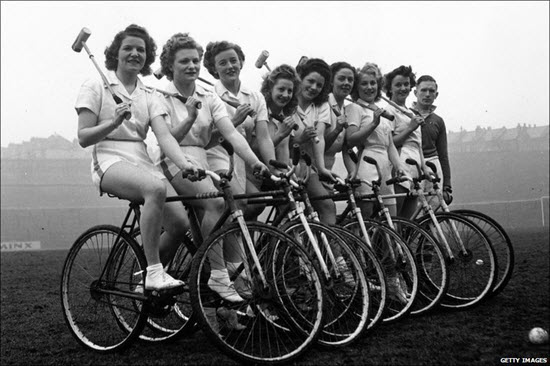
Said differently: How popular would golf be, if every swing resulted in a hole-in-one? That would be pretty boring, right? Who would bother to play a game where you're always successful? I suppose you could make the game more challenging by racing your foursome between the holes, or only play on hilly courses, or walk taking slow really big (or quick super small) steps to add variety. Maybe you could turn the game into something more like polo, using bicycles instead of horses.
Does any of that sound familiar? Part of SoulCycle's appeal is that the class itself is challenging to perform well. It's my guess that mastering all the movements is very gratifying – just as learning to hit and place a golf ball exactly where you want it.
SoulCycle is social… just like golf.
This is obvious.
SoulCycle is exclusive… just like golf.
‘Where are you playing this weekend?” I hear that asked frequently in the locker room where I teach. It's an exclusive club and many of our members are quite well to do. I'm not thinking that any of them would want to respond with; “we're playing the town course”, but rather stand up straight and tall, smile and respond with the name of one of the private golf courses in our area.
SoulCycle is a form of exercise… just like golf.
Play an 18 hole round of golf and you'll walk 4-6 miles. Is walking that far a good form of exercise? Sure it is. Is it the best form of exercise? No/maybe/yes/who's to judge. How about swinging the clubs 100 or more times during a round… will that help you increase your strength? Yes – and the muscle stiffness you feel over the next few days is an indication of the training effect. But is that the best way to increase strength? Again no/maybe/yes/who's to judge?
Is a SoulCycle class exercise? Yes. Do those exercises you do with the little hand weights increase strength? Maybe. Certainly they're not the best way to gain strength, but are they really any different from swinging a 9 iron – for the man whose only form of exercise is his week golf game?
SoulCycle is expensive… just like golf – see where I'm going with this?
SoulCycle classes at $34.00 a pop, are a bargain compared to many exclusive golf courses who charge $200 – $1,000 a round. People like to treat themselves to nice things – especially those people who work hard and can afford either of these two forms of exercise.
Golf has all kinds of expensive gear and clothing – and a quick check of the clothing displayed showed me SoulCycle does too.[/wlm_private]
Amy and I met Shirley (a former homecoming queen) after class. She told us how she had lost 65 lbs in advance of her reunion by taking 5 -6 SoulCycle classes each week. I didn't ask, but got the sense that she was a professional of some type and wasn't financially challenged by the cost of classes there. Shirley said she will normally do a triple on Sundays and based on how hard I saw her work in class – the girl could be an animal on the road.
So now let me know your thoughts.
by John | Jan 12, 2018 | Best Practices, Engage Your Students, Learn Leadership Skills

Take it away Tom >>>>
Great post and well detailed. I appreciate all the great articles you post.
The challenges you described are all too familiar to me. I’ve found a simple solution that works for my indoor cycling classes, and is based on my experience running a small business that provides software training classes. In that capacity, we teach software productivity courses (1, 2 and up to 5 day workshops) where there could be 20, 50 or even 100 participants. The distractions are numerous: participants checking their emails, texting, talking to their colleagues, etc. It is unfortunate because they have to bring their laptops and mobile devices to class. So, in order to deliver a more effective training session, we first had to understand the causes of distraction:
1. People use training classes, and for that matter, indoor cycling classes as a social venue, a “catch-up” of sorts. They meet friends, colleagues and chit chat about their families, work or other issues.
2. We are all wired, 24/7. The availability of mobile devices and the need to have them tends to add another layer of distraction. There is nothing more frustrating than being asked to repeat a key topic during a training class only because the person who asked was checking their email.
We found the solution to be tricky. The effectiveness of the solution, however, was in its simplicity.
1. Establish a basic ground rule and make them promise to respect it.
At the beginning of each software training class and also at the beginning of each indoor cycling class I teach, I ask all participants to silence their phones, avoid chatting, and in the case of software training classes, I ask them to not check their email, instant messaging or texts until break time. Then, and this is key, I request that they promise to respect this rule. I know we are all adults here, but sometimes, you have to go back to basics.
2. Make them commit to the belief that the class is their time, their investment and thus, their reward.
Again, at the start of each class, I define the objectives of why we are here and what we are trying to accomplish. For indoor cycling classes, I simply state that for next 60minutes, this will be “your time” where you focus on your health and mental well-being. I ask all participants to take a moment to empty their minds of all distractions, worries and anxiety and leave those outside the studio (to be collected later of course). Then I ask that we all respect our collective time by not creating distractions. [I love this line!]
With these two basic rules, I have found greater success in creating an experience for riders that extends beyond the social gathering aspects. In fact, I hear frequent feedback from riders that in that one hour, they have found a way to re-focus and re-recommit; to re-balance and de-escalate; and, to have fun and enjoy the workout at the same time.
In closing, the important of establishing these ground rules will define you as an instructor who places a high priority on the participants’ time and commitment. They will respond in kind.
Ride on!!
by Joey Stabile | Jan 10, 2018 | Best Practices, Class Work-Sets, Instructor Training, KEEPING IT FUN, Master Instructor Blog, Training With Power
Welcome to the The Weekly Ride by Cycling Fusion:
No more hunting for new music or counting out cues. Here is your ready to ride document, that can be displayed from your phone, or printed out onto cue cards. This ride is timed out, down to the second, to make your life as easy as possible!
(more…)