Master Trainer Cameron Chinatti from Stages Indoor Cycling joins me to offer suggestions on how you can solicit constructive feedback… and then what to do with it once you receive it.
Cameron's handout begins:
Dear _____________________________________________
As a fitness professional, I take every opportunity to improve my craft to better serve each and every one of you. In addition to the time and resources that I voluntarily dedicate to learning new exercise formats and methodologies, I also strive to improve myself.
My current self-growth project is entirely dedicated to being an effective “cue-municator”. I recently completed a cutting-edge indoor cycling course and one of my assignments is to fully understand and embody my strengths – not only as an instructor, but also as a person. If you are willing, please share your helpful, honest feedback.
[wlm_nonmember]
Cameron's handout is reserved for ICI/PRO members. We offer monthly and annual subscription options:
I love to share these short videos from communication expert Alexa Fischer
Picture this… You’re the new guy. It’s your first day. Your heart skips a beat as you enter the front door knowing that everything is new. New people. New desk. New job. Sigh. Now go ahead and switch roles. You are sitting at your desk, clasping your favorite mug, surrounded by the lovely pictures of your family on the wall. At once you notice the new guy heading into the conference room for an orientation meeting. That’s the moment you decide that you’re going to make that guy’s day. No need to wait for an awkward moment in the elevator or a meek hello at the water cooler. You are going to do what you wish others had done for you on your first day of the job.
Here’s how to be a hero to the new kid on the block. Kindness wins every time.
For over 13 years, until about a year and a half ago, I was in an athletic performance program that was progressive and periodized. Phases 2 and 3 involved some seriously difficult trainings. I was in the habit of eating what I called my “no-bonk breakfast” because it got me through even the toughest workouts without an energy crash.
Since then, nutrition trends have shifted, as they tend to do. So I thought I’d present the No-Bonk Breakfast in its original form and offer a few variations for those who would prefer those.
Here’s the original. It starts with oatmeal, although you shouldn’t eat that first, by itself. Cook it with water and cinnamon (for the glucose-stabilizing effect). If you’re feeling hardcore, you can open the refrigerator and find some protein, like chicken, from last night’s dinner and eat that while the oatmeal cooks. If not, stay with me for Plan B.
Plan B: Once the oatmeal is done, add a scoop of high-quality protein powder. This can be unflavored whey protein or a raw, vegan vegetable protein powder — or a combination of the two. (Other types of protein powder, like soy or brown rice, can also work. It’s a personal choice, although I find brown rice protein powder tends to upset my stomach.) Don’t cook the oatmeal with the protein powder, since heat can destroy amino acids. Add it to the cooked oatmeal.
Then add a wholesome fat. Examples might include raw, organic coconut oil; raw almond butter; cashew/macadamia butter (I gave you easy instructions for that over the holidays); walnuts, or another option that appeals to you.
If you want, you can add some fruit, such as ¼ cup of berries and/or ½ to 1 teaspoon of probiotic yogurt.
Okay, that’s the original breakfast. Many gluten-free readers will object to oats from that perspective. Instead, you can try exactly the same recipe using quinoa. Because quinoa is often a lunch or dinner item, people assume its seasonings need to be savory, but there’s no reason at all you can’t use cinnamon and fruit, if you wish.
Another gluten-free way to go is with brown rice. You might even try sweet potatoes. I’ve discovered that sweet potatoes and cinnamon make a great combination.
Some of these alternatives won’t lend themselves to blending with protein powder, so here are two suggestions: mix the protein powder in a cup with water and drink it first, then eat the rest of your breakfast, OR go back to the original, “hard-core” idea and eat some leftover protein from dinner while heating up your rice, sweet potatoes, or quinoa.
Whatever you decide, this will be a great pre-class or pre-ride meal, but do not have it immediately before the workout.
It’s a good idea to eat as soon as you get up in the morning. One sports nutrition expert advised us to wake up, use the bathroom as always, then immediately go into the kitchen and eat. That’s not only good advice, but somewhat radical, since it’s uncommon.
The worst thing to do is take care of everything else first — pack your gym bag (or get your cycling gear together), walk your dog, update your Facebook page — and then eat whatever you find before you run out the door. Doing that forces you to settle for the “grab-n-go” — whatever you can eat while driving, while cycling, while walking, or what-have-you. It also means the food won’t be available during your training because it will still be in your stomach.
So the No-Bonk plan is: a) wake up early and eat right away, so your food is more accessible when your body needs it; b) eat one of the above breakfasts that combines protein, complex starches, and healthful fats. Fruit is optional. Portion sizes are up to you. Judge your own calorie needs and what you can handle comfortably.
The right breakfast and the right timing should help you get through a tough class or a tough ride without an energy slump. Please let me know how this works for you.
Do you really know when your class music is at exactly the right sound level?
That it's not too loud so it's unsafe… but not too quiet that you miss out on the energy?
How about the level of your microphone… is it adjusted so your voice and cues are easily understood by your class?
I only know one Instructors on the planet who can answer this with, YES John, I do know when my mic and music volume are adjusted correctly – our very own Jennifer Lintz. That's because Jennifer teaches at a studio where they've spent $766.00 to purchase one of these soundear noise meters. In this article she discusses teaching class with it hanging in the back of her studio. She only needs to take a quick peek and watch the color changes to know when everything is adjusted properly.
Image from http://www.soundsafety.com.au/
$766.00, for something you could live without, is what my buddy Randy would call “Stupid Money”. To be fair, the SoundEar appears to have been designed for use in hospitals, where the intent is keeping noise levels very low.
Continuous understanding vs. checking once or twice a year 🙁
Do you still do this in your class?
Over the years I've seen infrequent requests from GF Dept Heads saying something similar to:
We're getting complaints about music levels in some classes!! Please check the sound levels in your classes!! I have a sound meter in my top drawer you can use. I'm also going to make spot checks of classes to check and see that you're under 100 decibels – which is our company policy.
How does checking my sound level today help me a month, week, day or even 20 minutes from now?
I can't help comparing an annual sound check to the good old days when we checked our pulse with fingers and a watch. This gave the illusion of doing something important, but it's a worthless exercise when you compare it with the understanding you get from a Heart Rate monitor that display BPM continuously. If my HR is too low, I can increase my level of effort, and then wait, check again and adjust as necessary.
The typical fitness studio sound system includes a bunch of knobs that will change the sound levels. Where I teach there are 5 ways I can adjust what my class hears:
Master Volume Knob
iPod Volume Knob
Mic Volume Knob
CD Volume Knob
And the volume level slider on my iPhone
+ don't forget how many tracks play at a different volume
All those knobs effect how loud the music will be in class. Making a mark on the Master Volume Knob (as often suggested) ignores all the other settings that will over ride the Master Volume Knob. I need a meter that tells me the correct settings to make for the best class experience.
You don't hear… what they hear
In most studios there's what I call a cone of silencer, that looks like this:
What sounds perfect to you on the instructor bike can be deafening to riders in the front row. The only way you can truly understand what your class is hearing, is to get off and walk around the room.
So I propose building a Fitness Studio Sound Meter that looks like this prototype
Why in the clock?
Every fitness studio (if it doesn't already) should have a clock hanging on the back or side wall, so the Instructor can easily know the time. I feel it makes perfect sense to incorporate the sound meter where it's plainly visible while teaching.
Visible to you… but discrete
I've already test marketed this idea to a few dozen Instructors and Studio owners. The one negative concern expressed was not wanting participants focusing or judging you based on their watching the sound meter. So our design features small LEDs that are very easy to see in any level light.
I have a saying; “my ideas always sound good… to me“. The purpose of this campaign is to find out if my idea sounds good to you 🙂
I'll be posting more details and a link to Indiegogo campaign tomorrow (Sunday 3/30/14)
Spinning® Instructor and music expert Chris Hawthorne provides our latest class profile that uses the four cornerstone movements in the Spinning program®:
Think of this profile like a square track. You will be taking your riders around the track four times. The first time around the track, each movement will be given 4 minutes. The second time around, 3 minutes. The third time around, 2 minutes. Your final lap will be 1 minute per movement.
Each square, or corner on the track is a ‘cornerstone’ movement:
Square One = Seated Flat (80-110 RPM)
Square Two= Standing Flat (80-110 RPM)
Square Three= Seated Climb (60-80 RPM)
Square Four= Standing Climb (60-80 RPM)
This to me is one of those profiles we all need to have in our “back-pocket” – and it will be perfect for a less experienced Instructor to use to teach a great class. As Chris says during the recording, her participants appreciate her simple & predictable profiles. Combined with her excellent playlist, Chris and I feel your class will enjoy Four Corners.
When I get the same question, from two ICI/PRO members, a week apart, it means I should probably write a post about the subject.
First the questions:
Hi John –
I hope you are doing well and have the prospect of defrosting in the near future! A question came up at one of the places where I teach about minimum age for spinning. Back when I was certified, I understood that 16 was the earliest age based on growth plates, etc. Has there been any change in thinking? Can you point me to the most current research? The owner has been hounded by a member who wants his 12 year old to spin with him. I encouraged the owner to send an email to all the members spelling out the club's policy regarding kids and spinning (a tactic employed by the lovely studio owner from California who you interviewed on a recent podcast!). Having the research will give him the ammunition he needs.
Thanks, John. I appreciate any leads you can give me!
—————————————————————————–
Hello,
The YMCA I teach at wants to let children join the spin class. Is there an age limit or height recommendations that you can suggest? I have been on line before when some children came to spin with their parent. I found one source that said 4'10 but I need something to show my supervisor.
Thank you so much.
Here's how I initially responded
Hi Alice – I actually talked to Dennis Keiser about your question this morning during the early AM workouts here at IHRSA in San Diego. He doesn't have any specific research he could point to, but the engineer in him made these points – which I'm paraphrasing as I didn't record our conversation.
Most children are not just small adults. Although manufactures build Indoor Cycles to accommodate a wide range of adult heights, you can't compare a 5′ 12 year old with a 5′ 30 year old.
The crank arm length (typically 170mm) maybe too long for many young children. This forces the rider's knees to move through too large a range of motion.
The flywheels on IC bikes (and especially friction resistance cycles) have too much mass for children's underdeveloped leg muscles to control at low or no load pedaling.
That said, there are always exceptions to every rule – so making a blanket: no one under 16 rule is bound to have someone complaining when their 6′ 180lb 15 year old son is told they can't ride.
Not sure if this helps but it's what I have.
John
I'm thinking I may want to amend this a bit – truth is I was really squeezed for time when I responded to Alice.
Effective communication is a tricky thing and I totally failed to follow my own advice here. I know better than to give into the temptation to quickly educate – it's almost always the wrong initial response.
Instead I should have responded with questions, to better understand the issue.
I could (and should) have asked in response…
What's your goal or intent here?
Are you trying to protect kids from injury?
Do you dislike having kids in your class?
Are you trying to identify the nominal age where kids are mature enough to participate in a class?
Is this to create an easily understood standard for participation? You must be this tall to ride.
Are you trying to encourage more kids to get involved in our sport?
My view is that any response to these questions is legitimate. For example; one of the clubs where I teach is an Adults Only Life Time Fitness. The minimum age is 16 – period.
Your club may allow younger kids on the fitness floor, but wish to set a height/age limit for group classes. The reasons why can vary. You may be concerned about safety or a lack of maturity – it makes perfect sense not wanting a pack of 13 year old boys disrupting your class.
On the flip side, don't we want kids active and enjoying fitness? If a member wants to bring their 12 year old son or daughter to a class, shouldn't we try to find a way to accommodate them? Despite two fitness Instructor parents, neither of my daughters are very active. Abby and Carly work & play hard at their jobs and school, but they have almost zero interest in a structured fitness activity. I'd love to find a way to get them involved at our club.
If I had asked a few of those questions, I might have responded differently. My guess is that these Instructors don't want to have to be the “Bad Guy” = be the one who has to say “no, I'm sorry but little Billy can't ride with you.” There's an easy solution for this.
Appeal to a higher authority
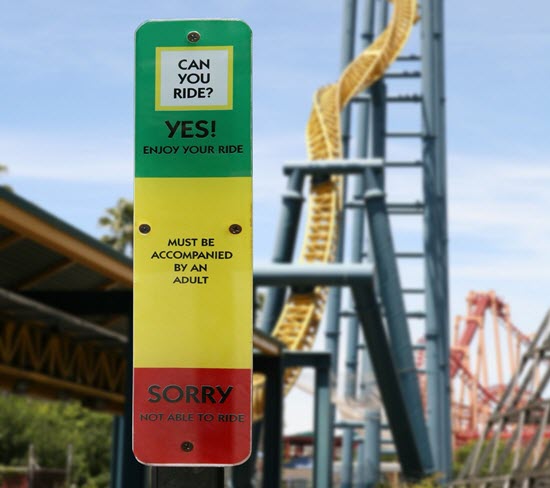
We're in a service industry and it's hard to have to tell a customer; “no sir, your 10 year old daughter can't take this class with you.” As an Instructor it puts you in a very uncomfortable place, and often has you debating with the parent to no good end. There's a simple solution that theme parks figured out years ago. Create a very clear GO/NO-GO line and display it prominently. The MUST BE THIS TALL TO RIDE sign becomes the authority you can point to. I know it can make you seem like an un-thinking robot, but having something solid to point at can really reduce conflicts.
Each Official Spinning Facility has its own policy on age requirements. Also, consider the following information in your decision —
Size: Proper bike fit is very important for injury prevention. Participants need to be big enough to get their proper seat height and fore/aft adjustments. Spinner® bikes usually fit people who are at least 4′ 11″. However, this is not an exact minimum height. Leg and torso length determine if the fit is appropriate.
Age/Maturity: Children need to be mature and responsible enough to follow the safety rules. It can sometimes be tempting for kids to pedal as fast as they can, and that can be unsafe. Because the Spinner® bike is a fixed gear bike, the weight of the flywheel can turn the pedals at a very high speed with a lot of momentum if there's not enough resistance.
I really like the sign pictured at the top of the post, with it's three zones 🙂 Would it make sense to create something similar you could post at your club? Maybe with these three zones?
Can I ride?
Red: Sorry, you need to be 4'11” or an adult to ride.
Yellow: Under 13 (you decide) needs to ride with a parent in the front row – so you can keep an eye on them.