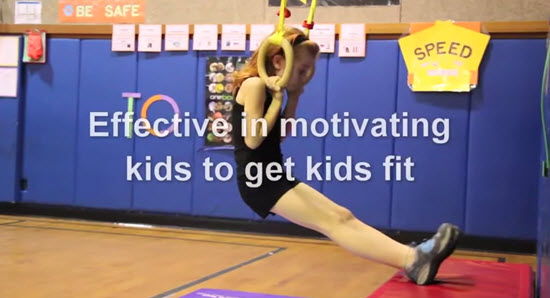
While most of us are focused on adult fitness, Sally Edwards and her Heart Zones company are doing some pretty amazing stuff with middle and high school aged children – using display training technology to motivate kids and get them active 🙂
https://youtu.be/psEPcsR-R3A
I love seeing active kids who are enjoying fun activities… they're our future Instructors and participants!
Use this contact form to request more information.
Thinking many of us would love to know how we could improve the fitness of the children in our neighborhoods, I'm sharing this press release I received earlier this week:
For Immediate Release
Contact: Joe Gooden Heart Zones, Inc.
Award-winning Physical Education teacher and visionary Beth Kirkpatrick joins forces this week with the experienced team of educators and entrepreneurs to accomplish a very large goal – get kids and teachers fit. “We are moving into 21st century education and PE is getting left behind,” says Heart Zones, Inc.'s CEO Sally Edwards, MA, MBA. “And, Beth Kirkpatrick has the spirit and the stamina to lead teachers, administrators, and students by revitalizing curriculum, leading professional development, and implementing technologies that will accomplish getting kids and getting America fit.”
From 1973 to 1993, Beth Kirkpatrick taught middle school PE in the public schools systems in Vinton, Iowa. She was one of the first PE teachers in the nation to pioneer the application of wearable technologies – the heart rate monitor – in schools. For the next 18 years, from 1993-2011 she was the Director of Education for Polar Electro Inc. using her experience, imagination, insight, and boldness to elevate physical education and education overall to new heights. A trailblazer ahead of her time, Beth has been unwavering in her conviction that the integration of technology and assessment through objective measurement best captured through heart rate and now almost any wearable smart device could create real breakthroughs in PE and in the health literacy of children long-term. “We must be able to prescribe personal exercise to individuals in a group setting. Without foot pods for tracking, heart rate monitors for assessing intensity, and hardware/software for collecting and interpreting the data, physical educators are prescribing exercise as one-size-fits all which doesn't work.”
Beth Kirkpatrick has been featured on CNN, NBC Nightly News with Tom Brokaw, Life Magazine, countless magazine and newspaper stories nationwide. Her published work includes one of the first books for using heart rate monitors in physical education titled “Lessons From the Heart.”
It would be difficult to find an individual who has impacted more lives in the PE profession than Beth. She has moved the profession forward and inspired countless teachers, administrators and decision makers to engage and motivate movement using sensors and software like the new Heart Zones “Smart Hearts System”. She has testified before the Congressional Health, Education, Labor, and Pension Committee in Washington D.C. and was part of the NASPE, National Association of Sport and Physical Education, advocacy group that lobbies Congress yearly to provide federal funding for physical education.
Beth's drive to incorporate fitness technologies into the more than 100,000 schools in the USA spans kindergarten through collegiate levels. She has worked with several NCAA Division I basketball teams introducing heart rate monitor training to universities including Duke University, the University of Kentucky, the University of Tennessee, the University of Connecticut, LSU, NC State, Fresno State, BYU, University of Iowa, Iowa State, Michigan State, and Ball State University to name a few.
Beth's reach extends far beyond the borders of the USA. Beth has keynoted over 1500 conferences in all fifty states as well as international keynotes in Malaysia, South Africa, Germany, Brazil, China, and Canada.
Beth was awarded the Emens Distinguished Professorship at Ball State University, and numerous state and national education awards including the U.S. Department of Education's Christa McAuliffe Fellowship Award, as well as the US West Outstanding Teacher of the Year for Iowa, and National Association of Sport and Physical Education's teacher of the year for the state and district.
According to Joe Gooden, Director of Physical Education for Heart Zones, Inc., “This is the era of Smart PE – integrating digital data and tracking into health clubs, sports teams, and school PE classes in an affordable way that it is in the reach of every PE teacher and every PE department. I know of no better educator than Beth Kirkpatrick to lead school physical education into the 21st century because of her dedication and commitment to kids and to health literacy. We are all excited that Beth has joined the Heart Zones team of like-minded PE advocates.”
____________________________________
About Heart Zones, Inc:
For the past 25 years, the fitness technology, education, and training company, Heart Zones, Inc. has been a leader in the development wearable technologies and their companion education and training solutions. Founded by author, professional athlete, exercise scientist, PE teacher, and app developer Sally Edwards, the company develops and markets wearable solutions for fitness enthusiasts such as the Blink heart rate monitor, the Apple iPad app Heart Zones PE, as well as the Smart Hearts System platform. These sensor based tools are used to track and assess participants activities and performance. The company holds several federal patent on the cardio- training methodologies ZONING and Threshold Training. Heart Zones, Inc. is headquartered in Sacramento, California.
Great post and well detailed. I appreciate all the great articles you post.
The challenges you described are all too familiar to me. I’ve found a simple solution that works for my indoor cycling classes, and is based on my experience running a small business that provides software training classes. In that capacity, we teach software productivity courses (1, 2 and up to 5 day workshops) where there could be 20, 50 or even 100 participants. The distractions are numerous: participants checking their emails, texting, talking to their colleagues, etc. It is unfortunate because they have to bring their laptops and mobile devices to class. So, in order to deliver a more effective training session, we first had to understand the causes of distraction:
1. People use training classes, and for that matter, indoor cycling classes as a social venue, a “catch-up” of sorts. They meet friends, colleagues and chit chat about their families, work or other issues.
2. We are all wired, 24/7. The availability of mobile devices and the need to have them tends to add another layer of distraction. There is nothing more frustrating than being asked to repeat a key topic during a training class only because the person who asked was checking their email.
We found the solution to be tricky. The effectiveness of the solution, however, was in its simplicity.
1. Establish a basic ground rule and make them promise to respect it.
At the beginning of each software training class and also at the beginning of each indoor cycling class I teach, I ask all participants to silence their phones, avoid chatting, and in the case of software training classes, I ask them to not check their email, instant messaging or texts until break time. Then, and this is key, I request that they promise to respect this rule. I know we are all adults here, but sometimes, you have to go back to basics.
2. Make them commit to the belief that the class is their time, their investment and thus, their reward.
Again, at the start of each class, I define the objectives of why we are here and what we are trying to accomplish. For indoor cycling classes, I simply state that for next 60minutes, this will be “your time” where you focus on your health and mental well-being. I ask all participants to take a moment to empty their minds of all distractions, worries and anxiety and leave those outside the studio (to be collected later of course). Then I ask that we all respect our collective time by not creating distractions. [I love this line!]
With these two basic rules, I have found greater success in creating an experience for riders that extends beyond the social gathering aspects. In fact, I hear frequent feedback from riders that in that one hour, they have found a way to re-focus and re-recommit; to re-balance and de-escalate; and, to have fun and enjoy the workout at the same time.
In closing, the important of establishing these ground rules will define you as an instructor who places a high priority on the participants’ time and commitment. They will respond in kind.
My guest in this PRO Podcast episode wants to help you develop a 1,000 Watt Presence & express yourself brilliantly. It starts with“taking a personal inventory” of yourself interacting with and teaching your class.
Listen as communication expert Alexa Fischer explains why recording yourself interacting and teaching your class is the first step to making small improvements to how effectively you present to and communicate with your participants.
About Alexa Fischer
There’s nothing like a 1,000 Watt Presence to ignite and inspire everyone you meet. In case you have lost touch with your own star qualities, Alexa Fischer knows how to bring out your inner light. She has transformed normal civilians into confident, dynamic speakers. The results? Less Fear. More FUN. And maybe some fame if you’re a really dedicated student! Alexa is a graduate of Northwestern University, B.S. in Speech, and The Yale School of Drama, M.F.A. in Acting. She has appeared on countless episodes of hit television shows and national commercials. Beyond the television, her audiences include entrepreneurs, non-profits, corporations and teens.
Listen to my interview with Alexa below or you'll find it in the ICI/PRO members only iTunes feed.
Here is a past Podcast that explains an easy way you can record your own class, using your iPhone or Android phone.
Click the image for more information on Alexa's course
I spent the morning thinking of some overwhelming wisdom to impart for 2018. I thought about clever phrases that would sum up the entire 2017 in 4 words or less, and power phrases that would inspire us all to be better, stronger and faster.
As I was doing this, I thought back to my the last class I taught in 2017, It was Thursday evening at the Robinson LA Fitness here in Pittsburgh PA that I was subbing, and it was a 4:30-5:30 class that only had about 8 participants. It is always a challenge for me to maintain my excitement and enthusiasm for a smaller class, but on that Thursday there were a few people in the group that I had ridden with before, so I felt connected and had a great ride. Actually, I am not sure there is such a thing as a bad ride, the worst ride is still always better than not riding!
I will pass along what I told the class: “We are about to embark on January, you know the time of year when the gym is busy, really more than busy, it is packed. It is our tendency to get a little aggravated because our routines are off. There is now someone on ‘My' bike in the spin room, and I can not find a bench to use for lifting. I get it, I have been there for about 30 years now. But….I challenge you to breathe deep and be patient (not one of my talents). Let us welcome these new fitness enthusiasts into the gym and into our classes. Help them out if needed, and let's show them how to be a respectful and courteous member through our example.
Just think, the few minutes we give up waiting may change the life of someone else for the better which is a gift that will continue for a lifetime. Maybe, just maybe, they will stick with it and pass along the same joy of exercise to someone new next year.”
Are you still as deeply passionate and in love with instructing as you used to be? If the answer is yes, good for you! If it is not, then good for you! You are about to be reminded of some things that perhaps you have forgotten.
It was the spring of 1985 and I will never forget the first time I saw someone teaching an “aerobics class”. Yes, that’s what we used to call what is known today as a “Group Fitness” class. It was absolutely intriguing. So much energy, rhythm and sweat! The music was playing (yes, sweatin’ with the 80’s) and my body starting moving. I was a junior in high school, and even though I was an athlete I had never done (or seen) this type of workout. I asked the owner of the gym how I could “do that”? She told me I could join the gym and start taking classes. To which I replied, “No, I don’t want to take the class, I want to teach the class.” She smiled, as she asked me if I had ever taken a class before. I told her no, but that I wanted to learn how to teach like the instructor that I was watching. She responded by telling me that the first place to start was by taking classes. I signed up and started training. Several weeks later I became certified and the rest is history. That was 32 years ago, and it seems like just yesterday that I put on my red unitard (yes, that’s what we called them), and white leg warmers as I began a journey that has never lost its passion for me!
When you are truly passionate about something, not only will you keep coming back for me…year after year. But your followers will do the same.
What is passion? Although I use this word a lot, I decided to find out what my trusty pocket dictionary had to say about it. (Thank you “Dictionary App”) “Any powerful or compelling emotion or feeling…” “The state of being acted upon or affected by something external, especially something alien to one’s nature or one’s customary behavior…”
That led me to the words, powerful and compelling. What do they really mean?
Powerful: “physically strong…producing great physical effects…having great effectiveness…having great power, authority or influence…”
Compelling: “having a powerful and irresistible effect; requiring acute admiration, attention or respect…”
Wow…by nature, when you are genuinely passionate about what you are doing, you will have the capacity to do something alien to your previous nature or customary behavior.
Naturally, you will also become physically strong(er), produce great physical effects (in yourself and others), have great effectiveness, and great power (previously mentioned), authority and influence! Would you like a little (or a lot) of that?
Passion equates to power. Being passionate equals being powerful. This leads to you being compelling, which ultimately will draw others (your students) to you. This is magnetic and multiplicable (Is that a word? Well, if it’s not…it is now. And it means that your magnetism will lead to exponential multiplicity. J) That means that you and those around you will experience expansion that comes from a rare and organic source deep within you. Thus, gaining you the “acute” (not “a-ugly J) admiration, attention or respect that you deserve (and let’s face it, quite possibly “DESIRE”).
Don’t you just love the power of words? I do too!
But these are far more than just words; they are a representation of the value (your core) that resides inside of you and every passionate leader. If it’s just “lip service”, then it really isn’t passion and therefore you will continue to seek something that seems distant and unattainable.
So let’s talk about this for a moment. What if you had passion for being a fabulous instructor, but somehow you seem to have misplaced it? Perhaps it’s hidden somewhere with your thong leotard and headband? OMG…has it been that long?
Thank God we don’t have to go back to move forward, but sometimes we need to go within so we do not have to go without. What do I mean by this?
Sometimes when it seems as though we have lost something that we thought we once had, we long for what some may refer to as “the good ole’ days”. It’s something we may long for, but is not possible to attain. Come on, would you really want to go back to using tapes, choreography, thong leotards, and leg warmers? O.K., maybe the thong leotards…they really did make our butts look smaller, don’t you think? JK! J Do you really want to go back to the stationary Air-Dyne bike that pumped your arms as you pedaled with your legs?
If you want to long for something and fully attain it, long for discovering your true passion. What compelled you to become an instructor in the first place? Do you remember it like it was yesterday? (I do!) Do you remember how excited (and nervous) you were to teach your first class? Do you remember the first time a student told you what a huge difference you had made in their life? Do you remember how great it felt to proudly tell your friends and family that YOU had become a fitness instructor (or perhaps an aerobics instructor…or cycling instructor)? You had a goal and you accomplished it. Why?
It’s time to tap into the reason you started in the first place, and give thanks for a dream fulfilled and a goal accomplished. It’s time for you to awaken the passion within you, and move ahead as you “make love” with what you are doing every time you do it. Let the sizzle inside you penetrate those around you. Then you, my friend, will be the instructor that your students cannot wait to see again!
Experts say that “sex sells”…well true LOVE not only sells, but it also pays…and it pays big! Pay yourself what you’re worth by investing your heart and soul into every class that you instruct, and watch what happens to not only your class…but also your own personal CLASS!
When you do what you love and love what you do…you will love YOU, and so will everyone around you! This is exactly how to be the Instructor (Inspirer) that your students can’t wait to see. It begins with being the instructor (Inspirer) that YOU can’t wait to see!
The program manager made that comment when a participant in our weight loss program didn’t get results. I was both an athletic coach and the lead nutritionist.
His comment exasperated me. Of course she trained well. She was an expert at that because of her food issues. She’d junk out, then “train well” to burn off the unwanted calories.
It wasn’t always the same ‘she’ — but she was typically a sugar addict. Sugar addicts don’t necessarily have difficulty training.
Training is the easy part. Early classes at the gym, hitting the weight room, weekend runs, core strength, scheduling with a trainer. No problem.
They don’t refuse to cooperate with the instructor. Workouts don’t threaten their addictive behavior.
The sugar addict wants to eat junk, work out to compensate for it, and keep the addiction going.
Nutrition Rules Push Sugar Addicts’ Buttons
Food guidelines, on the other hand, meet with stonewalling. My nutrition program — highly successful with most participants — annoyed the “resisters.”
I’ve posted about resisting weight loss, but one client kept demanding more and more specific instruction. Our guidelines were never good enough.
First, she claimed not to know what to eat. She wanted menus. When we provided those, she wanted more: exactly which foods to eat, exactly when to eat them, and precise quantities for her calorie and weight-loss needs.
The program manager saw this as our problem. I immediately recognized it as a smokescreen. “Until we provide those things,” he said, “she feels as if her program hasn’t begun.”
His comment was profound — but not in the way he thought.
Registering for a robust weight-loss program looks like a sincere desire to lose weight. Asking for more specifics seems like part of that sincere desire to lose — if you don’t know the games people will play to avoid doing the necessary work.
I’ve been around the defiance of resistant weight-loss clients a long time and see it differently: As long as we didn’t supply what she requested, that was her excuse not to change her eating. Not to give up pizza, margaritas, wine, or nachos. (All of these were in her seldom-kept food log.) Not to move forward — to any degree — until things suited her to a T.
If we had done everything she wanted, she would have had more complaints and more demands.
Bottom line? She saw the lack of personalized info as the chink in the armor, the point of attack. A good friend of mine who works as a life coach said, “It’s better for her if the program fails than if she does. Again.”
This life coach friend disliked many of her weight loss clients because of the games they played. Guess I’m not the only one who has noticed this nonsense.
Not all of you are coaching weight-loss clients, but if you are, here are a few suggestions.
– Encourage them to be honest.
What do they want? Whether their weakness is sugar, alcohol, butter, or something else, their goals should be what they really want.
It’s no crime for them to decide they don’t want to lose weight or end their food addiction.
– See the finish line with no time element.
I learned that from my ultra-endurance athletic coach. Don’t worry about fast results. These days, some people push rapid weight loss. That’s fine if the clients prefer, but there’s no race.
If it’s more comfortable to “set it and forget it”, they can decrease their calories by, say, only 200 to 300 per day. It will take longer to reach the goal, but that’s the only drawback. So what?
They do it daily, forget about it, and let the pounds melt slowly while they go about their business.
– If your client is addicted to sugar or other food, concentrate on the addiction first.
If the client takes on too much at once, it could sabotage the effort. Dealing with addiction first is a strong, solid step toward weight loss. Once eating is under control, the other goals will fall in place.
– Recommend qualified help and a proven system.
Everyone seems to have ideas on how to get rid of sugar cravings, and some of them are almost ridiculous. With the right help, it’s a straightforward process. The wrong advice can make it agonizingly difficult.
Suggest that your clients find a solid system and stick with it.