A certified Spin instructor, Hilgartner, 67, first started to work out on stationary bikes because he “couldn't run anymore.”
That led his to take Spinning classes at the Maryland Athletic Club in Timonium, after which he thought he could do better than the instructor.
After leading classes for several years, Hilgartner decided to see if he could turn his love of Spinning into a business.
First, though, he had to see how he could balance his fulltime job on the technology staff at St. Paul's School for Girls with running a cycle studio that boasts a room full of gleaming Keiser MS cycles.
Moreover, his wife, Anne, a guidance counselor at her husband's alma mater, Calvert Hall, had to sign off on the deal before InSync Cycle opened Feb. 20 in Ashland Marketplace, between the Amish Market and Baja Fresh restaurant.
Charles (Spook) Hilgartner teaching his class at InSync Cycle
It began as the dream of many Instructors – starting your own fitness business. Charles (Spook) Hilgartner made his dream real by opening the first dedicated indoor cycling studio in the Baltimore Metropolitan area. It was very sad to hear that InSync Cycle Studio closed.
On a personal note:
For the past three years, I have enjoyed the challenge of creating and operating InSync. I have had the pleasure and privilege of meeting and greeting hundreds of riders and making some special friends.This, I will really miss.
But what happened in the studio, during class was really incredible. We have had the best instructors! Their teaching skills and unique styles, music and personalities created an amazing cycling environment that all of us have enjoyed. I thank them for that.
It’s the combination, of instructors and dedicated riders, that has made InSync Cycle Studio a pretty good place to ride.
Some of Spook's Instructors created this very touching video as a good-by.
http://youtu.be/N54Y-N9gJkg
I've known Spook since before InSync and appreciated his agreement to be interviewed on the Podcast. Our intent is to help other existing (and potential) cycling studio owners. We discuss his thoughts and feelings about what he did right… and what he did wrong.
Two main points surfaced during our conversation:
Spook's experiences reinforced the absolute importance of having quality Instructors + a bench of available substitutes.
He feels he would have benefited by having a partner with complimentary skills to his.
I wasn't previously aware of this regulatory issue > Depending on your studio's pricing model, your state or city may require you to secure bonding to protect customers who purchase ride cards with future expiration dates. Spook explains this need for bonding during the interview.
Looking for a used studio sound system? You can contact Spook 444-722-5433 or Spook@indoorcycleinstructor.com
Does your Health/Fitness Club have a sign like this in the locker room? And a similar sign in the parking lot saying essentially the same thing? You shouldn't leave your your new 4G iPhone or wallet in your car or the club's locker, so what do you do?
Bring them on the gym floor safe and snug in the waterproof pocket of the new TowelMateâ„¢
Watch the video below to see why you might want one for yourself and possibly recommend them to your club.
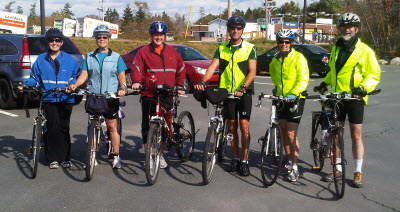
When a friend and I returned from a cycling trip in Croatia last June my IC classes were curious about the experience and I told them lots of stories. One day I mused “Now that we have done some hills in Europe I guess it’s time to do the hills here at home. We’ll be riding the Cabot Trail next.” http://www.mapmyride.com/s/routes/view/bike-ride-map/canada/nova-scotia/cape-breton/8895784
Follow that link to see just how big a challenge this will be 🙂
Within minutes the class had come up with a scheme to ride the trail as a group. Word of our plans has spread and new people have arrived in my classes to be part of this adventure. Most of them have never done any serious riding outdoors and several do not even own bicycles. We are aiming for a four to six day trip in late September 2012. Right now we are making plans for winter training and a spring reconnaissance ride for the ‘leaders’.
Yesterday, with temperatures in the mid-teens (℃) and under a sunny sky, a few of the group got together for their first ride. We did a safety check on the bikes and headed out with the promise that no one would be left behind. I placed experienced riders at lead and sweep and had a spare to accompany anyone who turned back. The most ambitious riders did 28 kilometers and realized after the fact that they could have done more. I was very supportive of their decision to ride within themselves. It will be time to test their limits after they have improved their form and bike handling skills.
Next time we do this route I will encourage them to do a 52 kilometer loop. They will all be amazed at how much farther and faster they will travel than they did on their first outing.
In anticipation of this weekend, I put together a profile for my classes which simulated parts of the ride and, in particular, highlighted how to avoid red-lining on the hills. Several people told me that they relied on that information when they found themselves in doubt during yesterday's efforts. As proof that they find real-time data useful — every one but me had on their heart rate monitor! I had an opportunity to ride with and coach each member of the group. One person stood out for me – her ability to receive verbal guidance and apply it was outstanding. Her skills improved dramatically and she was rewarded by being able to ride a hill she had had to walk on the way out. Another rider surprised us all – she was very strong even though she had previously only ridden on rail trails. She attributed her performance to her indoor experiences – improved endurance and better form.
Next up: a clinic on gears and shifting and a discussion about bike choice. Most of the group will be purchasing a new or new-to-them bike in the next few months.
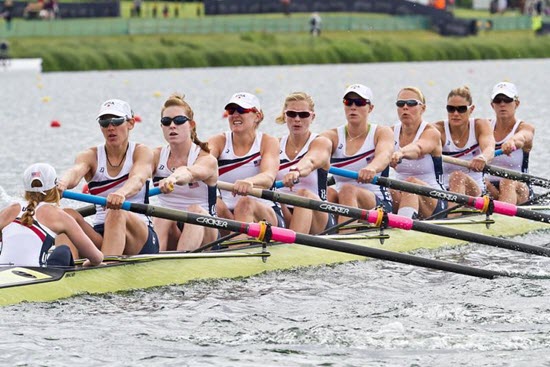
USA Women's Rowing Team – image credit boothbayregister.com/
If you’re about to start teaching a class that includes both cycling and rowing, here are a few tips.
Stay off the bike. To handle all the variables in a cycling/rowing class, you’ll need to be on your feet, moving around the room.
Will you warm up? On-bike stretches won’t work in a split class. Decide whether you’ll begin with a full-class stretch and warm-up, or have the participants take care of that on their own. Active Isolation Stretching is the most efficient in class — it warms the body as you stretch — but they all take up training time.
Pre-plan your trainings. You’ll need a specific and detailed rowing workout, along with your planned cycling workout. They don’t have to run parallel. That is, a 6:00 flat on the bike doesn’t have to run in sync with a 6:00 interval on the rowing ergometer (erg). They can if you prefer.
Feel the differences between the two workouts. Rowing workouts are often rigidly timed. That makes them effective and easy to cue. But some of the most unpleasant cycling workouts I’ve ever done were created by an instructor who was primarily a rower. His classes seemed to be created with a calculator and a slide rule (a what?). Instead, use cycling workouts that are similar to the ones you run now. Then you can mold your rowing workouts without alienating your riders.
Gear your music for the bikes. It’s less important to match music to a rowing drill, so keep handling your music the way you have been. There are exceptions — mostly performance-related — but generally this holds true.
Memorize the steps for setting the erg monitor. Concept 2 Models D and E use a complex procedure for setting time or distance. You’ll have to cue it every time. If you switch mid-workout from time to distance, be prepared to re-cue. Example: “Press Select Workout. Press New Workout. Press Intervals Time. DO NOT set the time yet! Use the Back Arrow to go back to the “tens” column. Set that for 1. Now use the Forward Arrow to get to the “ones” column. Change that to 0.” [At this point you have to cue setting the rest interval.] “Now press the check mark at the bottom of the screen.”
That lengthy description sets the timer for a 10-minute interval. If they set the “ones” column first to 0, it will default to an automatic “:20” (20 seconds). That messes up everything, and you’ll have to spend time changing it.
Note: The above cues are an illustration. You’re not done till you’ve set the rest interval (assuming you want repeating intervals). If you press the check mark midway through the process, you have to begin again. It will happen.
Don’t kill the Concept 2 people. All of the above is why the simple Model C was wonderful, but you’ll get used to the D/E. And you WILL remember the cues. I wrote the procedure from memory.
Always cue the rowers first. Let’s say you’ve decided to run the workouts in parallel format, which is easier for you. Separate the groups on their equipment. Cue the rowers while the riders roll their legs. Tell the rowers what to do during their warm-up (say it’s 10 minutes). Easy warm-up shortcut: Have them press “Just Row”. They row as instructed and stop when the computer clock reaches 10:00. While they row, you run a 10-minute bike warm-up. Once the warm-up is done, the riders roll and recover while you cue the rowing training — and setting the monitor.
This approach syncs the major changes for the two groups. The intervals will be of the same duration, but what the groups do during the intervals can be as similar or as different as you like.
Create a timeline. If you like multitasking, feel free to create workouts that don’t resemble each other at all. You may need some sort of timeline to track what’s happening. If you’re a spreadsheet geek, that approach will be fun for you. If you’re able to keep track of two different workouts mentally with no cheat-sheet, just go for it.
A timeline could be just a basic log with 3 to 4 columns. Minutes (0:00 to 30:00) go in the left column, rowing drills in the next, the cycling workout in the third column, and perhaps notes and prompts for you in the fourth column. Use a stopwatch. You’ll check your watch and know exactly what everyone should be doing at any given minute.
All of this planning makes improvising and modifying a lot easier. You have your plan, yet still feel ready to change whenever time or circumstances call for it.
At the 30-minute mark, switch equipment. The change will take a few minutes, so shorten the warm-up, but give everyone a chance to accustom the target muscles to the new activity for the second half of the class. Re-start your watch and repeat the body of the training.
If you can manage to do all of this AND deliver content — exercise physiology, technique, and training philosophy — your classes will be engaging and informative, and appeal to a broad base.
I hope these instructions are clear. I’d be happy to answer questions.
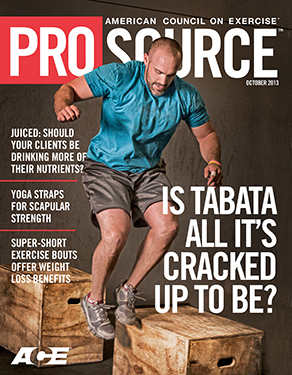
Image from http://www.acefitness.org/prosource/71/
I just read a press release and accompanying article from the ACE – The American Console on Exercise PRO SOURCE magazine about their study to gauge the effectiveness of High Intensity Training (HIT).
“It seems like everything high-intensity is now called Tabata Training,” says John Porcari, Ph.D., head of the Clinical Exercise Physiology Program at the University of Wisconsin, La Crosse. “The original Tabata study was done on a bicycle, but people are now doing that 20-second/10-second format with resistance training, plyometrics, calisthenics…with almost anything.”
Because of all of this recent interest in Tabata-style workouts, the American Council on Exercise enlisted Porcari and his research team to gauge just how effective a Tabata-style workout really is.
THE BOTTOM LINE
“The great thing about Tabata is it’s a short workout–only 20 minutes–and it incorporates your total body, so it’s working every muscle group that you possibly can,” says Embert, referring specifically to the Tabata-style workout she designed.
But what to do during the remainder of your 60 minute class?
There was a trainer at Life Time who told me years ago something I've never forgotten; First give them (your class) what they WANT… and then give them what they NEED.
The WANT he was referring to are very intense/anaerobic intervals. There's no secret sauce IMO at SoulCycle > they're just teaching very intense classes because they know that's what people WANT.
The NEED is for solid aerobic training. Not necessarily base building, but solid work below threshold HR / FTP.
Instructor Kathy Palkaninec was a past winner of our profile contest and her profile follows a similar WANT & NEED format.
You may want to announce your intentions to crush them (WANT) during a 20 minute Tabata round that will start fifteen minutes into class. Don't worry about telling them what follows. Keep everyone focused on doing their best effort during the Tabatas.
Give everyone a full 5 minutes or more of complete recovery. It's during this time that I talk about the “Golden Hour” and how most of us have 90 minutes where we can really perform well, before fatigue really limits our performance. The Golden Hour doesn't begin for most of us until ~30 minutes in. At the end of the recovery we're only @ the 40 minute mark of a 60 minute class and I explain how we're only 10 minutes into our Golden Hour – just now ready to perform. It's here where you can coach them through a 10 or more minute sub-threshold effort (NEED) to conclude the class. Here's where you can put that stage button to work if you have one – encourage everyone to ramp up to a big number, Stage Button, now maintain it by keeping your instantaneous wattage at or above the average 🙂