This week I have the extraordinary privilege to be working from my balcony in Punta Cana. I have never been to an all inclusive resort before, and it is quite the experience. The grounds are beautiful, you can go to any of the many restaurants or bars on the property, and there always seems to be a smiling face nearby ready to wait on your next need.
Last night we attended an outdoor band that was playing and there were six younger people that were hired by the resort to provide entertainment and get the crowd dancing etc… While all of them were great dancers, the lead young man was simply incredible. His feet were light and fast, and yet somehow thoughtful and deliberate. He was smiling from ear to ear, and seemed to be having as much fun doing his job as we were joining him on the dance floor. As talented at this young man was, one of his gifts seemed to be the ability to dance with a wide range of partners (guests that he would engage) and have them seem comfortable and loose. You could see the transformation in the people in only one minute: they went from thinking “oh, no, I can't dance with him, he is too good” to relaxing and enjoying themselves and then going back to their tables only to return to the dance floor with their spouse or partner.
It really got me thinking about customer service and how that impacts our industry and profession. Yes, being an indoor cycling instructor is, well at least should be, a profession. We have customers (riders) and it is really our job to guide them through this fitness experience that we have (hopefully) spent time and effort creating. In many ways, we should be presenting an image similar to this young man's for not just our riders, but all of those that are in the club or studio.
As with any great performer, his performance moved me, and has me thinking….Am I providing a high quality performance for my riders and most importantly, am I providing that experience to most of my riders or only just a few? As with most instructors, I have a core group of 10 or so people (about a third of the class) that seem to be in all of the classes I teach. They are all cyclists (they ride outdoors) and they work hard, they work very hard. They are inspirational to teach to and certainly in the midst of a very tough set they help to get me to the other side. But what about the other 20 or so people in that room? I am reaching them? Is my class actually fun and enjoyable, or has it become a 60 minute grueling experience?
I have often heard group exercise instructors talk about the class they just delivered and the gist of the conversation always seems to revolve around “killing” the people, or it being the “hardest” class they have had or something similar. Very rarely, if ever, do you I have pleasure of hearing about how they had the entire class pedaling to the beat and enjoying themselves. I am not sure that I myself have ever measured the success of one of my classes by the number of smiles I have seen on the participant's faces; but perhaps I should. Some, well really most, of my riders will never be on a triathlon course, so I should be mindful about training them like they headed there in three weeks.
So I challenge you, take a few moments and think about your next class. Are you providing great customer service? Are you including most of the riders, and not just your hardcore following? Are your riders having fun? As for myself, when I return I plan to taking the time to be sure that I am dancing with all of my customers, not just the cyclists!
Do you teach at a Big Box and a Boutique Studio?
By “Big Box” I'm referring to one of the majors with multiple locations; 24 Hour, LA Fitness, Club Sports, Equinox, etc..
If so I'd like to talk to you and (if it makes sense) interview you for the Podcast…
After sorting through over 300 responses (thanks to you all!) I followed up with some additional detail about the topics I was hoping to explore:
What I'm trying to learn from you is:
Is teaching at a Big Box different from a small studio?
If so, how are you or your classes different?
Are you a “different” person/Instructor at each location?
Do you enjoy teaching at one vs. the other
Do you feel limited and/or empowered at one vs. the other?
Are you more motivated to promote and build your class numbers at one over the other?
What quick advice would your offer a new instructor on-boarding at either?
​Your thoughts?
What I got back from a number of Instructors was amazing and exactly the type of thoughtful responses I was looking for. ICI/PRO is a platform for smart talented people and it looks like I've discovered a few more 🙂 I'm in the process of setting up these interviews and plan to produce them starting next week!
One question I'm seeing I could have asked differently (and will during the interviews) is; do you feel you need to project a different personality at each location? Instead of; are you a “different” person at each location. Of course you're the same person… it's just that over the years I've experienced Instructors who appear to be very different, depending on where I take their class.
While it may seem redundant to say, most indoor bikes do not move. Please, stop and think about that for a moment. We are not talking about forward motion or distance, of course an indoor bike does not move forward. But what about the other motions that are involved in cycling.
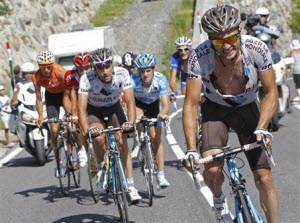
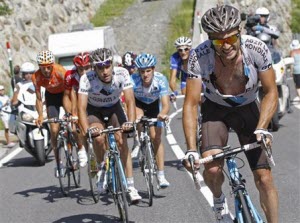
When a rider is out of the saddle, most riders sway the bike from side to side a bit. Why does this happen? Generally, it is the mechanical reality of the situation due to applying extreme power to each pedal. Since the pedals are not on the centerline of the bike, applying a large force to the right pedal will, physically speaking, apply a rotational force that pushes the top of the bike to the right and the bottom of the bike to the left. Without this counterbalancing motion, the wheel would kick out to the side. By swaying the bike in the opposite direction, the amount of force that can be applied to the pedals is increased without crashing.
The second primary aspect of swaying the bike is that it allows the rider to engage their upper body (especially core and arms) into the movement which increases power.
Take a moment and watch some of the pros race, they only have about a 12 degree sway; less than most avid riders. This is due to their efficiency and power.
The last aspect of swaying the bike is that it allows the rider to more thoroughly align their biomechanics with the work that is being done. By tilting the bike, the rider is able to keep the leg that is driving down with a majority of the force in alignment lessoning the outward lateral stress on the joints.
With the exception of a few new bikes on the market, most indoor bikes do not provide movement side-to-side, and none of them replicate the true motion of an outdoor bicycle. Because of this limitation, instructors must emphasize relaxation when riding and allow gentle upper-body movement. Attempting to maintain a still upper body can place the spine and surrounding muscles at risk from the forces being generated by the legs.
John, you absolutely need to interview this new customer of our's in Boston… she's only 25 years old and it sounds like her Indoor Cycling Studio is really doing well!
I was talking with Gina Perrault from MINDBODY Online last month, at their conference in LA. I had asked her if she knew of a studio owner with an interesting story to tell.
A few days later Gina connected me with Jessica Bashelor (now 26 – she had a birthday last week) and her Handle Bar Cycling Studio in South Boston.
Jess is The Handle Bar's owner and manager. She grew up a competitive swimmer and developed a love for fitness at an early age. Attending college at Northeastern University, Jess discovered her love for group exercise, specifically indoor cycling classes. Now, 7 years later, Boston is Jess' home and cycling is her passion. An avid music lover and listener, Jess is motivated by rhythm, calmed by acoustics, and touched by the lyrics of songwriters old and new. She opened The Handle Bar to offer classes with the intensity she craves, set to playlists composed with care. Jess rides to house music, hip hop, and heavy rock… Her classes are crafted to challenge riders physically, and inspire them to achieve greatness both on and off the bike.
If you're running or contemplating opening a new studio, Jessica shares some excellent ideas about understanding your customer demographic and connecting with them. Her studio's blog regularly features participants > a great way to make people feel valued and appreciated – not to mention they share these with all of their friends 🙂
You can listen below or find this episode + over 100 more on your portable device by
I’ll switch gears from my recent posts on using public speaking techniques to enhance our teaching to talk about what we say. In The Art of Cueing, I discussed the use of cues to bring depth to the class and make it more than just a workout. Cues concerning the science, the music, the video, your personal experience, even philosophy can make your class more interesting and more impactful.
Philosophical cues are the most difficult to incorporate. Instructors don’t typically cover philosophy when they teach because they don’t think people want to hear it, or they don’t feel comfortable talking about it. Someone who doesn’t teach might say the first is true. But maybe that person hasn’t yet heard a well-delivered philosophical message and is just uninformed.
I understand not feeling comfortable talking about it and will address that later.
Adding philosophy to a class so it doesn’t sound like preaching is what I call “messaging.” A class without messaging is just a workout. It might even be a good one. But the instructor’s power will weaken over time, just like playing the same workout video over and over. It diminishes with no message. All the public speaking techniques in the world can’t compensate for a class that lacks substance.
Unforgettable lyrics are unforgettable because they send a message. A public address goes viral on YouTube when it sends a message. Messaging will touch a person’s life beyond the great workout you just delivered and compel him/her to come back to your class again and again.
What’s a message? Any life concept that you bring to the class and that can be experienced in the class as result of the training you’re providing. A couple of examples:
Focus
Coaches often tell you to “stay focused” but rarely tell you how. Focus is not simply directing your attention to what you’re doing. That leads to thinking. Thinking will weaken focus. Focus is complete engagement in what you’re doing. A focused mind pays no attention to distractions. Fast descending takes focus. If you’re not 100% engaged and non-reactive to distractions, you might crash. How do you train yourself to be this way — not just during a dangerous descent, but right now, so you get the most from your workout? That’s the essence of our class today.
Motivation
Something that happens outside of you that you consider “motivating” is not a strong incentive. You might see someone overcome great adversity or hear a story that strikes a personal chord with you and feel filled with motivating energy. These external motivations work temporarily, but have far less impact than motivation you generate by yourself. I want you to look at motivation as something personal. Then you have the ability to train and get better at it. You can train yourself to be motivated the way you train anything else.
When you understand how to do this, motivation is endless, limitless. The only time you won’t feel motivated is when it’s a personal choice, and you’ll recognize it as such. You’ll no longer look to me or to anyone else to motivate you to train. You’ll rise to the occasion again and again because you’ve trained yourself to do so. I’ll show you how to do this in today’s workout.
As an instructor, all you have to do now is deliver a physical practice (the day’s ride) that delivers the results you just promised to deliver in your message. If I’ve enticed you, and you want to learn how to focus or be consistently motivated, the solution is simple: Come to my class. That’s the power of good messaging.
The messages you can deliver are many: how to engage fully, how to sense meaning, how to expand your concept of what you can do, how to sense your life energy, how to direct it, how not to react to adversity, how to develop discipline, how to go beyond hope and fear, and on and on.
How do you, as an instructor, learn to deliver these messages, both verbally and physically? First, you must want to. Second, you must become a student of philosophy. You study and you ride, and you bring the lessons that you learn from your study to the bike, and then to class.
I have a small library of what I call my “Life Books”. These are about 10 books that I have found extremely helpful. I’ve read each of them dozens of times. A good philosophical book is one you immediately realize you need to reread. My first Life Book was Way of the Peaceful Warrior: A Book That Changes Lives. It was the first book to encourage me to approach my training from a conscious perspective. I have several copies with dog-eared pages and many handwritten notes throughout.
Physical movement has been part of spiritual training for thousands of years. It was not meant to provide exercise. Daily activity was supposed to do that. Keep a conscious attitude, go beyond the workout, and deliver a message every time you teach.
The Yellow Jersey Bicycle Insurance company is promoting their service with this very cool infographic about the Yellow Jersey, worn by the leaders of the Tour de France. As they are a UK company, it's fitting that they are highlighting past British riders who have worn the Yellow Jersey. If you follow professional cycling you're aware of how utterly dominate Team Sky / British Cycling has been over the past two years. More excitement will follow for sure 🙂




 r bike does not move forward. But what about the other motions that are involved in cycling.
 John, you absolutely need to interview this new customer of our's in Boston… she's only 25 years old and it sounds like her Indoor Cycling Studio is really doing well!
 It was the first book to encourage me to approach my training from a conscious perspective. I have several copies with dog-eared pages and many handwritten notes throughout.
