This Podcast is was originally published on February 22, 2009, I have updated it with our new Podcast host information and I am representing it now. I hope you enjoy it, Joey
Keiser Master Trainer Suzette O'Byrne and I discuss the initial response to their new correspondence Indoor Cycling certification course. Keiser has recently introduced their new M5 elliptical trainer and have created a certification program so you can bring the cross training benefits of an elliptical trainer into your class. Update: here is a video of the M5 in action - http://www.keiser.com/m5/
149 Keiser® Striding and Cycling: An Indoor Collision
Workshop PREMIERE (Description from IDEA's site) Suzette O’Byrne and Krista Popowych Group elliptical classes are HOT in Europe! Now you can be among the first in North America to experience “striding” in combination with indoor cycling in this fun and innovative workout format. First, we will cover striding foundations and teach you how to use the on-board computers so you may monitor your progress. Next, discover how you can implement a variety of training methods (i.e., interval drills, speed drills, hiking drills, recovery drills, etc.) for ultimate fitness. Finally, get information on how to develop a class that blends these two formats into one amazing workout. Repeated as sessions 209, 249 and 309. Listen to the Podcast below or subscribe for free using iTunes or Zune.
My original objective of the Power blog here in ICI/PRO was to build the case for power precept upon precept, slowly but surely. Good idea, except for folks who already find themselves teaching on power bikes and are anxious to get to the meat & potatoes. So, as the line in Monty Python’s Holy Grail said (whilst preparing to throw the Holy Hand Grenade) “Skip ahead brother…”
The most fundamental principal in power training is that you can sustain higher power output for shorter periods. This is common sense of course, but when trying to train or “hone in” on power levels you will use for different types of riding outside, one needs to identify these time periods, and develop power based on the length of those efforts.
For example, outside of the long mountain passes in Colorado, or Europe, your standard “hill climb” will often be only 3 to 5 minutes. This is also met with generally a steeper grade than those more gradual, longer climbs, and thus there is a measure of power required to climb those that is significantly higher, and requires different training.
In addition, if you race (or simply want to just impress your friends at every opportunity), you may want to develop significant sprinting or break away skills. To do that, you will want power that is even higher than climbing power, but may only be needed for as little as 60 seconds. This may seem quite short, but it is often all that is needed to achieve a real break away, or triumph in a race ending sprint.
Consequently, we have built the Cycling Fusion Power Training system on 3 zones of power; Sustainable Power (7 to 20 minute efforts), Climbing Power (3 to 6 minute efforts) and Explosive Power (1 to 2 minute efforts). These ranges are quite large, and there are 7 power levels within each zone. Rather than bore you with all the details, let’s just jump in and conduct a class that provides a sample of each of these zones.
The class design below is based on the Keiser M3 bike, since it is what we use at my club (Global Ride Training Center) in Pittsburgh. Since we also speak specifically to how we can reset our power numbers, I’ve written this class specifically to this model, and thus I call the class: The Keiser Tour De Power. For those that do not have a Keiser M3, but do have power, simply replace the portion of this workout that speaks to resetting the bike to get your average power numbers for one of the zones, and it will work just as well on any other bike.
Hello, I really enjoy your podcast, thank you for the production. I listen to them on my way to teach. It makes me feel motivated and often gives me items to share and use with my participants.
I wanted to follow up to this one podcast in particular. Our club got these bikes in the spring this year. The members are saying the gear tension varies among the bikes. I was pleased to hear Dennis talk of this issue and he suggested a way to remedy it by moving the gear handle up and down five times etc. Upon arriving at the club, I tried it and was disappointed it did not work. The numbers flashed zero and not the number “five “ I believe he suggested. Maybe he is talking about another version of the M3 Computer? Just an FYI. Maybe he could follow up again with additional information.
Dennis Keiser offered this response:
Hi Tara,
John forwarded me your email so that I could hopefully help you with your concern. (more…)
This Podcast is was originally published on November 26, 2008, I have updated it with our new Podcast host information and I am representing it now. I hope you enjoy it, Joey
Keiser Cycling Master Trainer Suzette O'Byrne and I discuss their M3 Indoor Cycle and it's unique magnetic resistance system. Suzette also describes the focus of their Indoor cycling certification and module based continuing education programs. You can find Indoor Cycling Certifications and Workshops here.
You heard it here first!
I think Suzette gave me my first “news scoop“. Keiser Cycling is planning to announce a correspondence (home study) certification course by the end of the year. Listen to the Podcast for the details.
After interviewing representatives from both Saris and Keiser, I have watched the debate about Indoor Cycling Bikes with power readings i.e. Keiser M3 vs. CycleOps Pro 300PT, with great interest. The CycleOps Pro 300PT IC Bike uses a version of their “Powertap” hub to sense torque. The Keiser M3's method of sensing torque isn't obvious so I decided to dig a little deeper and get some answers. I sent the following email to Darrin Pelkey, the VP Sales & Marketing at Keiser.Hi Darrin,
I didn't dig deep enough into this question during my interview with Suzette O'Byrne
How is the wattage computed on the M3? There is a lot of discussion / confusion on the forums as to how Keiser measures force without using a strain gauge in the pedal crank or wheel hub. Is it an estimate or actual power reading? Is there a calibration process?
See this thread – http://innercycling.com/f/showthread.php?t=8542I understand the basic physics and I'm an engine guy so I understand that most dyno's use eddy currents to load and measure power but I don't understand how you get your power readings on the M3.
I would love to inform my readers & listeners if possible.Here is Darrin's response:John,
First and foremost the M3 is not a ergometer nor is it priced like one. Power is an estimate. The price and our maximum usage (group exercise) dictate that it is not for testing and it cannot be calibrated. Though we do have some people that have used it with an IMET test when a bike is more preferential than a treadmill. One thing not mentioned below is magnet strength, they are consistent and do not weaken over the life of the bike.
To answer the question:Watts are calculated from the gear setting. A potentiometer is attached to the magnet holder (the round cone shaped disc at the end of the shifter cable). As the shifter is moved, the cable rotates the magnet holder. A potentiometer is rotated by the rotation of the magnet holder, thus feeding information to the computer on the position of the magnet holder. The rotation of the potentiometer is broken down into 24 gear settings. A dynamometer was used to test and develop a table of wattage at various gear settings and speeds. The speed of the crank is determined by a magnet attached to the large pulley on the right crank arm and a magnetic switch attached to the circuit board in the magnet holder assembly. Each time the magnet on the pulley passes by the magnetic switch, a signal is sent to the computer to compute the RPM's of the crank arm. Power equals force times velocity. The force is determined by the magnet position and the speed by the crank speed. The lookup table is programmed into the computer and the computer simply looks at the gear setting and speed and goes to the lookup table to find and display the Watts for those two settings.
Darrin Pelkey
VP Sales & Marketing at Keiser
The Power in Human PerformanceNow my two-cents as to Actual or Estimated — does it mater? Short answer — No. My feeling is that any bike that displays consistent and repeatable power readings is a vast improvement over any non-power based IC bike.
There are many ways that you can pick both bikes apart; CycleOps has actual power readings yet the M3 has (in my opinion) a vastly superior system for creating load/resistance. The heaver flywheel on the CycleOps causes inaccuracies in power readings — in their words: Why are there discrepancies between my PowerTap numbers and my Indoor Cycle numbers? Due to the external factors of riding a bike outside vs. riding a solid indoor cycle, you may experience different values on your PowerTap. Also, with the special design of the flywheel, inertia plays a much bigger role in your workout on the Indoor Cycle vs. riding your bike on the road. For instance, a larger effort is required to get your Indoor Cycle flywheel up to a certain speed, but due to inertia, the flywheel will spin much longer than a regular bicycle wheel, resulting in less work being required to maintain that predesignated speed.
For personal use, I'd say it's a wash… or more of a Ford vs. Chevy argument.If I was a club owner I would pick the M3. Less capital cost, it appears to need much less maintenance (calibrate 50 bikes each day? I don't think so) and how many of our members have a road bike with power?
There was some self-delusion to go along with lots of new fitness products and services.
There were a few things of interest at IHRSA this year that I'd like to tell you about:
NOTE: I completely overestimated my available time to write my review of the Stages SC3 = I hope to have it completed by Sunday… but don't wait for me if you're planning to pull the trigger on a studio > The SC3 is a solid IC option and I wouldn't have any reservations recommending it for your new studio.
Recumbent Indoor Cycling Classes?
This banner was the very first thing you saw walking into the LA convention center. My first impression was; “that's dumb… who would ever want to ride a recumbent bicycle in an Indoor Cycling class?”
As I walked past this display I did a double take and then it hit me > there's a huge population of people who are intimidated by the skinny, little seats on Indoor Cycles. Obese/overweight people for starters and you can't forget Seniors. Together they make up a sizable demographic that we are completely missing. They're two groups who would really benefit from the comfort of riding on a recumbent, with its large seat and easy to step through design.
UPDATE 3/16 – you can hear from a fitness director, who's been including recumbents in her classes with great success, in this podcast.
I talked at length with the representative from Cascade Health & Fitness about helping them establish a few beta recumbent cycling locations. They are very motivated to meet with anyone who's interested. Please let me know using our contact page.
Spinning® / Star Trac
There's a belt hiding in there.
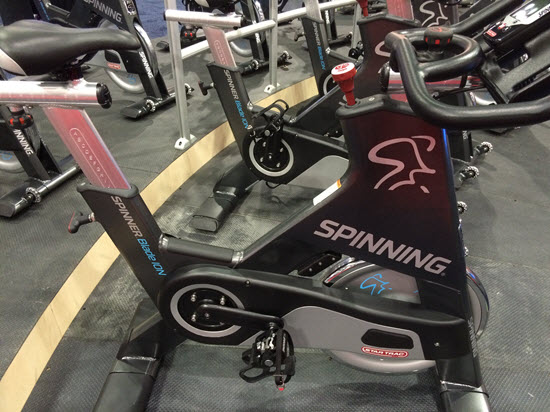
Star Trac has expanded their Black Belt option to the full line of commercial Spinner® Indoor Cycles, including the Blade Ion. But you wouldn't know it just by looking at it. Where the NXT carries the “Black Belt” logo on the frame, the Ion has no markings indicating if it's chain or belt drive.
I rode the Ion briefly and my initial impression was that this belt is both quiet and smooth. Yes you're missing the feel of the chain, but whatever they've done, the Ion didn't have the vague/weird feel some bikes using a similar flat belt have.
I discussed the question of, “why not use the Gates toothed belt?” with Mad Dogg Athletic's CEO John Baudhuin. John explained that they had experimented with the Gates belt years ago. What they found was a drive system that uses a heavily weighted flywheel just works better with the flat belt they've chosen. Which makes sense, the brands using the Gates belt (Schwinn/FreeMotion/Stages) all are using a much lighter flywheel.
Schwinn
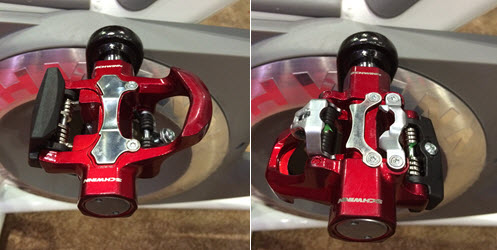
Schwinn has completely redesigned their Triple Link Indoor Cycling Pedal. No, unfortunately my Red Pedal Tool won't work with the redesigned shoe basket. This pedal has much larger bearings on both ends for increased reliability + they attach using the Morse Taper that's similar the Spinning® pedals.
NOTE: these can only be used with a new Schwinn AC – older versions use conventional 9/16s threaded pedals. I'm waiting on clarity from Schwinn to learn if this new pedal will be offered in a 9/16 threaded version.
There's another upgraded Mpower Echelon (version 2) console and power meter for the AC performance. They've made a substantial number of changes and improvements to the (previously Red) Echelon console and I'm hoping to have a Schwinn representative on the podcast to discuss all of them soon.
Keiser
http://icipromedia.s3.amazonaws.com/Keiser_M3.wmv
Refresh your browser if you're not seeing the video above.
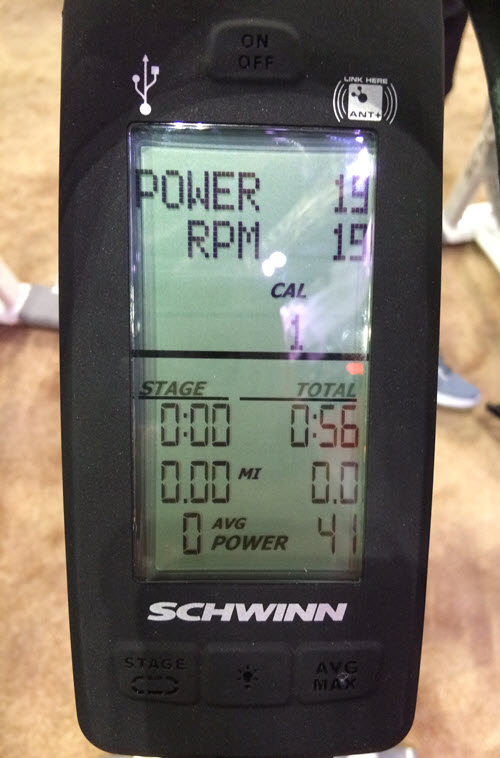
Did you know that the new M3i has a stage/interval timer? I didn't until Amy and I spent some time with Dennis Keiser. While we were chatting I made the suggestion; “you know Dennis, I would really like to have the option to record the average wattage during a short interval… you should consider adding that in the future.” Dennis's response was; “we all ready have it.” We all went over to a M3i and Dennis showed us (video above) how easy it is to start and stop the stage/interval timer > all you need to do is stroke the gear-shift lever all the way down and then back up 🙂


 –
–