Minimal required maintenance – the belt doesn't stretch and you never need to lube it.
Should last forever
Did I mention that it's very quiet?
Weaknesses
More expensive than a chain drive
It may require the pedal crankarms be spaced further apart = wider “Q-factor”
That's all I can think of.
Disclaimer and perspective: I have taught on the FreeMotion S11.9 for the past year at two Life Time Fitness clubs. I train at home on a S11.0 (the home trainer) that was given to me for evaluation purposes.
My only real complaint with the original chain drive FreeMotion S11 series Indoor Cycles has been the amount of chain noise coming from the drive system. That noise, multiplied by 50 or more cycles in a class (or just one in a basement) can be very distracting/unsettling/frenetic and it requires much more volume of both you and your music.
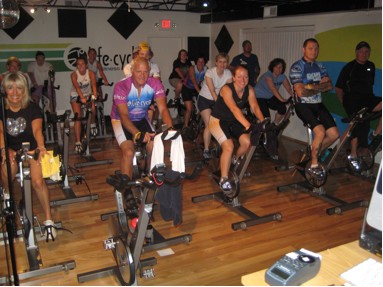
If you've every experienced how calm/relaxed a class with belt driven cycles is, you'll understand exactly what I'm talking about.
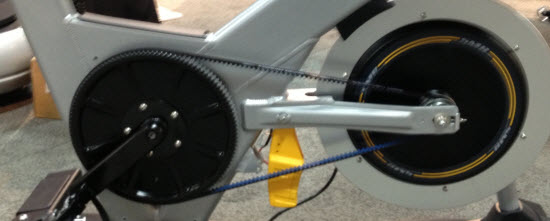
Where does this additional noise comes from? It's from the chain wrapping around very small front sprocket used to rotate the flywheel at a much higher RPM than on a friction IC.
Big drive gear x small driven gear = very fast flywheel RPM
All Indoor Cycles use some form of weighted flywheel to mimic the momentum of riding a bicycle. Cycles with magnetic (Eddy Current) resistance (FreeMotion S11.x, Keiser M3 & Schwinn AC) all use an aluminum (or combination aluminum/steel) flywheel. All steel alone won't work when you're using Eddy Currents to create resistance.
Aluminum is lighter than steel = less mass = less rotating momentum. Also the design of the combination flywheels has the “steel” portion closer to the hub, resulting in less mass around the perimeter of the flywheel. The flywheel needs to rotate quite fast to create enough of these “Eddy Current's” to make the requested resistance, which is good because this additional speed makes up for the aluminum's lack of mass. The gear ratio (big crankshaft gear x small flywheel gear) needed to achieve this flywheel speed = additional chain noise.
By using a belt, instead of a chain, FreeMotion has eliminated the noise problem… but all belts are not the same…
There are a number of popular Indoor Cycles using a belt drive system; Keiser M3, Livestrong/Tomahawk and the LeMond RevMaster. All of these cycles all use a Kevlar belt – perfect for most people, except for the cyclists in your class. For them, these Kevlar belts feel very foreign. They don't “feel” like a bicycle because chains create a vibration as it rolls across the sprockets and that vibration is missing from a super smooth Kevlar belt.
I'm sure that Gates did a bunch of research and testing when they developed the Carbon Drive system as a replacement for bicycle chains. Their success (I'm presuming here) would be dependent on creating a replacement for a chain that eliminated all the negatives; maintenance, wear, weight, grease and noise – while retaining the familiar feel of riding a bicycle. The “teeth” of the carbon belt, as it rolls across the pulleys, create a similar vibration to a chain = the “feel” of a bicycle, W/O any of the negatives of a chain.
My original objective of the Power blog here in ICI/PRO was to build the case for power precept upon precept, slowly but surely. Good idea, except for folks who already find themselves teaching on power bikes and are anxious to get to the meat & potatoes. So, as the line in Monty Python’s Holy Grail said (whilst preparing to throw the Holy Hand Grenade) “Skip ahead brother…”
The most fundamental principal in power training is that you can sustain higher power output for shorter periods. This is common sense of course, but when trying to train or “hone in” on power levels you will use for different types of riding outside, one needs to identify these time periods, and develop power based on the length of those efforts.
For example, outside of the long mountain passes in Colorado, or Europe, your standard “hill climb” will often be only 3 to 5 minutes. This is also met with generally a steeper grade than those more gradual, longer climbs, and thus there is a measure of power required to climb those that is significantly higher, and requires different training.
In addition, if you race (or simply want to just impress your friends at every opportunity), you may want to develop significant sprinting or break away skills. To do that, you will want power that is even higher than climbing power, but may only be needed for as little as 60 seconds. This may seem quite short, but it is often all that is needed to achieve a real break away, or triumph in a race ending sprint.
Consequently, we have built the Cycling Fusion Power Training system on 3 zones of power; Sustainable Power (7 to 20 minute efforts), Climbing Power (3 to 6 minute efforts) and Explosive Power (1 to 2 minute efforts). These ranges are quite large, and there are 7 power levels within each zone. Rather than bore you with all the details, let’s just jump in and conduct a class that provides a sample of each of these zones.
The class design below is based on the Keiser M3 bike, since it is what we use at my club (Global Ride Training Center) in Pittsburgh. Since we also speak specifically to how we can reset our power numbers, I’ve written this class specifically to this model, and thus I call the class: The Keiser Tour De Power. For those that do not have a Keiser M3, but do have power, simply replace the portion of this workout that speaks to resetting the bike to get your average power numbers for one of the zones, and it will work just as well on any other bike.
When I heard about a SPINNING® Certification Workshop being offered just minutes from my home-base in Eden Prairie, Minnesota, I jumped at the opportunity to sign up. Believe it or not, I have been teaching indoor cycling for nearly four years, but never received formal training on the bike. The workshop I attended was held in Minnetonka, Minnesota, on July 23rd, 2011, and was led by Seth Dedmon, from Tennessee. Seth epitomizes what it means to be a great workshop facilitator. His energy, sense of humor, and thick Tennessee accent made me want to listen, and his knowledge base from years of experience had me jotting down notes and quotes almost non-stop.
The nine-hour event was broken down into four sections:
– Bike Setup/Safety
– Form
– Heart Rate Training
– Class Design
Bike Setup/Safety
We spent the early part of the workshop learning how to properly set someone up on the bike. Because I had never been formally trained to teach indoor cycling; I knew that the bend in the knee should not be more than 25 degrees, but not much else. After completing this portion of the workshop, I now have a systematic approach to bike setup and feel completely confident with the entire process.
Form
Second on the agenda was form. During this part of the workshop, we were on the bikes for over an hour with absolutely no music (Imagine that!) and Seth led us through a series of drills while teaching us proper form for seated and standing flats, climbs, jumps, sprints, and running with resistance. Many of the participants — including me — realized form is something even we need help with from time-to-time.
Heart Rate Training
As someone who does not own a heart rate monitor, this was the time of the day when Seth convinced me to buy one. Additionally, he discussed the five types of cycling workouts — recovery, endurance, strength, interval, and race day — and their corresponding heart rates. Seth’s instruction helped me understand the benefit of workout periodization and encouraged me to make certain each class has a specific purpose.
Class Design
Finally, we learned about class design. As a team, we worked together to build unique profiles (workout routines) and also talked about the importance of using music to create feeling and emotion in class. It has always been a personal priority of mine to consistently create new playlists, but Seth encouraged me to broaden my horizons and search for songs from a wider spectrum of genres — from reggae and classical to tribal and alternative.
Sample Class
To top off the day’s experience, Seth had us get back on the bikes for a sample class, and he actually instructed off the bike. To our surprise, he encouraged us to do the same from time-to-time, as it allows the instructor to give riders personal attention, correct form when necessary, and check in on participant heart rates. Quite honestly, his brief, 30 minute class was one of, if not the best, cycling experiences I have ever had because of the ambience he created in the room. It motivated me to become a better instructor.
The Takeaway
In addition to what I learned about bike setup/safety, form, heart rate training, and class design, I learned two things. First, I discovered that indoor cycling is very much a mind/body form of exercise and have a stronger desire to encourage visualization through music, class design, and my words. Additionally, I realized that instructors reach plateaus in their teaching just as the everyday exerciser reaches ruts in their training. The entire day left me feeling empowered to continually improve my teaching so that participants — our number one priority — remain excited about their health and fitness.
*Jennifer Lintz is a Nutritionist, AFAA Certified Group Exercise Instructor, Certified SPINNING® Instructor, and ACE Certified Personal Trainer. Visit her web site at www.wellnessbyjennifer.com.
Hello, I really enjoy your podcast, thank you for the production. I listen to them on my way to teach. It makes me feel motivated and often gives me items to share and use with my participants.
I wanted to follow up to this one podcast in particular. Our club got these bikes in the spring this year. The members are saying the gear tension varies among the bikes. I was pleased to hear Dennis talk of this issue and he suggested a way to remedy it by moving the gear handle up and down five times etc. Upon arriving at the club, I tried it and was disappointed it did not work. The numbers flashed zero and not the number “five “ I believe he suggested. Maybe he is talking about another version of the M3 Computer? Just an FYI. Maybe he could follow up again with additional information.
Dennis Keiser offered this response:
Hi Tara,
John forwarded me your email so that I could hopefully help you with your concern. (more…)
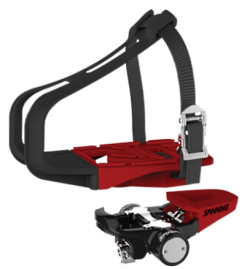
Josh Taylor had told me last year about a new pedal Spinning® was designing that would have the same versatility as the Schwinn Triple Link pedal; accepts LOOK, SPD and fitness shoes + they include the new Morse Taper pedal spindle (vs. a conventional threaded spindle) they're using on the new Spinner® NXT and Blade Indoor Cycles.
I see now that they've introduced the new pedal in two versions; the TRIO™ and TRIO QR™ – QR refer's to Quick Release.
My understanding is that even with dozens of different competing pedal types available, LOOK (who was the first mass-marketed clip-less pedal) is still the market leader in road bike pedals. So it makes good sense to offer these types of pedals to keep many of your cyclists participants happy 🙂
The two pedals appear identical except for:
Patented “Quick Release” lever allows for simple one-handed platform removal.
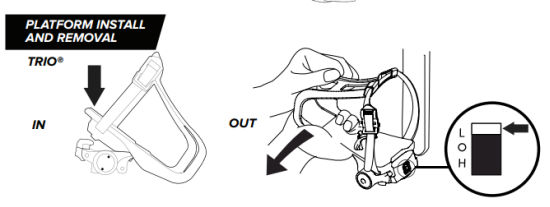
They may want to reword this as the owner's manual clearly shows you need two hands to remove the cage.
One hand or two, my hat's off to whomever designed the nifty Quick Release feature on the TRIO QR!
Fun Fact
You may or may not be aware that indoorcycleinstructor.com, the Podcast, ICI/PRO… everything began with my desire to market my Red Pedal Tool. After years of fighting with the shoe baskets on these pedals I created this tool which is designed to safely and easily remove the shoe basket from Schwinn Triple Link pedals.
I'll need to talk with Josh about why they have also chosen to manufacture a version without the quick release… The diagram below illustrates the very same removal issue Schwinn has with their Triple Link.
This Podcast is was last published on Oct 14, 2009, I have updated it with our new Podcast host information and I am representing it now. I hope you enjoy it, Joey
One of the things that most excites me about the potential here at ICI and the technology we are tapping into, is that we have created a platform that allows us to seek out and interview some of the most progressive and experienced people in indoor cycling and bring them to you, our listeners and members. Where else can you hear interviews with the pros on subjects that help you grow as an instructor? (Except at an expensive conference once a year!)
We certainly do not know everything there is to know about indoor cycling, but we know how to seek it out and bring it to you. I have so many mentors I've learned from over the years who I would like to bring into the discussion at ICI. With every new person we interview, you will learn a different style, a different approach, or perhaps a new twist on something you haven't considered.
Today we are speaking with Master Instructor Janet Toussaint from the Boston area.
One of Janet's expertises is teaching endurance. She ran the Spinning program for years at the Boston Athletic Club and not only got the instructors to buy into the concept of teaching a moderate intensity ride, but the large member base as well. Now that is a tough challenge when all they seem to want is high intensity all the time - I am sure many of you are faced with a similar challenge.
In January of 2003 Janet came out to visit me in Vail on a ski vacation with her son JP. When we weren't skiing, I made her teach Spinning at my club! We were in the middle of a base building program at the time so I had her teach an Endurance workshop to my instructors. She had such a positive impact on our instructors and our program and I still use some of her special cues and metaphors that she used to motivate riders.
When you hear Janet's passion, I am sure she will inspire you too!
John and I enjoyed this discussion so much that we decided to go deeper into the subject of endurance and scheduled even more time with Janet. For ICI/PRO members, we will offer two additional podcasts that you will receive in your Super-Secret iTunes feed. The next interview will go more deeply into the essence of teaching an endurance ride. Even more exciting, the second one will be an audio PROfile on Janet's own favorite endurance ride, The Endurance Connection, replete with her all-star cueing, coaching and playlist.
If you have difficulty coming up with motivational things to say in your endurance classes, you won't want to miss any of these podcasts!
Listen to the Podcast below or subscribe for free using iTunes or Zune.



 –
–