Let's talk a little bit about resistance today. While I do not want to get into the “how much should I add” debate, there certainly is a minimum amount of resistance that every rider should
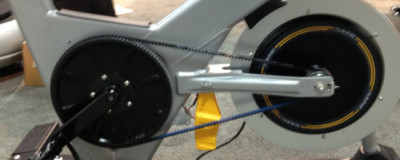
Big drive gear x small driven gear = very fast flywheel RPM
have on their bike. The true importance of resistance comes about due to the existance of a flywheel on an IC Bike.
Most indoor bikes have a weighted wheel (called a flywheel) to provide inertia and simulate the feel of riding a bicycle outdoors. It is important that riders remain in control of the flywheel at all times, particularly at higher RPMs, and not let the flywheel control them. Indoor bikes are designed with a knob, or lever, for controlling the amount of resistance placed on the flywheel which consequently affects how hard a rider will have to work in order to pedal the bike. This resistance can be either mechanical (the traditional friction pad) or it can be magnetic. The primary advantage of magnetic resistance is that it does not wear down over time, so it should provide a more consistent resistance over the life of the IC Bike. It should be noted that even with the last of friction and wear, magnetic resistance should be routinely calibrated due to operation cable stretching and general wear. This can be especially important on IC Bikes where the wattage is calculated (usually using the distance of the magnet from the wheel) rather than measured with a strain gauge.
Generally, I start my riders off at enough resistance to produce 25% to 50% of their bodyweight in pounds in watts (Watts/LB = 0.25) which generally is enough to keep them settle in the saddle and provides a good starting point. Riders should NOT pedal the bike without resistance at any time and should be encouraged to use the appropriate amount of resistance at all speeds and effort levels. Lack of appropriate resistance is the primary cause of “Hip Popping” in riders which is where the hips bounce quickly on the seat as the rpms are increased. There should be at least enough resistance on the bike to keep the hips settled and smooth in the saddle.
Please look for the next section of this series for the continued conversation and some safety specifics.
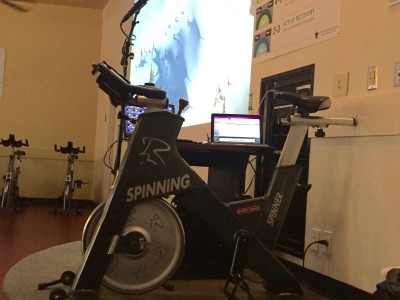
The overall concern of any fitness professional should be safety. We must always make every effort to provide a safe environment for those taking our classes. Health clubs and fitness studios are responsible for providing a safe environment and equipment for their members and staff. As instructors, our responsibility is to ensure that every aspect of our indoor cycling class, from specific training concepts to the use of the bikes, is conducted using safety guidelines.
Currently, there is a vast amount of discussion in the indoor cycling industry over what truly represents safe practices. On one side of the debate is the “Keep it real” faction. Their side of the safety story is that instructors should not do anything on an inside bike that they would not do on their bicycle. They consider anything outside of their limited movements on the indoor bike as dangerous and harmful to the students. This stance always evokes some debate in itself as there are many movements and riding styles that are done on bicycles that certainly even the boldest of instructors would never attempt on an indoor bike. For example, jumping on mountain and bmx bicycles, hopping over potholes or curbs on a road bicycle and many other necessary elements of outdoor riding that should never make their way into the studio. Generally, the rides from this group of instructors focus on a training objective and the music is considered secondary. This group considers themselves the traditional or pure indoor cycling instructors.
The other side of the debate is held by the “Rhythm” indoor cycling instructors. This group seemingly has a most things go approach to indoor cycling and often their rides include the use of small hand weights, quickly cycling jumps (or tap backs) and other non-traditional movements on the indoor bike. They contend that there is no scientific, or medical, evidence that would suggest that the movements they perform on the indoor bike are actually dangerous or cause injury to the students. Generally, the rides from this group of instructors focus on the music and the dancing on the bike and the clear training objective is considered secondary.
We look at this debate from a wider perspective. As a group exercise professional, we believe that your job is to get people off of the couch and entice them to join in an active lifestyle. We like to take the middle road on teaching styles: all rides should contain sound and clear training principles, but we also realize that music is perhaps the most important aspect of the ride construction. While delivering a quality class that gives the rider’s results is important, people with not continue to train with you unless the music is something they like and most importantly fits the work being performed in BPM, emotion and intensity.
Please look for the next section of this series for the continued conversation and some safety specifics.
After interviewing representatives from both Saris and Keiser, I have watched the debate about Indoor Cycling Bikes with power readings i.e. Keiser M3 vs. CycleOps Pro 300PT, with great interest. The CycleOps Pro 300PT IC Bike uses a version of their “Powertap” hub to sense torque. The Keiser M3's method of sensing torque isn't obvious so I decided to dig a little deeper and get some answers. I sent the following email to Darrin Pelkey, the VP Sales & Marketing at Keiser.Hi Darrin,
I didn't dig deep enough into this question during my interview with Suzette O'Byrne
How is the wattage computed on the M3? There is a lot of discussion / confusion on the forums as to how Keiser measures force without using a strain gauge in the pedal crank or wheel hub. Is it an estimate or actual power reading? Is there a calibration process?
See this thread – http://innercycling.com/f/showthread.php?t=8542I understand the basic physics and I'm an engine guy so I understand that most dyno's use eddy currents to load and measure power but I don't understand how you get your power readings on the M3.
I would love to inform my readers & listeners if possible.Here is Darrin's response:John,
First and foremost the M3 is not a ergometer nor is it priced like one. Power is an estimate. The price and our maximum usage (group exercise) dictate that it is not for testing and it cannot be calibrated. Though we do have some people that have used it with an IMET test when a bike is more preferential than a treadmill. One thing not mentioned below is magnet strength, they are consistent and do not weaken over the life of the bike.
To answer the question:Watts are calculated from the gear setting. A potentiometer is attached to the magnet holder (the round cone shaped disc at the end of the shifter cable). As the shifter is moved, the cable rotates the magnet holder. A potentiometer is rotated by the rotation of the magnet holder, thus feeding information to the computer on the position of the magnet holder. The rotation of the potentiometer is broken down into 24 gear settings. A dynamometer was used to test and develop a table of wattage at various gear settings and speeds. The speed of the crank is determined by a magnet attached to the large pulley on the right crank arm and a magnetic switch attached to the circuit board in the magnet holder assembly. Each time the magnet on the pulley passes by the magnetic switch, a signal is sent to the computer to compute the RPM's of the crank arm. Power equals force times velocity. The force is determined by the magnet position and the speed by the crank speed. The lookup table is programmed into the computer and the computer simply looks at the gear setting and speed and goes to the lookup table to find and display the Watts for those two settings.
Darrin Pelkey
VP Sales & Marketing at Keiser
The Power in Human PerformanceNow my two-cents as to Actual or Estimated — does it mater? Short answer — No. My feeling is that any bike that displays consistent and repeatable power readings is a vast improvement over any non-power based IC bike.
There are many ways that you can pick both bikes apart; CycleOps has actual power readings yet the M3 has (in my opinion) a vastly superior system for creating load/resistance. The heaver flywheel on the CycleOps causes inaccuracies in power readings — in their words: Why are there discrepancies between my PowerTap numbers and my Indoor Cycle numbers? Due to the external factors of riding a bike outside vs. riding a solid indoor cycle, you may experience different values on your PowerTap. Also, with the special design of the flywheel, inertia plays a much bigger role in your workout on the Indoor Cycle vs. riding your bike on the road. For instance, a larger effort is required to get your Indoor Cycle flywheel up to a certain speed, but due to inertia, the flywheel will spin much longer than a regular bicycle wheel, resulting in less work being required to maintain that predesignated speed.
For personal use, I'd say it's a wash… or more of a Ford vs. Chevy argument.If I was a club owner I would pick the M3. Less capital cost, it appears to need much less maintenance (calibrate 50 bikes each day? I don't think so) and how many of our members have a road bike with power?
This Podcast is was originally published on September 28, 2008, I have updated it with our new Podcast host information and I am representing it now. I hope you enjoy it, Joey
Sally Edwards, the originator of Heart Zones Training, and I discuss the origin of Zone based Heart Rate Training. Sally explains its importance to conducting an effective Indoor Cycling Class and the fallacy of using age based Max Heart Rate charts and formulas.
Listen to the show below or subscribe with iTunes with the link on the right.
I get the “Where can I get certified as a “Spin®”,”Schwinn®” or simply an Indoor Cycling Instructor?” question a lot. While trying to be helpful, more often than not my response is “I'm sorry, but you are asking the wrong person.” “The person you want to ask is the manager at the club where you would like to teach.”
Many people skip that step – here's why you shouldn't…
Sometimes I feel like Dr. Alfred Lanning from the movie I Robot where Will Smith's character, Detective Del Spooner, is quizzing Dr. Lanning's holographic image. The Doctor looks at him and says “I'm sorry. My responses are limited. You must ask the right questions.”
The right question is; “what do I need to do to teach a regularly scheduled Indoor Cycling class at my local club?”
UPDATE: It can't hurt to check first to see which studios & clubs are hiring. This Instructor jobs board is a great place to start 🙂
“That's a question I can answer” 🙂
I'll put this in the context of a question our daughter Abby, a Junior in college, asked us last fall; “I'd really like to write for a car magazine… and get to drive a lot of cool cars!” “How do I get a job like that?”
“My responses are limited. You must ask the right questions.”
“OK, so what would you suggest I do to get into the car business?”
“That's a question I can answer.”
Our advice for our daughter Abby was to find a company (any company) in the car business and see if they have some type of entry level job where she can get her feet wet. Luckily for Abby, her mother (Amy) had a friend who's husband (Brandon) is an area manager for Enterprise Car Rental. Not “Car and Driver”, but for a 21 year college junior, quite possibly the perfect place to get her start in the “car business”. Long story short, Abby met with the manager and learned that they offer a select number of summer internships. During this initial meeting she asked a lot of questions about what Enterprise is looking for in the people they hire. Armed with this “insider information”, she was able to successfully navigate a long interview process (there are hundreds of applicants) and she starts Enterprise's summer Management Training program next month 🙂 It's hard to say where it will lead, but it's a very positive start for a sharp young women.
I feel the same thinking applies to securing your first teaching gig; there are a lot of people who would like to teach, but few who will do the exploratory ground work where they can “ask the right questions”. It's really just the tried and true sales process that's been followed for thousands of years. Here are the steps:
Decide if you are willing to do whatever (within reason of course) it takes to secure a regularly scheduled class.
Identify your prospect(s) (potential customer). You are after all selling something here; YOU! There maybe only one location, or there could be a dozens near you. Don't rule out anywhere that offers Indoor Cycling. Your objective is to get a scheduled class. I shouldn't matter where and it may not be in the most convenient location.
Find the decision maker at the club/studio. This shouldn't be too hard; take a class there (everyone offers a free class) and ask the Instructor after class. It's important to be very direct with your intent; which is to learn who can say YES to you teaching there! Tell the Instructor that you are interested in learning about becoming an Instructor and you would appreciate knowing who makes the hiring decisions. That's all you want to learn from the Instructor – nothing more! Resist the temptation to ask if they are hiring – people tend to be protective of their “turf” and you want a friend, not someone who's fearful that you want to take their job. Be sure to get the Instructor's first and last name because you will need it later.
Repeat at every location. Rejection is much easier to handle if you have multiple prospects 🙂 Do yourself a favor and don't get emotionally committed to only one studio if at all possible.
Contact the decision maker (by phone or in person – never by email) with the objective of scheduling a short meeting where you can learn more about what the club looks for in an Instructor. That's it, nothing beyond the commitment to meet at a later date. You may say something like this; Hi Ms. Jones, my name is John and I took a class at your club last week. It was with (insert full name of the the Instructor here) and I wanted you to know that I really enjoyed her class and your club! Next you show him/her you're concerned about them; Am I catching you at a good time? I have a quick question I'd like to ask you. Wait for their response. If it's anything but I'm OK, offer to call them back when it's a better time. “What can I help you with?” I'm really interested in learning everything I can about becoming an Instructor. (Instructor's first name) told me you have a lot of experience in the fitness industry and I have a number questions. I realize you have a busy schedule but could we schedule a time for a short meeting this Thursday or Friday mid-morning? Always offer an either / or option, not a question that can be easily answered by NO. If the response is anything like “we aren't hiring any new Instructors” affirm this and again ask for the meeting; Sure, I understand that you aren't hiring now. I was just hoping to gain from your experience. It should only take 15 minutes or so… would Friday at 10:00am work for you? There's nothing wrong with being persistent! It must have taken Abby a month for her to get Brandon's commitment to the first meeting. We had to repeatedly encourage her to keep after him and in then end he told her that it was her persistence that caused him to finally agree to the meeting.
For many, securing the appointment will be the second hardest part of this process. With a meeting in hand you know the drill; show up on time, look nice, smile, etc… Keep your commitment to asking questions. Here are a few suggestions:
What certification do you require?
What makes for a popular Instructor?
Is there a certain type of Instructor your members appreciate more than others?
Do you feel you are missing/lacking any specific type of class format that would appeal to people who aren't currently members?
How do you decide on what types of classes you offer?
Do you have specific times during the year when you make class scheduling changes?
This isn't the time to talk a lot about yourself 🙁 Even if the manager gives you an opening “why do you want to be an Instructor?” resist the temptation to say too much. Keep your answers brief and end them with another question. People love to be interviewed and talk about themselves, so keep asking them questions.
How long have you been in the fitness industry?
Why did you first get into the fitness industry?
Do you participate in any events; triathlon, 5k, charity rides, etc.. ?
Then comes the hardest part (and only if you feel you've developed some rapport with him/her) where you ask a “If I could, would you?” question, as in; If I could get a (insert the certification they named) would you consider evaluating me as a potential Instructor? And then wait for the answer.
Many clubs and studios now accept an online certification. If they will you can get certified here.
If it's not positive, ask some more specific questions to learn exactly why and then thank them for their time and move on to your next meeting.
Please let me know if this was helpful to you by leaving a comment below – or visit indoorcyclinginstructorjobs.com to find your new class 🙂
// < 

 re responsible for providing a safe environment and equipment for their members and staff. As instructors, our responsibility is to ensure that every aspect of our indoor cycling class, from specific training concepts to the use of the bikes, is conducted using safety guidelines.