We were saving Kim Moody's profile; “The Gate” until it was closer to Halloween – and here it is!
Kim was one of the winners to the first Ultimate Instructor Class Profile contest as we really appreciated her take on creating a holiday based ride theme.
This profile is based on the urban legend, “The Gate,” in Libertyville, IL. One can find more information about this frightening place by going to www.hauntedusa.org/thegate
For this Halloween mixed ride, I wanted members to visualize the dark and desolate location so I began the class by retelling excerpts from the article to provide some background information and imagery material.
I have a friend, a very accomplished cyclist, who fancies himself a Ferrari. To look at Eddy you'd have to agree; he's long, lean and very sharp looking. But to ride with him may have you thinking more Peterbilt, than Ferrari. You see my friend is very strong and rides with a slow, powerful cadence. Many who ride with him remark; “the guy never shifts… he did the whole ride in one big gear.”
I'm finally continuing with this series, comparing the athletes in your class with the engine in their cars.
Let's explore the difference between small displacement > High RPM engines found in High Performance Sports cars and the large displacement > low RPM engines found in a Semi Tractor- Trailer or Lorie you see running down the highway. Then see if we can draw a a few correlations between them that would be interesting to the Gear Heads in your class… after all, if your class is anything like mine, you're beginning to see more men, now that it's getting cold outside.[wlm_private ‘PRO-Platinum|PRO-Monthly|PRO-Gratis|PRO-Seasonal|Platinum-trial|Monthly-trial|PRO-Military|30-Days-of-PRO|90 Day PRO|Stages-Instructor|Schwinn-Instructor|Instructor-Bonus|28 Day Challenge']
The F430 Ferrari is an incredible car. It will go zero to 60 in 4 seconds, a top speed of 200MPH and you can get one of your own for only $200,000 US. What moves this 3,200lb rocket, when you push on the “fly by wire” accelerator pedal, is a 4.3 liter gasoline engine that develops 483 horse power – once it is spinning at the maximum of 8,500 RPM.
A conservative choice for an engine in your new Peterbilt truck is a Cummins ISX15 diesel engine. This engine makes 485 horse power while turning a leisurely 2,200 RPM
So the F430 and the Peterbilt both have essentially the same horsepower (483 vs. 485) available to the driver.
What's the difference? Isn't Power… Power?
TORQUE
The Cummins engine creates 1,850 Ft Lbs of Torque, over 5 times that of the F430's puny 343 Ft Lbs, while only turning 1/4 the RPM. The Peterbilt needs all this Torque to move the combined tractor and trailer weight of a 50,000lbs up over a 6% grade. To create that Torque the Cummin's engine is massive (weighing over 3,000lbs – about the same as the whole F430) with huge pistons that are (you guessed it) about 4 times as large in diameter!
Torque in an engine is created by the force of combustion acting on the surface area of the piston. While there's a lot of other physics that go into the creation of Power, I'm reminded of an old racer's adage that goes something like; There's no replacement for displacement.
What's true in engines is true in humans… with all other things equal; bigger muscles can create bigger forces = more Torque. But Torque doesn't get you up the mountain – that's Power. So of two women of equal weight, the one with the biggest legs doesn't get to the top first.
The winner to the summit will be the one who can continuously make the most Power, for the duration of the climb.
My buddy Eddy, like most endurance athletes, is a student of himself. Over 10's of thousands of miles, he's learned exactly where his body makes the most Power, the most efficiently. In his case, he understands that his very strong legs work best while powering through at what many would say is too slow a cadence.
Fans of the Tour de France may remember the climbing battles between Lance Armstrong and Jan Ullrich – where the contrast between Lance's 90+ RPM and Jan's 60ish RPM had them climbing at the same speed = they (I'm assuming they have similar body weight) made the same amount of Power. The same Power that is, until Lance turned, looked, then accelerated to 100 RPM and dropped Jan due to his superior Volumetric Efficiency – ability of an engine to process Oxygen, by efficiently moving air through itself.
After all Lance Armstrong is truly a Ferrari – but that's a subject for another post.
A fun class you can offer (if you teach with Power/Watts) is to create a profile that includes a series of laddered efforts of increasing cadences – while maintaining a set percentage of FTP or some baseline wattage. The purpose of the class is to help each student find the RPM range where they are the most efficient, i.e are they a Ferrari or a Peterbilt?
Amy and I experience this every time we ride our Tandem. In His, Hers and Ours Audio PROfile we explore how different cadences can be used to create the same amount of Power, or ground speed, which is essentially the same thing.
You may choose to use only RPE or you could tie each step to a HR. Maybe you cue wattage as a multiple of body weight; Now everyone find their One Watt Per Lb wattage at 70 RPM. Now let's add 10 RPM and reduce resistance to stay at that wattage… after 3 minutes ask, what's the result? Do you feel like you are working harder? HR higher or lower?
This might be a fun exercise to use a few weeks ahead of an FTP assessment – where we first teach everyone their Natural Cadence (best efficiency) and then have them ride at that RPM during their assessment.
Sounds like a question for Cameron Chinatti – stay tuned…[/wlm_private]
If you're teaching with power, there's a good chance you'll have a participant ask you this simple question; how many watts should I be making when I'm working at my threshold? Same goes for any new studio or one that is upgrading to indoor Cycles with power/watts. You will be asked for a number from many of your riders. The reason is pretty simple, many people naturally want to know how they compare.
There are two schools of thought on if, or how, you should answer this question:
There's the “Don't give them a number – ever” school that believes whatever you tell them could be wrong and potentially upsetting. You don't want to demoralize riders, or hurt their feelings, especially with a new rider with no/limited fitness, by suggesting anything. The recommendation is to respond with a question; how many watts did you see today? Then respond positively to any response.
Then the “give them something to work with” approach. My preference is to start with the suggestion of one watt per pound or a little bit over 2 watts per Kg.
They're adults = tell them the truth… they can handle it.
Have you ever had someone lie to or mislead you, under the pretense that they didn't want to hurt your feelings? Did it make you feel valued and respected? If you have experienced a situation where you weren't told the truth, did you feel you would have acted differently, if you had been given accurate information?
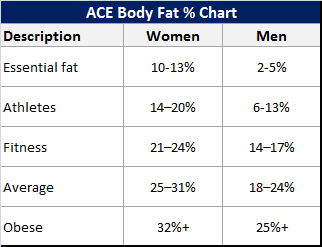
Imagine for a moment you're a personal trainer and your client asks you this question; what percentage of body fat should I have? A common question I'm sure. Is the correct response; “what is your body fat percentage now?” And then to positively affirm what ever answer they give? I don't think so… do you? There are established ranges for body fat %, published by credible fitness authorities like ACE. Here's their chart.
Let's see where you fall on this chart…
If your female client told you their body fat is 34% – would you smile and say; “that's great!” ? Of course not. You would probably suggest a diet and exercise program directed toward reducing their fat percentage down, with a goal to get into the average range. The person standing in front of you may not like hearing that they're obese, but don't they need to learn the truth so they can decide to do the work needed to change their body composition?
What about running a 5k? Or bowling for that matter? They both have metrics that define a reasonably achievable level of proficiency for an able-bodied person. Would it be wrong to suggest a goal time of 36 minutes (12 minute mile) for a 5K or 120 pin score in a bowling game?
Teaching with power for two years has me in the “give them something to work” with camp. And that something is a goal of one watt per pound of body weight*. I've asked multiple dozens of riders; “are you close to your body weight in watts?” Are they all there? No, but it's been very few. I'll bet if you were to privately poll your regulars, at the end of a 3-4 minute sustainable threshold effort, you would hear wattage #s around body weight.
At the end of the PST (Personal Spinning Threshold) assessment I did at WSSC, MI Janet Toussaint allowed me to ask the class this exact question. The majority agreed that their PST was at or above their body weight. Now a room full of fit Instructors may not be a representative sample, but it reaffirmed my experiences.
If you'd like to learn more about this concept – listen to this podcast where I first learned about it.
*I've heard other Instructors suggest using lean / goal body weight, which would reduce the number slightly. This calculator provided by ACE might be helpful.
Better late than never they say. It certainly applies to this season's Performance Cycle classes – now we're in full swing after some initial confusion that came from a sudden change on GFDH's.
We kicked off this past Sunday with an assessment to find the wattage numbers we will be using going forward. I like to use very simple terminology that minimises any mathematical computations.
… Instead I base my Life Time Performance Cycle classes on two numbers; PTP (Personal Threshold Power) and JRAP (Just Riding Along Power — AKA > Base Watts > VT1 / First Ventilatory Threshold Power). From these two rider identified threshold wattages, we can construct three meaningful power Zones;
Recover zone — watts below JRAP
Perform zone — watts between JRAP and PTP
Improve zone — watts above PTP
Today we added one more wattage number – their 20 minute FTP watts. As you can guess, riders should have a lower 20 min average than a 3-4 minute PTP / Best Effort and be above JRAP / Base Watts.
Wait John, you just said you only use the two thresholds in class.
What's the point of adding a third number?
Adding the third point of reference helps you draw a straighter line. At least that's what my high school drafting teacher taught me. It's much easier to draw between two distant points, if you add one in the middle = it helps you understand if you're on the right path between the two known points!
[wlm_private ‘PRO-Platinum|PRO-Monthly|PRO-Gratis|PRO-Seasonal|Platinum-trial|Monthly-trial|PRO-Military|30-Days-of-PRO|90 Day PRO|Stages-Instructor|Schwinn-Instructor|Instructor-Bonus']
The process of sustaining a 20 minute effort is helpful to many riders – it validates and reinforces the two threshold numbers and confirms that people are understanding my cuing.
Before/during and after these twenty minute efforts I tell everyone; this effort should fall between the two thresholds. Which you would think I shouldn't even have to mention… until you hear the confusion I heard after the effort was completed:
I really surprised myself – my 20 min watts was the same as my 3 minute level!
There must be something wrong with me – I couldn't sustain my base watts for the whole ride 🙁
Teachable moments here
In the first example; my 20 min watts was the same as my 3 minute level! I was able to ask him; “what does that say about your 3 minute effort?” He understood before I completed my sentence; “I'm not working hard enough!”
The women who told me I couldn't sustain my base watts for the whole ride also had a revelation and asked me; “Do you think I'm working too hard at my base level?” I didn't even need to answer her.
Do you now see the value of adding that third number?
A continuous state of observation
I asked my class on Sunday; how many of you are on a specific training plan? None. Not a single hand went up. This is very typical for my very diverse group of middle age men and women. Yes most ride outside – but their objectives aren't structured beyond not rolling over and hitting the snooze button. They come to my Performance Cycle class to get a nice combination of intensity and endurance work, in a fun group.
My object in this class is that everyone learn from observing their performance, make adjustments and observe again. Over time they learn exactly where they need be. When it's time to work hard – they WORK HARD and when they should work easy – it really is easy.
Make sense?
Here's my playlist –
I'll get the rest of the profile up later in the week if you want to try this in your class.
There's a recurring issue that keeps popping up on Facebook and Pedal-On forum:
Does anyone have a suggestion about to do about the consistent talkers in my classes? They're really disruptive, but I don't what to offend anyone. What should I do?
What follows are a series of well meaning suggestions from other Instructors; turn down the music, make a light joke – you don't want me to have to split you two up, do you?, stand between them, etc.
Others state something like; it's their ride, they're the paying customer, so I let them talk.
I don't feel any of these simple solutions are directed at the real problem or identify the real cause. In many cases there are no “simple” solutions. There will be a number of you won't be comfortable with the solutions I do plan to share. But before I go any further, I'd like your responses to what you see as the fundamental difference between these two scenarios:
Scenario #1
Breathless Betty and Chatty Cathy are long time fixtures at your club. They are inseparable and always ride the same two bikes (second row from the front, just off center) they have for years. They're talking as they come in and continue, non-stop, through your's (and everyone else's) class. Betty spends much of the class sitting up, soft pedaling, while looking and listening to Cathy. Cathy from a distance appears to be following the class, but never shuts up.
You've tried everything you can think of and have even asked them both privately to please stop talking in class. They don't. To make matters worse they've complained to the GM how they feel you've embarrassed them.
Despite your best efforts to ignore them, the negative affect these two have on you is wearing. Rather than being excited about teaching, you feel anxious, powerless and your class presentation suffers – resulting in fewer participants.
Scenario #1
You are super excited! You've staked out two great bikes (second row from the front, just off center) for Josh Taylor's Fighter Pilot ride at WSSC. Joining you for the ride is your dear friend Susan, who you only see once a year when you're together in Miami. You both laugh about how expensive this ride is, but agree that it will be so worth every penny. Josh mounts his custom Blade Ion. The lights come down. And with the start of the music, Josh launches into the ride.
Ten minutes in Susan looks over at you and asks; “so… how are your kids?” You're shocked in disbelief; doesn't she realize where we are? Without even thinking you turn to Susan and place your index finger across your closed lips > the universal sign for “Be Quiet”. Susan gets the hint immediately and you sense her embarrassment. The two of you ride in silence for the remaining time of the ride.
So what's the difference?
Why do Breathless Betty and Chatty Cathy not behave the same way that you and Susan did at WSSC?
In part two we'll explore what I feel is the answer to this and why, exactly, this happens.
I was reading this post over at Pedal-On this morning. In it an Instructor was asking about securing a teaching position with Life Time Fitness – where Amy and I have taught for years and feel we know the company well.
After posting my response a thought occurred to me; “teaching for a large multi-location chain like Life Time Fitness, with thousands of members and huge studios has it's own unique challenges… and I don't know that our existing resources really address the needs of a Big Box Instructor.”
So as a new service for our ICI/PRO members we will begin offering resources that are designed specificily toward helping those of you who teach at a Life Time Fitness, LA Fitness, 24 Hour Fitness, Equinox or other large Big Box health club.
You will be able to find this new category under the Instructor Training > Big Box Instructor navigation drop downs above.
Here was my response to the question about Life Time Fitness:
I've taught for Life Time Fitness for 6 years. I have scheduled classes at two Athletic (Diamond) level clubs here in MPLS where it's all about the members. I also sub regularly at the Chanhassen club that shares the parking lot with the LTF corporate headquarters. For you or anyone else looking to join LTF as an Instructor I can offer this advice:
1) Memorize the LTF mission statement –
Our Mission is to provide an Educational, Entertaining, Friendly and Inviting, Functional and Innovative experience of uncompromising quality that meets the health and fitness needs of the entire family.
I'm not kidding when I say memorize it as you will be expected to deliver it as part of any interview or Instructor audition.
2) Contact the club's Group Fitness dept head and ask to schedule a time for a call or better to meet with them in person. Do not call and just ask if they are holding instructor auditions. Your objective is to meet the Dept Head to learn what she/he is looking for in the Instructors they hire… which may be very different than who is currently teaching classes at the club. If the club is looking for someone or has a scheduled audition time they will tell you. Also, my experience is that Dept Head's do have some authority to hire someone without holding any auditions if they like/need you.
3) LTF is very focused on their Club within a Club initiative where they create small groups of interest; Run Club, Cycle Club, Tri Club, Swim Club, etc… If you are an outdoor cyclist I suggest contacting Cycle Club coordinator at the location and become their friend LTF is very interested in Instructors who could potentially take their Indoor class participants outdoors.
4) Understand that first and foremost your role as an instructor is to deliver a fun and entertaining experience for the members. You may teach the most real/authentic cycling class on the planet, but if it's boring because you feel constrained by focusing too much on what not to do, it will show in your class presentation and your chances of getting hired are slim. LTF's head of Instructor training Jeff Rosga said it best; “first you need to give them what they want, and then give them what they need.”
5) If you do get an audition, teach a class that's appropriate to the audience. LTF wants to see that you are flexible as an Instructor and can teach appropriately to varying member groups. You may teach a very “cycling specific” class, but that isn't what a room full of housewives want during a 9:30am class. (See #4)
6) Once you do get hired you can typically teach the class you want, remembering #4, as long as your numbers are reasonable, without interference from management. You are expected to follow the periodization schedule as to the objective of the class – but that doesn't dictate the actual profile you use.
Now I know there are many of you who instinctively revolt at the whole “you need to internalize our Mission Statement” group think thing. I know I did at first.
But when you consider that Life Time has thousands of Instructors, who are in front of something like half a million members each month, you really do need to find ways to keep some consistency of instruction… without forcing Instructors into little boxes that crush all of their creativity and passion for fitness.
I can think of a bunch of people I could have on the Podcast to explore the challenges and issues facing the Big Box Instructor. Stay tuned…





 LTF is very interested in Instructors who could potentially take their Indoor class participants outdoors.