With 40°f and rain scheduled for this past Sunday, I agreed to sub the 9:00am Cycle Sculpt class at the Life Time Fitness where I have scheduled classes. This was my third chance to teach this LTF branded format that combines Indoor Cycling and Resistance training. You can read about my earlier experiences here and here – both links include my class profile and Spotify playlist.
I was chatting with my friend Richard in the locker room before class. He has taken my cycling classes for years and he's front & center for this class religiously. He also knows something about training physically and mentally – Richard's a triathlete and Tae Kwon Do Grand Master with 9th Degree Black Belt. I told him how I rarely feel anxious before any class, but these cycle sculpt classes always make nervous.
Do you have any suggestions? I asked.
Just relax and do what YOU normally do…
Just relax?That's it? That's your suggestion?
Richard went on to explain; I haven't seen the John I know up on that bike, the other times you've lead this class. You need to lighten up man and just be you. Show us that you're having fun, work us hard and we'll all be happy!
Truer words were never spoken
As soon as Richard finished speaking I knew exactly what was wrong. Two things actually:[wlm_private ‘PRO-Platinum|PRO-Monthly|PRO-Gratis|PRO-Seasonal|Platinum-trial|Monthly-trial|PRO-Military|30-Days-of-PRO|90 Day PRO|Stages-Instructor|Schwinn-Instructor|Instructor-Bonus|28 Day Challenge']
I was trying too hard to make everything fit together. I had decided that the music, movements and transitions all had to flow together perfectly = the anxiety I felt before and during the class. I can remember panicking early in the last class I subbed when I heard the currently playing song crossfading to the next > Crap – they're not done with their exercise yet! This messed up my perfectly choreographed class and shortened the time available (and needed) for next activity… everything snowballed downward from there.
I wanted (needed?) everyone to like me and my class. I've been at this game for a long time and normally feel very confident subbing any class. Why, all of a sudden, am I now feeling insecure and looking for approval? Because these people don't normally come to my class. That's why. I realized that I was trying to be someone different in order to appeal to a group of people whom I assumed don't come to my other classes because they don't like me.
Separating their like/dislike of ME from a like/dislike of MY CLASS
After 9 years at LTF, I'm well known as the Instructor who teaches a very cycling specific class. Believe it or not, there are a lot of members who don't like that format. That's why they don't come. It isn't that they don't like ME, just my heavy emphasis on outdoor cycling. So after 30 seconds of self-talk while I walked to the studio, I had a new perspective – the proper perspective to lead the class confidently and it appeared that most participants enjoyed it 🙂
End note:After the class I was told by a member how she appreciated that I included the weight segments. She explained that a previous sub had refused to offer anything but cycling > which confirmed my new perspective (it's not ME they dislike) and I felt awesome knowing that I delivered a class very close to what these participants came for!
Evolution Cycle/Sculpt Profile #3
To keep this class more familiar to me, I switched my plan and followed our typical Evolution Cycling format through the first four tracks.
Equipment: Everyone needs hand weights = 12/15 Reps to failure and a floor mat.
This light between us 5:09 Warm up where we transition to a standing run after just a few minutes. Every minute after we sit, increase a few gears and then up again. NOTE: Cycle Sculpt includes a lot of standing work & jumps. Frequent variation is important = if you feel you've been doing something for too long, you probably have and need to change.
Revolution 5:09 Openers– I like to have everyone find a comfortable cadence and add load until they feel the need to stand. Each of 4 openers is a standing acceleration that's maintained for a progressively longer effort. Start with 15 seconds and add ten seconds each time. The goal is to get to threshold by the end of the last 45 sec effort.
Daybreak 5:04 Best Effort– This track has a long intro that lights off at exactly 1:00. I used that as a recovery after the openers. Sunday we recorded our Best Effort distance over three minutes. This is all out, absolute maximum sustainable power, from start to finish.
Remind everyone to remember both their miles traveled and Avg. Watts (if you have them) or average HR at the end. We'll be referencing these metrics later.
Runaway Baby 2:28 Reset – Resets are a short transition song, part recovery part just plain fun! Here I offer an option to either recover completely, or find a productive effort around VT1 – edge between Zone 2 & 3 in a five zone system.
Tribal Force 8:01 Floor set #1 – With only 12 participants, we had plenty of room in the front for everyone to have a mat. While standing we did: 10 x DB curls, 10 x DB OH press, 10 Pushups and 10 situps/crunch > repeat. These are all at self directed tempo and with 8 minutes there's plenty of time.
The few who choose to stay in saddle were instructed to find a comfortable climb and alternate seated and standing at their discretion.
Spectrum 5:01 Jumps on a climb – @62 RPM, this track has a very strong beat begins around the one minute mark. Use the intro to get everyone back on and settled, then build the hill – again to that point where they feel the need to stand. Follow the phrasing of the music first at 8 count, then 4 count jumps. It's super important that you can properly demonstrate these jumps exactly with the music. I'll start by calling out the count; up, two,three,four, down, two three four (or out to eight). Then get quiet and just watch them, watching you. If you see some struggling, go back to the basics of seated pedaling to the music. Rinse & repeat.
Until we go down 4:12 Floor set #2 Compound movements: 20 Squats/OH press and then alternating leg lunges with curls – 8 each leg.
Animals 5:04 Pick your head up – You're off the back! – this seated climb replicates the panic you feel when riding in a group, with your head down… only to raise it up and see you've slipped off the back. Have your riders find the 64 RPM pedal speed and then add the hill that has them thinking they should stand. There are a number of changes in the music (a great one at 1:50) that become your trigger to pick your head up, realise what's happened and then stand, accelerate and sustain the effort to fight to get back on. You'll find natural breaks that will have these efforts ~ 30 seconds. Perfect for a few brief trips to threshold.
Police and Thieves 6:10 Floor set #3 Floor work 2 sets of 20 pushups (using weights as support) and 20 crunch/sit-up.
Riders are following the 77 RPM cadence with a strong endurance (just below threshold) Time Trial pace.
Show Me 3:28 Reset Easy pace, taking time to drink, towel off and prepare mentally for the last hard effort of the class.
Ready to go 5:01 Big finish Time to replicate that earlier Best Effort – or better it if possible. This track as a nice, 30 sec building into where you'll be encouraging everyone to get back to their previously remembered watts or HR. Hit the stage button and see how far you can get over the next three minutes… or sustain that VT2 threshold HR over the timed section. [/wlm_private]
It's the end of the world 4:07 Warm down – my preference is to give athletes a chance to warm down = a gradual recovery vs. just soft pedalling. The cadence of ITEOTWAWKI is a tick over 100 RPM. Get there and then add enough resistance to keep yourself aerobic (around VT1) for the first three minutes and then slowly dial it back until everyone is conversational > that's your cue as the Instructor that everyone has recovered 🙂
Do you have noise problems / complaints from neighboring businesses? Have you changed class times or cancelled classes to keep the peace with another class in your club? This maybe a solution…
Message from Facebook this morning:
Hi there!
My name is Naomi and I have a summer internship at N2Shape My boss has recently given me a project to implement headset use in all spinning classes as there have been noise complaints in the studio we use. She wants to have it so in addition to the instructor having a headset, all people in the class have wireless earphones or headphones as well so that they can hear the music and the instructor. I have been looking online at a couple different websites such as Iqua Products, AV Now, Amazon, etc, to get ideas but it seems that most places only sell transmitters for the instructor headset. My boss told me you guys have a lot of information regarding spinning and I thought I'd contact you for help! Thank you so much in advance!
My response was easy:
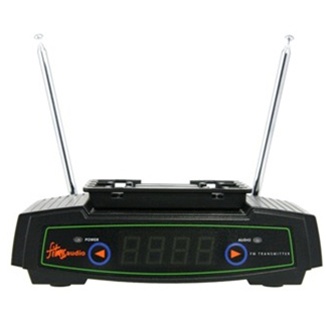
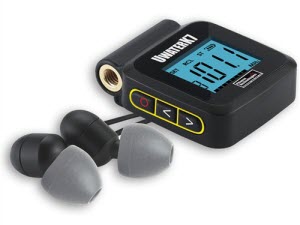
Hi Naomi – thanks for your question. We actually did this back in the late 90's when we first added Spinning classes. What you need is a FM transmitter like this http://www.avnow.com/WES_FM_Broadcast_System_p/wes-t-fm.htm and then have everyone tuned in with a FM radio receiver (old walkmans were FM) – your folks will need to dig into the back of their junk drawers.
Is that enough to get you going?
John
Back in the day (mid 1990's) when our club first introduced Spinning® classes, they employed this exact system. They had installed 24 Schwinn Johnny G Spinners (the original version) in a secluded corner of the fitness floor. A loud sound system with speakers was out of the question, so the Instructor's mic and music played through a FM transmitter. Everyone wore headphones connected to a Walkman tuned to the correct FM radio station.
This transmits both your music and voice to FM radios near by, tuned to the correct station.
Surprisingly it worked well. As long as you hadn't forgotten to turn off your Walkman the day before and were now scurrying around the club, looking for a pair of AAA batteries.
Talking between members was never a problem and there were no volume complaints with everyone having control of their own levels. The effect of having the Instructor's voice delivered directly into our heads was quite intimate as I remember. I'll never forget the classes lead by a particularly instructor (she's still an active Instructor and ICI/PRO member) who was very “breathy” in her class presentation 🙂
Working under the “everything new was once old” school of thought, could this be something you could offer in your studio? I'll bet if you asked, you'd find many of your members have an old Walkman shoved in the back of their junk drawer at home. Or you could buy a bunch to have for rental.
Indoor Triathlons are very popular here in the frozen north, offering club triathletes the chance to swim bike and run long before its warm enough to be outside.
In the past, the Life Time club where I teach used Spinner NXTs with a Spinning computer for the bike leg. Participants would run up from the pool, jump on a bike and pedal as fast as they can until the reached the prescribed distance. The clever one's figured out that the amount of resistance they used had no effect on how quickly the computer added mileage, so you had a bunch of flailing legs @ 130 RPM with no resistance = not really doing any real work 🙁
But not this year…
With all of our NXTs being replaced with Indoor Cycles with power, the participants in the Indoor Tri actually needed to “TRY” and ended up really working for their mileage this year!
I took this picture while I was riding a FreeMotion S11.0 at 115 RPM, but with no resistance. You can see in the display that even though I was pedaling very fast, I wasn't producing any power because I had zero resistance. No power = no speed and more importantly, no distance is recorded.
I talked with a couple of finishers about their experience, especially what the bike leg was like, compared to last year.
“It was a lot harder.”
“More like riding outdoors.”
“I completely over did it trying to keep up with the guy next to me. My legs were junk by the time I started the run.”
Ever notice how, if you teach on multiple brands of Indoor Cycle, your class presentation changes a little from one to the other? From the distance all the IC's from FreeMotion, Keiser, Schwinn and Star Trac, look pretty much the same. But you know better if you're teaching at more than one location. Each brand's bikes have their own unique characteristics:
The resistance systems react differently and the method for adding and subtracting load is different.
The consoles are all different in what information they display during and after class.
Is there a lap/stage button? How do you use it?
Hand locations & positions vary.
So why not help our ICI/PRO members learn the differences?
Do you spend any time practicing your classes? I realize that few of us have a lot of extra time. If you do – why not spend an hour of “ME” time, riding along with Dennis leading your ride. This may be the best 60 minutes you'll spend this week 🙂
Our membership really grows this time of year. So if you've been contemplating joining us here at ICI/PRO, you won't be alone.
Start your PRO/Monthly subscription $9.95 – no minimum. [wlm_paypalps_btn name=”Monthly-trial Product” sku=”E90D58D12B” btn=”pp_pay:s”]
Work Set Length: 13:44 + 7:17 recovery [21 minutes]
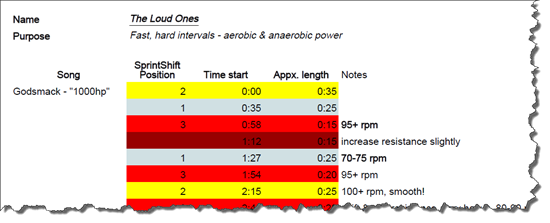
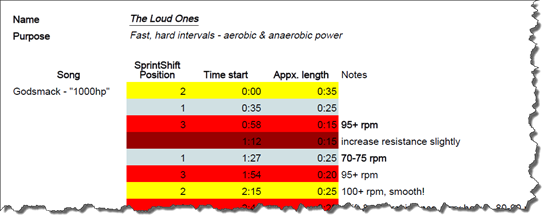
The Sprint Shift on the new Stages SC3 bike is your interval training solution. Left position for easy, Center position for medium, Right position for hard. Make micro-adjustments with the resistance knob during the interval. Could it be any easier?
Now, I am a big believer in training with power, benchmarking your effort, and documenting your progress. All three are important for successful long-term cycling training but people sometimes misunderstand my position as “all science, timed intervals — no fun.” That's not the case at all!
For the 3 songs below, all I would track is total distance traveled. My riders would hit “The Loud Ones” maybe once every 10 rides and see if they went farther. You could also use average wattage or average speed – it is still a benchmark, just not a complicated one.
As for the science, these are aerobic and anaerobic power intervals – near maximum, brief efforts with short rests. This makes you strong during the frantic parts of road races, during time trials on hilly terrain, and when you want to inflict some pain on your group ride mates. The ride gradually slows in cadence as the resistance and length of efforts creep steadily upward.
But don't think too much about all of that. Do a quality warm-up with 2 or 3 very short sprint-type efforts, tell your participants they are in for some HARD WORK, then just turn it up, follow the music's energy, and have some rough, fast, sweaty fun!
[P.S.: You really just have to feel the music to get the transitions. Don't try to follow the time stamps to the letter. But the Sprint Shift makes that possible! Call each position (left, center, right) “gear 1, gear 2, gear 3” if you like. Slam the lever into gear and ride hard!]
[P.P.S.: After “Little Man,” I like to throw in one long, steady effort, usually to “Animus Vox” by The Glitch Mob. You can take your pick of ‘finisher.']
I get the “Where can I get certified as a “Spin®”,”Schwinn®” or simply an Indoor Cycling Instructor?” question a lot. While trying to be helpful, more often than not my response is “I'm sorry, but you are asking the wrong person.” “The person you want to ask is the manager at the club where you would like to teach.”
Many people skip that step – here's why you shouldn't…
Sometimes I feel like Dr. Alfred Lanning from the movie I Robot where Will Smith's character, Detective Del Spooner, is quizzing Dr. Lanning's holographic image. The Doctor looks at him and says “I'm sorry. My responses are limited. You must ask the right questions.”
The right question is; “what do I need to do to teach a regularly scheduled Indoor Cycling class at my local club?”
UPDATE: It can't hurt to check first to see which studios & clubs are hiring. This Instructor jobs board is a great place to start 🙂
“That's a question I can answer” 🙂
I'll put this in the context of a question our daughter Abby, a Junior in college, asked us last fall; “I'd really like to write for a car magazine… and get to drive a lot of cool cars!” “How do I get a job like that?”
“My responses are limited. You must ask the right questions.”
“OK, so what would you suggest I do to get into the car business?”
“That's a question I can answer.”
Our advice for our daughter Abby was to find a company (any company) in the car business and see if they have some type of entry level job where she can get her feet wet. Luckily for Abby, her mother (Amy) had a friend who's husband (Brandon) is an area manager for Enterprise Car Rental. Not “Car and Driver”, but for a 21 year college junior, quite possibly the perfect place to get her start in the “car business”. Long story short, Abby met with the manager and learned that they offer a select number of summer internships. During this initial meeting she asked a lot of questions about what Enterprise is looking for in the people they hire. Armed with this “insider information”, she was able to successfully navigate a long interview process (there are hundreds of applicants) and she starts Enterprise's summer Management Training program next month 🙂 It's hard to say where it will lead, but it's a very positive start for a sharp young women.
I feel the same thinking applies to securing your first teaching gig; there are a lot of people who would like to teach, but few who will do the exploratory ground work where they can “ask the right questions”. It's really just the tried and true sales process that's been followed for thousands of years. Here are the steps:
Decide if you are willing to do whatever (within reason of course) it takes to secure a regularly scheduled class.
Identify your prospect(s) (potential customer). You are after all selling something here; YOU! There maybe only one location, or there could be a dozens near you. Don't rule out anywhere that offers Indoor Cycling. Your objective is to get a scheduled class. I shouldn't matter where and it may not be in the most convenient location.
Find the decision maker at the club/studio. This shouldn't be too hard; take a class there (everyone offers a free class) and ask the Instructor after class. It's important to be very direct with your intent; which is to learn who can say YES to you teaching there! Tell the Instructor that you are interested in learning about becoming an Instructor and you would appreciate knowing who makes the hiring decisions. That's all you want to learn from the Instructor – nothing more! Resist the temptation to ask if they are hiring – people tend to be protective of their “turf” and you want a friend, not someone who's fearful that you want to take their job. Be sure to get the Instructor's first and last name because you will need it later.
Repeat at every location. Rejection is much easier to handle if you have multiple prospects 🙂 Do yourself a favor and don't get emotionally committed to only one studio if at all possible.
Contact the decision maker (by phone or in person – never by email) with the objective of scheduling a short meeting where you can learn more about what the club looks for in an Instructor. That's it, nothing beyond the commitment to meet at a later date. You may say something like this; Hi Ms. Jones, my name is John and I took a class at your club last week. It was with (insert full name of the the Instructor here) and I wanted you to know that I really enjoyed her class and your club! Next you show him/her you're concerned about them; Am I catching you at a good time? I have a quick question I'd like to ask you. Wait for their response. If it's anything but I'm OK, offer to call them back when it's a better time. “What can I help you with?” I'm really interested in learning everything I can about becoming an Instructor. (Instructor's first name) told me you have a lot of experience in the fitness industry and I have a number questions. I realize you have a busy schedule but could we schedule a time for a short meeting this Thursday or Friday mid-morning? Always offer an either / or option, not a question that can be easily answered by NO. If the response is anything like “we aren't hiring any new Instructors” affirm this and again ask for the meeting; Sure, I understand that you aren't hiring now. I was just hoping to gain from your experience. It should only take 15 minutes or so… would Friday at 10:00am work for you? There's nothing wrong with being persistent! It must have taken Abby a month for her to get Brandon's commitment to the first meeting. We had to repeatedly encourage her to keep after him and in then end he told her that it was her persistence that caused him to finally agree to the meeting.
For many, securing the appointment will be the second hardest part of this process. With a meeting in hand you know the drill; show up on time, look nice, smile, etc… Keep your commitment to asking questions. Here are a few suggestions:
What certification do you require?
What makes for a popular Instructor?
Is there a certain type of Instructor your members appreciate more than others?
Do you feel you are missing/lacking any specific type of class format that would appeal to people who aren't currently members?
How do you decide on what types of classes you offer?
Do you have specific times during the year when you make class scheduling changes?
This isn't the time to talk a lot about yourself 🙁 Even if the manager gives you an opening “why do you want to be an Instructor?” resist the temptation to say too much. Keep your answers brief and end them with another question. People love to be interviewed and talk about themselves, so keep asking them questions.
How long have you been in the fitness industry?
Why did you first get into the fitness industry?
Do you participate in any events; triathlon, 5k, charity rides, etc.. ?
Then comes the hardest part (and only if you feel you've developed some rapport with him/her) where you ask a “If I could, would you?” question, as in; If I could get a (insert the certification they named) would you consider evaluating me as a potential Instructor? And then wait for the answer.
Many clubs and studios now accept an online certification. If they will you can get certified here.
If it's not positive, ask some more specific questions to learn exactly why and then thank them for their time and move on to your next meeting.
Please let me know if this was helpful to you by leaving a comment below – or visit indoorcyclinginstructorjobs.com to find your new class 🙂
// <