The debate over cardio vs. high-intensity interval training (HIIT) usually assumes that the issue is an either/or choice. In that debate, HIIT is usually compared to absurdly low levels of cardio exercise — not to the kinds of classes ICI-PRO instructors probably teach.
This post explores the evolutionary value of combining cardio and HIIT.
In his book Born To Run, Christopher McDougall reveals the blend of morphology, paleontology, anthropology, physics, and math that led to understanding how humans became the greatest distance runners in the animal kingdom.
There’s no way this short article could do justice to McDougall’s fascinating and detailed description of the emergence of homo sapiens over Neanderthals (they were parallel species), and the evolution of humans as supreme hunters — hundreds of thousands of years before the creation of the tools we associate with hunting (spearheads, bows and arrows).
A few of the evolutionary changes include:
– upright posture to allow deeper breathing and limit retention of sun heat
– the ability to release body heat through sweat, rather than panting like other mammals until they must rest or die of hyperthermia
– the ability to accelerate when the pursued animal has been run to exhaustion.
So human “persistence hunting” combined endurance running primarily, with some sprints. Humans evolved to run in conditions that no other animals can match, and it’s easier for us.
Good At Endurance, and For a Long Time
Endurance athletes can typically continue into what would be considered old age in other sports. In many cases, such as distance running, they can still out-perform teenagers or 20-year-olds until their mid-60s.
At his first double-marathon, the most notable thing my then-35-year-old coach, Jim Karanas, saw was the age of most of the runners, who were 45 to 55. He said it told him immediately that the ultra-run was more of a mental than a physical challenge.
When workouts are always high-intensity, over-training is likely. So are failure to recover fully and a high incidence of injury.
It’s also likely that someone will burn out after constant high-intensity work, making it feel like drudgery, instead of something to look forward to each day. Why not work out in a way that you’d enjoy making part of your schedule long-term? Why not create classes like that to bring your participants back over and over again?
Matt Fitzgerald, noted marathon runner and author, suggests endurance training primarily with 2 to 3 high-intensity trainings per week.
McDougall quotes researcher Dr. Dennis Bramble, who said, “If you don’t think you were born to run, you’re not only denying history. You’re denying who you are.”
But let’s not limit this to running. Endurance athletes of other types display similar results. Countless stories describe master’s cyclists in their 50s and up outperforming younger cyclists.
In his 50s, my coach raced against the cyclists in the 30-year-old category — because he found he could perform better against them than against the experienced racers his own age! Those guys kicked his butt when he was first starting to race.
He was also one of the few (and the oldest that weekend) to ride the notorious Furnace Creek 508 fast enough to qualify for RAAM.
So the choice isn’t really between short, intense intervals and long, slow cardio with a magazine. The right kind of training is not either/or, but both.
(The cardio, of course, should be hard enough to cause a training effect, not help you catch up on your reading.)
This perfect combination is effective, enjoyable, sustainable over the long haul, and entirely in sync with our evolutionary nature.
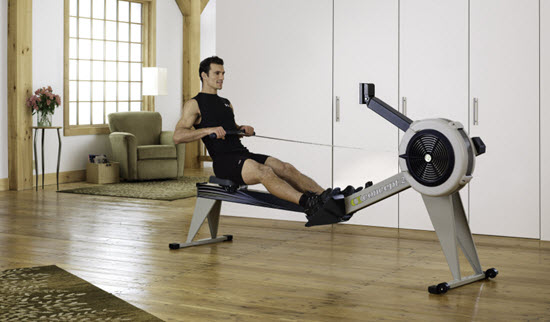
What do you do when you want to train but need a break from cycling? Indoor rowing is an excellent alternative. If you’re into power training, this is for you.
Most of my teaching of indoor cycling was done in Performance Max, a program that included both cycling and indoor rowing. I took the program as a participant for 14 years and taught it in a different location for 12. This post covers the basics of starting to row.
Truly, the only indoor rowing machine worth using is the Concept 2 Rowing Ergometer (“erg” for short). Yes, other rowing machines exist, but no one who rows takes them seriously. The Concept 2 is the gold standard. The current models are the D and the E (slightly higher off the floor). The longest-standing model is the C, which was the one-and-only for many, many years. (I have one, love it, and wouldn’t trade it for a D for anything!)
If you have access to a Concept 2 erg and are new to rowing, learn correct technique from the start. It’s easier to learn it the right way than to unlearn the mistakes that people commonly make when trying to row on their own. If you teach at a gym with an instructor who really knows rowing, that’s ideal because you’ll get good instruction and correction. Years of teaching rowing have shown me that correction is essential.
If you don’t have either an erg or personal instruction, visit the superb Concept 2 website (concept2.com). This 5-minute video teaches rowing technique step by step and repeats the steps clearly and slowly.
There’s also an “erg finder”. Enter your location, the type of facility you want (e.g., health & fitness club), and the distance you’re willing to travel. You’ll get a list of clubs with addresses and the number of available ergs there. You might want to call to verify the info. (When I looked for ergs in San Francisco, the club I taught at for years was listed as having only 1 erg; that was wrong. Farther down the list, though, the same club was listed again, accurately, with 17.)
Once you’ve learned to row, you can take advantage of Concept 2’s Workout of the Day. You can choose short (30 minutes), medium (40-45 minutes), or long (60+ minutes). It’s available on the website daily — or can even be delivered to your inbox.
A few points to keep in mind:
– Rowing is not an upper-body activity. It’s a full-body activity that centers on leg power. Sliding seats were added to rowing shells in the 1870s to optimize the superior power of the lower body. The best training I’ve heard on this came from a Performance Max instructor who rowed on the U.S. National team: “The arms are an afterthought.”
– Rowing has a definite learning curve. In the beginning, it may feel frustrating not to have sufficient power in your stroke to reach a high heart rate. That will change with practice. Believe me, rowing heart rates can go very high, typically higher than in cycling.
– Because of the learning curve, novices often use a higher damper setting than necessary. The damper opens the drum to let in more air, increasing the resistance. Skilled rowers, however, use a moderate setting and create effort by accelerating quickly at the start of the stroke (the catch).
– The most common mistake is bending the knees too soon after you finish the stroke. (This will make sense once you’ve watched the video or gotten some instruction.) It’s almost instinctive and can be difficult to correct. One effective correction is to stop rowing and hold for 2 seconds after you’ve extended the arms before letting your knees bend. Repeat with each stroke for a few minutes.
– Rowing should NOT be done with a straight back. Curving the shoulders slightly forward will engage your core and protect your back. A straight back is more likely to be injured.
Holding an even and consistent pace can be difficult to learn. Jim Karanas, who created the PMax program, always said rowing builds character: With every stroke, the computer tells you you’re a failure [i.e., your pace is off], but you have to keep going.
Working on pace feels like moving meditation. Skilled rowers doing sustained efforts even look relaxed and meditative.
So here’s to a character-building, meditative yet exciting alternative to cycling. I think you’ll like it. You might even find yourself adding it to your training on a regular basis.
It seems I made a few enemies on Wednesday. I subbed a “Housewives” 9:30 am class that had a bunch of talkers in it. I'm not too tolerant of people disrupting my class. So I told asked them to please save their conversations until after class. As it turns out, a regular of mine overheard a conversation the following day, between the scheduled Instructor and a few of the participants. Though you might enjoy seeing his email to Amy describing the exchange…
John Macgowan is on the unofficial Eden Prairie Housewives “hit list”. You may want to let him know to keep a low profile and wear a disguise if going out and about in EP.
Thursday morning during his spin class he mentioned that he subbed for XXXX at 9:30 Wednesday. I had scheduled interviews with some candidates for a job and used the restaurant at LTF (Life Time Fitness where I teach) this morning.
Had a two hour break so was able to go to XXXX's 9:30 and those housewives were giving XXXX hell because “the sub instructor” (John) worked them too hard and (here is the best part) seemed annoyed because they wanted to carry on conversations during the class.
I personally have complained to XXXX multiple times about the nonstop talking in her class and went so far as to call XXXX (Dept Head) about it. I held my tongue for as long as I could this morning, then I let those housewives have it.
You (Amy), Adam and John run organized classes, XXXX's tends to be a yard sale, but she is a really strong instructor. This morning I proceeded to say something along the lines of if you want social hour go upstairs and have it there and don't criticize the instructor for properly managing a class.
I also referred to the loudest and most annoying lady in the class as a manatee who should be more focused on the workout and less on annoying the entire class. Needless to say, I probably need a disguise now as well.
Kind of made my day to hear John overwhelmed them. Hope you all are well. Happy Friday!! See you tomorrow.
If you're one of the 10,000 Instructors who teach at one of the 300 clubs or studios currently using GroupExPRO to manage class subs and Instructor communications, you can skip listening to this Podcast.
If you're not, please read on…
For Instructors who are tired of; sub requests for class formats you don't teach, the endless string of needless Reply to All mass emails that fill your inbox, the difficulty you have simply finding a sub or worst of all (at least for me) not being notified when there's a class you can teach.
Or maybe you manage your club's Instructor team and are completely overwhelmed by Instructors who can't (or won't) find subs for their own classes and expect you to pull a rabbit out of your hat at the last minute to cover their class – or end up teaching the class yourself.
Either way you'll want to take a few moments to listen to this interview with Schwinn Master Trainer Shannon Fable. Shannon is a long time group fitness department manager who, together with her husband, created GroupExPRO to solve the problem of managing the continuous need for fitness class subs.
If you can relate to the frustration I express during this interview Shannon has a simple way for you to forward information about GroupExPRO to the proper person in your organization. Click > indoorcycleinstructor.com/subhelp to be taken to her referral page. Add your info and your manager's – then please add a short note about how you see this improving your club or studio.
As her way to thank you for your efforts, Shannon will be sending you a $50.00 gift card if your recommendation leads to GroupExPRO being implemented in your facility.
Hey John & Amy, I have an audition coming up with LIFETIME for cycling instructor. OK, I'm given 3 minutes to present my best ride. Crunch time. Any suggestions or advice on this?
How exciting for you! Amy and I enjoy teaching at Life Time with their dedicated cycling studios, great sound systems, video projectors and fabulous bikes.
NOTE: What follows will apply to any Instructor audition, at any club or studio. 1) Memorize the LTF mission statement
Our Mission is to provide an Educational, Entertaining, Friendly and Inviting, Functional and Innovative experience of uncompromising quality that meets the health and fitness needs of the entire family.
This isn't about drinking the Life Time Kool-Aid. It's showing your determination to work for Life Time. I'm not kidding when I say memorize it as you may be expected to deliver it as part of your Instructor audition.
2) Understand that first and foremost your role as an instructor is to deliver a fun and entertaining experience for the members. You may teach the most real/authentic cycling class on the planet, but if it's boring because you feel constrained by focusing too much on what not to do, it will show in your class presentation and your chances of getting hired are slim.
3) Be prepared to teach a class that's appropriate to the audience. LTF wants to see that you are flexible as an Instructor and can teach appropriately to varying member groups. You may teach a very “cycling specific” class, but if your audition is to a room full of housewives during a 9:30am class see #2. That said you should be familiar with the LTF Heart Rate chart – 5 Zones with the top of Zone 3 being AT (it isn't LT at LTF) and give a few HR based cues.
Beyond that I would…
4) Choose an energetic song, without lyrics, that you love to teach to. But don't over think it 🙁
5) BE ENERGETIC! LTF doesn't hire dead fish. If it takes an extra cup of coffee then drink it. Your excitement and your energy should radiate from you like a spotlight.
6) Stack the Deck! If at all possible get some of your friends in that class. If you can't, I would be sure to get there early and connect with a few participants who are setting up in the front row. Nothing says “Friendly and Inviting” like connecting (eye contact) with members during the class and it may help reduce your nervousness to have someone to focus on. I had Amy come to my audition and having her there in the class, to draw energy from, was invaluable.
7) Teach an intense, simple profile. Think K.I.S.S. Maybe a three step ladder profile where you have them up, out of the saddle, for the last 30 seconds when you…
8 ) Get off the bike and quickly work a few riders in the front row. Clap and congratulate your students at the end and then thank them sincerely for taking your 3 minute class!
Hope that helps and feel free to ask other questions.
I'd say good luck with your interview, but you don't need it… you're going to be awesome 🙂
// <