So which fitness club or cycling studio is looking today to hire a passionate & talented Indoor Cycling Instructor?
EVERY. CLUB. AND. EVERY. STUDIO.
How can I say that with such conviction, without actually surveying every club/studio on the planet?
That's easy 🙂 Every successful business owner/manager I know, is continuously looking to hire good people. It doesn't matter if they have a “help wanted” sign hanging in the window or not.
EVERY. BUSINESS. IS. LOOKING. FOR. GREAT. PEOPLE.
Why is this important for anyone interested in securing their first regularly scheduled class? Because, quite simply, it's important for you to understand (and more importantly believe) this when you approach a studio owner or manager. Having the perception that they're buying, what you're selling, is a great confidence builder.
So is 2017 going to be the year you land your first teaching gig? Or maybe the year when you'll decide to move beyond your comfort zone and audition at the hot, new studio opening down the street?
Either way, I'm thinking some of these articles will be helpful for you.
I've felt that it was only a matter of time, before one of the mainstream Big Box clubs added an official Rhythm and Movement class offering.
Last month Life Time Fitness introduced AMP Cycle – from this video it appears to be a no-holds-barred, full on party, that will engage the same participants who are drawn to the massively popular studios offering similar class formats. NOTE: I haven't experienced an AMP Cycle class yet, however I plan to ASAP.
https://youtu.be/wRMgT-UZf9U
There were three important points that I found interesting in my interview with Rob Glick (LTF's Senior Director of Group Fitness, Yoga and Cycle). First how Rob placed their three Indoor Cycling offerings along a continuum…
AMP Cycle – Far Left > An entertaining party with a purpose!
EDG Cycle – Center > A nice blend of entertainment and metrics.
PWR Cycle – Far Right > Focused training, with no fluff.
… second – Instructors aren't forced into teaching a class format they either don't like, or aren't comfortable teaching…
… and third – participants enjoy a choice of three different class types.
Listen to the complete interview with Rob Glick below and then share your comments below.
If you're interested in becoming an AMP, EDG or PWR Cycle Instructor with Life Time Fitness, here's the link I promised Rob I'd provide to search for jobs in your area 🙂
AMP Cycle Instructor Job Description
Hey cycle junkie! So, you have an interest in becoming our next artist on the AMP Cycle team? Well, that's awesome and we can't wait to meet you. If you like loud music and choreographed high-energy workouts, AMP is for you!
In AMP we’re all about the beat of the music and the rhythm of our riders. AMP is an addicting, sweaty, party-like workout to challenge your Ambition, Motivation, and Passion. The best part of instructing this class is you get to be you…period. Engage with your audience! Be authentic! After all, class is all about connecting with yourself and the positive energy in the room. If this sounds like you, apply and audition to be an AMP Cycle Instructor at Life Time Indoor Cycle. We offer training, ongoing continuing education, support and resources to help you be a successful instructor. We believe we are stronger together and take pride in supporting our instructors while helping them be the best they can be! Are you ready to join this rapidly growing team? There’s an AMP Cycle class waiting for your encouraging voice and energetic personality. We're so excited to see what you got.
Not every binge eater has binge-eating disorder (BED). But even those who binge less frequently than people with BED, or on less food, may struggle to control their eating.
That can be especially true when holiday treats — and holiday stresses — are all around us.
My PhD research was on women with BED. Before that, I ran a class for women who didn’t have BED but still binged at times. They were longing to change their eating behaviors. The class was called Food & Eating Recovery.
This post is on how binge eaters handle cravings. You may wish to pass this along to any class participants who have told you they have trouble controlling their food.
Binges and Cravings Were Familiar To Me
If you’ve read my book Stronger Than Sugar — or if you read my articles regularly — you already know that I’m a recovered sugar addict. In the bad old days, I did plenty of sugar-triggered bingeing.
I’ve also resisted many cravings. They showed up frequently. I wanted sugar almost all the time back then, but was able to resist most of the cravings for most of the day. (But not all days.) No doubt that helped me limit the number of my binges.
My dissertation included lots of evidence that eating sugar triggers binges. That was certainly true for the group that did not eliminate sugar during the 8 weeks of the study.
What I Learned Was New To Me
When the topic of cravings came up in the F&E Recovery class, we talked about resisting cravings. I figured everyone would relate to that behavior because they’d done it, too.
Was I wrong!
Most of the women in the class looked at me as if I were speaking Klingon. So eating behaviors were different in this group of bingers.
Instead, the notion of ignoring a craving seemed to be foreign to them. When they craved a specific food, they ate it — or as close as they could get to it at the time.
Did That Affect Their Weight and Health?
It did. As you might imagine, the women in the F&E Recovery class who gave in to all their cravings were more likely to be overweight. In many cases, they were obese and had metabolic conditions or other health issues.
As my research showed, sugar has a lot to do with both weight and health.
Regarding weight, the vast majority of cravings were for sugary foods. The sugary foods the women ate when they craved sugar were typically also high in fat.
Why? Studies of “sweetness ratings” show that fat makes sugar taste sweeter. That may be one reason that a craving for sugar will lead to ice cream or brownies, rather than a roll of Lifesavers.
Of course, the fat added extra calories. But that wasn’t all.
Besides the calories, sugar triggers the release of a brain chemical — endorphin — that increases appetite. So giving in to a craving was likely to result in a high-calorie episode for the participants.
Sometimes — and for some of the women, often — it was a full-fledged binge.
Because sugar’s so addictive, many women in the F&E Recovery class were hooked on it. When they tried to go without it, they’d have more cravings. And, not surprisingly, more sugar, more fat, and/or more binges.
What’s the Best Way To Handle Cravings?
If you’re tough enough to resist, you might try doing that — as often and for as much of the day as you can. It can help with weight control and health.
But that may not work for you. I’ve previously posted an effective, short-term solution for cravings: liquid B-complex. (Please check with your doctor before trying this.)
For a long-term solution to cravings — in other words, eliminating your cravings completely — a change in diet is probably the answer. I can help you make that easy. Just visit www.FoodAddictionSolutions.com/Coaching and request your free Eating Empowerment call. Find out how simple it can be — and how great you can feel — once you’re free of cravings and completely in control of your food and eating.
It seems like just last month I was busy completing the last few of the 20 credit hours (2.0 CECs) I needed for my ACE group fitness Instructor renewal. Actually it was two years ago and at the time, I took advantage of the free CEC's offered by Team ICG.
While I was scrambling again this year to complete all my credits, I figured I should share my bookmarked sources for relevant online courses with our ICI/PRO members. All of these educational offerings carry ACE CECs and credits with other certification providers.
$29.00 for these 0.4 CECs is a great deal!
Team ICG
While ICG's CECs are no longer free, they are still a real bargain at $7.25 to $10.00 per credit hour. That's about half what I'm used to paying. There's a bunch of interesting study topics available like; periodization, music & motion, heart rate training and overtraining. Click over to www.teamicg.com/en/team-icg/education to learn more and you'll need to scroll down to find the CEC courses.
Cycling Fusion
I've been a fan of Cycling Fusion for years (that's me in the white do-rag) and they offer multiple, comprehensive online certifications. Existing instructors who want to learn to teach with Power will benefit from their excellent Power Training certification.
Parkinson's Cycling Coach
Coach Kathy Helmuth's online certification prepares instructors to successfully lead a Parkinson's Cycling class.
The research is clear — physical activity has been shown to reduce the symptoms associated with Parkinson’s Disease, (PD for short).
Multiple studies point to the benefits of exercise in improving muscular strength, flexibility and balance with subsequent functional improvement in individuals with PD. However, the information in the literature suggests that physical activities require some specific characteristics for this population. Exercises focusing on strength training, balance, aerobic conditioning as well as the use of external cues during gait can result in overall improvement in motor performance and quality of life related to PD patients’ health.
The last post offered real-life examples that suggest the way you do anything is apparently not the way you do everything — in contrast to the common saying to the contrary.
I’ve saved the worst for last.
When I ran a weight-loss program in Silicon Valley, many of the participants were engineers, all very smart. Over the years, we had some excellent groups who followed instructions and achieved their goals, and also clueless groups.
The clueless groups couldn’t seem to manage anything pertaining to the training program.
They never showed up on time and were often up to 45 minutes late in a 90-minute program. They would forget to bring their workout equipment with them — heart rate monitors, cycling shoes, water bottles, towels, and more. They were undisciplined about making time for training on their own, between the scheduled studio sessions. They frequently failed to log their food as required. Some even had difficulty focusing on the training.
I asked one particularly scattered group to please start showing up as if they were doing it on purpose.
Clearly, people who performed their jobs with the same haphazard incompetence would be promptly fired. But these guys all had jobs and seemed to be good at them.
So the way you do anything is not necessarily the way you do everything.
How Can This Help Your Participants?
What have they done with great success? It may be any victory, small or large.
Are they great at planning the day? At making the most of in-between moments — spare blocks of 5 to 15 minutes, for example? They can find some stretching or strength exercises to do standing or seated, in office attire. (They do exist!) They an find a short but intense cardio workout to fit in first thing in the morning, or in the evening on days they can’t make it to your classes.
Are they good “just in case” people? Suggest that they pre-pack a gym bag and leave it in the car, even on days that seem too crowded for a trip to the gym. You never know. And if it’s packed and ready, they’ll never forget a key item.
Are they disciplined enough to get up an extra 15 minutes early? Suggest they wake up and immediately head to the kitchen and eat real food. It’s far better than waiting and grabbing something convenient but junky, like a granola bar, as you run out the door.
Bonus tip: Tell them to stop buying granola bars.
Are they adventurous enough to get away from standard breakfast meals? They can try healthful dinner leftovers for breakfast (something other than pizza and beer, right?). Seriously, if they start the day with protein and vegetables, they will probably notice a big difference in energy and mental focus.
Are they good at planning and pre-planning meals? Why not suggest they prepare lunches and snacks on the weekend, enough for a couple of days? Repeat midweek.
Many examples can be found in virtually anything they’ve done well. The obvious, but overlooked, trick is simply to assess their wins for the skills that made them possible. Apply those skills to fitness and wholesome food.
Then it’s easy to make them part of their lives — in a way that’s already comfortable for them. Maybe the way they do anything will, in fact, become the way they do everything.
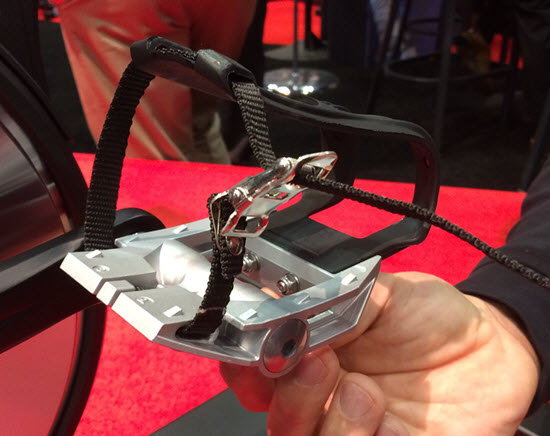
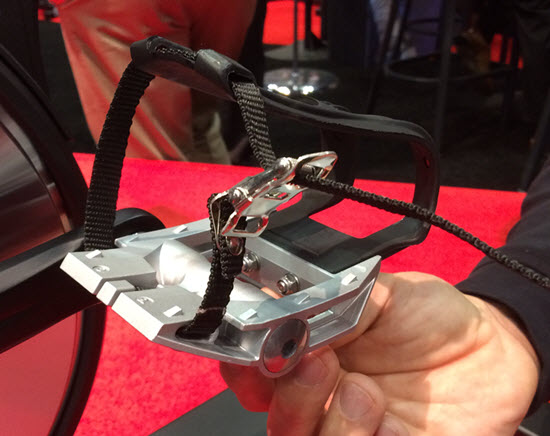
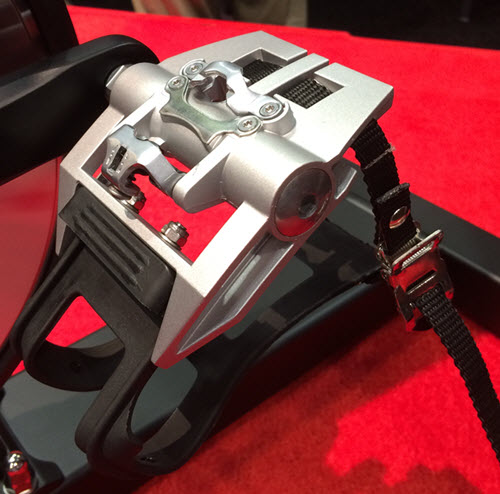
When I'm at IHRSA (which I was last week) I spend a bunch of time searching for the next “Big Thing” that I can share with you. What I found is a rather small and yet indispensable component of the bikes we ride – Keiser has developed a new Indoor Cycling pedal that looks awesome!
As the major point of contact, Indoor Cycle pedals take a lot of abuse in our classes. They're kicked, torqued, sweated on, rotated millions of times and rarely maintained. I can't say for certain if this is universally true, but I've gotten the impression that the OEM pedals shipped with many bikes are a bit of an afterthought = manufactures don't invest much development into the two sided (SPD/Basket) pedals they supply. They end up failing after a year or two and need to be replace, requiring a reasonably large investment – 50 bikes x ~$80.00 = $4000.00 – way too much and too soon IMO 🙁
Feel free to correct me if there are specific instances where you feel I'm wrong about this.
Clubs and studios in the past would often replace the OEM pedals with the Schwinn Triple Link – I call them Red Pedals – that offered two sided cleat engagement for riders with either SPD or LOOK Delta equipped cycling shoes + the option for plain old tennis shoes. If you are currently using these pedals and don't have one of my Red Pedal Tools to safely and easily remove those $%^& shoe baskets, you can order one from my distributor Sportsmith.
Later Spinning® began manufacturing & selling their version of the Triple Link – the TRIO. FYI: The TRIO is an enormous improvement over the Schwinn pedal. The primary reason being the TRIO has much larger bearings and should offer much longer service life. Unfortunately my Red Pedal tool doesn't work with these, so I recommend purchasing the TRIO QR which includes a clever little red lever to simplify removing the shoe basket.
NOTE #2: The LOOK Delta cycling shoe cleats found on both the Schwinn Red Pedal and Spinning TRIO pedals are pretty much obsolete – very few cyclists continue to use them. LOOK no longer manufactures pedals using the the Delta cleat – the new version is the KEO. KEO's look similar to Delta's and appear to work, however they do not interchange and attempting to use KEO cleats with either the Schwinn or Spinning pedals creates a real safety issue.
NOTE #3: Hard-soled cycling shoes with exposed cleats of any type are dangerously slippery on smooth/polished floors. I've personally gone down a few times at Life Time on their bamboo floors = they really don't belong in many cycling studios. For that reason I always encourage studios to only offer two sided pedals – SPD on one side and shoe basket/toeclip on the other.
Has Keiser re-invented the Indoor Cycling pedal?
I've gotten to know Keiser's founder Dennis Keiser over the 7 years since I first interviewed him about the then new Keiser M3. Being a real gadget guy, I have have been continuously impressed by his commitment to manufacturing very high quality fitness equipment – the M3 has to be the one of the most reliable Indoor cycles ever built.
It was explained to me that this new double sided pedal was designed from scratch to be the most durable pedal ever made:
Completely rebuildable – notice the replaceable SPD parts held together with screws, not rivets
Corrosion resistant cast aluminum body
Stainless steel axle is specially heat treated
Quote from Dennis; “the best bearings we could find”
The small angled tabs on the platform make it easy to slide your show in, but not out = improved safety.
They even designed the pedal so replacing the strap is easy 🙂
If I had to bet, I'd wager that these replacement pedals will outlast the bike they're installed on. No pricing information yet – I'll be sure to pass it on once a hear.