by John | Oct 11, 2019 | Engage Your Students, Instructor Training, KEEPING IT FUN, Promote and Build Your Class, Your Fitness Business
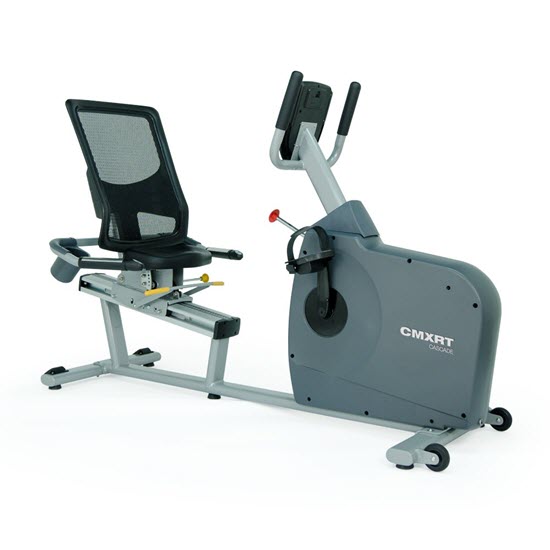
Would a few of these recumbents make your class more inclusive?
Would you agree that Indoor Cycles are a poor method/modality of exercise – for some populations?
There's a long list of people who would never consider participating in our classes, or even riding an indoor cycle alone at home. There's a bunch of reasons:
- Physical limitations
- Obese/overweight
- Existing injury
- Just plain afraid of that skinny, little, bicycle saddle 🙁
So, would it make sense to add a few recumbent cycles to your studio?
The reason I'm asking is because I met a great guy at this past IHRSA convention. John Kennedy's company, Cascade Health and Fitness, manufactures that recumbent cycle pictured above. He shared his idea to incorporate recumbent indoor cycles, into a traditional indoor cycling class, to accommodate people who won't or can't ride a conventional Indoor Cycle. I'll admit, at first it sounded like a crazy idea to me. But the more I thought about the potential to make our classes more accessible I got excited.
That would mean more butts-in-seats = people exercising. I'm all for that!
The first place I can see recumbents making a positive impact is in Parkinson's Cycling Classes. Parkinson's Cycling Coach Kathy Helmuth has taught me that many people suffering with PD have physical limitations.
The symptomatic relief that comes from cycling isn't available to someone who can't ride a typical cycle. A recumbent is completely different; a big comfy seat that sits low and a step-through frame that anyone who can stand should be able to mount. I think this could be a way to make PD cycling classes more inclusive. Awesome!
What about your run-of-the-mill cycling class? Would a recumbent work there too?
I've got no idea, so let's find out!
We're conducting an experiment
We're looking for two studios to participate in a trial to see what happens when you add a few recumbents to a cycling studio. John has offered two of their recumbents at no cost + you'll keep them in the end.
In exchange they're asking that you:
- Install the recumbents in your studio and make them available in as many classes as possible.
- Experiment with different class formats, profiles, cuing, etc. You'll be charting new territory here and I'm happy to help you as much as possible.
- Actively promote this new accommodation to your customers – running the trial to see what happens for two months.
- At the end of the trial you will be interviewed by me on my podcast We will explore what worked and what didn't, your ideas for improvements, etc…
- You'll provide a few short video interviews, where you discuss these classes with your actual participants.
Is this something you'd consider?
Then contact me and we'll discuss next steps.
Originally posted 2015-04-13 15:44:38.

by John | Sep 12, 2018 | Health and Wellness, Instructor Training, Master Instructor Blog, Promote and Build Your Class, Training With Power, Your Fitness Business, Zone based Heart Rate Training

How cool would it be if your insurance company paid for indoor cycling classes?
A national policy of Prescriptive Exercise would be the holy grail* for small studio owners.
Imagine; A new client walks in with her doctor specified exercise regimen for you to “fill”, just like at a pharmacy. As an approved provider, you and your studio would provide the required exercise and then bill the clients insurance company… and not at your normal class rate – at a much higher rate in recognition of your fitness expertise.
A fantasy? Nope**, not if you're near The Wellness Institute in Winnipeg Canada. Doctors there are actually writing detailed prescriptions for exercise. How cool is that?

Doctors at a unique medical facility in Winnipeg are starting to write some unusual prescriptions.
“A lap a day keeps the doctor away” is one of the mottos at the Seven Oaks Wellness Institute (SOWI), a fitness facility attached to the Seven Oaks General Hospital on Leila Avenue, where doctors have started prescribing exercise instead of pills.
Dr. Kevin Saunders is one of the founders of the SOWI and the medical director. He said exercise is an effective treatment for all kinds of illnesses, including hypertension, Type 2 diabetes, high cholesterol and even some forms of cancer.
The facility offers clients a more holistic approach to fitness, helping people from all walks of life to understand what kinds of exercise they should be doing, and what they need to avoid if it puts their health in jeopardy.
You'll note that what Dr. Sanders is targeting with this program are Special Populations of people who would benefit from physical activity. I'm guessing you'd have a little trouble getting a prescription for a USAT Triathlon coach to get you ready for your next Ironman 🙂
What has me most excited here is the potential for prescriptive exercise for people suffering from Parkinson's Disease. It's been shown repeatedly that people of all ages with PD respond well to Indoor Cycling classes. Especially classes that are designed and taught by a Parkinson's Cycling Coach. Indoor Cycling studios already have the necessary tools to conduct this hugely beneficial classes. They're best held around 10:30 – 11:30 in the morning, which is normally a time without a scheduled class
I did some research and found an excellent article here at emedicine.medscape.com that explains in detail what Perscriptive Exercise is (different from physical rehab) and includes a number of areas where exercise is typically prescribed by a physiian.
Background
Exercise prescription commonly refers to the specific plan of fitness-related activities that are designed for a specified purpose, which is often developed by a fitness or rehabilitation specialist for the client or patient. Due to the specific and unique needs and interests of the client/patient, the goal of exercise prescription should be successful integration of exercise principles and behavioral techniques that motivates the participant to be compliant, thus achieving their goals.[1, 2, 3, 4, 5, 6, 7]
Components of exercise prescription
An exercise prescription generally includes the following specific recommendations:
-
Type of exercise or activity (eg, walking, swimming, cycling)
-
Specific workloads (eg, watts, walking speed)
-
Duration and frequency of the activity or exercise session
-
Intensity guidelines — Target heart rate (THR) range and estimated rate of perceived exertion (RPE)
-
Precautions regarding certain orthopedic (or other) concerns or related comments
Note that a properly structured, Power based Indoor Cycling class would easily include all of the stated components.
Consider this simple prescription:
- Type of exercise or activity – Indoor Cycling class.
-
Specific workloads – Below, @ and Above riders observed 4 minute
Best Effort PTP Watts
or FTP if known
-
Duration and frequency of the activity or exercise session – 3 x 60 min classes weekly
-
Intensity guidelines — each 60 class to include: 5 x 5 min intervals @ PTP, 3 x 1 min intervals Above PTP, that remainder of class Below PTP and Above VT1 (staying aerobic) + adequate recovery after each @/Above interval.
-
Precautions – None
What you'd have is essentially an endurance training program, written by an MD.
Taking this further. If you were to incorporate the rider's performance data capture, from a Display Training system like Performance IQ or Spivi, your doctor could review your progress = make informed recommendations for future exercise prescriptions. Wouldn't that be awesome?
If you can offer any additional information about prescriptive exercise, I'd love to hear from you!
*Yes, I'm aware that many insurance programs offer a discount/rebate for club dues – if you attend a speciaf number of days a month. This is very different.
** I don't know the specifics of Canada's reimbursement system, but I'm looking into it. I have asked for a representative join me on the Podcast to discuss all of this.

by John | Aug 23, 2018 | Best Practices, Instructor Training, KEEPING IT FUN, Learn Leadership Skills, Master Instructor Blog, Promote and Build Your Class

In part two we identified how the talkers act the way they do because of; cluelessness, a lack of respect for you and your class or they're challenging your position as the leader.
Much of this could also apply to the texters/bring their own music/do their own thing people.
I defined the three possible reasons WHY people act disrespectfully as:
- They don't know they are acting disrespectfully…
- They don't care they are acting disrespectfully…
- They're disrespecting you on purpose…
Because you've made it here to part three, I'm guessing you'd like to know my ideas on how to solve these problems. But first, a few words of caution.
My recommendations below will be difficult for many Instructors, especially for those of you with a short amount of teaching experience. They require you to be the Leader your class expects you to be – not just one of their friends who happens to be on the bike in the front.*
I realise that this will be difficult for many Instructors who would prefer everyone just get along… but they won't > that's why they need you!
These suggestions may conflict with your natural instincts to protect the feelings of others. Attempting to implement these solutions may make you feel uncomfortable. I've heard it expressed dozens of time; I really wish I could get these people to stop disrupting my class… but I don't want to offend anyone 🙁
That's why I broke this up into a series and spent so much time on explaining WHY people are acting the way they do. My hope is that through this process you would already be coming up with these solutions yourself, or at least understand that at times being the leader is hard and not always pleasant.
Your class participants and manager/owner are expecting you to be the leader of your class.
So ICI/PRO Members let's end these Talker problems today!
First – Set your microphone volume level correctly
I can't tell you how many classes I've been in, where I wanted to run up and turn the Instructors mic level up… way up. Your voice must be the most dominant sound in the room!” IDEA recommends a mic level 10 decibels over the music. Your amplified voice should be clearly heard and easily understood, over the music.
Many new Instructors (and some not so new) are not comfortable hearing themselves through an amplified sound system, so they keep their mic level low. Do whatever you need to correct this – today! If you're a manager/owner please offer to audit sound levels for your Instructors > many rooms end up with a cone of silence, shielding the Instructor from accurately hearing their voice/music ballance – ultimately what the class is hearing.

Get help to properly set your voice/music levels.
Your class needs & wants to hear your big strong, confident voice > weak, quiet voices are very easy to talk over and this alone may solve many of your problems.
Second – don't talk over the lyrics
If two people are talking at the same time, which one is the leader?
Neither
You are diminishing who you are as a fitness professional and what you're trying to communicate, by competing with the voices of Bono, Pit Bull, Nicki Manaj, Ellie Goulding or whoever else you're playing. Talking over them forces your riders to have to choose between listening to you or their favorite singer. You'll lose with some and they'll potentially tune you out. Others, who can't understand what you are saying, just might decide to start a conversation that they can hear – with the person next to them.
Third – keep your cues short and actionable
Ever been at a party where you were stuck talking with “that person” who never seems to run out of words? What do you do? When I'm in that situation, I'll listen respectfully for a few moments and then I'm looking around for someone to rescue me.
I'm convinced that Instructors lose control of their classes for the same reason. I've seen it happen. She/he drones on and on to the point where riders just shut them out. Too much talking = you lose people. Once they've lost interest in what you have to say, it's natural to turn and engage with the person next to them. That is until there's a “SQUIRREL” moment that catches their attention.
Are you with me so far?
Excelent. Suggest trying these in order and you'll soon be teaching to the quiet, focused class you dream of having. …
#4 Solving – They don't know they are acting disrespectfully…
This one should cut out 60% or more of the talking > if you do it consistently in every class. You must firmly and clearly explaining that conversations are not allowed after the initial warmup.
Say it with me with a bib smile: We run our studio like a movie theater. Now that our class has started, talking and other distractions should stop. Please, no further conversations until after class has ended.
PERIOD… END OF SENTENCE!
I know this sounds really simple and it is. Your class isn't (and can't be) a democracy where everyone gets a voice. It should be a dictatorship with only one voice – YOURS!
If you don't set clear expectations, how can you expect people to behave properly? You can't. If you have a talker problem (and I listened to a recording your class) I'll bet you don't say anything, or at best you mumble something unintelligible that no one listens to.
If after your warm up you still have talkers, I want you to clearly tell them how it makes you feel. Remember, this group of talkers just doesn't realize the negative affect their talking has on you and the class. I've personally found this to very effective. A man, talking about his feelings? I better listen.
Turn the music way down (almost off) and say along with me: Can I get your help here? Pause long enough to get the attention of the talkers. Look directly at the talkers and say; It's really hard for me to teach this class when when I'm competing with the two of you talking. Can you understand how this can be difficult for me?
The temptation is to address the whole class (there's that fear of offending someone) rather than communicate directly toward the talkers. Is that fair to the rest of the class? No. Demonstrate your leadership here by confidently addressing the actual people who are causing the problem.
For the next two (#5 and #6) you'll need the full support of your owner or manager because both of these could get ugly**. Which means you should have already discussed this problem with them and they agreed that the issue needs to be corrected.
#5 Solving – They don't care they are acting disrespectfully…
Members who feel entitled and don't care might not respect you, but they will care if you shame them (just a little) in front of other members. I used this method a few weeks ago at a class I subbed. The aftermath was overheard by another member who's email to me is part of this post; It’s a good thing I don’t teach in New Jersey .
After making specific requests for people to stay quiet and focus on the ride, I turned down the music – which makes my voice seem even louder – and I pointed directly at the people located around the two talkers. I asked them; are you all OK with those two talking? This resulted in a bunch of frowning faces vigorously shaking side-to-side. NO! Then sitting up, with both hands extended, palms forward, I made a meek, squinty face and said; I'm sorry, but they don't want you talking during class. And then got right back to my cuing as if nothing ever happened.
Both women looked at each other with stunned looks on their faces and we enjoyed complete silence for the rest of class. I do hope the regular Instructor will carry this policy forward > so I don't have to repeat this exercise again.
Why does this work, when making general statements to the whole class doesn't? The first is probably obvious; no one likes being shamed in front of their peers. These rich members might not respect you, but they do care about the opinions of those riding around them.
The second reason this works is that you are supporting all the non-talkers who are too polite to say something. Don't be surprised if you are thanked multiple times after you give them the chance to show their disgust for the Chatty Cathys who are disrupting your class.
#6 Solving – They're disrespecting you on purpose…
When nothing else works, then you're left with two choices and neither is easy:
- Confront them directly and they stay
- Confront them directly, they leave and never come back
You and your manager need to be OK with either result.
You've probably figure out that I have a very low tolerance for nonsense or disruptions in my classes. As a result my participants are all very well behaved 🙂 I've learned that people who are challenging your authority need to be confronted quickly and directly. The longer you tolerate their negative behavior, the harder it will ultimately be to address this successfully.
In my entire career, I've only had to ask two people to leave the room – they were together and it wasn't even my class. If you can believe it, this couple had removed their seatposts in the middle of a class I was attending. There were two loud BANGs as the aluminum posts hit the floor, scaring everyone. I saw that the Instructor had frozen in place, unable to comprehend what had happened. I hopped off and in a very loud voice I said: YOU BOTH NEED TO LEAVE NOW! And I stood there in front of them until they did. As you can imagine, there were a few angry phone calls to our GM. Because my GFDH was very understanding after talking with the Instructor, she backed me up and nothing became of it.
If I remember right, another two I asked on separate occasions not to come back. None of these confrontations were pleasant and part of me is sad that it got to the point where I would need to exclude someone from my classes.
In both instances I had decided during the class I would confront the person privately as soon as possible after the class.
Start with a question
Do you realise how disruptive it is when you; talk/criticise me/do your own thing/etc…? You've established the specific behavior you don't want in your class. My experience is they will get defensive at this point > be ready for “I've been a member here for 20 years!” but don't let it deflect where you're going.
You are welcome in this class, but not if you continue to; talk/criticise me/do your own thing/etc… If you come again and continue to; talk/criticise me/do your own thing/etc… I will ask you to leave immediately.
Is that clear? To confirm what you are expecting. And then quickly turn and walk away. You don't want to get into a debate here. Just set your clear boundary and leave.
Then I would document the exchange in an email to your GFDH/owner ASAP – so they aren't blindsided by an angry phone call. I would ask the GFDH/owner to contact the member and reinforce the requirements for her/his attending your class in the future.
My experience is that you'll never see the person in your class again. If they do (and behave) it's all good.
What if they return and continue to disrupt your class? You've done everything you can. Now it's time for your owner/manager to step in – so no I wouldn't publicly confront them… unless you feel it would be appropriate.
I truly hope this will help and I'd love to hear what happens in your quest for a quiet & focused class!
*I'm not suggesting you aren't supposed to be friendly with your class. Just as parents need to be Parents to their children and not their children's friend – Instructors need to be Leaders in the studio.
**There are some who dismiss what I'm writing here as overly dramatic and hyperbolic. They obviously have never had a regularly scheduled class, at a Big Box club, in an affluent part of town.
by John | Apr 28, 2018 | Instructor Training, Master Instructor Blog, Promote and Build Your Class

This look may not always be appropriate when you teach.
This was awkward. Have you ever had a dream where you're naked in some public space? Well yesterday I wasn't dreaming, I was dressed, but inappropriately it turned out. The feeling I had was very similar.
That's because yesterday I had the privilege of taking a class at The Firm in Minneapolis. They were the very first official Johnny G Spinning® studio in the Midwest – introducing Indoor Cycling to us here in the frozen north around 1995*. As far as I know, they could be the oldest operating indoor cycling studio. Do you know of another?
I had met the one of the owners, Neil Miyamoto, at IHRSA. I sheepishly told him that I hadn't been to his studio for about 20 years. Turned out he understood us suburban folks don't stray far from home. To remedy that, Neil invited me to come downtown to see his club and meet his wife Kelly. She actually started The Firm back in 1986. Our plan was for me to take a class and schedule a time for me to interview Kelly. I'm guessing there's a lot of new studio owners who would love to know how The Firm as been so successful, for so long.
So yesterday was the day and as I'm driving into the city, I'm thinking; who comes to a 3:00 pm class, on a Saturday?
I got checked in, quickly dressed and ran up the stairs to a nearly full studio. My quick count showed about 50 riders… many of them watched me as I walked in. And a number continued to look at me. Not in an unfriendly way, no. Their expressions seemed friendly enough, some even smiled as they continued their appraisal of me. I started getting that awkward, I'm standing out like a sore thumb, feeling as I set up my bike.
What are they looking at? Could I be the only new guy here… Is that it?
Then it dawned on me. I was the only person in the room wearing a full cycling kit – my Life Time Cycle Team bicycle jersey and matching bib shorts. There were lots of t-shirts, running shirts, ripped sweatshirts, women's workout tops, gym shorts, regular shorts and yoga pants – but nothing remotely like what I typically teach in. 50+ people and I only could see three pair of bike shorts. No wonder people were looking at me funny. I couldn't help but think how silly and out of place I looked. What was I thinking?
They're not cyclists
This experience has me re-considering something I feel I've mistakenly believed; at some level all indoor cycling participants are cyclists and I should look like a proper cyclist (to set a good example) when I teach.
These folks at the Firm seemed to really enjoy riding indoors, wearing whatever they wanted, but by no stretch were they cyclists.
Kelly (the Instructor) was wearing a cute top and yoga pants. Nothing to distinguish her role as the leader. She looked like her tribe and her tribe looked like her… and they fill the place, on a Saturday afternoon, in part because she makes everyone feel comfortable. There was no pretentious; look at how cool I look in my fancy getup.

In fact the entire club is much the same. Simple concrete floors and white walls. Quite a change from the cherry walls and bamboo flooring where I normally conduct class.
So what to wear?
This picture is of Stages Indoor Cycling Master Trainer Doug Rusho, at a past ICI/PRO conference. Notice there's nothing that screams I'M A VERY SMART LOOKING CYCLIST in what Doug is wearing. He looks sharp and professional, but nothing about his shorts or shirt would communicate; I'm a hard-core cyclist. If you aren't a hard-core cyclist like me, well… you might not fit in here. Which I'm now concerned I have been communicating (and not always subtly) to the people who come to my classes.
*1995 is my best guess. Amy was originally certified and her club (The Flagship Athletic – now a Life Time) added Spinning around 1996.


 ICI/PRO member Joey, a Cycling Fusion Master Instructor and routine contributor to The Weekly Ride on ICI/PRO, delivers a ride. THIS IS THE COMBINED FILE THAT INCLUDES THE MUSIC AND THE VOICE. IT IS NOT AVAILABLE ON ITUNES.