I wish I had taken notes or recorded Barbara Hoots' presentation from WSSC last weekend. Barbara's session was entitled, ” Studio Design: Creating Emporiums to Increase Profits.” The room was filled with eager fitness entrepreneurs looking to open a new studio or remodel an existing one. What Barbara said in her introduction was priceless.
I'm paraphrasing her here:
Can we all quit bashing SoulCycle now? Without the excitement they've created, most of you wouldn't be sitting here, energized by the prospect of opening and running your own Indoor Cycling studio.
Now I don't have any firsthand experience with CrossFit, but I do understand that they have been similarly disparaged by various “fitness experts”, for a multitude of supposed sins toward their members. I came across this article CrossFit Bashers, Can You Be More Constructive? written by Eva M. Selhub, M.D.in the Huffington post today. As I read it, it became clear to me how you could easily interchange CrossFit with SoulCycle.
It opens with…
Apparently people like Erin Simmons, who hate CrossFit didn't read my article on how CrossFit saved my health, nor have they considered the broader implications of how this fitness program may be helping tens of thousands (and maybe more) of people get healthy and happy.
Erin is just one among many who have made headway bashing CrossFit as being a sport that causes too many injuries, is overwhelmed by poor coaching or thoughtless programming, and, oh yes, for being a cult. And though there is some validity to some of what I have read, and I am happy to stand corrected on any point, it seems to me that these opinions are personal, ego-based vendettas written by people who feel the need to shout out warnings on subjects that are not completely substantiated by research or fact.
It's really incredible to me. Really. I've been practicing medicine for close to 20 years and none of us have figured out a way not only to get people motivated to exercise and get fit, but to stick to it. CrossFit is not the problem folks, obesity is. We have an epidemic of obesity that is not only propelling the rising costs of healthcare, but also morbid problems like metabolic syndrome, heart disease, cancer and diabetes. The estimated annual medical cost of obesity in the U.S. was $147 billion in 2008 U.S. dollars. The medical costs for people who are obese were $1,429 higher than those of normal weight.
Dr. Selhub goes on…
Let's start with bashing factor number one: CrossFit (CF) is dangerous because of the injuries:
This seems to be the most popular, though there is no current literature that validates that CF causes more injuries than any other sport. You can get injured skiing, running marathons, playing football and yes, the new research is pointing to injuries from yoga.
Perhaps it is more important to shine a light on the notion that injuries are occurring because people are actually exercising and talking about it? I don't know about you, but in my clinic, I hear more complaints of injuries people are sustaining from walking up the stairs because their knees can't handle carrying the heavy weight of their body.
If people actually like to run, do gymnastics, play basketball or become active in any sport, you are going to see more widespread injuries because being active and inactive come with risks, risks which can be avoided with proper education and learning to be mindful of one's abilities and the body's needs, instead of allowing the ego to run the show.
So if I were to pull out the value of this argument, I would surmise that the real concern is that novices and people who don't know their fitness levels are pushing too hard, too fast and getting injured. It seems to me that the solution is asking people to be more mindful and educated, to put their egos aside and understand their fitness level and set appropriate goals, and take into account that the fitness program also involves days of rest and recovery, appropriate sports and life nutrition, and self-care.
Marketers have specific names for people, based on how quickly they purchase new products or embrace new technologies. The people who lined up, days in advance, to buy the first iPhones are described as innovators. Those of us who waited a few weeks for our new phone are early adopters. The few holdouts still using a rotary dial phone fall into the laggards category.
It maybe a “guy” thing, but I love new technology and feel I'm a bit of an innovator. I'm very comfortable experimenting with new software, especially if it includes a promise to improve my fitness or help me deliver a better class. For example; the second I saw Spotify I knew I needed to learn how it worked – both for myself, and then be able to help motivate the thousands of Instructors who visit here use it as well.
When it comes to Social Media, I hate to admit, I haven't been very innovative. Closer to a laggard. I've been privately wishing that FaceBook would fade away. You see, ICI/PRO has always been about others. My response to questions; “so, what do you do John?” has always been; “I have a platform to promote smart, talented and passionate people in our industry”.
So after multiple promptings to “get more active on FaceBook” and my realization that it isn't going away any time soon – I have finally decided to do just that… get more active on FaceBook and other platforms. Except I realized that I needed some help.
Enter Social Media expert, blogger and Indoor Cycling Instructor – Courtney Messier Lee 🙂
Courtney makes her living helping businesses develop their brands, online, using the various social media platforms. She has graciously offered to help me, starting with the creation of a FaceBook fan page.
Courtney joins me to discuss her plans to enhance my social profile and some of her ideas may help you as well.
You can learn more about Courtney and the services she offers, by following the (you guessed it) links to her profiles below.
Don't depend on BCC email getting through to your athletes.
“Sure John – I'll email everyone on my list about your up-coming classes.”
My buddy Randy Erwin is a “Connector”. One of those awesome people who makes the effort to plan events (like outdoor rides) and get-togethers. Randy is the team captain of our Subaru MS 150 team and his love/passion for coordinating group rides lead to him being recruited to be the area Life Time Fitness Cycle lead.
Last night I talked to Randy and he told me he was excited for the FTP assessment I had planned for this morning and that he had emailed everyone three times, so he felt that we'd have a bunch of cyclist from his list.
Except most of them didn't show this morning 🙁
A couple of them did show up for the 9:00 am class that follows mine. Confused looks at those of us there who were cooling down; “Wait, was there an earlier class… why wasn't I told?”
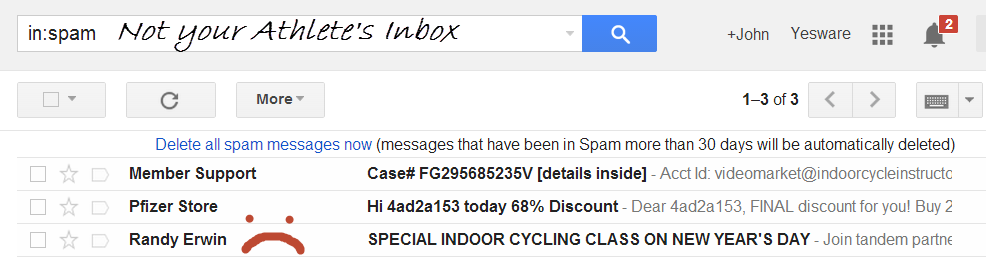
I hadn't received (and neither had many others) any emails from Randy this week. Neither did Amy – we're both on his list. So when I got home this morning I checked and found one of Randy's emails in my SPAM folder, which I rarely check on my laptop and never on my iPhone. Note to self to check there more frequently.
I called and asked; Randy…how many names are on your list? . About 200 was his response. Send a BCC email to a large of a list of email addresses must have triggered something in Gmail to think his email was SPAM = very few of us saw it.
So what to do?
It drives me crazy when I receive mass CC emails – typically I see them as sub requests. They are a total violation of email privacy and if one of the recipients have their email hacked, we all get the spam emails.
So if I want to email a list of athletes who take my class, I should use the BCC (Blind Carbon Copy) feature… right?
For a few people, sure that's OK. But once you have a large number (20+) of recipients, then No. At least not if you want to be sure your email doesn't end up in a SPAM folder and everyone will receive your latest class/event announcement.
Use a White-Listed Email Provider.
White-Listed just means trusted source… as in we don't allow any SPAM emails sent from our accounts Ms. AOL, Yahoo, Gmail, Hotmail, etc. so you can confidently deliver it to your customer. The two most popular are Constant Contact and my favorite MailChimp for a bunch of reasons. The biggest reason for you is that it's completely free until you go over 2,000 subscribers or send over 12,000 individual emails a month. So if Randy used MailChimp he could send 60 emails a month to is list of 200 subscriber each month at no charge. Fabulous deal – they don't even ask for a credit card.
Click to Subscribe
At one point you subscribed to the ICI/PRO Newsletter, by clicking a link and adding your name and email address. Using MailChimp you'll have the same ability to post a Subscribe Here link on your Facebook or Instructor blog = no manual entries!
You need their permission first
I decided that I would like to have all of Randy's contacts in a MailChimp account so I could email them > and know they are getting through. Except Randy doesn't have permission to give me the list, from the people on it, so he can't just give it to me. The solution is to:
Create a MailChimp account – here's the link.
Create a specific list
Have Randy send out my Subscribe Here link in an email. I'll suggest that he brake up the list into 20-30 address at a time and send the email with the link 2-3 times.
I already have a MailChimp account – so all I needed to was to create a new list. Here's the link to my list if you'd like to see it – http://eepurl.com/LQ_2P The Default in MailChimp is to collect First & Last Name + email address, which is normally plenty to start with. It's beyond the scope of this post, but the signup form can be easily modified to include pretty much anything. Please understand that you can ask for too much and they'll not subscribe.
Class sign-in list
I'm also collected emails at the start of each class using a hand written sign-in legal pad.
Instructor Tip: When adding emails to MailChimp from a sign in sheet, it's not uncommon to end up with a few you can't read. My tip is to do a quick search in Google using what you CAN read and search for the rest.
First and Last + the word “email” will many times display the correct email. You might need to add a state (MN, CA,FL, etc.) or city for common names. Google knows everything.
I will frequently check the domain alone – @XYZcompany.com or the domain + first/last name
Would you like additional info or help with this or other methods of marketing your class?
Many of us get near ZERO help from our club/studio > so it's up to all of us to grow our classes.
The Senior Group Fitness Instructor and I spent a weekend in Door County WI last month. Lots of quaint little towns to explore along the shores of Lake Michigan. We did what most tourists do as we walked along all the shops and restaurants… we stopped to check out the menus posted along the sidewalk, with the intent of finding the place where we would have dinner that evening.
I hadn't considered it at the time, but if one of the restaurants we passed didn't have a menu posted near the sidewalk, we wouldn't have considered eating there. Without some of the basic information (type of food, pricing, ambiance, entertainment, etc…) we'd never know if they had the best food in town or not.
We weren't looking for anything specific in a place to eat – the best I can tell you we were just looking for some place that fit us. Does that make sense? I guess it follows the; “I don't know what I want… but I'll know it, once I find it!”
So, is your class “menu” displayed somewhere prospective participants can find/learn more about you and your class? Or classes if you're a studio owner/manager?
I'm thinking this menu needs to be more than; “Indoor Cycling with John” which really doesn't tell you anything about me or my class. Maybe I could improve my menu by adding a picture of me and something all flowery and word-smithy like; “Experience outdoor cycling… indoors. Take a virtual training ride with John. Blah, blah, blah” which may or may not be effective. What else could you include?
Beyond your; charming / energetic personality, comprehensive knowledge of exercise physiology and dazzling smile, what else (if they could know more in advance) would be of interest to potential participants to our classes? Or your regulars for that matter?
How about your music!
Consider what primarily gets shared between members about your class:
How hard/easy is her class?She killed us this morning!
Was his music good?We rocked this morning! or What was he thinking with that playlist?
Technology from Spotify and Deezer now gives us the ability to easily share our playlists. Surge Cycle is a studio near me. On their Meet our Instructors page (Internet menu of sorts) studio owner Zion Anderson has posted a sample Spotify playlist of each instructor's class music. Here is Zion's playlist.
Now I think that's an awesome idea… now if I could get Life Time to do something similar.
Now I'm not talking about lying to you in a malicious/manipulative way, I have this awesome bridge in Brooklyn I can sell you really cheap – or – she's a real peach, only driven to church and back by the gentlest 80 year old grandmother you've ever met.
What I'm talking about is how people will/do lie to you… if they think telling you the truth could or would hurt your feelings.
Friends can be the worst. And I count a lot of long time members at our club, as friends.
“The truth is always an insult or a joke, lies are generally tastier. We love them. The nature of lies is to please. Truth has no concern for anyones comfort” – Arturo Binewski.”
― Katherine Dunn
Here's a recent example.
Two weeks ago I took over a class for another Instructor. 6:00 am Thursday mornings. The previous Instructor is very solid and she teaches a cycling specific class – I've taken and subbed it multiple times, so I was a good choice to take over her class. Everyone there knows me by name and most I've known for years.
The first week was Spring break = only about 1/2 the normal attendance. It was an endurance day and I thought; “why not run them though some Effortless Exercise intervals?” I lead everyone through a series of ladders where the challenge was to keep your mouth closed (staying aerobic) – while maximising power output. I had them experimenting with different cadences to observe where they each were most efficient.
After class I asked a few participants their thoughts (I try to always ask for questions/comments) and each was positive. But as it turned out, they were lying to me 🙁
This past week was an ugly snowstorm, so again a small class. Wanting to build on the theme we did a bunch of climbing, but stayed down around VT1 = aerobic. I needed to get on the road quickly that morning, so I didn't hang around very long.
Walking to to Amy's class Saturday morning, a member approached me with; “John, you've really got to step it up!” And she proceeded to tell me how such and such's class on Tuesday is really hard and how a number of other members were disappointed by how “easy” my class was.
Finally someone willing to tell me the truth!
I can do hard and these members know it. In fact I'll bet I disappointed most of them. Beyond their (misguided) belief that a hard class always equals a good class, my reputation is that John teaches hard classes. When I didn't meet their “expectations” for hard, they probably felt cheated at some level.
In Krista Leopold's Dear Instructor post, she shared the honest disappointment of Patrick, a frustrated member. He had an expectation that wasn't met that was based on his perspective; the scheduled Instructor is totally capable of coming come to class prepared. I found the very specific honesty refreshing and I'm hoping that this Instructor will appreciate Patrick. He could very well be the only participant in his class that believes enough in him, to tell him the truth.
As a think back through this, I'm realizing that my mistake was not considering that these members would have an expectation based on their previous experiences with me and my class. I had walked in thinking; “these folks need aerobic base training… so that's what I'm going to give them.” When I should have thought; “these folks are probably thinking I'm going to walk in and crush them… so I need to meet that expectation first and then slowly work in the base training I feel they need.” As I type this I'm also realizing that ME, deciding what THEY need, was about ME and not THEM 🙁
This week I'm planning a class that will bracket a long aerobic climb, with two very long/intense FTPish intervals. I'm also going to have everyone fill out this Instructor Evaluation Form that Dr. Haley Perlus had created for us for us a while back.
Gary Hawkins from Ride Fit contacted me last week about a new virtual cycling training video he had produced. Except this video doesn't feature typical cyclists – it's designed for people who train indoors on an ElliptiGO.
If you've never heard of an ElliptiGO you can join the club – it was completely news to me. But they are supposedly getting popular and they even have their own World Championships.
Now why am I asking if this could be the next big thing?
When I first watch the video I have to admit I thought they looked a little goofy to me. An elliptical for the road? Who would want that?
I called Gary and asked him; “who's buying these ElliptiGO things?”
“Mainly runners.” “They really like how low impact they are to ride.”
The indoor/outdoor cyclist in me started to say something snarky about people who choose to punish their bodies because they aren't smart enough to use the wheel… but I caught myself and asked Gary; do you know how many runners there are, compared with cyclists?
“Not sure, probably a lot more.”
So I checked and after a quick search it looks like committed runners out number committed cyclists by something like and an order of magnitude = 10 times as many runners.
Many of us are trying to build our classes by attracting cyclists. What would happen if we offered a group class that appealed to all those runners?




 Hotmail, etc. so you can confidently deliver it to your customer. The two most popular are Constant Contact and my favorite MailChimp for a bunch of reasons. The biggest reason for you is that it's completely free until you go over 2,000 subscribers or send over 12,000 individual emails a month. So if Randy used MailChimp he could send