I'm seeing that E! Entertainment Television has released a couple of trailers for their upcoming show about Indoor cycling Instructors > Hollywood Cycle. Looks like your garden variety fitness studio drama. Nothing different than what we experience every week at Life Time. Does this look like your studio as well?
The show is scheduled to begin July 7th 10/9 central on E!
Do you have an elevator pitch? Mine has changed several times — all necessary. But this post is actually about the emotions that sugar generates.
I began with a standard 30-second elevator pitch. Remember that version? It was the original length years ago, but now almost nobody will listen that long.
I shortened mine to 15 seconds.
Yet people went glassy-eyed when I said “psychoactive nutrition,” even though I immediately defined it as “how foods affect brain chemistry.”[wlm_private ‘PRO-Platinum|PRO-Monthly|PRO-Gratis|PRO-Seasonal|Platinum-trial|Monthly-trial|PRO-Military|30-Days-of-PRO|90 Day PRO|Stages-Instructor|Schwinn-Instructor|Instructor-Bonus|28 Day Challenge']
Still, brain chemistry interested them, so I changed the pitch again. I started with ‘food and brain chemistry’ and left out ‘psychoactive nutrition.’
Then I heard great recommendations from speakers and marketing pros on the perfect pitch:
– Don’t explain your process, just the results.
– Keep it short.
– Avoid big words.
– Start with a question.
All sounded like good ideas. I re-crafted my pitch with a starting question and shortened it again — this time to 10 seconds.
“You know how people have diabetes, high blood pressure, or other medical problems they can’t fix because they’re stuck on sugar? Well, I help people conquer sugar addiction so they can transform their health and feel great.”
I could never finish it. Everyone would interrupt by the time I said “high blood pressure…”
“My father has both, and high cholesterol. What should he do?”
“My mother’s diabetic. Are you a doctor?”
One woman told me, “The second part interested me, but the first part didn’t.”
(Ironically enough, when I asked what she did, her answer took 45 complicated, boring seconds. I didn’t have the heart to challenge her critique of my 10-second pitch when hers was a remedy for insomnia. But I digress.)
I changed my pitch again and dropped the opening question.
“I help people conquer sugar addiction, so they can transform their health, feel better, lose their mood swings, and gain control of their eating.”
It’s 6 seconds long. And I can’t make it through the 6 seconds without being interrupted, right after ‘sugar addiction’:
“Oh, that’s so important!”
“That’s a big deal right now. Everyone’s addicted to sugar.”
“My daughter is addicted to sugar; it’s all she eats.”
“Sugar is more addictive than heroin. Don’t you agree?”
“Do you really believe it’s possible to be addicted to sugar?”
So — and I already knew this — it’s an emotional topic. If I can’t even get through a 6-second sentence, something is charging people up enough that they must speak then and there.
In past presentations, people have glowered at me when I’ve talked about the health problems linked with the granulated white stuff.
A man walked out during one talk because I answered his question that, yes, fruit is sugar.
While I was still working on my doctorate, fat was the go-to dietary demon. In a lecture I gave to fitness pros, I was discussing sugar as a factor in health issues. “I have the same degree you do,” an angry woman shouted [we had master’s degrees in exercise physiology], “and you don’t know what you’re talking about!”
With all of these food-related emotions, this past weekend was such a relief. A real estate agent asked what I do.
He gave me the full 6 seconds to finish my sentence and questioned, “Is there a market for that?”[/wlm_private]
Was it just me, or did that last Instructor never make eye contact with you, either?
Amy and I were both participating at a teach-back assessment a few months ago, for Life Time's new Evolution Signature Indoor Cycling format. There was a handful of Instructors trying out and we all assumed the role as a “participant”, while we waited our turn on the Instructor bike.
It wasn't only you John, was Amy's response. That guy looked everywhere but directly at me… At first it was a little weird – his focus kept switching from the floor > ceiling and then at alternating walls on either side of the room. After a while I felt kind of dismissed,by how he seemed to purposefully avoid directly looking at me 🙁
Amy and I discussed our experiences with the guy, in the car on our way home. We both felt like he had all the right words = technically he sounded like he knew what he should be saying. But he had ZERO connection with his riders. Now I know this was probably an extreme example, but;
How effective are you at making eye contact with your riders?
If I came to your class, would you look at me?
Would I see you making eye contact with others in a meaningful way?
Take a moment and reflect back on your last class. How many people do you remember connecting with?[wlm_private ‘PRO-Platinum|PRO-Monthly|PRO-Gratis|PRO-Seasonal|Platinum-trial|Monthly-trial|PRO-Military|30-Days-of-PRO|90 Day PRO|Stages-Instructor|Schwinn-Instructor|Instructor-Bonus|28 Day Challenge']
Johnny G is a master at connecting with his audience of riders. Watch this short segment of him presenting. Pay particular attention to how he scans the faces in the room.
Make connections the objective of your class
I've featured presentation coach Alexa Fischer here in the past because she is a master communicator. She has a new blog post that expands on the video below, where she explains:
For me, winning over your audience has nothing to do with seeing everyone in their birthday suits. It has everything to do with making a genuine connection, in the exact same way you would when you meet a new friend in a cafe. In today’s video, I share my surefire strategies for keeping my audience engaged.
As the late, great Maya Angelou said, “I’ve learned that people will forget what you said, people will forget what you did, but people will never forget how you made them feel.”
The same is true for when you are on stage.
Click here to see Alexa's other video > and by all means, join her email list. She's sending out good stuff every week that I find very helpful.
Look up here at Me… not the video!
If you frequently play video in your classes, you're probably creating a connection problem with your participants. They are focused on the big screens, not you. For some of your members that will be OK for you to be an unseen narrator, while they watch what's happening on the video.
But many riders won't. They need you to make them feel important, if only for an instant, where you connect and flash them a quick smile or some other acknowledgment.
Random thought: does it make sense to whiten your teeth? Would your smile be more impactful, especially to those riding way in the back, if it was whiter/brighter?
So how do you get people to pay attention, so you can connect with them, when you're playing a video?
Check your lighting.
Maybe it was because I was a little self conscience, but early in my teaching career I wouldn't turn on the stage spotlights. I normally kept the studio lights down low. But over time (and watching other Instructors teach in the same room) I learned that I retained people's attention longer, if they could see me clearly. Having two focal points in the room, #1 the screen(s) and #2 YOU, should help direct your riders attention.
Make a change
Did you see how Johnny G maintained the room's attention, by asking them to sit up? How about suggesting in your next class, “this is a good time for a water break / toweling off.” Then watch what happens. Catch people following your lead and reaffirm those who do with a nod or a tip of your water bottle.
Ask questions
It's very natural for people to turn toward the person asking a question. Why? I think we instinctively do this to try and gather more information. I feel open ended questions (can't be a Yes/No response) work best. If you really want to get eyes up on you, ask a question that references something that needs to been seen to be understood and then point/demonstrate without giving any additional cues until you have their eyes-forward. Maybe something like; is your pedal stroke smooth like this? Then demonstrate the action while scanning the faces of the room for recognition.
Bring up the room lights
If you have a really dark studio, bring up the room lights for the cool down. It's here when you can really try to connect with each rider – or – try and develop a surrogate; have everyone turn, face each other and congratulate their neighbor!
You know we've gone mainstream when a large advertiser like Gillette, begins connecting their products to Indoor Cycling.
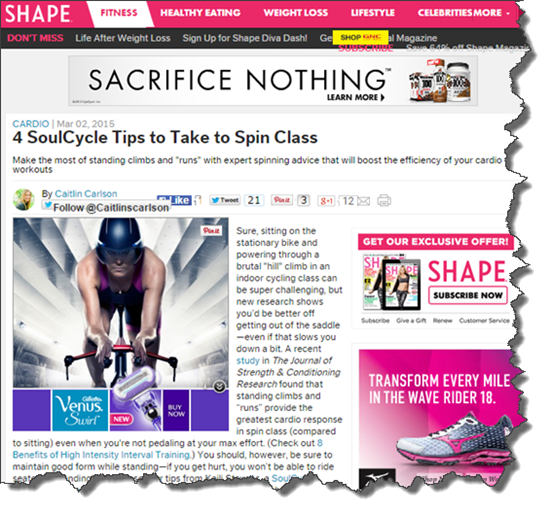
I ran across this article today in the online version of Shape Magazine. Seems like a typical bit of content designed to attract readers who have an interest in SoulCycle / Indoor Cycling.
Sure, sitting on the stationary bike and powering through a brutal “hill” climb in an indoor cycling class can be super challenging, but new research shows you’d be better off getting out of the saddle–even if that slows you down a bit. A recent study in The Journal of Strength & Conditioning Research found that standing climbs and “runs” provide the greatest cardio response in spin class (compared to sitting) even when you're not pedaling at your max effort. (Check out 8 Benefits of High Intensity Interval Training.) You should, however, be sure to maintain good form while standing–if you get hurt, you won’t be able to ride seated or standing! Take these four tips from Kaili Stevens, a SoulCycle instructor in New York City, to heart next time you hop on the bike.
What caught my attention wasn't the article itself, but the image of a very fit and serious women riding a time trial bike – she's even wearing an aero helmet. The background gives the impression of power and speed. And there at the bottom of the image is an ad banner for a women's razor. That made me smile 🙂
I'm willing to bet that this post was created specifically as an advertisement for Gillette. Online magazines exist for only one reason, to make money. The bulk of their revenue comes from advertisers. Publishers like Shape have small armies of creative people who dream up ways to build promotions around advertisers. This article is a great example.
So my question for you. Is Indoor Cycling becoming mainstream a good thing?
Can an argument be made for deemphasizing “Outdoor Cycling” in your Indoor Cycling class?
Or asked differently; would it ever make sense to remove many (if not all) of the references, imagery and cuing related to riding outdoors?
Life Time Fitness thinks we should and for some class times and populations, I agree with them.
Evolution Cycle is the latest branded cycling class format from Life Time Fitness. As part of the training, we were asked specifically to reduce/limit references to riding outdoors. Why? Because a large percentage of our members do not ride outdoors.
Have you ever had an experience like this?[wlm_private ‘PRO-Platinum|PRO-Monthly|PRO-Gratis|PRO-Seasonal|Platinum-trial|Monthly-trial|PRO-Military|30-Days-of-PRO|90 Day PRO|Stages-Instructor|Schwinn-Instructor|Instructor-Bonus|28 Day Challenge']
Do I look like a person who uses coupons?
Have you ever been in a situation where some passionate person is extolling the virtues of an activity, one where you have absolutely no interest? They go on and on, almost to the point of lecturing you, about how they know what's best for you.
I met one of these folks recently… a female cashier at the grocery store:
Her: Do you have any coupons, sir?
Me: Uh, no, no I don't.
Her: They could save you a bunch of money.
Me: I don't have any coupons.
Her: They're easy to find… we have a supplement in each Sunday paper.
Me: (getting annoyed) I don't subscribe to the paper.
Her: We're happy to mail them to your home – big smile – can I get your address?
Me: Can I just pay, so I can go?
Her (sensing my annoyance): I was just trying to help you save some money, sir. I can't understand why you wouldn't be interested in that!
Me: (losing it) I'm sorry, but do I look like a guy who uses coupons? I hate coupons. I have a lot of anxiety whenever someone gives me a coupon for my next visit. Will I remember to bring it? Of course I don't. Then I'll be standing here in line, dreading the inevitable question I know you'll ask, BECAUSE I WILL HAVE FORGOTTEN THE DAMN COUPON AT HOME.
Do you think that just possibly, there are a few participants in your class who are disinterested in outdoor cycling? Maybe they're a bit over weight and intimidated by a fit peer their same age? Or they are afraid to ride outside? Or they don't want to be told they're missing out by not riding on the road?
The change from the previous 60 minute “Studio Cycle” format, to the new 45 minute Evolution format, is based on the competition Life Time is feeling from boutique studios. The goal is to appeal to everyone, cyclist and non-cyclist alike and fill the studio with people. As an Evolution Instructor, I now use slightly different language ad let the music do most of the talking. The class, now shorter, is supposed to be harder (above threshold work) and more energetic/entertaining than the old Studio Cycle classes were.
LTF has also added an official Rhythm/SoulCycle like ride they call Cycle Sculpt at select clubs. I taught one of these classes a year ago and wrote about my experience here (complete with the profile and playlist).
So how can I tell if I'm too much outdoor cycling?
When I consult or talk with Studio Owners I'll ask them this question. Overall, what is your participant split between cyclists and non-cyclists? My observation is that having a high percentage of cyclists – over ~30% across all your classes – is an indication that something is wrong. This high percentage of cyclists tends to correlate with smaller overall participation rates, especially in the summer months when cyclists abandon you for riding outside.
IMO a large percentage of cyclists is an indicator of who's not in the studio. It's my impression that Life Time is seeing and acting to make our classes feel more inclusive.
Please don't get me wrong here. Your studio should have cycling specific classes on the schedule, especially during the winter months. But even with all the cyclists coming inside, your participation levels of non-cyclists should remain healthy throughout the year. If it's not, there are a few things you could consider changing.
What have I done to change?
I started by looking in the mirror just before I started my class. Looking back at me was a fit, 53 years old cyclist, standing there in his coordinated Life Time kit. Then I asked myself a question; am I dressed like the typical participant I have in class? Yes and No were my answers.
Yes – I do look like my Performance Cycle class participants. Then again they are comprised mainly by cyclists, so it would make sense that I continue wearing my kit for these classes.
No – I don't look like most of my morning class. Not for when I participate in, or sub, Amy's Saturday morning class either. This class of Amy's is one of the most popular at the club. It's normally a 50/50 split men/women, but very few are recognisable as cyclists. For these classes and classes that I participate, I wear my pearl izumi bibs and a workout shirt. I miss not having a back pocket for my mic transmitted, but I do feel I fit in better. I look like everyone else 🙂
I'm changing my language. It's been hard, but I'm slowly removing words that have an outdoor cycling connotation. Gone are; climb, flat, mountain, draft, peloton, race and time trial. Now I'm cuing on different “challenges” like strength, speed, stamina, etc.
I have started this journey on an ordinary day in February 2013. I was in the car with my husband and two step-kids, driving home from somewhere when I said: “I will go and work out at the YMCA every day for a month starting today”. Just like that — out of the blue. I can’t even remember why I said that or what prompted that decision. I just said that and once I did, I had to do it. So I did.
Lena's first step was saying it out loud – where others would hear her.
Making public commitments can be very powerful – especially when told to people who will hold you accountable. Which got me thinking; “wouldn't it be cool to use social media to give Instructors a place to post their commitments to change/growth/improvement and then other Instructors could hold them accountable?”
So I told Lena about my idea. Not only was she excited about developing the concept, she wanted to see it become real. Not wanting to disappoint her forced me into action – which I did by agreeing to collaborate with her until we had completed this task. Here's the result:
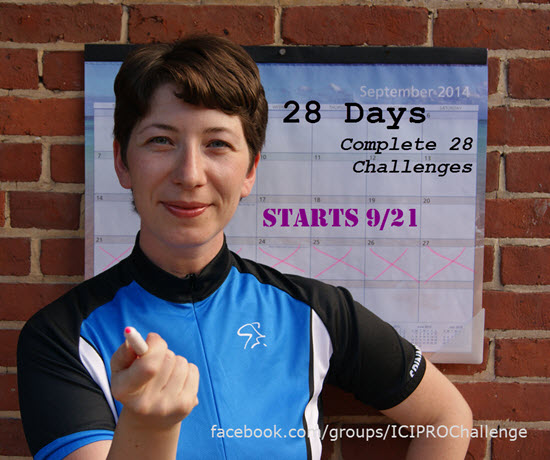
28 unique challenges, to be completed over 28 days. Are you willing to do the work required to become a better Indoor Cycling Instructor?
Nothing impossible (teach 10 classes back-to-back & non stop) or dangerous (base jumping). Each challenge is designed to help you grow as a person and as an Indoor Cycling Instructor. Some might be easy for you… others you’ll want to skip when you read them – but you won’t because you made the commitment and you're going to keep it.
The group's privacy settings are set so your posts and comments are not visible to non-members of the group and none of your comments should show up in your newsfeed.
Make a public commitment to complete Challenge #1 before you know what it is (or any of the others are) on the post we’ve provided. Don’t ask for more information before 9/21 – our lips are sealed until…
On the morning of Sunday September 21st we’ll reveal the first seven challenges for you to complete.
You'll have one week to complete the challenges.
The next seven challenges will follow on Sunday 28th, October 5th and 12th.
Four weeks x seven challenges each week = 28 total.
There will be a post for each of the 28 challenges in the FB group where you'll note your completion and leave a comment about what happened/what you learned/what you experienced during that challenge.
We will tell you this much:
None of the challenges are particularly time consuming, but some may require planning on your part.
A number of challenges are focused on Teamwork — assisting and supporting other Instructors you work with and participants in the group.
Other challenges are about stepping out of your comfortable cocoon and doing those things you know you should do, but for whatever reason (fear, insecurity, procrastination, etc..) you choose not to.
Prizes
First of all, the real reward will hopefully be a better you at the end of this ☺
But I love offering prizes so here they are! Season pass to ICI/PRO – Complete all 28 challenges to the best of your ability and earn a six month subscription to ICI/PRO, a $60.00 value.
The winners of the ICI/PRO challenge – will be the two Instructors we feel best exemplify the spirit and intent of this personal growth exercise. We realize that this is hard to define, but we feel we’ll know who wins when we see it.
If we can't decide we'll be asking the group who they feel should win.
And what do they win? My friends at Fit Bodies Inc are providing the top 2 instructors with vouchers for a free (agent fee is normally $400-$550) one week fitness vacation for two adults (+ two kids* under 12) at any of 60 Caribbean all-inclusive resorts.
Many of you have heard me talk about my wife Amy and I have taken dozens of these trips — everyone was fabulous. They are the absolute best deal for a fitness Instructor to spend a romantic week at a gorgeous resort in Jamaica, Mexico and other exotic locations.
These are 4/5 star resorts where couples pay $3-5,000 per week + Air. You are treated as a full guest… except that you’re also the 9:30 cycling Instructor.
Travel (air-fare) is not included and some resorts do require a Group Fitness or Mind-Body certification.
More information here http://www.workingfitnessvacation.com/about/
* There are multiple resorts that are kid friendly, but all of them require you to be a Group Fitness instructor.








 $550) one week fitness