SoulCycle doesn't offer Indoor Cycling “classes” so much as they offer Indoor Cycling “productions” where the participants (if they choose) are part of the show. Not just as “extras” playing bit parts, but critically important actors and actresses in each SoulCycle performance.
During these 45 minute scripted fitness events, the Instructor's role is split between; Performer, Cheerleader, Coach and lastly as the Director – directing the participants in their parts of the production.
If you missed any of my earlier articles about SoulCycle, you'll find them all here.
Any great musical or theatrical production begins with building anticipation in the audience. The SoulCycle location we visited has what can best be described as a waiting area. A room with multiple benches that's midway between the hall with the lockers and the primary entrance to the studio.
After I got dressed in a very nice locker room, I met Amy in the waiting area. The previous class was just ending and a stream of sweaty, smiling faces flowed out and past us, on their way to shower and change. (Yes they have showers) We chatted with a couple of women regulars (I never miss this class for anything) one told us, while waiting for an indication it was time to go into the studio. My typical experience has been when one class leaves, the next files in right behind. Not here. You could feel and hear the excitement of the 30 or so of us waiting, when a man wearing a SoulCycle shirt walked out of the studio with a handful of rags. He didn't say anything and didn't appear to need to. The group knew it was time for us to go in.
As I described in part #1, SoulCycle understands that details matter. Between classes they have a crew (it looked like three people) go in and clean everything before the next class. Every bike appeared spotless and functioned properly. Each had a clean towel across the handlebars and two clean hand weights in the little holders under the seat.
When we walked in it was obvious that the studio is a very special place. They had the lights were very low, primarily lit by the faux candles on the four corners of the Instructor platform. What was a noisy/chatty group became much quieter as everyone filed in and found their reserved bike, got set up, and climbed aboard. With 60 people in that small space and so much activity going on, I didn't see when Instructor Heather P (Peggs) walked in – but it was obvious once she cued up her music and turned on her mic.
Among friends
Amy and I were two of the three new folks in that class. Heather seemed to know most everyone else in the room, greeting what seemed like dozens by name as she bounced around the room before the start. She must have reviewed her attendance list because she walked over and welcomed us both by first name.
Heather explained that this was her third class of the day and that two of her favorites would be up front demonstrating, while she conducted the entire class off the bike. The cleaning/setup crew had already prepared for this. Before we walked in there were two bikes on the Instructor platform – in my second class there was only one.
Heather P
Intros
In both classes the Instructors introduced themselves and explained a little bit about the ride to come. I was surprised how both Heather and Lindsay B (who taught the second class I took) offered modifications; the need to keep enough resistance on the wheel and suggestions for taking it easy if today wasn't your day. Lindsay made the point several times; “turn it down until you can't feel anything… then add back a half turn. We never ride in here without resistance“.
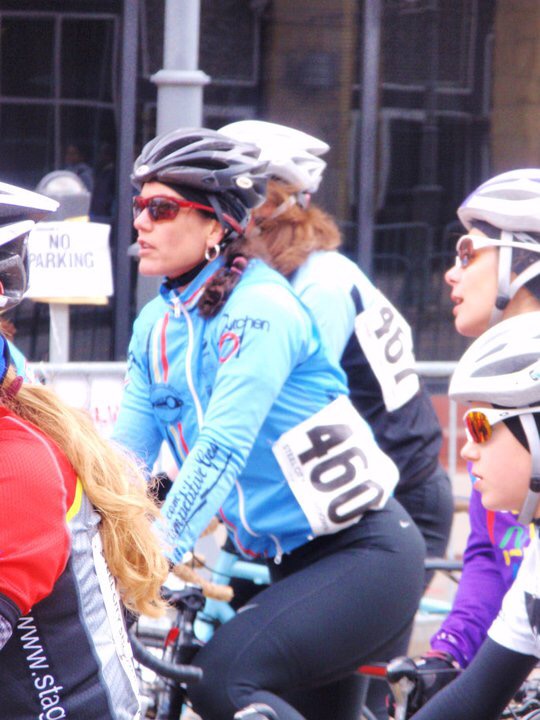
Note about form. I can't remember when I saw so many people who looked so good on their bikes. And no it wasn't that they are all young females. Nice flat backs, relaxed upper bodies, very smooth pedalling techniques and I didn't see any of the wild, out-of-control crazy stuff I expected to see. Yes there is a lot of 110+ RPM in these classes – and it looked very controlled.
My idea, and it's only based on observing two classes, is that there's a lot of peer pressure between riders to look good on the bike. They know they're part of the “show” and do their best to look the part.
If you ride in a group outdoors, you've probably experienced the same peer pressure to look good – that's why many men shave their legs 🙂
I've taken this class before
Both classes I rode started exactly on time and followed the same basic profile. I wasn't keeping track of time so I don't have any specific segment lengths. Actually I didn't watch the time on purpose. I wanted to know; how long did the class feel? It felt like it zipped by very quickly. Amy felt it was short – she normally teaches 60 minute classes.
The class profile was something like this:
Standing warm up, with cues to add load over ~ 10 minutes
Transition to a climb with a lot of push ups and jumps
Lather, rinse, repeat
Weight segment
Inspiration/reflection time
Big finish
Stretch and transition
Key Detail: These Instructors know their music exactly and teach to it very effectively. Both exhibited Group Fitness backgrounds, giving us helpful 8 count – countdowns, that always ended right with the phrasing of the music.
I was very impressed by both Heather's and Lindsay's professionalism in the way they conducted their classes. NOTE: with the one exception that Lindsay used music (hip hop) that had a lot of profanity in it and swore herself on occasion. It's not for me, but the guy with the gauges and sleeves riding next to me said he never misses her class. Throughout class they both discussed and encouraged proper form. During the weight segments we were instructed to add a bunch of load and sit up straight and tall. It was also suggested that we stop pedalling. Most slowly rolled their legs during this part.
Is there purpose to all of these extraneous movements?
Critics of SoulCycle (and similar) classes point to how non-cycling specific movements; jumps, push ups/rhythm presses, “tap-backs”, figure eights, etc… have no proven training value and/or diminish the potential training value of riding an Indoor Cycle… like an Outdoor Cyclist would. For those reasons, along with perceptions the some of these movements may be potentially dangerous, we're told we should not include these movements in our classes as they're “Contraindicated”.
Based on what I saw at SoulCycle (and other similar classes I've taken) my feeling is that critics are completely missing the point. IMO these movements are a critical part to the appeal of these classes. It is a thing of beauty, watching a room full of people exactly on the beat and rising and falling in unison. I've heard this described as “tribal” behaviour, similar to fans doing the ‘wave' at a sporting event. It's a very powerful way to connect a group of people together. And at the same time, these jumps are very challenging to perform correctly – which I feel is another reason for the success of SoulCycle that I explained in this post.
Soultime
I found this element of each class interesting. After the weight segment, both Heather and Lindsay turned down the lights and described overcoming a challenge in their personal lives. Playing some trance like music, Heather explained how this week marked the five year anniversary of her sobriety and how appreciative she was of the support she'd received from SoulCycle and all of her regulars.
Lindsay did something a little different. She invited a man to ride her Instructor bike. Then described how she had lost her voice for 10 days and couldn't teach. She then put her arm around the man and explaining how he was the doctor who helped cure her vocal paralysis.
Both short speeches ended with loud applause.
This then segued into a time where we were all asked to reflect on some personal challenge of our own. We rode in near total darkness for a few minutes with just the music. From here the intensity built in a way to communicate how we could overcome whatever it was – leading into a final big effort to finish the class.
Closing time
Each class includes a three minute stretch/cooldown. How do I know it was three minutes? They both said so in their closing. With everything else tightly scripted, I'm guessing the class ended exactly on time. Here's where these Instructors diverged a little; after each did hamstring and lower back stretches while on the bike, Heather did most of her stretches off the bike. Lindsay did all of her's on the bike.
After we were told their upcoming class times and locations (there are 6 SoulCycles around the LA area and they both teach at multiple locations) we were thanked and encouraged to leave quickly. This may explain what didn't happen. I've been in classes like these where the “groupies” flock to the Instructors after class. I observed both pretty much alone after the immediate end of class. This gave me and Amy a chance to say hello to Heather and tell her that we were visiting instructors. She said she appreciated us being there and asked if we would be attending other classes while we were in town.
Overall impression of SoulCycle
In case I haven't effectively communicated it here, Amy and I were very impressed by our experiences at SoulCycle. I participated in two classes, led by true professional Indoor Cycling Instructors who understand what their participants want from a class and they both delivered it.
With the exception of the horrible music (I hate Hip Hop) Lindsay played in the beginning of her class (she did win me over during her weight segment as she went around cuing proper form to multiple individuals), I didn't see anything that wasn't near perfect in the delivery of this experience.
Final note: I appreciate the 20 or so emails and Facebook PM's I received about part #1 – my preference would be that you leave your remarks as comments to this post. But if you're concerned about publicly expressing your views, your email or PM is still appreciated.
That would be your FTP looking back at you… catch him if you can.
Now that I'm an official Stages Indoor Cycling Master Educator, I figured I needed to create an Audio Profile so you can hear how I teach one of my Power classes. My profile is “Racing Your FTP”.
The goal is very simple; beat your FTP or “Threshold Check” numbers on every set. The ride will consist of two warm up songs, a “Threshold Check”, and three efforts of around 12, 18 and 9 minutes with a 1 minute recoveries after each interval.
I love mixing my class music and I've provide you with the MP3 below. I have also included an actual recording of me coaching this complete class. I suggest riding to this class by yourself, to experience exactly how I present this profile and you'll have a better idea of where & what I'm cuing during the class.
[wlm_private ‘PRO-Platinum|PRO-Monthly|PRO-Gratis|PRO-Seasonal|Platinum-trial|Monthly-trial|PRO-Military|30-Days-of-PRO|90 Day PRO|Stages-Instructor|Schwinn-Instructor|Instructor-Bonus|28 Day Challenge']
Enjoy and please let me know how it works for you as a comment below.
Myth: Rider Setup / Bike Fit should be done before class.
Common sense says that the best time to help someone with their bike setup would be before class. After all, this new student has just walked in and they have 45 – 60 minutes in the saddle ahead of them.
So pre-class would be the best time, right?
Well… no, it probably isn't. And when you think about it for a few minutes, I'll bet you'll agree.
I got this myth from our local bike fit guru Chris Balser, who's actually known as The Bike Fit Guru.
4. Saddle Height is not static. To demonstrate, bend forward and try to touch the floor. Do it again. Try repeating the exercise when it is cold, hot, at the end of a hard ride, before an easy ride, etc. It will never be identical because our activities and climate are always changing. Remember this when prescribed the “magic number”.
The point I think Chris is making here is that there are a bunch of external factors that can influence setting a rider's saddle height properly… the most important being the temperature.
Living here in the “Frozen North” we face the issue of “shrinkage” when we're cold – no, not that shrinkage silly 🙂 I'm talking about how your muscles and connective tend to shorten/tighten when they are cold. One of the worst feelings imaginable is how your back tenses up after climbing into a car, when it's been cooling all day in a 10° parking lot. You're forced bolt upright, with your back muscles near spasm and you can't bend forward to save to save your soul. Thank heavens for heated seats!
The opposite occurs when we are warm. We relax. Our muscles loosen and can extent completely. Is this beginning to make sense to you?
It's only after a thorough warm-up can a leg (or legs) comfortably extend. And proper saddle height can only be set with full extension.
So wouldn't it make more sense to check/adjust participants at the end of class?
When I rode with the top level cycling team here in Minneapolis, it wasn't uncommon for one to the club leaders to ride by and offer; “You need to raise your saddle 2 millimeters”. So I would. Except I can remember thinking the next morning when I went off on a training ride; “that can't be right… my seat is too high”, as I would feel the pulling in the back of my knee with each revolution. But then it would go away, or I forgot about it. Either way, once I was warm and could fully extend, my saddle height was exactly where it belonged.
Outdoor riding tip in cool/cold weather: If you leave home and don't feel slightly chilled for the first mile or two (or a slight pull in the back of your knee), you're wearing too many clothes – or your saddle's too low… or both.
But what about a new person to class?
I say get them close, but don't forget about them at the end of class. You could discuss this during your into/warm-up and then remind everyone during the transition/cool-down that you will be available post class to assess everyone's warm position.
I'm guessing you'll get more than a few takers – because I can guarantee that they've never heard this before.
By Team ICG® Master Trainer Jim Karanas and ICG® Marketing & Product Director Gary Warren
Forward Motion Video was first produced for, and used in, Indoor Cycling classes in the form of DVDs. DVDs paved the way for production companies like Virtual Active to bring Hollywood-level filming to the fitness industry.
We would never detract from the contribution these DVDs and their producers made to the indoor-cycling industry. Going forward, however, there’s a point of contention that we consider critical: continuing to use DVD as the medium for providing forward motion video.
In response to Jim’s last post, “Video Done Right”, Gino Nacey, one of the pioneers of Forward Motion Video, offered his “1% disagreement” and commented, “as long as the DVD is played on a big screen, I don’t really see why we should knock it — if all a site can afford is a projector, screen and some DVDs then if the video is well done, they should have a great experience.” We appreciate Gino’s feedback.
DVDs are seen by some in the industry as a good option for clubs, a way to provide a quality visual experience in an indoor cycling class. ICG® believes that, at this time, DVDs will do more to inhibit the development of both indoor-cycling programs that offer video and the instructors who teach with it.
DVD is being superseded as technology progresses. Despite DVD’s low initial purchase cost for club owners, is it really forward-thinking and fit-for-purpose with respect to the skills instructors need to develop to enhance their classes with video, as they do with music? We believe DVD limitations are one reason more instructors don’t teach with forward motion video.
What can an instructor truly do with a DVD? The instructor can’t alter the programming or investigate the synergies that exist between music and video. The profile is unchangeable. DVD length can’t be altered to fit the music. That limits the music that can be used with the DVD. The instructor can’t swap out portions of the DVDs, which makes it impossible to alter the profiles to create endless class variations.
DVDs lack the essential tools the instructor needs, such as selecting and changing footage at any given point in a profile, repeating parts of a video, skipping parts of a video, or switching to panoramic footage for water breaks or to shift the experience. Even more importantly, DVDs don’t permit the instructor to keep the footage running to match the music track length, or vice versa. Any of the above can be done — with one touch — with a system like Myride®+.
DVD offers the same ride time and again, and the ability to use different music is limited.
The use of DVDs for virtual classes may seem to make sense initially, particularly if the voiceover coaching and the music are good. Again, the number of different rides is limited because DVD footage is fixed and can’t be reprogrammed. Also, quality of filming comes into play because Standard Definition on a large screen looks unrealistic.
But it’s more than that. Virtual classes have to be highly advanced in coaching, graphics, filming techniques, post-production techniques, and exhibit extremely compelling locations because they now do what instructors do — lead the class. We also have to push the limits of technology to enable consoles to provide “virtual class” schedules, where console and projector turn on and off at selected times to enable the club owner to offer classes without an instructor present.
It takes a platform of technology that can continue to grow to make the experience (and the buyer’s investment) stronger over the years without fading. Sustainability is key, and DVDs can’t make the cut.
Are DVDs passable? For the retail market, yes. But for sustainable commercial operations where the consumer is savvier and more demanding as competition rises, perhaps not.
Finally, our tree-hugging moment. DVDs are not green and create an enormous amount of waste product that is eliminated with the use of advanced digital technology. CDs and DVDs don’t decompose. Their composition is too complex to make large-scale recycling possible, unlike aluminum, glass or paper. So old CDs and DVDs must be shipped to a special center for recycling.
Then there’s packaging. 85% of under-24s believe that downloading music can help save the planet by reducing the packaging, waste, and carbon emissions involved in producing and transporting CDs and DVDs to shops.
Here’s what video in indoor cycling needs:
1. Improved content-delivery tools for video that offer increased programming features, designed to enable instructors to utilize this new asset fully and owners to embrace the ROI they can get from video done right.
2. Increased availability of high-quality video through network delivery that will enable us to bring new video to our customers as easily as we bring new songs.
3. Improved filming and post-production techniques to enhance immersion and raise the member experience and the demand for video.
4. A shift away from a retail product that’s not green and that experts say won’t be around much longer.
We believe Myride®+ fulfills these needs, except item 2, which it will in the immediate future.
As always with new technology, there’s a higher initial cost — in this case, for the digital media console and the HD projector. But let’s not confuse initial cost with “total cost of ownership” (TCO). The cost of a DVD media system may be low, but it wastes money if it’s not sustainable and/or doesn’t fully meet the market’s needs. As demand increases and more companies play a role in development, digital video costs will decrease. Continuing to advocate DVDs, which give the club owner a cheaper option without a complete understanding of its limitations, will hinder forward progress.
The end result seems inevitable, and DVD may delay the transition but won’t prevent it.
ICG® respects Gino and his organizations for all they’ve done to pave the way. But ICG® can’t recommend adherence to an outdated form of presenting video to the Indoor Cycling industry.
The beginning of class can be disjointed at times. Riders are trying to get settled. Some people are still chatting (loudly) and we are trying to establish that official “class has started” moment. Then 5 new people show up and need to be setup on their bikes.
Yesterday I’m teaching at a club I’ve taught at for over 7 years. The cycling class is held in a multi-purpose room, so each member is responsible for pulling their bike onto the floor from the side of the room. The class starts right on time (I’m a stickler for punctuality). Five minutes into the class, 5 “new” riders enter the room. All of them have on running type sneakers and they are standing next the to the remaining bikes and appear confused.
I meet them at the back of the room and immediately understand their hesitation. The bikes are equipped with Schwinn Triple-Link pedals, which allow for the standard SPD clip on one side and then a removable toe cage on the other side, which accepts a LOOK compatible cleat. The problem was that none of the available bikes had toe cages. I found a set of cages thrown to the side. One cage was missing a strap, which I found and re-threaded. Then I went around the room to other riders who were not using their cages and started removing them from their bikes to allow the remaining 4 people to ride. Throw in a few bike setups and now we were 15 minutes into class before I re-emerged back at the front of the room.
Obviously, the big challenge was not the pedal hunt, but trying to teach the class and keep everyone focused while controlled chaos was unfolding in the back of the room. At the time my 5 newbies entered the room, I had just finished my opening spiel. So while I was getting them situated, I was simultaneously leading the class through some Spin-Ups (short 10-second accelerations followed by 20 seconds of easy pedaling) and then a set of 30-second speed intervals. In addition to staying on top of the timing, I found myself continually pushing the headset mic onto the top of my head so I could talk with the new riders without our conversation bombing over the sound system.
As chaotic as all of this was, I actually love this kind of challenge. As a cycling coach, I spend a good amount of time coaching off the bike. I’m constantly leading drills while speaking one-on-one with riders to help them with specific issues and technique. But it made me think, “how could an instructor train themselves to handle a situation like I experienced gracefully?” Here is a suggestion:
Try teaching your entire intro and warm-up off the bike. But don’t just stand at the front of the room. Instead walk around from rider to rider. Pace the isles (if you have them). Provide encouragement and make suggestive corrections as you go. Try to keep track of the timing and any intervals. See how it goes. Remember, it is all about experience. Obtaining the ability to stay on task and keep your riders focused in this way will provide some great preparation when those 5 new riders show up at the last minute.
Also, please share any other tips you have used to stay in control and command when all hell breaks loose.
Building a class profile can be one of the most enjoyable aspects of teaching Indoor Cycling. Instructors sometimes find it stressful because they feel they’re “out of ideas.”
There are many approaches to class design. A few possibilities are: music as the road; duplicating an actual ride profile with which you’re familiar; fully interacting with selected videos; teaching cycling principles and philosophy; and eliciting specific training adaptations.
A general approach can become static over time. That’s what’s so much fun. Because of the many training elements that indoor cycling utilizes, any general approach can remain fresh and inspiring. Indoor cycling lends itself to structure, so it’s easy to formulate new and exciting variations on common training formats.
Intervals are a perfect example; every instructor uses them. There are thousands of ways to put a class through intervals. But the creative instructor is the one who comes up with an interval format you haven’t experienced before.
Once I decide on my approach to building my class for the day, my mind searches for an organizational format that supports the approach. For example, I decide that my approach to today’s class will be to teach a cycling principle. The principle will be cadence. With my approach and underlying principle selected, I need a structure to support that principle — and make the class enjoyable at the same time. It’s that last part that may take some creativity.
Having planned thousands of classes over the years, I frequently return to four basic organizational formats: Intervals, Ladders (or Ramps), Pyramids, or Steady State. These four organizational formats form the backbone that supports any indoor cycling class. The key to creative instruction is to find new ways to use them.
INTERVALS
Interval training is a common training technique designed to improve strength, power, aerobic capacity or endurance. It alternates periods of higher-intensity work with periods of recovery (i.e., lower-intensity work). Depending on the length of the work and rest periods, intervals may be aerobic or anaerobic. The higher-intensity periods instructors typically use are at, or close to, an anaerobic level of effort, but they can actually be of any intensity. That fact alone can generate a great deal of variation in a class.
The ratio of work to recovery will usually vary with the intensity of the work effort. Max-effort intervals, for example, are necessarily short, with recovery periods of equal or greater duration than the work interval. Aerobic intervals may be longer and require much briefer recovery. The recovery periods may permit either complete recovery (full drop in heart rate) or limited recovery of lower, but not resting-level, intensity.
Sample interval workout:
5 minutes of warm-up: light ride, low intensity, gradually increasing at the end of the warm-up period
1 minute of moderate or high intensity, followed by 1 minute of low intensity. Repeat six to eight times.
5 minutes of cool-down: light ride, low intensity, gradually decreasing by the end of the cool-down period
The above is a standard interval format that every indoor cycling instructor has used in his or her class at one time or another.
How can the intervals be varied? Here are some suggestions.
Use different durations for the work and recovery efforts. A 2:1 format, with 2 minutes of seated climb at 75 RPM and 1 minute of recovery spin at 100 RPM is a good rollers simulation.
Alternate the difference. 2:1, 1:2, 2:1, 1:2. 2 minutes moderately hard with 1 minute of recovery, followed by 1 minute very hard with 2 minutes of recovery.
Vary the recovery. 2:1, 2:3, 2:1, 2:3. 2 minutes very hard with 1 minute of limited recovery, followed by another 2 minutes very hard with 3 minutes of full recovery.
Vary with no pattern. This is called “fartlek.” The name is Swedish for “speed play”. It consists of hard-effort bursts of different durations, followed by recovery of different durations. The lack of predictability increases overall intensity, compared with standard interval training. 2:1, 4:1, 2:5, 3:3, 1:2, 4:3.
LADDERS
A ladder, also known as a ramp, is a training technique that involves progressive, incremental increases in one or more training variables, such as duration, resistance, cadence or heart rate. The progression can either increase or decrease. The ladder can be continuous or in interval format.
Here are some examples of a ladder, using an interval format:
Increase the work duration, keeping the recovery constant. 1:1, 2:1, 3:1, 4:1.
Decrease the work duration, keeping the recovery constant. 4:1, 3:1, 2:1, 1:1. These “descending intervals” are a commonly used form of a decreasing ladder. As the interval duration decreases, some other training variable increases.
Maintain the work duration while decreasing the recovery. 1min:1min, 1min:45sec, 1min:30sec, 1min:15sec.
Increase the work and decrease the recovery. 0:2min, 30sec:1min, 45sec:45sec, 1min:30sec, 2min:0. Easy for 2 minutes, followed by 30 sec hard with 1 minute easy, followed by 45 sec hard and 45 sec easy, followed by 1 min hard and 30 sec easy, catch your breath quickly and hammer the last 2 minutes.
A ladder can also be continuous. My favorite is a 10-minute, 4-3-2-1 format: 4 minutes easy, 3 minutes a little harder, 2 minutes a little harder, and 1 minute hard. These are done with no recovery between them. The often-used song Mojave by Afro Celt Sound System is perfect for a 10-minute, 4-3-2-1 ladder.
The next post will cover variations in pyramids and steady state training.