
by John | Jun 8, 2017 | Best Practices, Instructor Tech Help, Master Instructor Blog, Spotify
ICI/PRO member Dr. Marc Schlosberg is one of those Early Adopters you've no doubt heard discussed in the media. This group is quick to experiment with and embrace new technology. Marc was one of the first Instructors to use Spotify in his classes and he joined me on the podcast to discuss this (at the time) exciting new option for delivering music to our classes. Marc sent me this email yesterday, providing his comments related to my conversation with Chris Hawthorne on Podcast #303
Hi John,
I was listening to the latest podcast and heard about the Spotify syncing issues. I have a couple of suggestions/solutions. I think the reason rebooting all units works to fix syncing is that the newest versions are then installed on all devices. I believe syncing problems develop when Spotify updates and there is a version mismatch. You don’t always know this is the case or sometimes it’s difficult to track that one device has updated, but you haven’t checked the others. Simply shutting Spotify down, checking for updates and updating it, then restarting the program should solve the problem. You have to do this with all the devices you use.
Another roadblock to syncing is lack of space on a device. It won’t tell you you’re out of space, but won’t take individual tracks offline — they stay grey rather than green. It’s a good idea to switch playlists to online only after you’ve used them to preserve space (except for those you always like to have in your back pocket). You could also delete unused apps to make room. My iPhone is 16gb and I’ve run into this problems (and 16gb used to be an unimaginable amount of space). It’s probably less of an issue for those with 32gb and up or Android devices with huge plugin memory — unless the memory is full.
Whoa — it looks like Spotify updated their iPhone interface yet again while I was writing this.
Hope this helps.
Take care,
Marc
Thanks for this Marc! Your suggestion that available storage maybe limiting the number of “off line” playlists is a good one and begs the question; “how can I tell how full is the memory on my iPhone?”
There are a couple of places that will show you how much space/memory you've got left. My preference is to go to: Settings > General > Usage… where at the top you'll see how much room there is for a few more playlists.
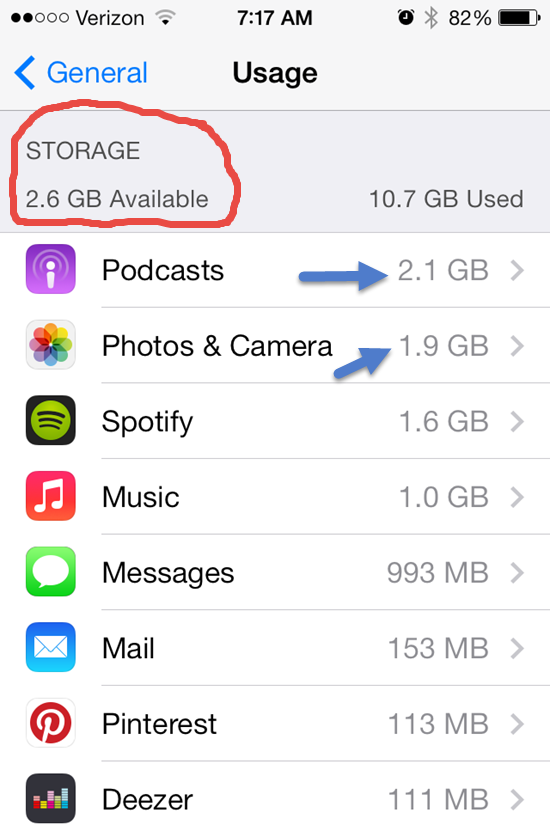
This also shows you all the other memory hungry Apps on your phone. One common culprit is your camera's memory and all those pictures and HD videos. Downloading them to your computer and then deleting can free up some space.
Depending on your settings, Podcasts download automatically and can quickly crowd out your favorite playlists. Open your Podcast App select a specific Podcast > Settings > Episodes to keep and select a number to save (Last 2 / Last 5 / ect…) instead of All.
Do you have any other tricks you can share?
Originally posted 2014-04-04 07:53:40.
by John | Jun 3, 2017 | Engage Your Students, Instructor Training, KEEPING IT FUN, Master Instructor Blog, Promote and Build Your Class

Click to join our new Facebook group!
Happy Thanksgiving Everyone!
Waking up to -3° F this morning reminded me again how thankful I am for Indoor Cycling 🙂
I felt today would be the perfect time to announce our new Facebook group – Celebrate Indoor Cycling
Celebrate Indoor Cycling is dedicated to the memory of Jim Karanas
Anyone who knew Jim, loved him. He was a very influential part of creation of what all of us recognise as Indoor Cycling today. Jim's knowledge of training was unequaled, as was his wisdom and understanding of what Instructors needed to do, to truly meet the physical and emotional needs and expectations of their participants.
All of us here at ICI/PRO benefitted immensely from Jim's insightful articles and Podcasts. This post of his profoundly changed my perception of my role as an Indoor Cycling Instructor. Three simple concepts that began the slow process of opening my eyes and accepting both the appeal and value of non-traditional forms of Indoor Cycling…
Who am I to decide?
If a workout session has to produce a result, you have a paradigm for unhappiness. Instead, my current approach is to create a training session that allows a person to get whatever he/she needs from the workout without interference on my part.
Just present the opportunity
As an instructor/trainer, my job is to create a situation and an environment in which members can experience the benefits of physical exercise, and nothing more. Which benefits these are will vary with the individual, and it’s important that I never assume what they could or should be.
Then accept their choice without judgement
I offer suggestions but recognize that this is their path. I can't overshadow it with what I think they should do with, or gain from, their training. That’s not my job and would be a misuse of the trainer role.
Shortly before we lost Jim, he wrote Non-Authentic Indoor Cycling. If you haven't read it please take a moment and do so, because it describes his progressive vision for Indoor Cycling and what he felt would be our roles as Fitness Professionals.
If non-authentic IC is going to make a mark, why not embrace it for what it is — a way to train on the bike that makes (some) people fit and happy?
…
Why shouldn’t any and every indoor cycling program be taught by those who are truly qualified to teach indoor cycling? That would be the likes of us. We know indoor cycling best. We could create a program — inauthentic fluff, if you will — that’s still authentic in its safety, structure and cardiovascular benefit. Why not?
Interested in being part of a group of Instructors who believe like Jim did?
We'd love to have you join us 🙂
Originally posted 2014-11-27 13:38:05.
by Jim Karanas | Jun 1, 2017 | Master Instructor Blog
By Team ICG® Master Trainers Jim Karanas and Joan Kent
Over 12 years ago, Jim developed an athletic training program that eventually earned the tagline “Stop exercising. Start training.” At ICG®, we think there’s a difference between the two, one that people ask about frequently. Training encompasses more than the physical aspect of the ride.
Currently, training versus exercise is a popular topic. An internet search readily reveals the ongoing discussion, with suggestions and ideas as to the difference.
According to some sources, training is based on having a purpose, setting goals and achieving specific results. Exercise, in contrast, has been said to lack focus, goals or purpose. Training is said to be intense and engaging. Exercise is said to lack intensity and even be boring.
But are those really the differences? Say someone wants to lose weight and begins the following process: an indoor cycling class on Monday, an elliptical workout on Tuesday, a kickboxing class on Wednesday, Bikram yoga on Thursday, treadmill running on Friday, and body conditioning on Saturday morning.
Is that exercise or training? There’s a goal/purpose. The activities listed would provide intensity, plus variety to prevent boredom. Yet the weekly plan looks more like random exercise than structured training, so the differences must lie elsewhere.
We think the above distinctions are only part of the difference between training and exercise, and not necessarily the key points.
First, for a workout plan to be training, it probably needs to be progressive. Progressive training might start with foundation-level workouts and move into more intense levels of effort that are also designed to make the participant stronger in the activities. For that to be effective, the activities might need to be limited (say, to indoor cycling and treadmill running), rather than a hodge-podge of many unrelated things. Specific adaptations occur more consistently when the activities are specific, too.
Limiting the activities and following an overall progression wouldn’t preclude changing the format. But changes would be designed to elicit a specific training outcome for each session, rather than simply to prevent boredom, and the student is made aware of that objective.
The progression might culminate in performance events. A lot can be said about athletic performance, and will be in another post, but maximum efforts differ from what could be called “pseudo-hard.” People who love to work hard are typically talking about pseudo-hard efforts, rather than max.
Attitude or mindset is also important. It’s not simply working out to drop a few pounds, but training to develop our consciousness, nourish our body, change and quiet our thoughts, and balance our mind. Let that be the philosophy. Workouts without philosophy lack consciousness. Training is about bringing consciousness into the process. When we focus on what we’re doing and stay highly conscious of all of it, it’s never boring. It’s simply what is.
To maintain presence, we need to recognize the intrusion of thought immediately and bring awareness back to the moment, no past, no future. A sense of self in the moment is the way to turn off the mind. If we project into the future, the mind comes in like a tidal wave and sucks us into a stream of thought. Thoughts create time, make minutes feel like hours, and rob us of the desire to continue.
Then there’s pain. Or more precisely, the approach to it. We’re all familiar with “no pain, no gain” and the attitude that pain — certain types, at least — can be good because it means the workout is beneficial.
There’s also the “Hulk Will Smash” approach: the more it hurts, the more I like it. Grrr. Fanatics with no sense beyond the muscle of exercise may use that to complete their workouts, but addiction to pain isn’t training.
Training is a more mindful approach to pain that involves feeling it, fully understanding it, being sensitive to it — and putting a space around it, becoming nonreactive.
In what we do, pain is inevitable. But it’s just a trigger. It may stimulate resistance that compares to an emotional state. As our emotional threshold rises, our reaction to the pain changes. It doesn't feel any better. It just doesn't bother us as much. The warrior chooses death. Athletes choose physical pain, or at least non-avoidance of pain. As the polarization in our mind diminishes, our emotional reaction to the pain becomes one of acceptance or even dismissal.
Any athlete can recall having had the time of his/her life despite feeling pain during an event. A couple of decades in the fitness industry make it clear that anyone who wonders why an athlete would do something unpleasant, like push through pain to reach a goal, can’t adhere to a fitness program for any length of time.
Tools such as consciousness, presence in the moment, attentiveness, curiosity, non-reactivity, and so on are ultimately ways to add balance. Training tests our effectiveness with them. Exercise lacks these tools.
Originally posted 2012-03-26 09:52:29.
by Jim Karanas | May 26, 2017 | Engage Your Students, Master Instructor Blog
By Team ICG® Master Trainer Jim Karanas
I’ll switch gears from my recent posts on using public speaking techniques to enhance our teaching to talk about what we say. In The Art of Cueing, I discussed the use of cues to bring depth to the class and make it more than just a workout. Cues concerning the science, the music, the video, your personal experience, even philosophy can make your class more interesting and more impactful.
Philosophical cues are the most difficult to incorporate. Instructors don’t typically cover philosophy when they teach because they don’t think people want to hear it, or they don’t feel comfortable talking about it. Someone who doesn’t teach might say the first is true. But maybe that person hasn’t yet heard a well-delivered philosophical message and is just uninformed.
I understand not feeling comfortable talking about it and will address that later.
Adding philosophy to a class so it doesn’t sound like preaching is what I call “messaging.” A class without messaging is just a workout. It might even be a good one. But the instructor’s power will weaken over time, just like playing the same workout video over and over. It diminishes with no message. All the public speaking techniques in the world can’t compensate for a class that lacks substance.
Unforgettable lyrics are unforgettable because they send a message. A public address goes viral on YouTube when it sends a message. Messaging will touch a person’s life beyond the great workout you just delivered and compel him/her to come back to your class again and again.
What’s a message? Any life concept that you bring to the class and that can be experienced in the class as result of the training you’re providing. A couple of examples:
Focus
Coaches often tell you to “stay focused” but rarely tell you how. Focus is not simply directing your attention to what you’re doing. That leads to thinking. Thinking will weaken focus. Focus is complete engagement in what you’re doing. A focused mind pays no attention to distractions. Fast descending takes focus. If you’re not 100% engaged and non-reactive to distractions, you might crash. How do you train yourself to be this way — not just during a dangerous descent, but right now, so you get the most from your workout? That’s the essence of our class today.
Motivation
Something that happens outside of you that you consider “motivating” is not a strong incentive. You might see someone overcome great adversity or hear a story that strikes a personal chord with you and feel filled with motivating energy. These external motivations work temporarily, but have far less impact than motivation you generate by yourself. I want you to look at motivation as something personal. Then you have the ability to train and get better at it. You can train yourself to be motivated the way you train anything else.
When you understand how to do this, motivation is endless, limitless. The only time you won’t feel motivated is when it’s a personal choice, and you’ll recognize it as such. You’ll no longer look to me or to anyone else to motivate you to train. You’ll rise to the occasion again and again because you’ve trained yourself to do so. I’ll show you how to do this in today’s workout.
As an instructor, all you have to do now is deliver a physical practice (the day’s ride) that delivers the results you just promised to deliver in your message. If I’ve enticed you, and you want to learn how to focus or be consistently motivated, the solution is simple: Come to my class. That’s the power of good messaging.
The messages you can deliver are many: how to engage fully, how to sense meaning, how to expand your concept of what you can do, how to sense your life energy, how to direct it, how not to react to adversity, how to develop discipline, how to go beyond hope and fear, and on and on.
How do you, as an instructor, learn to deliver these messages, both verbally and physically? First, you must want to. Second, you must become a student of philosophy. You study and you ride, and you bring the lessons that you learn from your study to the bike, and then to class.
I have a small library of what I call my “Life Books”. These are about 10 books that I have found extremely helpful. I’ve read each of them dozens of times. A good philosophical book is one you immediately realize you need to reread. My first Life Book was Way of the Peaceful Warrior: A Book That Changes Lives. It was the first book to encourage me to approach my training from a conscious perspective. I have several copies with dog-eared pages and many handwritten notes throughout.
Physical movement has been part of spiritual training for thousands of years. It was not meant to provide exercise. Daily activity was supposed to do that. Keep a conscious attitude, go beyond the workout, and deliver a message every time you teach.
Originally posted 2015-01-07 07:16:21.
by John | May 25, 2017 | Instructor Training, Master Instructor Blog

The road isn't segmented into definable sections… it flows along as one continuous, undulating strip of asphalt. Your cyclists may appreciate your class more if it flows like the road they ride. Here's why & how…
Common practice for many of us is to construct a class profile out of a playlist of songs:
- Warmup songs followed by
- Songs that communicate Flats
- Songs the communicate Climbs
- Interval songs
- Recovery songs
- Cooldown songs
- etc…
The end of each song signals a transition. We'll use that brief change to cue the next segment “now we're going up!” or “nice flat road ahead” or something similar. A gap follows the end of each track – before a new section of road begins.
But the road really doesn't work that way, especially when it comes to random rollers or out-right climbs. Everything is connected. Flats flow into climbs, the downhills back to flats and the flats are broken up by rollers. Your; speed, heart rate, power and even your ability to recover once over the summit, was determined long before you needed to shift down with the increase in grade.
I wish I was wearing a recording Heart Rate monitor this past Tuesday night, because a graph that showed the 2 1/2 hours of my HR would have told the tale much better than I can describe here in words.
Everything on the road is connected… there are few, if any, gaps… I'm realizing now that I had been training my class (and myself) like there were.
It was the first Tuesday night Life Time Fitness outdoor group ride. Me and my very fast VeloVie Vitesse showed up with a just a little bit of anxiety. “Which group are you riding with, John… the “B's” or will you being going out with the “A” group?” Great question and at that point I hadn't really decided. Of the 40 or so riders in attendance, I recognised almost everyone as either other Instructors or past participants. Maybe it was just me, but I got the sense that some of my regulars were watching to see what I was going to do.
These are well organized rides, with designated “Ride Leaders” who are paid LTF employees. After a brief welcome and introduction of the A, B and C leaders it was time to roll out. “A' group goes first. “Riding with us John?” Of course I was. My pride and ego didn't leave me with any other choice 🙁
The LTF “A” group has a well deserved reputation as an ego driven, hammer fest. Even though this was night #1 you wouldn't have known it. They start out fast and only get faster. The first 30 minutes are spent working our way out of town, to some very nice rural country roads. Here's where the fun begins and the reality of how everything on the road is connected came front & center to me.
If I can slot in tight behind a big guy, hanging with a paceline @ 26mph is a near threshold, continuous effort. Challenging, but doable. CoRd 6, as it winds west of the cities, flows through a series of rollers. Each change in grade required a substantial increase in power to maintain my sheltered place in the group.
The downhills that follow aren't for recovery. Nope. They're for building back your average speed. Well that's my theory anyway because once I crossed each summit I was forced to shift up to keep with the acceleration that followed each short climb.
I found myself trying to do two things at once (well three if you count staying focussed on my chosen wheel);
- Fight to recover from the previous effort…
- While mentally preparing for would come next
I've described this as “recovering on the run” to my class. How your group doesn't slow/stop at the top of a climb to give you a chance to rest. They keep going. If you're committed to stay with them, you need to accept whatever reduction in effort you're offered and use it to recover as best you can. Over time, with a slight reduction on power output, your HR will come down. You just need to wait for it – or slip off the back and soft pedal until the “B” group catches you.
I told this story to my class this morning. How out on the road everything is connected. There are no “gaps” between segments. Only small changes in effort. And while I talked about my ride… we rode a class without gaps. Flats flowed into rollers and we accelerated down the back. Slight reductions in effort on the flats, followed by more of the same.
Over and over, just like the road.
Originally posted 2013-05-02 09:56:10.
by John | May 23, 2017 | Best Practices, Instructor Training, Master Instructor Blog

Are you calling out SQUIRREL!!! in class?
There I was, enjoying another instructor's class JRA (just riding along) in my own little zoned out world. I get that way often, when I'm aerobic and don't have to focus on teaching. It's typical for this to happen to me in a class where the instructor tends to offer too much… of everything.
Too much droning, unrecognizable fitness music.
Too much explanation.
Too much encouragement.
Too much talking/chatter… period.
So I tune them out and ride by myself until I hear the Instructor yell “SQUIRREL” and I snap back to reality. OK, they don't exactly say “SQUIRREL” but they may as well have.
I can't repeat them verbatim, but it sounds something like this to me; “Blah blah blah, blah blah Mitochondria blah blah blah. Blah blah blah, blah blah blah blah blah blah Shoulders blah blah blah.Blah blah blah, blah blah blah blah blah blah Blah blah blah, RPE of 7 blah blah blah blah blah blah Blah blah blah, blah blah blah Scrape Mud blah blah blah Blah blah blah, blah blah blah blah Hand Position Three blah blah Blah blah blah, blah blah blah blah blah blah Blah blah blah, blah blah blah blah blah blah RECOVER!!!
My head pops up. Did she just say “SQUIRREL”? “What were we doing?” “Did I miss an interval?”
If you're missing my “SQUIRREL” reference, the Disney movie UP includes dogs who can talk, courtesy of a special collar they wear. A running joke throughout the movie how easily the dogs are distracted by one of them calling out “SQUIRREL”. Regardless of the seriousness of the conversation or situation, inevitably there's a “SQUIRREL” moment where everyone snaps to attention and scans for something furry to chase. Here's a clip.
http://youtu.be/OxYYPziLdR4?
There are certain words you may use in class that are the equivalent to “SQUIRREL” for humans, when thrown out between an endless string of chatter. Many I'll bet you use frequently; Recover, Go, Up, Down, FTP, Zone 3, Add a gear, Attack, Stand, Smooth, Breath and Climb to name a few. Notice that they describe something specific you'd like me to do. Don't get me wrong here, all of these words are perfectly fine to use in your class – just as long as you aren't inserting them into an endless string of blah blah blah's.
So what's the solution?
Please learn to be OK with silence 🙂 Understand that less is more in many situations. I'll bet that your class would be perfectly fine with you telling them to work for three minutes @ threshold and for you to ride along quietly with them until near the end. “Thirty seconds… Just ten… Recover.”
Are you OK with silence? This maybe another great reason to record yourself teaching and listen for times when you don't speak – or maybe discover that you have a little bit too much blah blah blah in your class that ends with a “SQUIRREL”.
This interview with communication expert Alexa Fischer may give you some additional ideas on what you should be listening for, in a recording of your class.
Originally posted 2014-04-09 09:54:07.
