PRO member Kay asked a very good question about ANT+
… I'm also wondering about Heart Rate. If the bikes are ANT+, will they only pick up ANT+ Heart Rate Monitors? I noticed that the new Schwinn did not pick up my Polar HRM
Thank you for your comments!
Kay
The short answer is; No. Indoor Cycles with or without ANT+ consoles will detect and display most Heart Rate straps.
It all comes down to the type of HR strap you are using, but it can get confusing. I'll try to explain.
First let's identify the three players:
Analog (Low Frequency) HR Monitor straps
Digital/ANT+ (High Frequency) HR Monitor straps
Hybrid HR Straps that offer both High and Low Frequencies
Analog HR straps & monitors have been around for years. I guess you could say they are the generic version and any inexpensive HR monitor is Analog. For many people they work just fine but they have two problems:
They will “Cross Talk” with other monitors as they are indiscriminate in which signal they will choose to display.
Battery life of the strap can be relatively short (measured in months of use) due to the amount of power they consume broadcasting their low frequency (5000Hz) signal. It takes comparably more energy to generate low frequencies vs. high frequencies – think how much work a Tuba Player expends vs. the Piccolo Player in a marching band and I'm not referring to the weight of the instrument.
To solve these two problems HR manufactures introduced Digital HR straps and monitors using a very high frequency 2.4gHz or 2,400,000,000Hz which is what is referred to as ANT+ or some like Polar describe it as “Coded”.
ANT+ receivers will lock onto the source – commonly known as “Pairing”, they will reject other competing signals once they have been successfully paired.
Battery life is measured in years – Garmin says their strap's battery will last over 5 years, operating one hour a day.
ANT+ has another ability that Analog doesn't, the ability to transmit and receive multiple data sets over multiple channels. Where your Analog monitor can only understand; Beat…Beat…Beat, ANT+ can transmit an incredible amount of information that's really limited to the engineer's imagination. I'll bet that that CycleOps PowerCal Power Meter that uses only heart rate data from the users chest strap to estimate Power Output is transmitting a lot more than just Beat…Beat…Beat
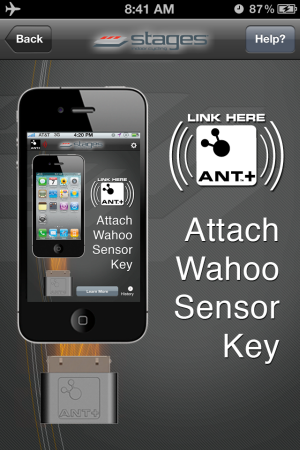
The Spinning Fitness Tracker uses a Garmin ANT+ strap and ANT+ iPhone Dongle
So ANT+ looks like the perfect solution, except for one little problem… every piece of fitness equipment on the planet is designed to receive and display Analog signals. But this is changing and Garmin as an article here that lists the change with more and more pieces of equipment adding ANT+ technology.
Enter Hybrid HR straps that transmit in both the high ANT+ and Low Analog frequencies. This give the user the option to display their HR on a club's treadmill, while at the same time only pairing with a compatible ANT+ device.
So back to your question about not being able to see your HR on the Schwinn AC, Kay. Either the Schwinn AC MPower Console or FreeMotion's should display your HR, regardless of what strap you were wearing. I have a Hybrid Polar strap which works just fine on the Schwinn, but not an exclusively ANT+ strap – so I don't have first hand experience.
I've asked the question to both companies and will update this post when I know more.
UPDATE: Schwinn Master Instructor Julz Arney got back to me with:
Yes, the wireless technology used by the MPower console is ANT+ (owned by Garmin.) Any HR strap using ANT+ should connect. There are a few hints to make it easier:
-Have HR strap on and functioning before turning on console
-Be on the bike saddle (i.e. in close range of the console)
The console looks for a HR signal for approximately 30 seconds from when it's turned on. If it doesn't find a signal it will stop looking. The rider will then need to turn off the console and turn it back on.)
I hope this helps!
Both the Schwinn AC and FreeMotion have a limited time for the rider to pair to the console. The S1.9 will only connect during when the console shows Warm Up.
This is the last of our re-publishing of of past articles from Team ICG® Master Trainer Jim Karanas.
Pyramid training is a method typically used by strength athletes and body builders. A session starts with high reps and low weight and incrementally adds weight while reducing reps per set.
Pyramids are typically described as ascending or descending. Descending pyramids are also called reverse pyramids: you warm up, then start with your heaviest weight. From there, you decrease the total load, while trying to do a few more repetitions. Triangle (or up-down) pyramids include both ascending and descending pyramids.
Pyramids are less commonly used by cardiovascular athletes, although they’re strongly recommended by many pros. Ascending pyramids are the only type discussed, and the format involves decreasing time with increasing intensity. An example is a 4-3-2-1 ascending pyramid: 4 minutes easy, 3 minutes moderate, 2 minutes hard, 1 minute very hard. Descending and triangle pyramids are seldom referenced.
In previous posts, I’ve referred to ascending and descending pyramids as ladders and referred to a triangle pyramid as a pyramid. I change the nomenclature here simply to align with how other trainers refer to these training patterns.
The infrequent use of pyramids in indoor cycling always amazed me. Rowing introduced me to structured cardiovascular workouts. I rowed competitively on the water in the ‘70s and competitively indoors in the ‘90s. Rowing ergometer workouts investigate every possible variation of pyramid training and provide a useful template for indoor cycling instructors. With that, you can create an almost endless variety of trainings.
Whether or not you have a computer on your bike, you have four primary variables: cadence, resistance, intensity, and time. In cycling, most ascending pyramids use only time and intensity. The interval gets shorter and the intensity (RPE, HR or power) goes up. This overlooks many potential training opportunities. What about time and cadence? Interval gets shorter and cadence goes up.
What if you involved more variables? How about time, cadence and intensity? Interval gets shorter, cadence goes up, but RPE, HR or power output has to stay the same. This requires a subtle adjustment in the resistance as well as a greater integration of breathing to facilitate relaxation. The result is greater efficiency at high cadences.
How about an ascending pyramid to build strength at higher RPM and improve the ability to spin a harder gear? Time and resistance stay constant but cadence increases. Perform three 1-minute intervals with a fixed resistance and ascending cadence (80-100-120 or moderate, fast, faster). You can also put three of those pyramids together and add in ascending resistance. After each pyramid, you increase the fixed resistance level for the next pyramid.
How about a reverse pyramid to facilitate strength development? The intervals get longer as the cadence decreases, but intensity must increase. This requires massive addition of resistance, as the slower RPM will tend to drop the HR or reduce power. Increasing intensity while cadence is slowing requires a very hard gear. Increasing duration as this happens is quite challenging.
Up-Down (triangle) pyramids are by far my favorite. An 11-minute triangle consists of intervals that are formatted 3-2-1-2-3. How about cadence going up and down (80-100-120-100-80) while intensity goes up and down? I rarely see people coach the down side of this kind of pyramid effectively.
One of my favorite ways to coach this pyramid is to extend a super-threshold effort. First, these 11 minutes are done after extensive warm-up. The ascending and descending portions of the pyramid are performed at different intensities. I’ll use HR percentages of max just for an example: 75%, 85%, 90%, 88%, 86%. As the super-threshold effort begins to induce muscle failure, you drop the HR just enough to squeeze out the next interval.
You can vary this. How about using the same ascending pyramid for HR but with a fixed cadence at 100 RPM? On the descending portion, you maintain the 90% HR but drop the cadence (90 and then 80 RPM). The slower cadences will very likely make 90% impossible for most people when sitting, so you move everyone to the standing position. 90% is possible when jogging at 90, as well as 80 RPM, but you’ll have to increase the resistance as you drop the cadence to 80. Brutal.
The variations are endless. For those who haven’t had the benefit of training on an indoor rowing ergometer, I’d strongly suggest reviewing the rowing workouts available on the Concept 2 website (www.concept2.com). You’ll find many workouts that are easily adaptable to indoor cycling.
When I'm asked to review a product or service that includes new technology, I'm always a bit hesitant. You see I like simple and I tend to see many new products trying to solve a problem that really doesn't need to be solved or will add another (needless) layer of complexity/frustration/distraction to the lives of Instructors and/or their students.
Power indication in our classes is a perfect example. Seeing our watts is a huge step for many of us and equally so for our students. We see the value of all this information (metrics) about the amount of work we're doing in class. Many of us are excited to use that data as the basis for improving our fitness.
But what do we do with all this new information?
Collecting your data is a good place to begin. Both the FreeMotion and Schwinn Power Meter consoles offer the option to plug in a USB flash drive. After your training session you can download the ride to your computer to see what you've done. Which is interesting, about two times. Then you realize that looking at a snapshot of a single day isn't really telling you anything of value. If you're an Excel expert you can build a fancy spreadsheet to show graphs where you can see trends. Or you can subscribe to an online service like Training Peaks ($20 a month if you want the graphing features), upload your results and track your fitness. I see online services as an excellent choice for a committed athlete, but a bit over-the-top for the Club Athletes that make up the majority of our classes.
When Cameron Chinatti from Stages Indoor Cycling explained their new iPhone App, which is designed for use with the FreeMotion console, I saw it as a potentially useful tool that could benefit both you and your students.
So I agreed to give it a try to see if it was in fact useful and not needlessly complex or distracting.
I have a “Is it intuitive and easy to use?” test, which is simply; “do you turn it on and it works… Yes or No?
The App passed – and as long as I followed the proper procedure, every time I turned it on it worked.
The console is designed to “Pair” fancy word for connecting to both a Heart Rate strap and/or your iPhone during “Warm Up” mode. Once you advance to Stage 1 Pairing is no longer available. With the Stages App turned on, pedaling the bike and the console in Warm Up you will see:
Pressing the Stage button brings you to the main screen.
My second test is; “what value does this product provide, beyond some fancy graphics?”
Something we all need to know.
The Stages App will calculate your FTP (Functional Threshold Power) and your Heart Rate at FTP over a series of rides. Understanding your FTP is as important as knowing your Threshold Heart Rate. With both these metabolic markers you can create specific training zones. Once your student's know their Power Zones your class will be a whole lot easier to teach for you and more understandable (and beneficial) for them 🙂
Here's the setup screen where you can select to App to calculate your FTP or you can manually add it if known.
Auto-Calculate FTP is HUGE
I talked to Cameron about the auto-calculate feature because after three rides it was showing my FTP as 186 Watts vs. ~240 watts which I'm normally seeing during a long hard effort. Her response was; “how hard did you ride during those classes?” I admitted that I hadn't worked as hard as I could have. Cameron explained that App is looking for your best 20 minute average wattage and if I don't provide a hard/long effort the App doesn't have the necessary data to work from. It didn't have any trouble calculating my FTHR 🙂
There's much more to this App and I am planning a Podcast with Cameron to explore all it's functionality in more detail. For more now please check out this Quick Start video and if you are teaching or training on a FreeMotion S11 series Indoor Cycle I highly recommend that you start using this App – ASAP. Order your Freemotion S11.0 Indoor Cycle – with Power Sensor Console
Cycling Fusion Master Instructor Tom Scotto is back! Tom conducts a Cycle Strong Instructor workshop and here is an abbreviated version for you to enjoy and learn from.
As this is an actual workshop I asked Tom to provide a PDF of Cycle Strong that includes the Power Point slides that you can reference while you listen.
I taught my last class today. My last ride so-to-speak. It all started seven years ago. I had been Spinning® for years. That day our regular instructor asked me to lead her class. She was just too sick.
To me – a pilot – it was like being asked to safely land an airliner because the pilots were incapacitated. Truth be told, I was far more prepared to land a 747 than lead the class. But I did it, and that is where my ride as indoor cycle instructor began.
Penning this post for ICI/PRO is – for the most part – where it ends. A memoire of sorts that highlights milestones of my journey from certified but lost, to Master Instructor, what I learned along the way about our craft and our industry.
Realizing the joy of being in the front of the studio, I took the first of countless certifications the next month. A one day, eight hour class. Leaving that afternoon I realized what I didn’t know.
I knew that to be the instructor I wanted to be, would require more than eight hours. So I did what all red blooded Americans do, a Google search on teaching indoor cycling.
Lucky for me John understands search engine optimization. ICI/PRO was top of the list and my life as an instructor changed.
Back then John was publishing ‘podcasts’ and posts talking about something he called Indoor Cycling 2.0. What?? I was in my car a lot in those days with my iPod plugged into the radio. I listened to it all trying to figure the best way to integrate such wisdom into my teaching.
There were guest speakers who discussed everything from music to very cycle specific training.
There were posts from this guy, Gene Nacey, who had started a company called Cycling Fusion. Gene wrote a book back then about training with power. The forward, written by Sally Edwards. Who were these people and why are they always talking about heart rate, power and cadence?
ICI/PRO offered class profiles with music suggestions. I found these very helpful but they had names like muscular strength or climbing power or aerobic volume training. It was all very overwhelming.
I realized what made it so overwhelming was that I had not really been educated. That my eight hour class hardly scratched the surface of what ‘training’ on an indoor cycle was really about.
My experience taking classes was just the opposite. My favorite instructor never did any of this stuff. I had reached a defining moment. Indoor cycling version 1.0 or 2.0.
I chose 2.0 because it had the education I yearned for and the structure that seemed missing from the classes I took. I had always been a fan of heart rate. Moreover, the new bikes at the JCC – where I was trying to land a sub job – measured heart rate and had power meters. I knew that seemed like the perfect combination but – at the time – had no idea why.
I got the sub job and a fair amount of opportunity to teach in those early years. I began my quest to get better through education. My sub classes (all I had at the time) were – unbeknownst to them – my guinea pigs.
Having read Gene’s Power Training Book there were some questions. I had found a way to land a ‘regular’ class in prime time by offering to do a power training course. I had questions, so I called him.
Gene is the quintessential professional. He always gave freely of his time to answer my questions. But he warned me, “Chuck where you are going you will discover a culture, the culture of indoor cycling. Good luck.” But more on that later.
Later that year he was doing the official launch of his new company, Cycling Fusion by hosting a summit of some of the most nationally regarded indoor cycle instructors. I’m not sure where I found the nerve, but I offered to kick off the summit suggesting that I was representative of the new 2.0 instructor. To my surprise Gene said yes.
The rest is history. My relatively short, but incredibly intense career really began at that summit, west of Denver high in the Rocky Mountains at Keystone Ski Resort. Why? I met Sally Edwards. Talk about unbridled energy. Sally – the only person ever inducted into both triathlon halls of fame – epitomizes it.
Suffice it to say that when I ran into Sally at the Denver airport after the summit I knew I was home. John led me into the room, Gene opened the window and Sally was the sunshine that poured through. There are not enough words to describe the learning one experiences working with Sally Edwards.
But if Sally was the sun shining on my personal learning crusade, Jim Karanas was the fresh air flowing through the open window.
Jim was indoor cycling 2, 3, 4 and 5.0 way before anyone ever heard of a ‘podcast’. Sadly, Jim left us a while ago, but his legacy lives on in all of those he touched. From Jim I learned to put the icing on the cake. That at the end of the day, it was not about me or just about heart rate or power, cadence or cycle specific training. It was about bringing to class the ability to touch each rider such that they were sure I was teaching class just for them.
When I made the choice to give up leading classes I did it with the knowledge that I had met my own challenge – to understand the whole of indoor cycling yes, but to touch the people who trusted me in a positive manner. How did I know? Simple really, rider feedback. Additionally, I had grown past the place where I was committed to only one way. I was comfortable teaching outside the keep-it-real philosophy that had governed my every thought for so long. I knew that Indoor cycling 2.0 was only a pass to explore and learn, not a rigid protocol to vigorously defend. That my job was not to suppose I knew what my riders needed, or how they got it, but to provide for them what THEY thought they needed that day. I can do that. I have done that. I am content. I have moved on but I have not forgotten.
In the coming weeks I will give John some additional posts written but never submitted. Posts that take a close, perhaps inside look at the realities of our industry. Fruit for thought or maybe, fuel for a fire.
It has been my privilege to have met and worked with so many great and talented individuals.
My understanding of Yo-Yo dieting was that it's not good for you. Lose weight, gain weight, lose weight, gain weight… the process of restricting calories and then reverting back to your normal eating habits can't be good for you.
ICI/PRO member Colleen Mathews send me a link to this article that says just the opposite, Yo-Yo dieting is good for you.
I was so intrigued I contacted the author; Nutritionist Katherien Tallmadge and she agreed to join me on the Podcast to discuss new findings that show Yo-Yo dieting really isn't bad for you or your students. We also discuss her book: Diet Simple which I found to be full of digestible (pun intended) tips that you could convey to your class week after week.