This Podcast is was originally published on February 8, 2009, I have updated it with our new Podcast host information and I am representing it now. I hope you enjoy it, Joey
Why did you become an Indoor Cycling Instructor? Why do you continue to teach?
An interview with the senior Group Fitness Instructor in my family, my wife Amy Macgowan. We discuss our reasons for becoming Indoor Cycle Instructors.
We would love to hear your reasons why you started and continue teaching.
Accountability
Practicality = Like or need to be paid to teach and appreciate the free membership.
Leadership = You are always in charge.
Personal fulfillment
Recognition
Camaraderie
Frustration = "I can teach a better class than so and so."
You love teaching
Some other reason?
Call the listener line and leave a voice mail with your reason. Skype ID john.macgowan1 or phone 952-388-0661
Listen to the Podcast below or subscribe using iTunes or Zune.
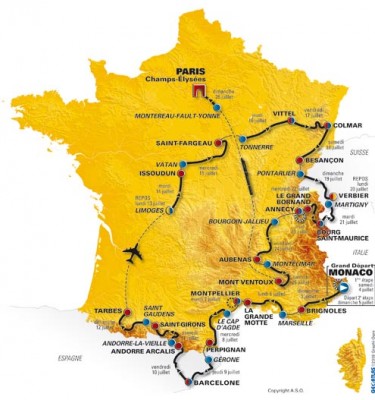
If you are one of those instructors who loves to bring the experience of riding outdoors to your indoor riders, now is the time to get them excited. Give them a taste of the Tour de France and introduce them to some of the fun we enjoy during this special time of year. Maybe we want to learn more about all of that tour lingo so we can share more with our classes. Here are some recommendations I have to wrap your mind and riders around one of the greatest sporting events of all time.
This year is the 98th edition of the Tour de France (twitter: #TDF). With it’s 21 Stages (days) of racing over the next 3 weeks. The riders will cover an astounding 3,430.5 kilometers (2132 miles) which is even more amazing considering the speed at which they are traveling (stages can average over 25 mph for 6+ hours of riding — Yikes!). Now there are all kinds of tidbits we can share, but I like to give my riders homework to help them better understand how to ride during class. Here are a few of my homework assignments:
(1) Watch just 1 complete Stage of the TDF (YouTube is OK for partial credit)
(2) Notice how riders stand (out of the saddle) and move their bikes back and forth when climbing — Let’s imitate that!
(3) Look at how balanced riders are between the handlebars and seat when they are standing. They are not leaning back over the seat or hanging forward over the bars.
(4) Try to catch a glimpse of a rider’s stomach from the side. Notice how it balloons out? One minute they look pregnant and the next not. This is how our stomachs should look during class — relaxed and moving in and out as we breathe.
(5) Notice how relaxed they appear on the bike (shoulders, arms and hands).
(6) Watch how smooth their pedal stroke is. A gentle waving (ankling) movement where the heel of the foot is not forced down. Let’s imitate that!
Just listening to the voices of the Tour de France, the announcers, Phil Liggett and Paul Sherwen will give you enough knowledge of the race to fill a set of encyclopedias, but if you are craving more, I recommend the following:
(1) Boy Racer : My Journey to Tour de France Record-Breaker (Book)
This is a great book that will not only get you to fall in love with Mark Cavendish, the Max-Missile from the “Isle of Man”, but will teach you a great deal about the TDF. Mark not only mentions 100s of aspects of the race, but takes the time to explain each one in laymen's terms.
Amazon: http://www.amazon.com/Boy-Racer-Journey-France-Record-Breaker/dp/1934030643/ref=sr_1_1?ie=UTF8&qid=1309973467&sr=8-1
There is no greater time than the present to enjoy/learn about the Tour de France and share it with those in your classes. They will feed off your energy, so if you are excited — they will be excited!
As is customary, I’ve opened my big mouth and am faced with the proverbial “put up or shut up”. Don’t get me wrong, I’m not one to trash talk and overstate my abilities. However, I am one that is always challenging others to accomplish things they think are bigger than themselves; to push past their own perceived limits and discover things about themselves they never knew. Sounds all good so far, but I have a basic life philosophy that tends to get me in trouble. To wit, I believe that whatever you teach, you should experience first. Consequently, all my challenges to others end up first putting me to the test.
Way back in January when our annual Winter Training Program kicked off, each participant was required to have a goal to train for. Goals ranged from doing a 50 mile charity ride to having 2 separate peaks during the race season. For me however, having just finished filming the Pittsburgh Dirty Dozen as a charity project for Livestrong, and watching some of the strongest riders I know struggle just to finish, that event seemed to be the logical choice. So I said it, I would train to complete – NOT COMPETE – in the Pittsburgh Dirty Dozen Race.
Starting this weekend, I will have exactly 12 weeks to prepare for The Pittsburgh Dirty Dozen. I’m going to post my training plan (both Heart Zones® as well as Power Training), and pre-ride schedule on this blog for others in the Pittsburgh area who would like to train along with me. The training plan will provide some structure to follow even though we will train in different areas. Every 2 weeks I will take on at least 2 (or more) of the 13 climbs as part of the overall training plan as well. Exact times and dates will also be posted here so riders who want to share the pain can join me if they like.
Point of fact is: this IS a race. Point of reality is: only about 10 to 15 of the 180 riders that rode last year were strong enough to garner any points at all. The format of this “race” is that the entire field is together at the bottom of every hill, and then the organizer, Danny Chew blows the whistle (by the way, someone needs to buy him a new whistle this year, it was sketchy at best last year), and the first 5 riders to the top get points.
While a few supermen and wonder women surge to the top like they have hidden motors in their bikes, the rest of the field climb at varying speeds, with an inevitable group on every hill pushing their way if they can’t maintain at least 4 to 5 mph. In surveying the group last year, it was clear that a lot of the field were experienced amateur racers, and that this was not bringing out the average casual rider. So when I say people were pushing, and there are always people pushing, it does not mean they were weak or inexperienced riders.
The graphic above is from the training DVD we created (Global Ride Productions) from last year’s race. It is slated to be released in 2 to 3 weeks, just in time to mix up some great indoor cycling with the outdoor application. Stay tuned, as I will endeavor to keep this updated once per week as we head towards this epic event.
This cute kid found something good – image from http://www.kingarthurflour.com/blog/2012/09/24/gluten-free-apple-crisp-fall-away-from-tradition/
The posts with more than a couple of comments always catch my attention. It shows a hit on a subject that interests people enough to share their thoughts. I have always considered this forum's primary objective to do just that. Light a fire so-to-speak.
That said, the post on Single Leg Pedal Drills got me thinking. They are a staple of my classes. I teach on both magnetic as well as friction resistance bikes. Like Doug (Yo Doug good to hear from you) I cue the riders to “let one leg go along for the ride.
The term ‘contraindicated' has – over the years — been associated with these drills when the rider has been instructed to ‘unclip'. And I agree though I see the risk as minimal. Even on bikes using MR we have a few ‘bouncers' — those that will just never put the kinds of resistance we instructors are trying cue — and as such are at risk for getting a pedal in the back of their leg. So I just don't do it.
Yet, what I liked most about John's post is that he has come back around to an important issue. It clearly got us talking with our fingers which means — hopefully — we gave it some thought. We don't always need to be finding something new so much as reinforcing something good. And that got me thinking.
As I have moved from beginner to journeyman to experienced to grizzled veteran, I've learned a few things.
Embrace and learn from those that take the time to compliment you/your class. Lately there have been many more of my riders — some regulars some new — that have taken the time after class to come to me with an acknowledgement of well delivered class. “Your best yet” said one just yesterday. The irony was that I'm doing nothing really new. In fact I used a playlist favorite of mine that has been collecting dust in my iPad for a while. When I think about it I've not really put anything new together in quite some time. Oh, I've got a pile of audio podcasts printed out waiting for me to take action. But I believe the truth is that the riders in my regular classes are enjoying my growth as an instructor far more than hearing Katy Perry's new tune. Or another way to climb.
People resist change. We already know we cannot please everyone in class every time. So if you are committed to bringing new everything to your class, every class, you may be setting yourself up for failure. Your regulars have an expectation of what you're going to deliver before they walk into the studio. Try your new stuff out when you sub.
You are who you are. If you have been teaching well attended, prime time classes then it is very likely that your success has more to do with you, than what you play and cue. While I don't recommend getting stale I do strongly urge you to stay true to your style.
I will use John as an example of what I mean. Recently he posted about a technology, Harmonic mixing, that blends tracks of the same musical key. His frustration was that others could put together better mixes than he. Ok, I guess. First, that is his opinion of his playlists and probably not an issue for his riders.
Next, while his integration of harmonic mixing may have a subtle effect (positive or negative) on what the riders hear, John is teaching to full room because he is John. A great smile, always happy to see his riders, has a plan for the workout and best of all, his voice over the mic during his cues are about the best I've heard. Right up there with the late Jim Karanas. Which segues nicely to.
Know your strengths and play to them. Maybe wife Amy and Chris Hawthorne put together mixes that he thinks flow better. Good for them, that is their strength, among many others, 🙂 not his. We all chose to get to the front of the room. On stage is what I call it. So face it, you like the affirmation. What gets you applauds is what your strengths are. If you are a new instructor then you may still be searching for key performance parameters. I use the word performance intentionally because that is what we do. It's not just about the workout but how you deliver it. Your performance.
One last thought on strengths. The best of the best are quite adept at getting their riders attention and holding it. I cannot stress this enough, go watch them. How? Maybe at your club there is the one instructor that ‘packs em in'. Attend conferences. IDEA here on the left coast is dedicated to instructor continuing education. SCW has monthly conferences around the country. Find one near you.
Know when to say when. If you are teaching more than an average of a class a day it will be very difficult to keep the fire burning hot. Motivating ain't easy. If you are teaching your third class of the day it will soon become obvious to your riders that you are not feeling the love. Teaching indoor cycling for living is tough and — in my opinion — not sustainable at pro levels. Unless teaching that many classes is standing between you and the street, consider what your optimum number is per day as well as per week.
Do continuing education. You can always get better. Our craft is one of caring, connecting, nurturing, prodding and sweating. But none of that is possible if you don't base it on sound fundamentals. Indoor cycling is about doing cardio vascular training on an indoor cycle. Knowing as much as you can about training both, will never hurt. Add your personality, a touch of some stuff you picked up from the pros and you've got a winning recipe.
We don't always need to be finding something new, so much as reinforcing something good.
We are getting closer to solving the multitude of problems we've been hit with, sort of:
ICI/PRO -The login widget was causing the login trouble. Please use the temporary link to the right.
Pedal-On – I'm fighting a battle with two separate web hosting & domain registration companies over what should have been a simple request >company “A” made a change that needed company “B's” cooperation… except “B” either (depending on who I talk with) can/won't or can't make the necessary change. I'm currently working with a “can” person. Stay tuned.
Podcast feed in iTunes is still broken and I'm waiting for a response from Apple.
It must be drive John crazy week. Technical difficulties everywhere I turn and don't get me started on the continuation of the cold crappy weather we are privileged to suffer through. Yesterday's group ride was 3 hours of steady rain @ 55 degrees.
iTunes isn't receiving our free podcast feed and yesterday one of my hosting companies needed to make just a teeny, tiny, little adjustment… which turned out to be huge and has pedal-on.com unavalible for the next (hopefully only) 24 hours or so.
While I try to bring everything back to some level of normalcy, please enjoy one of my favorite early episodes of the Podcast.
Whenever I teach an Indoor Cycling class, I try to create an experience that takes the students beyond exercise. A class can affect students even more when video is added. So far, though, video has been used in classes more as a backdrop to create atmosphere than to augment the experience.
The trick to teaching with video is to act as if the ride is real.
When we teach, we can make our students feel that they’re somewhere else through cueing, guided imagery and choice of music. When we dim the lights, play the perfect song, and describe riding through the desert under a full moon on a road with no cars, we can immerse the student in that imagery. Whatever doesn’t add to it detracts.
Can you imagine that same scenario with a disco ball? No congruence. The same holds true for leading a ride profile that has nothing to do with the video playing behind you, and never even referencing it. The video grabs the student’s attention from time to time but doesn’t create virtuality on the ride.
To make video more than a diversion or backdrop, we must embrace it. Then we can create an experience in our classes like never before.
John Chambers of Cisco Systems describes “telepresence” as technology that makes us feel present somewhere other than our true location. A popular application is videoconferencing.
Telepresence allows our students to feel themselves in the video. This leads to immersion, where a student’s self-awareness blends into the absorbing surrounding environment.
Video can create immersion in our students. The acronym ‘SIT’ describes the coaching process:
– Simulation references the video as a real-life scenario. “We’re on Highway 89 in the Arizona Desert, heading to Glen Ferry National Park. It’s 95 degrees with zero percent humidity. The road rolls, and we’re moving at 25 mph.”
– Interaction adapts the training directly to the video. “Our next stage is a straight-line climb, averaging 5%. Stay in the saddle and pedal at 70 RPM. Match your pedalling to the beat of the music.”
– Telepresence helps the class feel present in the video through cueing (words and voice), music (genre, tempo, structure), and the workout (cadence, resistance, intensity and choreography). “You’ve ridden hills like this before. Relax. Control your breathing and fall into the tempo of the music. It’s mellow. Let the music carry you up the hill. We’ll peak our HR at the summit of this climb. We’ll ride the first 3 minutes in the saddle and stand for the last 2, increasing resistance every 60 seconds without losing one RPM.”
With this link, (it's a big HD file so you may need to wait for it) you can download a segment of an HD virtual class, created by the Indoorcycling Group of North America, in conjunction with Virtual Active. When we use video this way — selecting words, music and a workout that make sense to us with the footage — our students achieve immersion. Note from John – you really want to watch that video 🙂
The degree of immersion will vary with the club setting and your comfort, which grows with experience. But even instructors with less experience can create immersion. As your coaching develops, your students’ immersion will deepen. The focus is less on the instructor and more on the video and the thrilling sense of forward motion it creates.
Video quality and high-def imagery enhance the forward motion feel, thus immersion. Virtual Active’s video enhances indoor cycling in a way that’s been missing till now.
You are now ready to begin delivering a complete and synergistic experience for your students.