Wait… what the @#$%^ happened to my Spotify Music Library?
It seems that every new Spotify update includes something that can be considered as an actual down-grade. This time they've removed a function many of us used regularly – the music library 🙁
The music library was a sort of master playlist. It included all the tracks from every playlist you've created or had followed. I would go there to find tracks of a specific length of time. Sorting your music library by the time column made easy work of finding that perfect song or two to round-out the perfect class.
Here's the solution
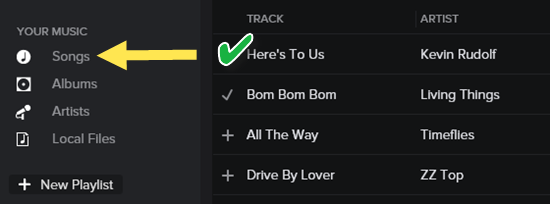
Your Music > Songs replaces the now missing music library. It provides the same function, except it's no longer auto populated with all the tracks you add to a playlist. Click on Songs and you'll probably find it empty. To add songs to it you need to tic the “+” symbol next to a track you “like” and it will appear in the Songs listing.
Easy enough to add tracks until you realise that you're going to be spending a bunch of time clicking each and every track – there is no option to “like” a whole playlist. So pour yourself a cup of tea, or adult beverage and start clicking if you want to re-populate a master list of all your favorite tracks.
Or you could just forget the whole thing and do without.
Why did Spotify remove this feature?
It's only a guess on my part – Spotify is hoping to improve their track referral engine… they see that you “like” song “A” and others who like song “A” also “like” track “B” = a better discovery experience for users. Music services have very sophisticated software that is constantly learning from watching our behavior, while using the service. For example Pandora tracks skips (indicating dislike) and Spotify now figures you'll only tic the best tracks to add to your Songs list.
John Manrique from Revolutions Cycling Studio in Jupiter, Florida joins me to explain how his riders have pedaled 200,000 miles. Along the way John and his wife Michelle have really forged a connection with their riders.
Since opening in December 2012, the folks at Revolutions Cycling Studio have been doing one thing: pedaling. A whole lot. As the only studio in Jupiter that exclusively offers indoor cycling (aka “spinning”) classes, Revolutions' founders Michelle and John Manrique estimate that the more than 11,000 individual rides completed over the last eighteen months will reach the 200,000 mile mark in May.
“We started Revolutions based on our shared passion for indoor cycling,” said Michelle, who along with husband John, moved to Jupiter in 2001. “Since there wasn't a ‘cycling only' place in town, we saw an opportunity to open a studio for people like us who like to ride hard and get a great workout in a fun, family environment.”
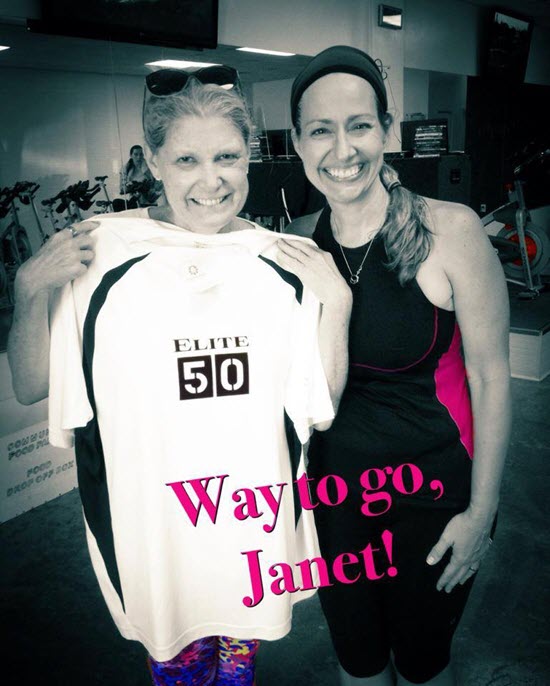
During our interview, John offers a number of great ideas you can implement to reward your riders – such as the special t-shirts shown above.
For those of you who aren't an “Excel Spreadsheet Geek” like John Manrique, there are simple options for collecting and disseminating rider data collected from these indoor cycles with power; Keiser M3i, FreeMotion S11.9, Schwinn AC and Spinner Blade Ions.
Performance IQ used in conjunction with Station/Bike Reservations and My Stats will connect riders with their data and send out an email at the conclusion of class automatically. Amy's an expert on how these systems intigrate and would love to show you a demo – feel free to call her 320-685-0183 or amy.macgowan@getliveedit.com
This is one that just makes me want to move…and climb…and move…and climb some more. There's also something about it that feels emotional. I can't quite put my finger on it. Maybe you can?
This Dutch hip hop rap artist is known for his raps, songs and choruses in both Dutch and English and this specific remix brought him international recognition.
The original version is 63 bpm's and 3:28. Almost better, the free SoundCloud download is 62 bpm's and 5:18!
It seems like a logical thing for a studio to offer; a variety of Indoor Cycling class formats, targeted at a wide demographic of people:
Early AM classes that are full of purpose, for all those “A” types who get up before dawn.
Fun/party/social class formats for the mid-morning crowd.
Shortened (express) class for the lunch hour.
High-energy classes in the evening (maybe with a DJ) to attract the youngsters.
Combo/hybrid classes that feature cycling (cardio) and a strength/flexibility component.
Endurance Sports Training.
A beginner's class to recruit new participants who might be a little apprehensive to join your HIIT classes.
It's common to see many of these class formats offered – except the last one, a regularly scheduled beginner's class.
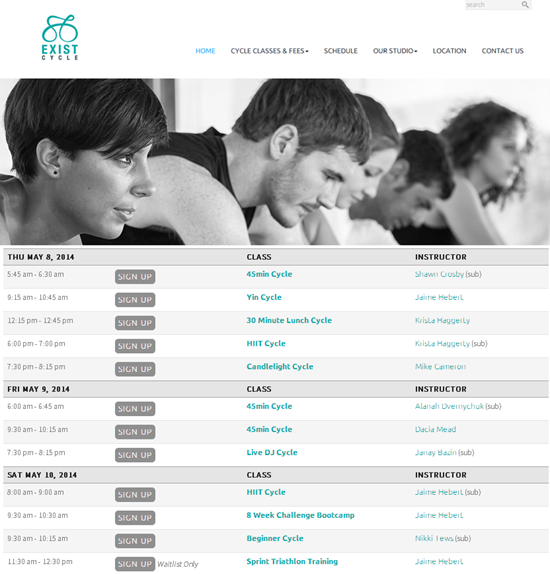
Exist Cycle in Sherwood Park Alberta CA offers them all – and it sounds like they're having great success!
Hi John,
We are finding that many people are intimidated by indoor cycling so the beginner class is a great way to introduce people to the cycling community. If people are new to cycling we always suggest our beginner class first but doesn't take long before they are riding in all our classes. Many clients love our 30 minute cycle and 30 minute HIIT class. It truly is a full body workout and 30 minutes of cardio.
We have had many success stories with a lot of returning riders and we are always excited to see new people in the studio each week. We are in to our 4th week of a 8 week wellness challenge with 20 clients. One of our instructors is a holistic nutritionist so the challenge includes 2 cycle classes/week, a boot camp class and then weekly meal plans. So far all our challengers are down in weight and inches and many have told us they are starting to feel stronger and healthier in just 3 short weeks.
Love reading your articles and visiting your website for a variety of great information!
[This is from the intro to my new book Sugar Addiction Is Real, and So Are Sugar Cravings: What Causes Cravings (It’s Not What You Think!) and How To Stop Them.]
The short story is I’m a sugar addict. I discovered that a long time ago, decades before anyone knew about sugar’s addictive effects. In fact, mentioning it to anyone was sure to result in a smirk and a visual body scan, known these days as the “up-and-down.” I got tired of the smirks and the up-and-downs.
Because no one knew about sugar addiction or believed it was true, I had to fend for myself. I eventually learned a lot — and recovered.
Sugar addiction is based on brain chemistry, and often genetic. I had no way of checking that out in my own family because I’d been adopted as an infant. I never met my birth parents (NY had closed adoption laws), and no one in my adoptive family had the same reaction to sugar that I did.
I felt weird and ashamed. I tried to keep my addiction a secret, but my family couldn’t help but notice my preferences in food. Because they weren’t a subtle bunch, they often had unkind comments about the foods I liked.
Things got worse in college when I was eating on my own for the first time, and kept getting worse when I was an adult. I’ll skip the details (lots of binges, frequent colds, odd symptoms), but I wanted sugar from the moment I woke up till I went to sleep at night. Sure, I ate other things, but only because I knew I was supposed to. All I ever really wanted was sugar. I don’t think anyone ever wanted it more than I did.
My low point came when I left work one day at about 5:00 pm. It was summer; the sun was still shining. I had eaten some sugar a couple of hours earlier. As I drove on the freeway, I felt tired and fell asleep behind the wheel. I woke up suddenly and had to brake hard to keep from hitting other cars. The car skidded, turned 90 degrees, and slammed into the left guardrail. It was totaled. I was shaken, but relatively unhurt — although my neck was never quite the same after that.
Fortunately and miraculously, no other cars were involved. The police officer who arrived on the scene asked if I’d been drinking. I answered truthfully that I don’t drink. That didn’t stop him from shining a flashlight in my eyes and asking me to get out of the car to stand on one leg.
Well, I passed the drunk driving test, but we never discussed the subject of food. No one made those connections back then. Maybe that was fortunate for me in its own way, but the whole thing was a frightening experience and an expensive lesson.
Not long afterward, I met a woman who ran a treatment program for addicts. Her unique system kept the addicts in recovery far more successfully than usual treatment programs.
Until she met me, she didn’t know that someone who was not an alcoholic or drug addict could be addicted to sugar.
I started going to all of her lectures and reading everything I could find on the subject of sugar addiction. That was difficult. At that time (24 years ago) there was hardly any material to read! I pieced together whatever I could find on hypoglycemia, psychiatry, the neurochemistry of drug addiction and alcoholism, food cravings in addicts, and more.
After I’d spent years educating myself, this woman finally said, “Joan, this is all you think about, all you read about, all you talk about. Why don’t you go back to school and do it for real?”
Until that moment, I had never thought about getting a Ph.D., but it made sense. The subject fascinated me — and still does.
I got a doctorate in Psychoactive Nutrition, how foods affect neurochemistry. Me, the woman who found classes in nutrition more boring than reading the phone book! (Okay, I still find most nutrition classes boring, but my program was about how foods affect behavior, eating behaviors, moods, cravings, food preferences, hormones. Great stuff, and far more interesting than the Food Guide Pyramid or the USDA Plate….)
My dissertation involved using my research to treat women with binge-eating disorder. To shorten a four-year story, sugar was a major trigger for binge eating and cravings. The low-sugar group got better results than either the low-fat or the control group over the eight-week pilot study.
I was, to my knowledge, the first person to outline the neurochemical pathway of addiction to sugar (and even to saturated fat or white flour). That was in 1999. Now the nutrition field is moving in this neurochemical direction. People acknowledge sugar as an addictive food, even a drug. Much information is available on quitting sugar and ending cravings.
Lately, I’ve been subjected to self-titled nutrition experts trying to discredit me. That’s okay. Some of the information I use is based on what I studied at the time — often on drug addiction. The important thing is IT WORKS on sugar addiction and cravings. It’s highly effective in getting people off sugar, improving their health, and helping them lose weight, feel better AND feel great about themselves.
It’s over 15 years later. I no longer have the time or energy it took to get my degree. I simply won’t study at that level of intensity again. I always read and keep up with interesting updates, but mainly I listen to the wise voice of my late (and great) mentor and coach. The voice reminds me that I do what I do to help people. It reminds me that I have helped many people. And it tells me to ignore my “detractors” and KEEP helping people.
So that’s why I’m here. I recovered, and so can you! I hope the information in this book helps you.
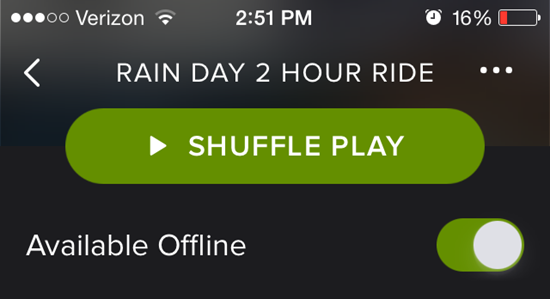
I had a feeling this big shuffle button was going to cause trouble.
The latest Spotify update included this very prominent SHUFFLE PLAY button – which I see as a bit of an over reaction. The old versions of Spotify kind of hid the shuffle option… except many of us still inadvertently found it – often with embarrassing results.
Now we've got this big button sitting there at the top of the screen, just daring us to tough, tap or drip sweat on it.
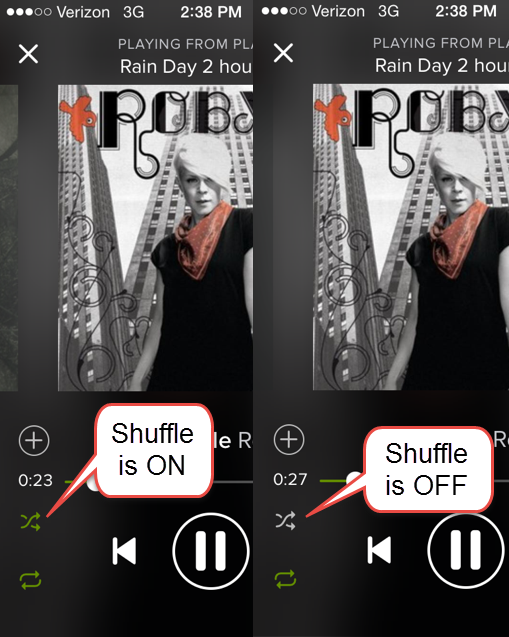
So how do check to see if shuffle is off and your playlist will play in the order you selected?
Check this image showing the little x icon. Green = shuffle is ON and grey = shuffle is OFF