Marketers have specific names for people, based on how quickly they purchase new products or embrace new technologies. The people who lined up, days in advance, to buy the first iPhones are described as innovators. Those of us who waited a few weeks for our new phone are early adopters. The few holdouts still using a rotary dial phone fall into the laggards category.
It maybe a “guy” thing, but I love new technology and feel I'm a bit of an innovator. I'm very comfortable experimenting with new software, especially if it includes a promise to improve my fitness or help me deliver a better class. For example; the second I saw Spotify I knew I needed to learn how it worked – both for myself, and then be able to help motivate the thousands of Instructors who visit here use it as well.
When it comes to Social Media, I hate to admit, I haven't been very innovative. Closer to a laggard. I've been privately wishing that FaceBook would fade away. You see, ICI/PRO has always been about others. My response to questions; “so, what do you do John?” has always been; “I have a platform to promote smart, talented and passionate people in our industry”.
So after multiple promptings to “get more active on FaceBook” and my realization that it isn't going away any time soon – I have finally decided to do just that… get more active on FaceBook and other platforms. Except I realized that I needed some help.
Enter Social Media expert, blogger and Indoor Cycling Instructor – Courtney Messier Lee 🙂
Courtney makes her living helping businesses develop their brands, online, using the various social media platforms. She has graciously offered to help me, starting with the creation of a FaceBook fan page.
Courtney joins me to discuss her plans to enhance my social profile and some of her ideas may help you as well.
You can learn more about Courtney and the services she offers, by following the (you guessed it) links to her profiles below.
ICI/PRO readers know that exercise can reduce the risk of heart disease, type 2 diabetes, hypertension, cholesterol problems, cancer, and more. Underlying those diseases is insulin resistance. Exercise reduces health risks by making skeletal muscle more sensitive to insulin, effectively reducing the resistance.
Insulin is a hormone that’s produced by the pancreas and allows glucose to enter cells for metabolism. It has several other functions, as well.
Under certain circumstances, someone might become insulin resistant, and the cells no longer respond to insulin’s cues. To get the job done, the body’s first line of defense is to produce more insulin. This may work, and can continue to work until the production of insulin no longer outpaces the degree of resistance. (That’s an extremely oversimplified description of the onset of type 2 diabetes.)
Along the way, the high levels of insulin are likely to cause a variety of health issues. So it’s not insulin resistance per se that causes disease, but the extra insulin that’s released to compensate. This is associated with Series 2 prostaglandins and inflammation, a topic covered in a previous post (An Important Key to Health).
What we typically learn about insulin resistance (IR) is that it’s a result of overweight. That’s a true enough statement, but not the whole picture. For example, IR can be caused by genetic factors. Over 40 genetic mutations can result in someone’s being born with insulin resistance or with a predisposition to it.
IR can also be the result of lifestyle factors. Lack of exercise is one obvious cause, along with diet. A high-fat diet can cause resistance to insulin through a specific mechanism, a high-carb diet through a different mechanism, and a high-fructose diet through yet another.
Insulin resistance isn’t always a result of overweight/obesity. It can also be a cause. Cells differ in their sensitivity to insulin. The primary site of IR is skeletal muscle. How does insulin-resistant skeletal muscle behave? It doesn’t allow glucose to enter the cell. The glucose ends up being transported to fat cells.
Another important site is the liver. How does an insulin-resistant liver behave? It doesn’t respond to the feedback loop that tells it to stop releasing glucose, so glucose levels remain high.
An interesting connection with depression exists, as well.
You recall from 7th grade biology that amino acids are “the building blocks of protein.” One of insulin’s functions is to transport amino acids to skeletal muscle, where they can be used for a variety of functions. Those functions include immune support, formation of hormones and enzymes, insulin receptor site turnover, pH and fluid balances, wound healing, tissue growth and repair, blood protein formation, energy use, and more.
The most important function is the formation of specific brain chemicals from specific amino acids. One amino acid, tryptophan, is the precursor of serotonin. The brain chemical serotonin has become commonly known, due to the anti-depressant medications that have been on the market for years.
Insulin resistance interferes with the transport of tryptophan to the brain and can therefore contribute to depression.
To the degree that indoor cycling can help reduce the incidence of insulin resistance, it can therefore help reduce the incidence of depression. This isn’t as far-fetched as it sounds. In the research for my dissertation, participants completed tests for depression and anxiety, both before and after they had gone through the 8-week study. Consistently, the participants who were exercising regularly had lower scores for depression and anxiety.
It’s kinda cool to realize that what we love to do helps our riders reduce their risk for health problems — along with their risk for mood issues.
Not sure where your are, but multiple days above 50°F has us all giddy with excitement here in the Frozen North! Then again it does signal the end of my Sunday Performance classes – last one is this weekend.
If it doesn't rain there's a good chance it will be very lightly attended, with all my normal's out enjoying the sunshine. For those who do attend (I get a bunch of non-bikers) I thought a lighthearted class would be in order.
Many of my class playlists begin with a “root” song/track that I build the rest of the playlist around. Looking for inspiration, I cued up Chris Hawthorn's Top Indoor Cycling Songs for 2013 list and there was exactly what I was looking for, right at the top of her list:
Counting Stars by One Republic: This song is so upbeat and catchy, that I could use it in every class. It has a great beat and can be used seated or standing, or in combination. Some other great songs from this album that made my top list: What You Wanted and I Lived. This is by far my favorite album that came out this year.
I'm thinking that this 5 minute remix could make an interesting warmup.
The good news is things have moved forward with respect to food addictions. For one thing, food addictions are now acknowledged as real. (When I started doing this work, they were not — I remember how people would argue against the idea.) Now we know that food addictions are based in neurochemistry, making them physiologically real.
Those who claim they’re something else tend to be unaware, either of the neurochemistry and physiology of addiction OR of the neurochemical effects of foods.
Sugar addiction is still the most common food addiction I see in my practice.
But other common addictive foods, such as saturated fats and processed white flour, are not always recognized as such.
Genetic factors may predispose someone to a given food addiction. These can include a family history of alcoholism, diabetes, hypoglycemia, hypertension, depression, and more. There are also non-genetic predisposing factors, including, but not limited to, post-traumatic stress disorder (which alters neurochemistry) and body type.
The brain response to sugar, saturated fats or other foods is often as genetic as eye color. We each got what we got. What’s great is we can do something about it. Changes in diet can alter neurochemical levels and modify cravings, appetite, mood and food preferences in a beneficial way. My dissertation was on the treatment of women with binge-eating disorder. Eliminating sugar was found to bring a significant decrease in bingeing and craving.
It helps no one to ignore an addictive response to certain foods and treat it as if it were not an addiction. Treating an addictive response as an emotional problem misses the point. (Amazingly, there are still people in the weight-loss field who do that.) And it never gets to the underlying issue. Worst of all, it could very likely make the addicted individual feel like a failure if she or he couldn’t control the addictive response to sugar emotionally. How unnerving, when the response is physiological.
In some ways, food addictions may actually be more difficult to conquer than other addictions. Obviously, abstinence is not an option. We can decide to give up alcohol or any other drug and only be the better for it, even if going through the rehabilitation is tough. But food is something we have to deal with several times a day, every day, for the rest of our lives, so the problem is insidious.
Virtually any food can result in addiction for people who are susceptible. That can occur due to various food sensitivities (sometimes called “allergies”, a controversial term with respect to foods). The sensitivity may result in a neurochemical cascade that can trigger an addictive response. So, interestingly, some people with food sensitivities end up addicted to the very foods that make them feel worst.
Elimination diets are sometimes used in such cases. I have used that approach at times for suspected food sensitivities. Most food addictions, though, seem to hinge on general neurochemical responses (by all) that are problematic for some due to predisposing factors, based on family history. That can often be determined via questionnaire. If more specific information is necessary (by blood test, for example), I refer to an M.D.
The bad news in this situation is that food addictions, especially sugar addiction, are disturbingly common and are contributing profoundly to obesity, diabetes, heart disease, and several types of cancer. But that’s a post for another week.
How cool is this? I hadn't experienced an Indoor Cycling studio that offered reserved seats before. It had me feeling like a VIP when Amy and I visited CB Cyclebarn, Karen Casler's studio last month.
The website system she uses integrates her Mindbody account with the class rider data collected by Performance IQ. I thought you might like to see the string of conformation and followup emails the system creates automatically.
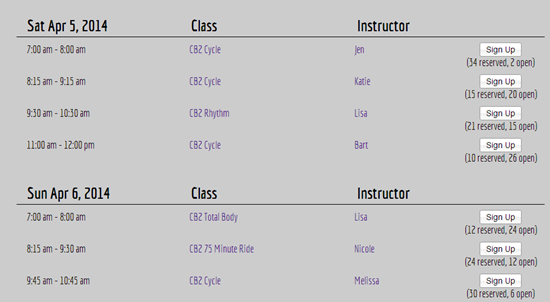
First let's reserve a spot in the class. I didn't think to take a screen shot at the time so I'm showing tomorrow's schedule.
Better hurry and sign up now for Jen's 7 am class! There's only 2 spots left.
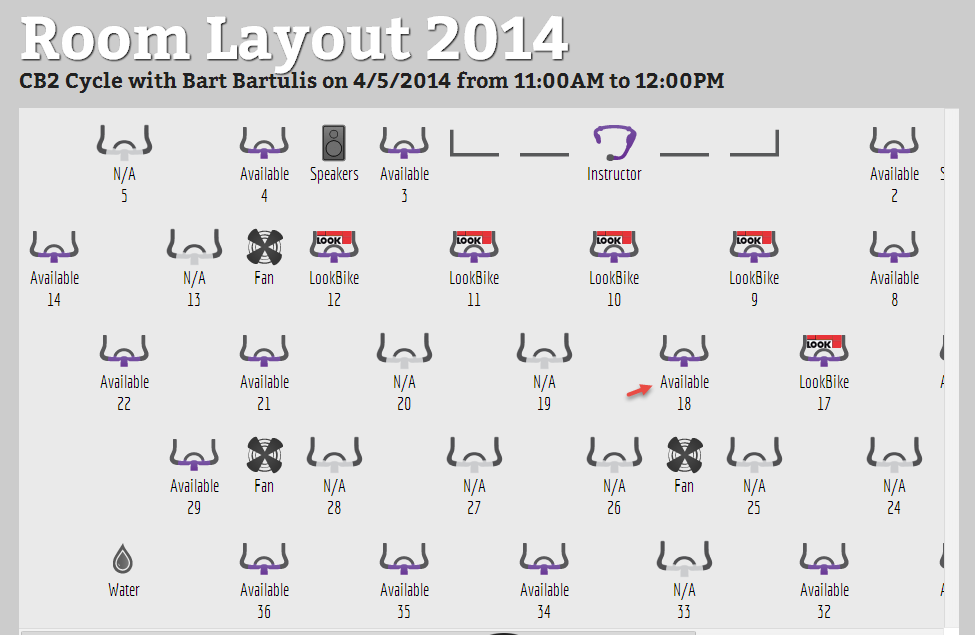
Next you select your bike – just like picking a seat on an airplane or at a concert. The image is for Bart's 11:00 am class. Note how you can pick a bike that has your type of pedals.
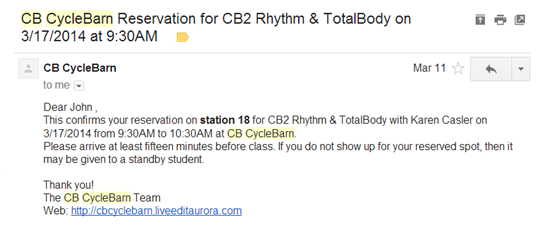
Once you've completed your purchase you receive a conformation email – all this happens automatically.
Having a confirmed seat, in a sold out class, is awesome.
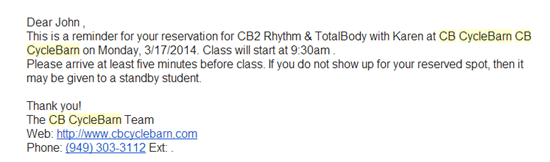
A friendly reminder is appreciated by scatter brains like me.
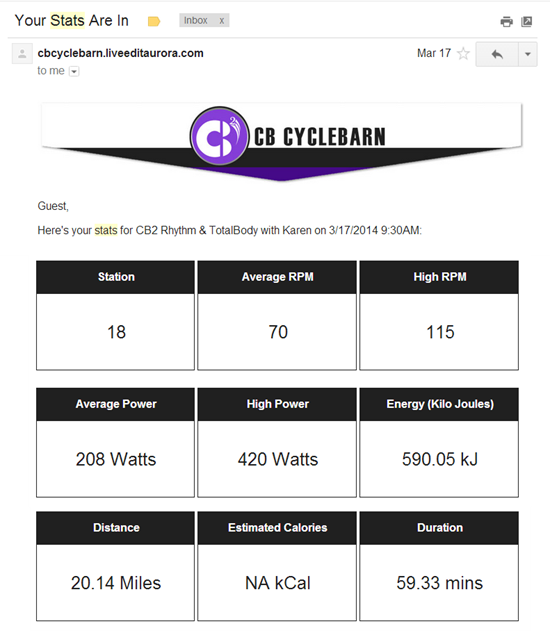
After the class I checked my email and saw all of my performance data. I wasn't wearing a heart rate strap in this class. If I had that data would show as well.
Receiving this information had me wanting to return to see if I could improve my average.
Amy and I were very impressed by this system and feel it will really get your participants excited about training with power on a consistent schedule! The website integration system is offered by LiveEdit and will work with these Indoor Cycles with power; FreeMotion S11.9, Spinner® Blade Ion and the Schwinn AC Performance.
Disclosure – Amy recently joined LiveEdit as a representative, specializing in helping new Indoor Cycling Studios. She would enjoy answering your questions. Amy.Macgowan@getliveedit.com or feel free to call her 320-685-0183







 This song has it all: a soft jungle beat start, enticing vocals, driving piano and ‘Saturday Night Live' like sax!