“For all intents and purposes, your body works exactly like the engine in the car that brought you to the studio today.” I like to use that line, especially when I sense I have a bunch of gear heads in the class. First to get their attention by saying something profound and secondly, because it's (grant me a little leeway here) technically true; your body powers a bicycle exactly like an internal combustion engine powers a car.
Now at the risk of one of my daughters admonishing me with “Dad, your class doesn't want another science lesson”, let me explain;[wlm_private ‘PRO-Platinum|PRO-Monthly|PRO-Gratis|PRO-Seasonal|Platinum-trial|Monthly-trial|PRO-Military|30-Days-of-PRO|90 Day PRO|Stages-Instructor|Schwinn-Instructor|Instructor-Bonus|28 Day Challenge']
Your students and their cars use a Carbon based fuel sources that contain essentially “Stored Sun Light” derived from plant photosynthesis.
Both have a system to ingest air (more importantly the Oxygen it contains)
Both have a process to chemically combine fuel and Oxygen which creates heat and pressure
Both use this pressure to create linear motion
Both use an offset crankshaft to convert linear motion to rotary motion.
Both have a system to expel the waste byproducts of combustion
What brought this to mind was last night in my class I had a number of students who rode most of the class looking straight down, instead of the “Head up – Look at your self in the mirror and smile :)” posture we all want. But why do we want it?
I remember listening to the commentators during the China Olympics talking about how you could tell who was strong and who wasn't on the big climbs by how each rider held their head.
Head up = Strong … Head dropped = weak. But beyond the body language, why is head position indicative of performance?
And then I thought of this:
Modern engine designers understand that best power and efficiency is dependent on moving the maximum amount of air into and out of the engine. For that to occur the path the air takes, as it flows into the engine, needs to be as straight as possible.
Here is a diagram of the Intake Track in an older, much less efficient engine, circa; 1940
Now compare that to the Intake Track of one of your students.
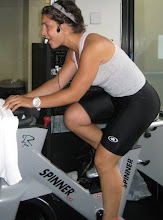
Here is a cyclist demonstrating good form with “Head Up – Eyes Forward” posture. Notice how the Intake Track becomes straighter?
Does it then follow that;
Head up = Efficient Breathing (Strong) … Head dropped = Inefficient Breathing (Weak)[/wlm_private]
I received and email from Arlene de Guzman-Alpuerto
If you are near San Marino CA, and a female IC Instructor, you may want to check this out –
Dynamic Female indoor cycling instructors with current certification and CPR; min. 1 yr experience, great motivating personality. Need sub and permanent instructors. Facility located in San Marino, Calif. Women only facility.
Here's her contact info
Arlene de Guzman-Alpuerto
General Manager / Co-Owner Womens World Fitness Center
2000 Huntington Dr.
San Marino, CA 91108
626.284.7741
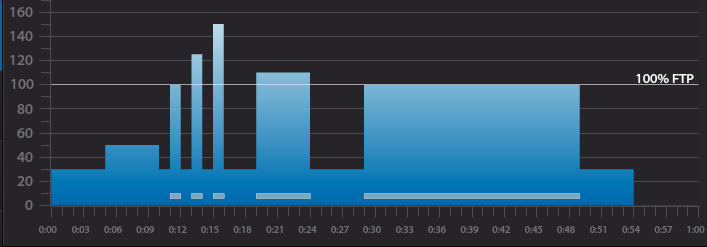
Over the last 2 years I've been performing a FTP (Functional Threshold Power) test on the first Thursday and Friday of every month in every facility I teach in that has bikes with power. I have yet to have anyone complain or comment that I test too often or that the 20 minute FTP effort is too hard. What I have been told is how much people like knowing their threshold numbers and how much they enjoy the challenge of the test.
Last week I was involved in a conversation on Facebook where some indoor cycling instructors were discussing various ways to estimate FTP with their class. My response was “Why estimate it when you can perform a REAL test and get some REAL FTP numbers?”. Some of the responses I got back were that the test is “too hard”, “too long”, “too complicated”, “newbies might get scared away”, or “some people just want to ride and not focus on numbers”. I was, quite frankly, shocked by the lack of confidence these instructors had in their class participants. If we, as instructors, don't have the confidence that our riders are strong, tough and smart enough to handle and understand the benefits of a FTP test, this doubt will quickly turn into a self-fullfiliing prophecy and class participants will never reach their full potential.
I believe the best instructors don't only know the science of exercise physiology but are also masters of physicology and expert motivators. It is our job to show each and every rider the respect they deserve by having the faith that they are capable of completing any physical task we ask of them. I am in constant awe of what my riders are capable of, they impress me every day, but amaze me on FTP days.
Bikes with power are becoming the norm in most indoor cycling facilities. This new technology will keep riding a bike that goes nowhere in the forefront of group exercise for years to come. If your facility is going to invest in these state of the art bikes, instructors and facility mangers should program regular FTP tests so they can be used to their fullest capabilities and riders can be aware of their current fitness levels, set up proper training zones and track improvement over time. The use of power can be a bit confusing at first, but after performing a FTP test most riders quickly gain an understanding of their maximum sustainable intensity or threshold wattage.
Believe in your students and they will surprise you, doubt your students and they will affirm you.
Here are some links to articles I have written about FTP and Threshold over the years. My testing profile may have changed slightly but the science is still the same.
Full articles are only available to ICI/Pro members.
By Jennifer Lintz, Registered Dietitian and ICI/PRO Member Soigneur
Recently, I had the opportunity to attend a Schwinn training led by the very talented, energetic, and inspiring Julz Arney.
The training was called “All the Right CUES” and boy, oh boy did I walk away with a ton of great information. Julz gave us awesome examples of effective coaching strategies to use on the instructor bike. Interestingly, one of the points that stuck with me the most from this session had nothing to do with talking and everything to do with keeping my mouth shut.
To start the conversation, Julz asked “How many of you would consider yourselves extroverts?” and “How many of you would say you are introverts? For the most part, the group was mixed, with slightly fewer extroverts.
She then told us about a time she attended a cycle class where the instructor narrated every single minute. Participants were told what to think virtually non-stop, from warm up through cool down. For some students – extroverts, in particular – she explained, this type of teaching technique might be ideal, but it wasn't for her. For introverts, she said, some of the most interesting moments happen during the quiet, when there is time to process, reflect, and think.
Even though we all want riders to have a positive experience, I doubt any of us plans to poll the room before class to ask: “How many of you are extroverts?” or “Where are my introverts?” No way! A better approach would be to assume there is a mixture in the room. In other words, expect to have some extroverts who love it when you spend time talking, and also plan to have introverts who appreciate it when you give them a chance to hear their own thoughts.
The take away from Julz Arney's message, at least for me, was that I do not have to fill every single second of class with my voice.
She suggested having a “minute of silence” at least six times in an hour-long class.
In other words: I (and you) have the right to remain silent!
Coincidentally, after the Schwinn workshop, I viewed a recording of one of my classes from earlier this year (we are required to do this annually where I teach). As I watched, I waited and waited and WAITED for a “minute of silence,” hoping that I might already be on the right track, but it never came. As I told my supervisor afterward, I would have been so annoyed if I were a participant in my own class that day. I talked the ENTIRE time!
Since listening to Julz and watching that video of myself teaching, I have learned that great coaches need not talk non-stop, and that a blend of talking and being quiet can be a beautiful thing. Am I meeting the goal of having a minute of silence six times in every class? Not quite. But, I am definitely working on it.
This Podcast is was originally published on April 27, 2009, I have updated it with our new Podcast host information and I am representing it now. I hope you enjoy it, Joey
I love people who see a question and decide to find the answer. Melissa Marotta is just such a person: Spinning Instructor, Medical Student and also an excellent writer. Check out her blog and you see what I mean - http://www.spintastic.blogspot.com
Melissa asked the question; "does using heart rate monitor improve your Self-efficacy -- that is, one's belief in one's own ability to navigate the challenges of one's world?" And then decided to do a study to find the answer.
This post describes what she has planned and the Podcast adds more detail about - EXPLORATION OF THE PSYCHOLOGICAL EFFECTS OF HEART RATE MONITOR USE DURING EXERCISE.
Once you have listened to her interview please complete her survey HERE.
You can contact Melissa melissa.marotta@gmail.com
I plan to have Melissa on later this summer to find out what she learns.
Listen to the Podcast below or subscribe for free using iTunes or Zune.
So you find yourself riding along a smooth, flat section of road. You may have a little wind at you back and you are making good time, as you enjoy the sights and smells of the country. “Hello there Mrs. Cow,” you call out as if one will respond. All that aerobic activity has your brain working at maximum effectiveness and thoughts and ideas fill your head. Suddenly you realize you can’t remember the last 20 minutes or so… that’s JRA.
My music suggestion for these long endurance classes is using some of the excellent mixes available from cadencerevolution.com
Here's your Spotify PRO/Playlist!Dreezer. We have made every attempt to replicate the original playlist. In some instances the tracks specified were unavailable in Spotify. When necessary we have substituted individual songs of similar length and tried to maintain the Instructor's intent.