The Manx Cycling Club on The Isle of Mann has created some incredible cyclists who have contributed to the recent success of British Cycling. The “Fasted Man on Two Wheels” World Champion / Tour multi stage winner Mark Cavendish (they call him “Sir Mark Cavendish” now) and Olympic Cycling Gold Medalist Peter Kennaugh Jr. are both Manxmen.
So how, with only 80,000 people living on this tiny island, do they turn out cyclists of this caliber?
I thought you'd be interested to know 🙂
So I contacted Peter Kennaugh Sr. – Head Coach and Director of 3LC.tv (he's also Peter Jr's father) to learn a few of their secrets – many of which you can learn through the series of Turbo Trainer / Indoor Cycling DVDs and training plans they offer and potentially apply them to your classes.
Peter's approach as a virtual cycling coach, is to focus on cadence during indoor training sessions, rather than HR or wattage. He has some compelling arguments that he shares during our discussion.
Why could this be of value to you as an Indoor Cycling Instructor?
Speciality Performance Based Indoor Cycling Classes will be next evolution of Indoor Cycling 2.0. Serious endurance athletes are recognizing that many of our classes have moved beyond Aerobics on Bikes and we are now offering results driven training thru specific metrics like HR and Watts. These people are looking for coaches to help them train effectively and in time, clubs/studios will be looking for Instructors who can also coach.
Motivated Instructors will have an opportunity here. ICI/PRO is committed to providing you with the resources you'll need to make the transition.
Another Contest!
At the end of the interview Peter offered to send a lucky listener a pack of their DVDs and training plans. You can enter by leaving a comment below and we will draw a name after the 10th of this month.
The only attribute better to possess than that of being an encourager, is being an honest one. Honestly, it’s true!
I like to think that most people are honest, but sorry to say, that is simply not the case. Although I still like to believe it. J
In a world full of silicone, pleather, faux, knock-off this and a nip and tuck off that…it’s no wonder that the act of simply being real is considered rare and therefore, valuable. People are hungry for the truth; whether they like to admit it or not. Of course, they won’t admit it, because most people are afraid. That is why they are dishonest. And usually it’s with him or herself more than anyone else. So this is going to be the focus of what I share with you today. But before I do, is it acceptable for me to be completely honest with you about this issue? Is a little tough love O.K.? Can you handle the truth?
If you desire to be the Instructor (Inspirer), as well as PERSON, that your students (and others) cannot wait to see again, then you must look at yourself openly and honestly. I like to think of this as our time (noticed I said, “our”…because we all need this) to be naked and unashamed!
Years ago I started writing a 12-Step Program for healthy people to keep them that way. After unknowingly attending a Narcotic’s Anonymous meeting, I discovered this remarkable thing called “12 Steps”. I was absolutely inspired and on a mission to discover a 12-Step Program that I could also be a part of. Since I was told that I would need to have a drug or alcohol addiction, or have a family member who did, in order to attend N.A. or A.A. meetings regularly.
I searched, but didn’t find anything available. So I began a journey to discover what the 12 steps would look like for someone who desired to “make healthy their habit”. Let’s face it; 12-Step Programs are designed to keep people from falling off the wagon. So what’s available to a healthy individual who gets stressed out, busy, etc. and they find themselves eating horribly and not exercising…”falling off the wagon” of great health?
The good news is, I now KNOW the 12-Steps to do just that. And these steps are tried and true; because they have taken me through some of the deepest valleys of my life, while staying “on the wagon” of great health and WELLTH. I share these steps in my book, Dr. Shannon Knows…The 12 Steps for Wellthy People. Quite simply, it’s how to make healthy your habit.
Through many of my own experiences (some intensely painful) I realized that the first step in being our best is facing our fears. I call it, “Exposing Yourself”. It’s when you truly ask yourself, “What am I afraid of?” and you answer with honesty and courage. From there the process of wonderment takes over as you dare to wonder, “What if?” However, it’s the kind of “What if?” moment that leads you to being your best. Not worrying…just like all the rest.
Imagine what you and your life would be like if you were the best in the world? Perhaps it’s being an Olympic gold medalist, national titleholder or the best instructor, associate, employee or boss. Or maybe, just maybe, it’s being the best YOU that you can be. This is the revelation I had one day as I was imagining what it would be like to be the best in the world at something. I thought, “Hey, how about being the World’s Best ME!” What would that look like?
So what’s standing in your way? Who is standing in your way? What are you afraid of? When was the last time you looked in the mirror and gave honest (and loving) feedback to the person standing in front of you? Or do you see things as you would in a funhouse (usually not so fun) mirror? Are you seeing distortion, blown out of proportion, too fat, too thin, and certainly not a true reflection of the person you really are?
Are you ready (and willing) to see the truth?
Now we are really starting to get to the “not so easy to talk about” stuff. But remember in the beginning when I asked if it was O.K.? I thought I heard everyone say, “YES”! So here it goes…
Are you honest? Come on, this is not the time to candy-coat anything. Perhaps you have been candy-coating so many things in your life that you are gaining weight. Sometimes people (you or your students) gain weight not because of what they (or you) are eating, but what’s eating them (or you)!
Seriously, this is a huge issue and no cycling class is going to change this unless you lead from a place of loving honesty. Both with your students and your self!
People seem to lie about everything! From their weight, to their excuses, to their reasons for this or that, or simply why they are where they are. It’s always everyone else’s fault or is it?
One of my past coaches used to say, “Excuses are like toilets. We all have them and they all stink!” Years ago I realized that if my failures are someone else’s fault, then my successes will be too. In that moment I realized that no one besides me would be responsible for my successes or my failures. When we own our mistakes, we can own our successes.
Are you honest with yourself about you, your life, your passions, and your desires? Do you honor your commitments with others, as well as yourself? Do you keep your word? Do you show up when you say you’re going to show up? Or do you make excuses for your lack of integrity? Are you lovingly honest with your students? Are you worthy of their trust? Are you worthy of YOUR trust?
Remember that a trustworthy messenger brings healing. That’s right, and whether you’re a doctor or an instructor, we are all teachers. Those who come to us are seeking something. You can be the one who delivers it to them, even if you never say a word! They will feel (and heal) better just by being in your presence. Honesty and integrity have an unforgettable presence, because they are qualities that are highly productive and attractive.
As I said before, people (you and your students) are hungry for the truth. Make sure that you honor your words to yourself and your students, think the best and speak the truth.
Live what you believe and reflect the truth that is within you! If you don’t like what you are seeing, then it’s time to take a deep look at your “truths”. What do you believe? How is it working for you? (These are two of the most profound questions you can ask yourself.) YOU CAN DO IT! And remember to be kind and encouraging when you do.
Honest self-awareness and authenticity are the keys to your success (health, happiness, WELLTH) in every area of your life. And they will be the core of what makes (and keeps) you the Instructor (Inspirer) that your students (and you) can’t wait to see again!
No more hunting for new music or counting out cues. Here is your ready to ride document, that can be displayed from your phone, or printed out onto cue cards. This ride is timed out, down to the second, to make your life as easy as possible!
What do you do when you want to train but need a break from cycling? Indoor rowing is an excellent alternative. If you’re into power training, this is for you.
Most of my teaching of indoor cycling was done in Performance Max, a program that included both cycling and indoor rowing. I took the program as a participant for 14 years and taught it in a different location for 12. This post covers the basics of starting to row.
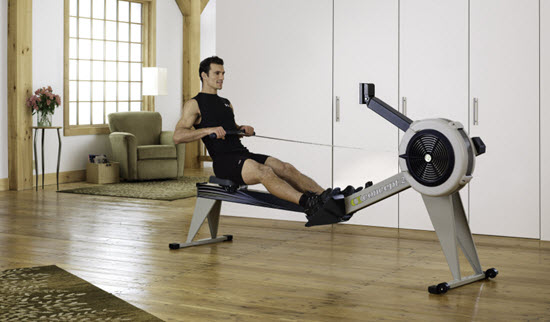
Truly, the only indoor rowing machine worth using is the Concept 2 Rowing Ergometer (“erg” for short). Yes, other rowing machines exist, but no one who rows takes them seriously. The Concept 2 is the gold standard. The current models are the D and the E (slightly higher off the floor). The longest-standing model is the C, which was the one-and-only for many, many years. (I have one, love it, and wouldn’t trade it for a D for anything!)
If you have access to a Concept 2 erg and are new to rowing, learn correct technique from the start. It’s easier to learn it the right way than to unlearn the mistakes that people commonly make when trying to row on their own. If you teach at a gym with an instructor who really knows rowing, that’s ideal because you’ll get good instruction and correction. Years of teaching rowing have shown me that correction is essential.
If you don’t have either an erg or personal instruction, visit the superb Concept 2 website (concept2.com). This 5-minute video teaches rowing technique step by step and repeats the steps clearly and slowly.
There’s also an “erg finder”. Enter your location, the type of facility you want (e.g., health & fitness club), and the distance you’re willing to travel. You’ll get a list of clubs with addresses and the number of available ergs there. You might want to call to verify the info. (When I looked for ergs in San Francisco, the club I taught at for years was listed as having only 1 erg; that was wrong. Farther down the list, though, the same club was listed again, accurately, with 17.)
Once you’ve learned to row, you can take advantage of Concept 2’s Workout of the Day. You can choose short (30 minutes), medium (40-45 minutes), or long (60+ minutes). It’s available on the website daily — or can even be delivered to your inbox.
A few points to keep in mind:
– Rowing is not an upper-body activity. It’s a full-body activity that centers on leg power. Sliding seats were added to rowing shells in the 1870s to optimize the superior power of the lower body. The best training I’ve heard on this came from a Performance Max instructor who rowed on the U.S. National team: “The arms are an afterthought.”
– Rowing has a definite learning curve. In the beginning, it may feel frustrating not to have sufficient power in your stroke to reach a high heart rate. That will change with practice. Believe me, rowing heart rates can go very high, typically higher than in cycling.
– Because of the learning curve, novices often use a higher damper setting than necessary. The damper opens the drum to let in more air, increasing the resistance. Skilled rowers, however, use a moderate setting and create effort by accelerating quickly at the start of the stroke (the catch).
– The most common mistake is bending the knees too soon after you finish the stroke. (This will make sense once you’ve watched the video or gotten some instruction.) It’s almost instinctive and can be difficult to correct. One effective correction is to stop rowing and hold for 2 seconds after you’ve extended the arms before letting your knees bend. Repeat with each stroke for a few minutes.
– Rowing should NOT be done with a straight back. Curving the shoulders slightly forward will engage your core and protect your back. A straight back is more likely to be injured.
Holding an even and consistent pace can be difficult to learn. Jim Karanas, who created the PMax program, always said rowing builds character: With every stroke, the computer tells you you’re a failure [i.e., your pace is off], but you have to keep going.
Working on pace feels like moving meditation. Skilled rowers doing sustained efforts even look relaxed and meditative.
So here’s to a character-building, meditative yet exciting alternative to cycling. I think you’ll like it. You might even find yourself adding it to your training on a regular basis.
Next I'll answer the question; can I use a Display Training system with my non-power Indoor Cycles?
The short answer is yes you can…
While there's no option to affordably* add Power/WATTs to an Indoor Cycle, Wahoo Fitness sells a brilliant little cadence sensor that attaches to the crank arm of each of your ICs. Those $50.00 sensors will wirelessly transmit cadence/RPM info to the Display Training systems from either PIQ or Spivi.
Providing a visual representation of each rider's pedal speed, when none existed before, can really enhance your class. So your Instructors can cue; “I want everyone at 90 RPM and then we'll maintain it while adding load” which is very effective.
… but just because you can, doesn't mean you should 🙁
You can get into trouble with only having cadence. People can get competitive and as soon as you start displaying anything, you'll have riders trying to post the biggest number. In this case RPM. Spivi's video game like display of riders will work with just cadence… but do you really want folks at 140+ RPM trying to catch that show-off up front?
What at are your objectives and/or expectations for the system?
* Yes, I suppose you could purchase a set of Polar Keo Power Pedals for each cycle in your studio. But at over $1,500 a set, they're not very affordable and you'd be money ahead just replacing all of your bikes.
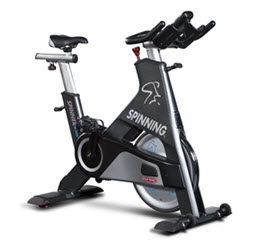
The Star Trac Spinner® Blade Ion is the latest Indoor Cycle with power to hit the market. The Blade Ion boasts strain-gauge technology and a cool blue light emanating from the flywheel hub that doubles as a battery charger.
There are only of handful of studios riding Ions and we only had responses from 14 Instructors.
I'm sticking with the same format we're using with each of these Indoor Cycle surveys – click here for the list.
Satisfaction while riding your cycles.
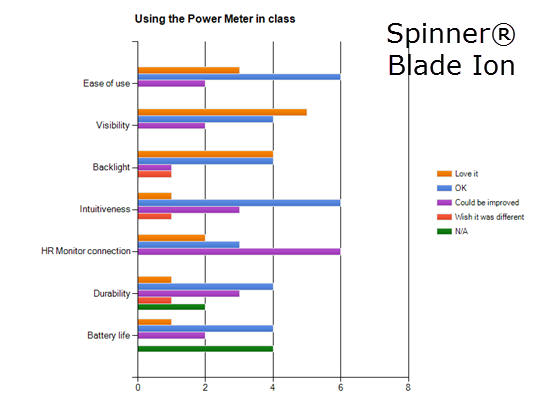
Using the Power Meter in class.
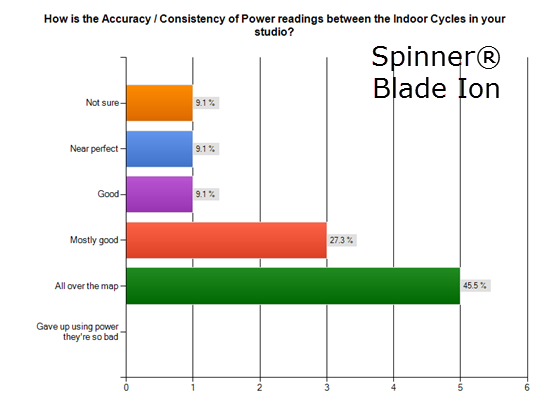
Accuracy / consistency in power displayed.
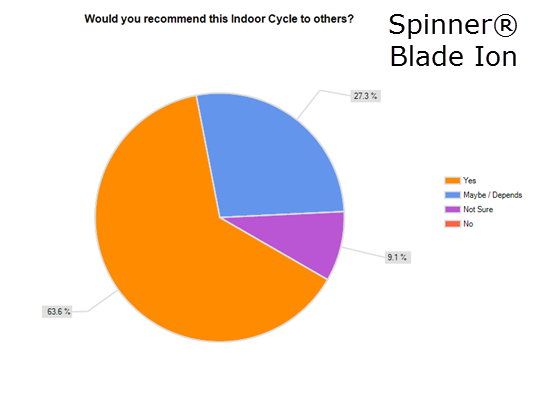
Would you recommend this Indoor Cycle to others?
First up, how do instructors like riding the Star Trac Spinner® Blade Ion
How about using the power meter?
If your responses are included here, I'd be interested to know more about the Heart Rate strap issues. Is this a difficulty pairing (connecting) the HR strap? Or something different like cross talking or a loss of connection?
Every Instructor I know is interested in the accuracy of wattage displayed and consistency between cycles.
All though this was a very small sample – the lack of accuracy / consistency does square with private conversations I've had with with multiple Instructors and studio owners. I'm aware that Star Trac has been trying to sort this problem and hopefully they will have it corrected soon.