Team ICG Master Trainer Missy Crosson contributes our latest Audio PROfile – Rolling to the Classics.
Profile Description: I created this profile with the sole purpose of letting the music itself create the ride. I wanted the songs themselves to control intensity, cadence, movement motivation, and even position on the bike. Music has a powerful effect on an individuals’ exercise experience. It distracts from discomfort, enhances ones mood, increases ability to endure physical and psychological stress, and may even promote metabolic efficiency.
Magical in December – not so much in April. That's all the farther John got last night.
It’s John’s fault….spring simply will not arrive here in Minnesota because he bought a new bike! Kind of like when you wash your car, it is certain to rain…
So, in the meantime we are preparing for the killer potholes in the roads when it finally dries out and the temps rise above 32 degrees Fahrenheit.
Here is a flat I’ve been using after a series of four climbs that focus on lifts (i.e. the pothole story). At 82 rpm, and 3:23, it offers participants a ‘breather’ before we go right back into the potholes again. I describe this flat as a little spot where the DOT paved a smooth road for us.
A few great voices have come out of the Disney franchise and Bridget Mendler is another one. She has a great range and voice purity that is wonderful.
Enjoy ‘Love Will Tell Us Where To Go’ from Bridget’s Hello My Name is…..album:
Here's a fun acoustic version for your free track.
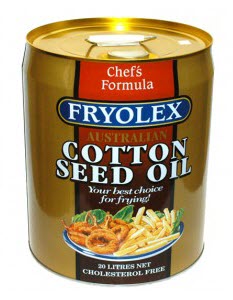
Last month, a participant in the weight management program for which I’m the nutritionist asked me about cottonseed oil. He was confused because the statements he found were strongly divided between positive and negative. It occurred to me that you might have students who wonder about it, too, so it could be worthwhile to post some information on health factors around cottonseed oil.
Based on the research I was able to do in the time I had available to look into it, I can tell you that the positive comments about cottonseed oil come primarily from companies that make or distribute it. The other sources tend to rate it negatively.
The drawbacks of cottonseed oil appear to fall in different categories. One drawback is its saturated fat component. While other saturated fats have some “redeeming” health value — organic coconut oil and butter, for example, both contain a healthful fat called lauric acid — cottonseed oil has no similarly redeeming nutritional value.
Another drawback involves the pesticides cottonseed oil is likely to contain. They’re there because pesticides are used in the growing of cotton, and regulations for cotton crops differ from those for food crops.
There’s also the fact that, in most cases, cotton crops are genetically modified (GMO). As many of you know, considerable bad news surrounds GMO products, especially when they're eaten, but maybe that’s a post for another week. Suffice it to say that GMO farming is an experiment for which we’re the subjects, and the long-term effects are not yet known. Many countries refuse to sell GMO foods, but the U.S. hasn’t gone in that protective direction.
Because it’s inexpensive, cottonseed oil is used in many products: potato chips, Crisco shortening, cereals, mayonnaise, salad dressings, baked goods, cake frostings, margarine, snack foods, sauces, and the like. The fact that most of these products are on the junky side could be considered another drawback of the oil.
Finally, cottonseed oil is high in omega-6 fats, as well as in saturated fat. Omega-6s have been getting plenty of bad press for the past several years, but, in and of themselves, aren't necessarily bad. However, the products that contain cottonseed oil tend to be highly insulin-triggering, and cottonseed oil would be, as well, since it contains saturated fat, which triggers insulin.
Insulin can affect the body’s enzymes that process the cottonseed oil-containing foods. That in turn could accelerate the formation of series 2 prostaglandins, as described in a previous post. Series 2 prostaglandins are associated with inflammation and other negative health effects. So that’s when and how omega-6 fats become harmful.
Based on these factors, I’d suggest taking a cynical view of the positive reviews of cottonseed oil, as they represent vested interests. Limit foods that contain cottonseed oil whenever possible and advise your students to do the same.
Now I'm not talking about lying to you in a malicious/manipulative way, I have this awesome bridge in Brooklyn I can sell you really cheap – or – she's a real peach, only driven to church and back by the gentlest 80 year old grandmother you've ever met.
What I'm talking about is how people will/do lie to you… if they think telling you the truth could or would hurt your feelings.
Friends can be the worst. And I count a lot of long time members at our club, as friends.
“The truth is always an insult or a joke, lies are generally tastier. We love them. The nature of lies is to please. Truth has no concern for anyones comfort” – Arturo Binewski.”
― Katherine Dunn
Here's a recent example.
Two weeks ago I took over a class for another Instructor. 6:00 am Thursday mornings. The previous Instructor is very solid and she teaches a cycling specific class – I've taken and subbed it multiple times, so I was a good choice to take over her class. Everyone there knows me by name and most I've known for years.
The first week was Spring break = only about 1/2 the normal attendance. It was an endurance day and I thought; “why not run them though some Effortless Exercise intervals?” I lead everyone through a series of ladders where the challenge was to keep your mouth closed (staying aerobic) – while maximising power output. I had them experimenting with different cadences to observe where they each were most efficient.
After class I asked a few participants their thoughts (I try to always ask for questions/comments) and each was positive. But as it turned out, they were lying to me 🙁
This past week was an ugly snowstorm, so again a small class. Wanting to build on the theme we did a bunch of climbing, but stayed down around VT1 = aerobic. I needed to get on the road quickly that morning, so I didn't hang around very long.
Walking to to Amy's class Saturday morning, a member approached me with; “John, you've really got to step it up!” And she proceeded to tell me how such and such's class on Tuesday is really hard and how a number of other members were disappointed by how “easy” my class was.
Finally someone willing to tell me the truth!
I can do hard and these members know it. In fact I'll bet I disappointed most of them. Beyond their (misguided) belief that a hard class always equals a good class, my reputation is that John teaches hard classes. When I didn't meet their “expectations” for hard, they probably felt cheated at some level.
In Krista Leopold's Dear Instructor post, she shared the honest disappointment of Patrick, a frustrated member. He had an expectation that wasn't met that was based on his perspective; the scheduled Instructor is totally capable of coming come to class prepared. I found the very specific honesty refreshing and I'm hoping that this Instructor will appreciate Patrick. He could very well be the only participant in his class that believes enough in him, to tell him the truth.
As a think back through this, I'm realizing that my mistake was not considering that these members would have an expectation based on their previous experiences with me and my class. I had walked in thinking; “these folks need aerobic base training… so that's what I'm going to give them.” When I should have thought; “these folks are probably thinking I'm going to walk in and crush them… so I need to meet that expectation first and then slowly work in the base training I feel they need.” As I type this I'm also realizing that ME, deciding what THEY need, was about ME and not THEM 🙁
This week I'm planning a class that will bracket a long aerobic climb, with two very long/intense FTPish intervals. I'm also going to have everyone fill out this Instructor Evaluation Form that Dr. Haley Perlus had created for us for us a while back.
I'm not quite sure how else to describe it. Catchy, invigorating and instantly (to me anyways) ID'd as a track I would Shazam. But this time I didn't need to. All it took to discover the name was walking into older daughter Abby's room and ask what she was listening to.
Quick tip: If you're ever in a music funk find a college student (doesn't need to be your own – anyone at random will work) and ask; “what are you listening to?” They're always listening to something… and some may actually be good 🙂
Chase & Status — End Credits is an interesting song. It starts out as a nice little acoustic number, with a friendly flat road tempo. But at about a minute in it gets, interesting.
I've used this track Chase & Status — Pieces in the past – another very interesting composition. In both cases you can use the flip in personality to communicate a drastic change in intensity.
If you're not seeing a download button you can use this link.
When should you go hard… and when should you take it easy?
It's a great question. Often our response depends on very subjective feelings = we may think we know, but we really aren't completely sure.
As Jim Karanas pointed out in his Intervals post this week, we are often too focused on the Work component of exercise and not enough on the Recovery.
So how can you know when your body is rested and ready for more work? Athletes have for years used resting heart rate as a measure to understand. If it's elevated above normal maybe it's time to take it easy, or if normal, time to hammer.
My guest today is Simon Wegerif, an expert on HRV and the founder of myithlete.com. Simon feels he has a more scientific method of deciding if & when your body is recovered and ready for more.
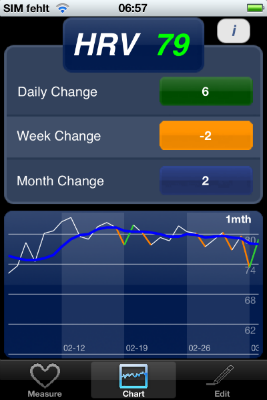
ithlete is an application for either iPhones or Androids that measures and tracks Heart Rate Variability (HRT).
We're using a new player now and iPhone & iPad users will now (finally) be able to play the Podcast directly from your device. Yes I realize it's a little ugly, I'm working on getting a better looking version.