
by Cameron Chinatti | Oct 16, 2020 | Freemotion - Foundation Fitness, Master Instructor Blog

Of course, those of us at Stages Indoor Cycling believe the opposite to be true, (made you look, didn't I!) but we hear this all the time from people that haven't experienced a power-filled class the way it was meant to be. There exists an assumption that indoor cycling is moving away from fun and silently drifting towards a sterile, personality vacuum filled with muzak and boredom. Fortunately, it doesn't take long to convince people otherwise… just a content-rich, fun-filled ride.
In this two-part exploratory look at training with reliable metrics, we'll first discuss HOW to infuse data monitoring in your classes while keeping things fun and interesting. Then in Part 2 we will dive deeper into the physiological benefits and even the community benefits that these new tools can provide. For those of you that don't yet have immediate access to indoor cycles with data providing consoles, I think you'll find that the tips below apply to you as well.
To be fully transparent, I am the Director of Education for Stages Indoor Cycling and Foundation Fitness. Our team is responsible for the research and development behind the FreeMotion Fitness S11 series of indoor cycling bikes and power consoles. I will be approaching this specifically from the Stages Indoor Cycling methodology and in Part II will occasionally be referencing features on the FreeMotion power console.
I'm all about Super-7 lists, so… Here are my Super-7 ways to keep Power-Based classes interesting.
1.) Establish a goal and tell them why: Talking about data for the sake of talking WILL get boring really fast. Choose one particular metric to discuss because it will aid your participants in reaching– as I like to call them– “micro-goals.” Micro-goals can be anything, for example:
“For the next 5 minutes your goal is to give me a thumbs-up at the top of each minute. No thumbs-up means you're suffering and this 5 minute segment is about remaining in a place of comfortable, sustainable effort.”
Based on that particular micro-goal, the only thing they should be concerned with on the console is the TIME. They were not asked to base their efforts on ANYTHING other than a perceived effort. And that's okay!! Which leads us to the next point…
2.) Leave the kitchen sink at home: It's very tempting to talk about all the metrics on the console…ALL AT ONCE! Remember, no one is pressuring you to constantly speak about the numbers- this is unnecessary! In fact, it is rare that I ever focus on more than 2 pieces of data in a typical indoor cycling class, because people get easily overwhelmed. We have to warm them up to these concepts over time. Pick something that supports your micro-goal and stick to it.
3.) Luv ya, Don't ever change!: Did that just remind you of your middle school yearbook signatures? Well, it has merit when it comes to teaching- especially if you're already successful! Don't forget to be YOU! Not only is throwing in the kitchen sink overwhelming for your riders, but it has another dreaded side-effect: instructors forget to be themselves and do what they do best. Don't neglect your charismatic side! Tell them that funny story, sing along with your music (if you dare!), ask trivia questions… Basically continue doing the things that make you the unique leader that you were obviously born to be. The data at your disposal can never replace you: it simply increases your odds for more effective communication.
4.) Reduce the filler: 60 minutes is a lot of time to talk about… nothing. With quality information we can now reduce some of the fillers that creep into indoor cycling classes. I promise you, people won't mind if you reduce the number of times you…
- Count backwards from 8. (It ain't Sesame Street folks!)
- “Woohoo!” (That gets old quickly)
- “How we doing?!” (This come across as a cheap way to get them to respond. It only works once or twice before they tune you out.)
- “Give me more!” (More what?)
Don't get me wrong, there's nothing inherently bad about these group exercise idioms, but are they really motivating people the tenth time you've said them? Probably not. Once you reduce the fluff, you give yourself valuable time to discuss the task at hand, ask them work-inducing questions and give them a reason to want to achieve those micro-goals.
5.) Lather, Rinse, Repeat: There's no easier way to feel successful on an indoor cycling bike that measures power than to have multiple chances to reach your goal. Near the conclusion of a stage or interval, ask your riders to look at one piece of information and remember it. Give them ample recovery time and let them know that they get another shot at improving upon last time's performance. For instance,
“Get ready to rumble folks because we have a 5 minute stage coming your way, but don't fret; it's nothing that you can't handle, and I'll guide you the whole way. Towards the end of your 5 minutes, before we press the Stage button, I want you to focus on your total distance for this stage.” 5 minutes later… “How did you do? Do you remember the distance you covered? Great, because we get to do that exact same 5-minute stage again. No surprises from me! However, this time I want you to find a way to go just a little further. Could you increase your distance by 1/10 of a mile? Even more? Let's find out!”
Seriously, nothing is more motivating then knowing beyond a shadow of a doubt that you are capable of besting yourself!
6) Games, games and more games!: We've all done games in our classes: front row busts a gut for 30 seconds while everyone else is recovering, then the 2nd row goes, then the 3rd row…etc, but in order to truly be playing a game there must be an objective and there has to be a way to win or at least achieve said objective. The objectivity piece was always missing prior to bikes with consoles. Let the games begin! We'll do an entire post on games in the near future, but for a few examples of games you can check out the BIG RIDE that Pam Benchley and I taught on Saturday night of the ICI/Pro conference. Just remember, competition can get overly fierce very quickly amongst your participants. For this reason, consider integrating games as team efforts first.
7) Deliver Measurable Progessâ„¢: For those of you familiar with the Stages Indoor Cycling method, it will come as no surprise that I really, I mean REALLY stand behind this mantra. At Stages Indoor Cycling we Deliver Measurable Progress via Benchmarks. By assessing where you are today, you now have a means by which to achieve where you want to be 6-weeks or 12-weeks down the road. Functional Threshold Heart Rate testing is wonderful, but what if you could compare that alongside your ability to generate Power at Threshold?! Surprisingly it's very doable even in a large group setting. Of course, FTP/FTHR testing isn't for the Day-1 newbie off the street, but there are many other initial assessments that we can provide our participants that will show them where they are today and what to shoot for tomorrow.
Once benchmark assessments become a regular part of your programming, magic takes place! Participants start planning their workouts around these benchmarks as if they were training for an event, even if participating in a race or organized outdoor event has no appeal to them personally.
This all boils down to the “Susan and Bob” conversation from a few weeks back. It's true people come to your classes for a plethora of reasons, but I think it's safe to say that NO ONE would be disappointed if by coming to your classes they were able to do more work with less effort, endure more physically and emotionally, travel farther and go faster. If this helps them achieve their weight-related goals, what a wonderful side effect! If this breathes new life into indoor cycling as we know it – PRICELESS! And that, my friends, is far from BORING.
I'm so excited for Part 2! Your feedback regarding the Super-7 reasons above will dictate the direction of ‘Power Is Boring: Part 2.” Think of it as a “Choose Your Own Adventure” novel! Speak now or forever ride in silence. 😉
Originally posted 2011-12-21 04:00:19.
by John | Oct 16, 2020 | Audio PROfiles, Video PROfiles

Here's part two of It Isn't Staying Green from Master Instructor Cameron Chinatti with STAGES Indoor Cycling.
In case you missed Pt1 you can find it and the music playlist here and you can also find the video in the iTunes feed.
Did this help you?
Podcast: Play in new window | Download
Originally posted 2012-04-14 11:47:51.
by John | Oct 16, 2020 | Engage Your Students, Instructor Training, Master Instructor Blog, Training With Power, Zone based Heart Rate Training
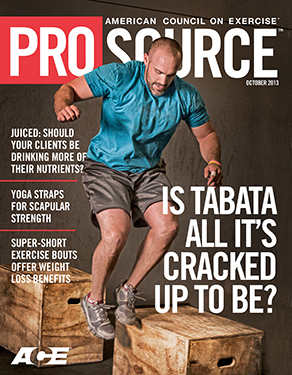
Image from http://www.acefitness.org/prosource/71/
I just read a press release and accompanying article from the ACE – The American Console on Exercise PRO SOURCE magazine about their study to gauge the effectiveness of High Intensity Training (HIT).
Is Tabata All It's Cracked Up To Be?
“It seems like everything high-intensity is now called Tabata Training,” says John Porcari, Ph.D., head of the Clinical Exercise Physiology Program at the University of Wisconsin, La Crosse. “The original Tabata study was done on a bicycle, but people are now doing that 20-second/10-second format with resistance training, plyometrics, calisthenics…with almost anything.”
Because of all of this recent interest in Tabata-style workouts, the American Council on Exercise enlisted Porcari and his research team to gauge just how effective a Tabata-style workout really is.
THE BOTTOM LINE
“The great thing about Tabata is it’s a short workout–only 20 minutes–and it incorporates your total body, so it’s working every muscle group that you possibly can,” says Embert, referring specifically to the Tabata-style workout she designed.
You can download the article for printing here.
But what to do during the remainder of your 60 minute class?
There was a trainer at Life Time who told me years ago something I've never forgotten; First give them (your class) what they WANT… and then give them what they NEED.
The WANT he was referring to are very intense/anaerobic intervals. There's no secret sauce IMO at SoulCycle > they're just teaching very intense classes because they know that's what people WANT.
The NEED is for solid aerobic training. Not necessarily base building, but solid work below threshold HR / FTP.
There are a lot of serendipity going on here at ICI/PRO. A quick check back to our latest Audio PROfile is another – Bad A*s Intervals Audio Class PROfile from Schwinn Master Trainer Rachel Buschert Vaziralli could be a perfect work set you could add to an existing profile.
Instructor Kathy Palkaninec was a past winner of our profile contest and her profile follows a similar WANT & NEED format.
You may want to announce your intentions to crush them (WANT) during a 20 minute Tabata round that will start fifteen minutes into class. Don't worry about telling them what follows. Keep everyone focused on doing their best effort during the Tabatas.
Give everyone a full 5 minutes or more of complete recovery. It's during this time that I talk about the “Golden Hour” and how most of us have 90 minutes where we can really perform well, before fatigue really limits our performance. The Golden Hour doesn't begin for most of us until ~30 minutes in. At the end of the recovery we're only @ the 40 minute mark of a 60 minute class and I explain how we're only 10 minutes into our Golden Hour – just now ready to perform. It's here where you can coach them through a 10 or more minute sub-threshold effort (NEED) to conclude the class. Here's where you can put that stage button to work if you have one – encourage everyone to ramp up to a big number, Stage Button, now maintain it by keeping your instantaneous wattage at or above the average 🙂
Make sense?
Originally posted 2013-10-10 08:28:16.
by John | Oct 16, 2020 | Spotify

Click to get the free trial details.
I love Spotify!
It's hands down the most convenient service on earth for discovering, sampling and sharing music. I use Spotify every day and enthusiasticly promote it to anyone who will listen.
If you're privileged to live in an area where it's available, you can try their Premium version free for 30 days.
With the Premium version you can download and use the Spotify App for both iPhones and Droids. Try using it in your class and you may never use iTunes again 🙂
IMPORTANT NOTE FOR NEW PREMIUM USERS!
Spotify only works via a wireless connection between your computer and device. Yes it shows an option for connecting and transferring music using the USB cord on your iPhone – DON'T USE IT!
Please review these help articles for more tips and tricks.
Originally posted 2012-06-19 05:22:30.
by | Oct 13, 2020 | Instructor Training

By ICG Marketing Director Gary Warren
The culture of learning is radically changing. Formal education just can’t measure up anymore. Our new Team ICG Education Platform on the new ICG® website strives to make education “effortless” for anyone who wants to become part of Team ICG. You now have greater flexibility to search, navigate and read our great courses and blogs, absorb the information and share it with others.
Every education provider in Indoor Cycling — until now — uses a traditional approach to instruction known as “linear learning.” From the manuals to the curricula to the workshops to the certifications, the delivery model has been designed around standardized tests — tests that don’t accommodate individual learning needs.
The assumption has always been that content must be delivered in a linear progression to be learned. You can’t proceed to section 2 until you’ve learned section 1, and you definitely won’t understand section 3 until you’ve mastered the content in sections 1 and 2.
Team ICG’s Education Team believes learning is a process of removing resistance. For instance, we feel requiring someone to read an entire module of information before being allowed to take an online exam generates resistance. What if you could simply take an online exam that provides CECs without having to read all the content in the module?
This type of learning, called “question answering” is, for many people, a preferred method of learning. So, instead of having to read a lot of info, store it in your brain, and remember it for a test (linear), you can now go directly to the online test and try to answer the questions. You’ll be surprised by how much you already know and how fast you learn new material, simply by answering questions before reading the material, which “directs” your reading.
If you like to learn linearly, that’s still available; however, many learn new information in a way that’s quite random. “Random learners” are impulsive and spontaneous. Rather than following a linear sequence, their minds learn best by skipping steps, working backwards, or even rearranging the order of the sequence. For these individuals, learning is more of a network than a line. This is why the new Team ICG Education Platform on our new website enables you to access any and all of our information in a completely random fashion.
You can learn in any way you want, and that's a big difference.
What if you want to get certified? Take an exam. Or not. We think it’s radical. We already have more education online than anyone else in indoor cycling, and plans are underway to expand our curriculum.
The web, like the brain, is all about links. Its network qualities have massive implications for learning. We’re not looking to end linear learning — far from it — just opening up your education opportunities with other possibilities.
Something else you’ll notice is that we took lessons learned from ICI/PRO (Thanks, John!). What ICI/PRO does so well is “informal learning.” It gives you a chance to search and learn in an open and friendly space without a formal setting. This is supported “socially” by enabling others to comment and post viewpoints or questions, and for the authors and other readers to answer. Add value. Correct. Challenge. Debate.
(Along that line, it’s worth mentioning that not all of our blogs have been transitioned to the new site, but will be on line as soon as possible.)
At ICG, our perception of learning is always changing. Such is the evolution of our spirit. 
We feel Effortless Learning is based on three pillars: science, community and fun. We have endeavored to build this into our new online education platform, while keeping it FREE and globally accredited (ACE, AFAA, REPs and ACSM).
Effortless Learning occurs in the state of flow (covered in several previous posts by Jim Karanas). As we have worked to remove resistance, we hope that your learning and knowledge expand so you can provide more value for your students.
Originally posted 2013-03-18 05:33:45.
by John | Oct 13, 2020 | Big Box Instructor, Instructor Training, Master Instructor Blog, Training With Power

F430 pic from Wikipedia – pretty, isn't it?
As a followup to Part 1, a question for you;
Are you a Ferrari or a Peterbilt?
I have a friend, a very accomplished cyclist, who fancies himself a Ferrari. To look at Eddy you'd have to agree; he's long, lean and very sharp looking. But to ride with him may have you thinking more Peterbilt, than Ferrari. You see my friend is very strong and rides with a slow, powerful cadence. Many who ride with him remark; “the guy never shifts… he did the whole ride in one big gear.”
I'm finally continuing with this series, comparing the athletes in your class with the engine in their cars.
Let's explore the difference between small displacement > High RPM engines found in High Performance Sports cars and the large displacement > low RPM engines found in a Semi Tractor- Trailer or Lorie you see running down the highway. Then see if we can draw a a few correlations between them that would be interesting to the Gear Heads in your class… after all, if your class is anything like mine, you're beginning to see more men, now that it's getting cold outside.[wlm_private ‘PRO-Platinum|PRO-Monthly|PRO-Gratis|PRO-Seasonal|Platinum-trial|Monthly-trial|PRO-Military|30-Days-of-PRO|90 Day PRO|Stages-Instructor|Schwinn-Instructor|Instructor-Bonus|28 Day Challenge']
The F430 Ferrari is an incredible car. It will go zero to 60 in 4 seconds, a top speed of 200MPH and you can get one of your own for only $200,000 US. What moves this 3,200lb rocket, when you push on the “fly by wire” accelerator pedal, is a 4.3 liter gasoline engine that develops 483 horse power – once it is spinning at the maximum of 8,500 RPM.
A conservative choice for an engine in your new Peterbilt truck is a Cummins ISX15 diesel engine. This engine makes 485 horse power while turning a leisurely 2,200 RPM
So the F430 and the Peterbilt both have essentially the same horsepower (483 vs. 485) available to the driver.
What's the difference? Isn't Power… Power?
TORQUE
The Cummins engine creates 1,850 Ft Lbs of Torque, over 5 times that of the F430's puny 343 Ft Lbs, while only turning 1/4 the RPM. The Peterbilt needs all this Torque to move the combined tractor and trailer weight of a 50,000lbs up over a 6% grade. To create that Torque the Cummin's engine is massive (weighing over 3,000lbs – about the same as the whole F430) with huge pistons that are (you guessed it) about 4 times as large in diameter!
Torque in an engine is created by the force of combustion acting on the surface area of the piston. While there's a lot of other physics that go into the creation of Power, I'm reminded of an old racer's adage that goes something like; There's no replacement for displacement.
What's true in engines is true in humans… with all other things equal; bigger muscles can create bigger forces = more Torque. But Torque doesn't get you up the mountain – that's Power. So of two women of equal weight, the one with the biggest legs doesn't get to the top first.
The winner to the summit will be the one who can continuously make the most Power, for the duration of the climb.
My buddy Eddy, like most endurance athletes, is a student of himself. Over 10's of thousands of miles, he's learned exactly where his body makes the most Power, the most efficiently. In his case, he understands that his very strong legs work best while powering through at what many would say is too slow a cadence.
Fans of the Tour de France may remember the climbing battles between Lance Armstrong and Jan Ullrich – where the contrast between Lance's 90+ RPM and Jan's 60ish RPM had them climbing at the same speed = they (I'm assuming they have similar body weight) made the same amount of Power. The same Power that is, until Lance turned, looked, then accelerated to 100 RPM and dropped Jan due to his superior Volumetric Efficiency – ability of an engine to process Oxygen, by efficiently moving air through itself.
After all Lance Armstrong is truly a Ferrari – but that's a subject for another post.
A fun class you can offer (if you teach with Power/Watts) is to create a profile that includes a series of laddered efforts of increasing cadences – while maintaining a set percentage of FTP or some baseline wattage. The purpose of the class is to help each student find the RPM range where they are the most efficient, i.e are they a Ferrari or a Peterbilt?
Amy and I experience this every time we ride our Tandem. In His, Hers and Ours Audio PROfile we explore how different cadences can be used to create the same amount of Power, or ground speed, which is essentially the same thing.
You may choose to use only RPE or you could tie each step to a HR. Maybe you cue wattage as a multiple of body weight; Now everyone find their One Watt Per Lb wattage at 70 RPM. Now let's add 10 RPM and reduce resistance to stay at that wattage… after 3 minutes ask, what's the result? Do you feel like you are working harder? HR higher or lower?
This might be a fun exercise to use a few weeks ahead of an FTP assessment – where we first teach everyone their Natural Cadence (best efficiency) and then have them ride at that RPM during their assessment.
Sounds like a question for Cameron Chinatti – stay tuned…[/wlm_private]
Originally posted 2012-10-02 10:00:00.
