
by Joan Kent | Oct 1, 2020 | Master Instructor Blog, Zone based Heart Rate Training
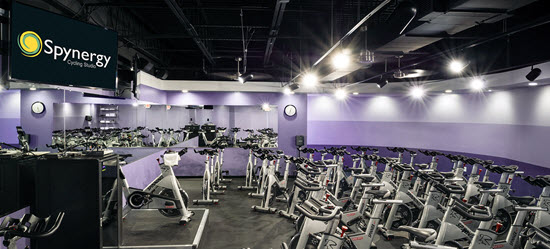
Bill Pryor's Spynergy Studio
By Joan Kent
Indoor cycling classes have become inextricably linked with dim lighting, and I’ve never understood why. Personally, I’m not crazy about training in the dark and will tell you why in a moment.
Studio lighting is one of the factors involved in creating the best class environment, along with music, video, voice, tone, cueing and more. Here are two scenarios from my teaching experience, in which the lighting differences span the spectrum.
In Studio A, the lights are always on and always bright. There’s no on/off switch in the studio because the lights go on when the club is opened. The master switch controls all.
In Studio B, the lights can be brought all the way up to a bright level, but the previous instructor, who had a huge following (okay, it was Jim Karanas), liked to keep the lights dim by flipping only the middle switch on the 3-switch panel. Needless to say, whenever I subbed for him, I made sure the lighting matched what everyone was accustomed to in his class.
The dimmer lighting was okay, but periodically one bank of lights, often on the far side of the room, would burn out, leaving everything on that side of the room just plain dark. It wouldn’t affect the participants close to the door because light outside the studio shines in on the near side of the studio.
We’d notify the front desk staff about the burned-out bulbs, and a short time later, we’d have lights — until they burned out once more.
By my last observation, though, that infamous bank of lights was out again and had/has been for a long time. It made me think about this topic. Apparently, no instructors have reported it to the desk. Apparently, no one has complained.
That last fact amazes me. Because of Jim’s teachings, everyone in the class uses a heart rate monitor (see How to Get Your Students to Wear Heart Rate Monitors). I always train with a HR monitor, mainly because of what I learned from both Johnny G and Jim.
So here’s the thing. In this studio, the bikes don’t have computers that light up and display HR. It’s virtually impossible to see a HR monitor on the far side of the partially lit studio. I’ve seen riders hold up their HR monitors, twist them around to catch available light, and keep track of their heart rates that way. What’s wrong with this picture?
Now I happen to find it difficult to train extremely hard in the dark. For a club anniversary one year, the theme involved decorating the studio like a spooky forest and turning out almost all the lights. Several people did complain that they felt nauseated. Guess I tend to feel that whenever I’m training really hard in the dark.
I had hoped the current instructors might take notice (read ‘take the hint’) when I started bringing a small flashlight to class with me to light my HR monitor on days that I ride on the far side. No such luck.
I have a feeling I’m in the vast minority on this — indoor cycling is almost always taught in dark rooms. Of course, in studios with bike computers that light up, much of this is solved. Still, if I had to choose between the glaring lights of Studio A and the darkness of Studio B, I’d go for the glare. I can monitor my HR easily and definitely feel better physically.
How do the rest of you feel about lighting? Which is most important to you — the atmosphere that goes with dimmer lighting, tracking heart rates, other factors? Please let us know, and thanks.
Originally posted 2014-02-13 10:09:37.
by John | Sep 28, 2020 | Instructor Training
I was sitting in the Airport and started thinking about how useful Twitter could be to communicate with my Indoor Cycling Class regulars.  Many people set up Twitter to send updates to their phone. I could…
Encourage attendance
Let them know what’s coming next. Give advanced notice of each class profile. Offer words of encouragement. Ask “where has so-and-so been? Anyone seen him?
What are your ideas?
Are you using Twitter to communicate with your class? If so post your ideas for others in the comment section below.
Here is the Twitter site. It’s free to use and you have complete control over who you follow.
Save
Originally posted 2017-09-26 08:00:15.
by John | Sep 25, 2020 | Instructor Training
I sleep better knowing that for 17 cents a night, everything I have saved on my computer is fully backed up. All my Indoor Cycling class music, profiles, playlists, files, pictures…everything. When I see the backup status report below, I know that my three year old Dell laptop can fail tomorrow and I will lose NOTHING!
Makes me happy 🙂 They let you try it for free here.

Originally posted 2009-05-20 06:27:06.
by Joey Stabile | Sep 25, 2020 | Best Practices, Class Work-Sets, Creativity Indoor Classes, Instructor Training, KEEPING IT FUN, Master Instructor Blog, Training With Power
Welcome to the The Weekly Ride by Cycling Fusion
No more hunting for new music or counting out cues to develop your ride profile. Here is your ready to ride profile for a fully choreographed ride, that can be displayed from your phone, or printed out onto cue cards for your class. This ride is timed out, down to the second, to make your life as easy as possible!
(more…)
Originally posted 2018-05-09 08:10:21.
by John | Sep 25, 2020 | Instructor Tech Help, Instructor Training, Product Reviews

LTF Instructors get a 15% discount – are you taking advantage of this?
I could lease a nice car for what I'm paying Verizon Wireless each month. Service and data plans for daughters; Abby and Carly (two iPhone's), Amy's Droid Razr M and my iPhone run $250.00 a month = $3000.00 a year.
It may not be for you, but that's a serious amount of money to me 🙁
So my ears perked up this morning when I heard an interview on Fox for a company that said Americans pay something like $50 billion more than they should for cell services. The guest, the founder of savelovegive.com, explained that they have an easy way for you to analyze your monthly bill and compare the different service plans.
I didn't take the time to look, but I'm guessing there are other companies that do something similar. What makes savelovegive.com unique is that you can choose to simply pocket the money you save using their service or contribute it to their chosen charity – The Seven Bar Foundation.
The Seven Bar Foundation, a 501(c)3, is the brand for the empowerment of women. As a social enterprise it fuels microfinance institutions by driving profits with purpose with cause-marketing brand partners. To reach a critical mass with its ladder symbolic message, the Foundation hosts the top couture and luxury lingerie shows in the world – Lingerie New York, London Miami, etc. Together with the Foundation’s alliances we enable women in need to start or grow their own small businesses, breaking the cycle of poverty for their children via microfinance.
We believe that microfinance is an effective tool to combat poverty and empower women because it fosters self-reliance and encourages sustainable development. As loans are repaid to our Microfinance partners, the funds are then reissued to other entrepreneurs. Investments in Seven Bar Foundation will help countless women over the long-term, constantly growing in size and increasing its impact with every woman that the funds reach.
I love anything that empowers people to become productive 🙂
Using savelovegive.com was free, really easy and took me all of ten minutes to set up. Eight of the ten minutes was consumed by trying to remember which of our four lines was the Primary # and then resetting the forgotten password.

That $102.00 a year could go somewhere better than Verizon. If you choose to spend on on yourself maybe a Spotify premium or ICI/PRO subscription?
You create a user and password at savelovegive.com and then confirm the email they send. The actual tool that analyses your service is called Vera. Enter your cell # and password and Vera goes to work. I was shown four plan options and the potential change in costs. Plan option 1 showed I can save $102.00 a year just by making a simple change to my service.
Now to be fair, Amy watches all our expenses like a hawk (she was a CPA when I first met her), so we were already pretty close to optimal. But the conformation was both comforting and a bit depressing… I was hoping to see some huge, untapped savings we could take advantage of.
If you opt to make the suggest change, savelovegive.com generates an email to send to your carrier this the new plan data. Hit send and hopefully they will respond. It's when your carrier responds that the changes will be made – savelovegive.com doesn't make any changes directly, just shows you which changes to make.
If you're concerned with savelovegive.com having your personal info, I suggest running the test and then you can go back and change your password.
If you try this let other's know your results below.
P.S. savelovegive.com is a great example of a website built using HTML5 – the new hypertech markup language that we were discussing earlier in regards to iPads and how they won't display the Flash audio player that uses the old/current version of HTML.
Originally posted 2013-01-24 08:49:06.
by Joan Kent | Sep 22, 2020 | Instructor Training

Whenever I work with a new client who needs to get off the sugar roller coaster, I see some familiar patterns as the client struggles with her or his sugar addiction.
The pattern may include lapses, relapses, frustration, embarrassment, giving up, moving between compliant and noncompliant behaviors, getting past all of these, and finally moving forward decisively.
As the process goes on, mistakes may occur that could be labeled “predictable” because they’re things many clients have done before and conquered. Best of all, they can be modified so the end result is getting off sugar for good.
In this post is a list of mistakes that are common in trying to quit sugar. I made all of them and probably a bunch more. I discovered what I had been doing wrong mentally and emotionally that had kept me from becoming a successful quitter.
My Addiction Created This Sugar Quitting Mindset
I’m a good person to talk to about sugar addiction. I have a PhD in psychoactive nutrition (how foods affect brain chemistry), with a specialty in sugar addiction. Before that, I got a master’s degree in exercise physiology. I’m also certified by ACE (American Council on Exercise) as a Health Consultant.
I wrote a dissertation on using psychoactive nutrition in the treatment of women with binge-eating disorder. In it, to the very best of my knowledge, I was the first person to outline the neurochemical pathways of sugar addiction, and a neurochemical and hormonal explanation for the sugar/fat seesaw.
But there may be a more compelling reason to listen to me about sugar addiction. I’m arguably the world’s foremost recovered sugar addict.
I quit sugar more times than I can count. I tell this to all my clients because it’s helpful for sugar addicts when they know I’m not just preaching from an academic perspective.
In the process of making every mistake in the book — and inventing a few of my own — I discovered a formula that works.
Mindset Mistakes That Mess Up Quitting Sugar
Let’s look at the mistakes that kept me stuck for quite some time — and might be keeping some of your students stuck, as well.
Mistake 1: Expecting quitting to be easy
You’ll probably have good days and bad, easy moments and difficult ones. If you expect quitting to be easy, you might be unprepared for the bad times.
If you expect instead that it will take effort to quit, you’ll be ready to deal with whatever happens.
It’s not that quitting sugar won’t bother you at all, but you’ll be less reactive. Not only to external factors — like tempting foods around you — but also to internal factors, like sugar cravings.
Eventually, you’ll be non-reactive to sugary foods in general, whether you see them, smell them, or even taste a little. It’s definitely worth getting to that point!
As for cravings, liquid B-complex is the most effective short-term solution, as explained in a previous post.
Mistake 2: Not having a solid system
It’s easy to find questionable “wisdom” on websites, in magazines, in books, on podcasts. But it’s not a good idea to cobble your plan from a mishmash of unrelated bits of advice.
Instead, find one plan and stick with it.
Because I quit sugar before it was recognized as harmful, I had to piece my plan together from my research. Not every step was a clear one forward, and there was backsliding. My continued research eventually led to a solid system.
Part of that system is to focus on your sugar addiction first until you succeed in quitting and feel ready to move on to the next issue. This isn’t the time to focus on weight loss, become a vegan, go raw, or schedule your life makeover. Conquering sugar addiction gets top billing now.
Mistake 3: Looking for support … in all the wrong places
It’s only natural to want support. But telling the wrong people about your decision to quit sugar could lead to sabotage that undoes your efforts!
As detailed in a previous post, telling everyone at the dinner table that you’re turning down dessert because you’re addicted to sugar might trigger this:
“Have it; you can eat less tomorrow.”
“Just work out a little harder tomorrow.”
“A little bit can’t hurt.”
“But I made it myself.”
Not one of those comments shows an awareness of the issues a sugar addict faces. If they succeed in getting you to go against your plan, you’re the one who suffers and has to start over again.
Part 2 will cover the changes that are key in making quitting sugar possible — the Mindset Shifts I needed to stop resisting — and finally implement — so I could quit sugar successfully. Some of your students may need to know them, too.
Originally posted 2015-06-29 14:49:24.
