For the past two year's or so I have been lobbying for a universal “Standard” for the description of Heart Rate Training Zones. The purpose is to get all of us talking with a common language, so we aren't confusing our students and help them reach their weight loss goals by training more effectively.
I love what we have been calling 2T/3Z or Two Thresholds / Three Heart Rate Zones and feel it is perfect for the “Club Athletes” who make up the majority of our classes.
Now there is a multi-week Heart Rate training program, designed around 2T/3Z & the Blink Heart Rate monitor, that you can offer to the clients at your club or studio. Zoning was developed by Ms. Zone Based Heart Rate Training herself; Sally Edwards, along with her partner (and ICI/PRO member) Chuck Cali.
Zoning is literally a Turn-Key fitness program in a can. I mean it will actually arrive at your studio in a can 🙂 The Zoning can contains everything you need:
Handouts and training video to educate your instructors
Promotional materials to help you sell your 6 week Zoning program to your clients
Class plans for leading each of the 6 weekly small group classes
Having seen the complete program I'm confident you will want to offer Zoning
Zoning is due to be released on November 15th and they are currently interviewing potential Beta sites. If you own or manage a fitness studio and would like to be considered as an early test facility (or you would like to be contacted when the program is released) follow this link to submit your contact information.
We are now offering both ACE and AFAA CEC's at the ICI/PRO conference and Zoning Fitness is providing Blink Heart Rate Monitors to the next 75 Instructors who register to attend the conference.
MyZone displays your students Heart Rates on a screen during class… and a lot more. Listen to my Interview with Steve Newell from MyZone and learn how their system will have your students coming back to your studio – not your competitors 🙂
A popular choice for Performance Tandems and Single Speed bikes.
Rules are not necessarily sacred; principles are. — Franklin D. Roosevelt
My cycling background revolves around the chain. My coach used to say, “The chain is sacred.” It vibrates, and that’s precisely what gives the bike its feeling of life. The vibration brings the rider a deeper sense of, and connection with, the bicycle. Without that vibration, without a chain, a bike is dead. I’ve believed, taught, and ridden this way since long before belts were introduced to Indoor Cycling.
If you had asked me back then about building a bike with a belt, I would have said without hesitating, “Don’t mess with the chain.”
Because of my background and the coaching I got, I can argue for the chain better than almost anyone. Those arguments, though, are philosophical, not focused on moving the industry of Indoor Cycling forward.
From my new perspective, working for a company (Indoorcycling Group, ICG) that makes a spectacular line of bikes with belts (LIVESTRONG), the conclusion is clear. The belt requires less maintenance, has fewer breakdowns, improves pedaling technique, does not allow for momentum-based recovery, makes the rider work more efficiently, is quieter, and is safer for new riders. It will save the club owner money, decrease liability, train participants more effectively, and make less noise.
No one on the management side of the club business would need to hear more to choose a belt. For economic reasons alone, the industry will go this way. It’s generally wise to ride an elephant in the direction it’s going. It seems foolish to push for a chain drive in light of that.
But here’s another thing to consider: 95% of the people who get on an indoor cycle won’t understand that “the chain is sacred.” They will notice only that the belt is quieter and smoother. This was the point that sold me. Although I tried relentlessly to find people who understood why I insisted that the chain is sacred, few people got it, almost no one felt it. Not even instructors who were currently teaching on chain-driven bikes.
Instructors whose jobs depend on the Indoor Cycling industry should not need any more convincing. Convincing club members who are used to chain-driven bikes, however, may take a bit more work.
The first thing I ask them to do is tell me what they like about bicycle riding. After they go on for a while, I ask them what they like about indoor cycling. That, too, goes on for a while. Regardless of the individual answers, the key point is that indoor cycling is quite different from riding outdoors: no need to balance, different movements, different hand positions, fixed gear, and more. There are many differences, all far more noticeable than the drive train.
Next, I ask them what other kinds of bikes they've ridden. Performance bikes only? How do they react when they see someone riding down the road on a cruiser in flip-flops? My point is a bike is a bike. You’re not a consummate rider if you fixate on what you think a bike should be. In fact, you’re less a cyclist than the overweight woman struggling on the hybrid. She has more grit. She’s happy just to be riding. THAT is a cyclist.
I ask them if they know which bike is the best in the world. It’s the one you’re on 🙂
Cycling is sacred, not the chain. I dig the vibrations and the sound of all the chains in a peloton as much as any roadie. But chains are secondary to the circular motion of the pedal stroke. The continuity of the circle is what creates the sense of peace that allows you to get outside your mind. The chain or belt simply permits the transfer of power to the forward motion. It’s the motion that makes you feel like you’re flying.
If you want to call yourself a cyclist, get past the chain. Respect all bikes. Find peace in a smooth circle with a belt and satisfaction in the increased work it puts your legs through without the free-spin of a chain.
With good instruction, a belt won’t detract from the class experience — and may very well add to it.
Whenever I think of recovering faster, I hear my dad in the back of my head telling me to sleep faster when I only had 4 hours until the morning. I by no means want you to start short changing your recovery time nor trying to psychologically speed up the process. I do want you to consider how fast your heart rate recovers and some valuable information we can provide to educate our riders.
I’ve mentioned numerous times that I use recovery between efforts as a litmus test to determine whether a person is working at the appropriate intensity. The length of time given for recovery is often directly linked to the level of intensity we expected. For intensities that fall in the 80-95% range, I often provide a minimum of 3 minutes of recovery before the next effort. To put more context around this, if I was asking my riders to maintain a hard effort of 80% or greater for 3 to 5 minutes, I would provide 3 minutes for them to recovery. In a similar fashion, I may throw 4 to 8 short 1-minute intervals at them with only 30-60 seconds of intermediate recovery (between intervals), but would then give them 3-5 minutes to recovery after the set.
With both of the above scenarios in mind, I would expect riders to “need” at least 2 minutes to allow their heart rates to drop (near 60-70%) with the third minute providing some transition time before we launch into the next challenge. The bigger issue is always, did they work hard enough? And frankly, without a heart rate monitor it is very subjective. They may say, “I felt like it was hard, but then I recovered within a minute and now I’m ready to go”. It is far more objective for a rider to say, “I ended that last interval with my heart rate at 165 BPM and 2 minutes later it went down to 130 BPM”.
So what’s happening when someone pushes very hard and does not recovery very much within the 3-minute period? This is a question a few riders asked me this week. Here are 3 possible answers:
(1) The rider may be deconditioned and has possibly pushed himself or herself too hard. This is common with indoor classes that cater to all levels of fitness. Some riders do not have the body awareness and find themselves beyond their limit. They usually don’t have to stop riding, but you may want to suggest they take more time to recover before jumping back in. This suggestion is a sign of a mature and professional instructor who is not just interested in beating the riders to a pulp.
(2) The rider is just tired from a long day or is maybe lacking sleep or has not eaten well. This is where you can ask if this is a common occurrence or something they are just experiencing today. Similar to the rider above, they may need to sit out a few efforts or drills and then jump in once they feel recovered.
(3) The rider is borderline over-reaching or over-training. This is sadly a “silent-killer” in the fitness world. People workout on a regular schedule, regardless of whether the intensity and volume is correct, and eventual find themselves plateauing because they have not taken time to recover. I would ask this rider, “when the last time you took a light week or a total week off?” If they didn’t know or it was more than 5-6 weeks ago, I would strongly recommend they take the next 5-7 days off. Now, they don’t have to do completely nothing during those 5-7 days, but the intensities should be very light (50-60% perceived effort). If a person didn’t feel they had the disciple to go easy, then I would recommend they refrain totally.
As fitness professionals, we have to be prepared to help people deal with the challenges they experience as they strive for a healthy body. This includes saying the hard things (because they don’t want to hear it – which is why they are where they are at). So how can our riders recover faster after hard efforts (a sign of good fitness), it just may be that they need to pay more attention to their body’s signals for overall rest. It is our job, to provide the valuable input that helps them make an educated decision. Eventually then need to believe that rest and recovery IS training.
No more hunting for new music or counting out cues. Here is your ready to ride document, that can be displayed from your phone, or printed out onto cue cards. This ride is timed out, down to the second, to make your life as easy as possible!
FREE ICI/PRO PODCAST: What an exciting day, this is our third ride recording. ICI/PRO member Amy Smith, a Cycling Fusion Master Instructor and routine contributor to The Weekly Ride, delivers a ride.
“This is a race week. On this course I have less hills so we have to keep them on target in the saddle pushing to zone 4 with some high zone three's for them to catch a drink or two. As always allow them to ride their own ride /race to be at their own pace. Hope you enjoy the ride.” Amy



 Exciting News!
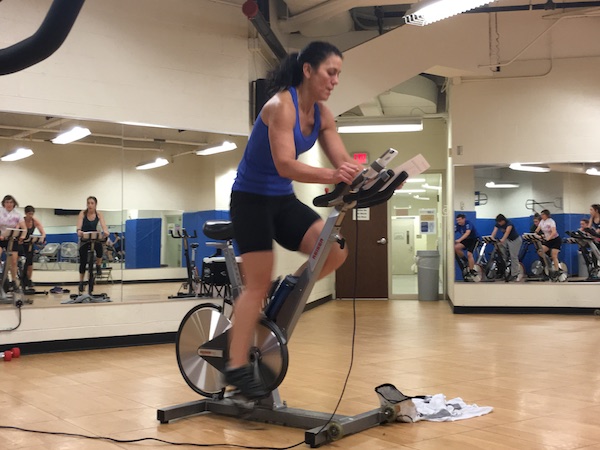
 FREE ICI/PRO PODCAST: What an exciting day, this is our third ride recording. ICI/PRO member Amy Smith, a Cycling Fusion Master Instructor and routine contributor to The Weekly Ride, delivers a ride.