Interval: n., the amount of time between two specified instants or events.
You teach indoor cycling, so you know intervals. If you asked another instructor for the workout he/she used in class that morning, odds are you’d get a response something like, “The main climbing set was 4 X 5/1:30 min at 85%,” indicating four five-minute climbs at 85% max effort, with 90 seconds of recovery between efforts.
Intervals are standard practice in indoor cycling and all types of CV training because of how effective they are. Interval training dates back to the 1930s, when German coach Dr. Woldemar Gerschler pioneered training methods based on sound physiological principles. He teamed up with cardiologist Dr. Herbert Reindel to develop a training protocol that would maximize the heart’s fitness.
The study involved some 3000 subjects completing three weeks of precise, heart rate-controlled training. The participants were track athletes who ran a relatively short distance at a very fast pace. Average stroke volume increased 20%, with significant improvements in performance. Gerschler and Reindel dubbed the repetitions “interval training” and considered the recovery period between the runs the most important part of the training.
When I first read this, I was amazed. To the founders of interval training, “interval” meant the recovery interval. When managed correctly, that period of time had the greatest physiological impact. The descriptive “formula” I used above would have made no sense to them because the rest interval should be the primary concern and dictate the repetition of the work effort.
For Gerschler and Reindel, if my heart rate did not recover properly in 90 seconds, I wouldn’t be allowed to do the next interval. Improved fitness would have occurred when my heart rate actually achieved the desired recovery in 90 seconds.
If that heart rate reduction didn’t occur, the workout was too difficult. Unless it was adjusted, the heart would be overworked, leading to fatigue and exhaustion, rather than to the desired training effect. So, the reduction of the recovery interval is the most important aspect of the training, not the degree of effort or duration of the work interval.
Consider the state of training within indoor cycling today in light of that information. Rigid interval formats form the core of most classes, with limited (or no) attention paid to what the founders of interval training actually meant by interval training. And not just in indoor cycling. Consider the prevalence of high intensity interval training (HIIT), such as the Tabata Protocol, in the fitness industry in general. Tabata intervals are often max efforts with extremely short recovery — less than half the duration of the work interval. Consider Gerschler and Reindel rolling over in their graves.
Is respect for recovery even possible with current class schedules, equipment or perceptions? My guess is no, except in selected, controlled situations. Is it even desired by the average class member? Most of them would not feel they were getting a good enough workout because we gave them too much recovery.
As indoor cycling instructors, we’ve all heard, “It’s not how hard you work but how fast you recover.” Yet it’s difficult to implement, given what we have to work with, and that includes the mindset of our members.
Maybe the question becomes whether or not we should really be doing intervals at all. When an interval is considered as described in the first sentence — the amount of time between two specified instants — then it’s a valuable tool for us as instructors. It allows us to develop patterns and give participants an understanding of the training we have planned for them. It also enables us to implement music more effectively by selecting songs by length to fit the patterns that we create.
As soon as “interval” becomes “interval training”, however, I think it’s wise to take a step back and consider where this kind of training came from and what the founders of interval training discovered about the work/recovery relationship.
There was a question over on a Facebook page asking about Spotify and a mysterious shuffling of the playlist – when it appears that the shuffle is turned off. Chrispins beat me to the answer, but I wanted to add some screen shots to make it easier for you to understand.
I had this exact problem and it drove me nuts until I figured it out.
If you open a playlist in Spotify there's a big “Shuffle Play” button. If you click it – it turns gray for a moment before launching the first track… but it stays white… so you think; “I'm good, the shuffle must be off… I can get on with my class… but wait… this song isn't supposed to come next… WHAT's GOING ON WITH MY PLAYLIST?”
Click on a track – then click the “i” symbol in the top, LH corner.
Which takes you to the info screen. This split screen view shows shuffle on (green) and off.
Any song will show this and you only need to change it once.
Why Spotify makes this so hard to use is anyone's guess 🙁
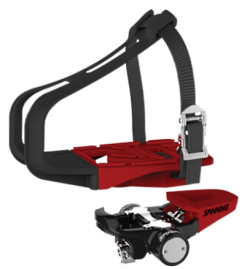
Josh Taylor had told me last year about a new pedal Spinning® was designing that would have the same versatility as the Schwinn Triple Link pedal; accepts LOOK, SPD and fitness shoes + they include the new Morse Taper pedal spindle (vs. a conventional threaded spindle) they're using on the new Spinner® NXT and Blade Indoor Cycles.
I see now that they've introduced the new pedal in two versions; the TRIO™ and TRIO QR™ – QR refer's to Quick Release.
My understanding is that even with dozens of different competing pedal types available, LOOK (who was the first mass-marketed clip-less pedal) is still the market leader in road bike pedals. So it makes good sense to offer these types of pedals to keep many of your cyclists participants happy 🙂
The two pedals appear identical except for:
Patented “Quick Release” lever allows for simple one-handed platform removal.
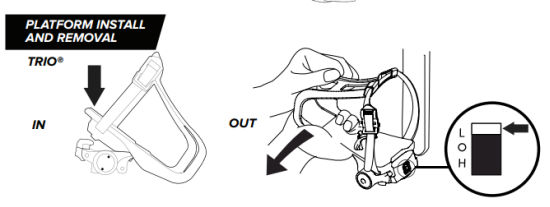
They may want to reword this as the owner's manual clearly shows you need two hands to remove the cage.
One hand or two, my hat's off to whomever designed the nifty Quick Release feature on the TRIO QR!
Fun Fact
You may or may not be aware that indoorcycleinstructor.com, the Podcast, ICI/PRO… everything began with my desire to market my Red Pedal Tool. After years of fighting with the shoe baskets on these pedals I created this tool which is designed to safely and easily remove the shoe basket from Schwinn Triple Link pedals.
I'll need to talk with Josh about why they have also chosen to manufacture a version without the quick release… The diagram below illustrates the very same removal issue Schwinn has with their Triple Link.
Barbara Hoots and I discuss how you can grow your Indoor Cycling classes using the same techniques she has successfully used to grow her own Spinning classes.
SIX WAYS TO GROW YOUR CYCLING CLASS
1. Create an Ambiance which allows students to disappear from the real world. Paint the walls dark, add mood lighting to enhance the mind body connection, LED candles, draped fabric along the walls for sound absorption, etc.
2. Treat your class (and students) as if they were coming to your home for a dinner party.
Use warm lighting, background music playing, perfect air temperature, clean, clutter-free environment, instructor first to arrive to greet students as they enter, make introductions so everyone feels welcome, etc.
3. Pass out Free Multi-Class Passes and brochures describing the musical styles of various instructors at your facility. The rule in our gym: As long as there is an empty bike, there is room for friend. Bring friends. Create a vortex of energy using people who are excited about the class and like each other. Students should have passes to give out to their friends and relatives. A brochure describing the class and a brief description of each instructor's musical style, students will FIND the class they connect best with. For example, I play alternative, progressive tribal, trance. Another instructor may use Big Hair Bands from the 80's and hip-hop. A third could use dance diva's and top 40. Music is the first judgment made about your class. Don't lose members over music – provide knowledge beforehand so everyone can enjoy the ride.
4. Donate charity rides for fundraisers in your community.
Find a local charity benefit (Cancer, schools, etc.) and donate a private indoor cycling ride for 50 (or the limit of bikes you have). A silent auction bid will usually generate interest, as it can be marketed as a group ride to celebrate the end of a cycling/sports team season or even a birthday party! Provide iced cold adult beverages after the ride and photos. Follow up with a press release in your local newspaper as a fundraiser for (name of organization). Charity rides work best on Thursday or Friday evenings.
5. KNOW your audience. While as an instructor your must be passionate about your music, yet be aware of your audience. If you have some young guys who are ripped animals, use mixes of Nine Inch Nails or heavy beats by Crystal Method. Any instructor who has students that arrive to class wearing their iPod means simply put, “Your music is awful.” NEVER criticize the student….it's your job to connect to the class via music.
6. Reward your students. After completing 6 classes, students receive a black Spinning sticker to place on their bumper. It's not only a sign of pride, but great advertising as well.
and always say thank you. Remember, respect the time of your students – they are busy people and should never wait on you. As in instructor, you are the first to arrive and the last to leave. Make your room warm, inviting, nonjudgmental, and watch your classes soar.
Blink, Blink, Blink …………………goes the clock on your VCR. Yep, I said it, VCR. It is mind boggling to me that I have children (ages two and four) who will never know a Tape Player, VCR, 8 Track, and possibly even a DVD. Technology moves fasters than the fastest cyclist on his/her best day. But this story isn’t about VCR’s or technology. It’s to illustrate a point about how we as a culture like to change, modify, and complicate things even when they don’t need to be. I am writing this even at the risk of getting backlash from much more “technical” and experienced outdoor riders. But like I said in my first post, I speak from the heart and you’re either going to love me or hate me. If you’re looking for stats or data to shave off 3 seconds from your hill climb…..then I’m not your guy.
I still remember the very first VCR my mom and stepfather bought. He was a car dealer and had gotten a great bonus check. It was summer, probably July, and we loaded up in the car and headed to the Video Rental store. For you young readers, we used to have places that had VCR tapes lined up on all of the walls so you could choose what you wanted. In addition, WAY back then (early 1980’s) we had discs that looked like large vinyl records but played like a DVD. They were encased inside hard plastic covers. Anyway, back to my story. The VCR most likely costs us $600, weighed as much as my brother and I combined, and if I am not mistaken had no more than 5 features. Play; Stop, Pause, Forward and Backward. More expensive ones had “Record” so you could tape Price is Right or your favorite soap, but as a 10 year old I was just excited to rent Friday the 13th (The first one).
That VCR had less technology than the cheapest, crappiest cell phone on the market today, but when I look back it did absolutely everything that we ever needed it to. Then somewhere in some big board room a group of people decided that we (the consumer) needed to have options. And not just a couple, but over a hundred that the most experienced technical engineer would have trouble programming. So my question is WHY !?!?! Why do we need to complicate every single thing in our world to the point that we either lose some of the enjoyment OR feel like a complete idiot because we can’t or don’t want to spend the day trying to figure it out ?
How does this apply to us, the indoor cycling people of the world? And actually, I will go so far as to throw in all Group Ex AND Personal trainers to this query. What are WE doing as coaches and leaders to complicate things that don’t need to be complicated? I still believe, and may be wrong with everyone OUTSIDE my class, that my people come to me for more than instruction on how to peddle, when to get their heart rate up, or when to stand up. Let’s face it, I “teach” (HATE to use the word teach, I prefer coach) a class on how to get on a bike and peddle. Sure, there are MILLIONS of ways to teach and A LOT that goes into it……FOR AN ELITE ATHLETE to do the tour!!! But I have 30 to 60 people who, like me, are there for so much more than to learn all the tricks to shave off 3 seconds from their best time. And even if my people ARE there to learn how to shave of the 3 seconds, I believe (speaking about my people of almost 20 years) are trying to shave that time for internal reasons. Reasons of personal growth, pride in ones accomplishments, or even to use that shaved 3 seconds as a metaphor for something much bigger in their life. That’s why I teach and have always taught from a spiritual perspective and not so much from a technical perspective.
I am so fortunate to “coach” at arguably the best club in the US. I spent 10 years in all 50 States as a Sales manager and so I have been in too many gyms to name. I have seen trends in workouts, classes, equipment, and I am never surprised at what comes next. Right now this “Cross Fit” craze is amazing to me. We are now as an industry demonstrating that “hey, you didn’t need to join a gym with all the Cybex equipment because that spare tire in your garage, sprints up and down your street, and jump rope is all you need for a great workout. And you know what, they’re right. Why is a sprint on a Schwinn spinning bike any more beneficial than a sprint up the hill in your neighborhood?? It’s different because our people come to us for something they can’t get at home in the basement or in the garage. For some of you, maybe it is the technical lingo you use. Some of you may be like me and teach good form but with a focus on the “spiritual” aspect of the ride. The truth is that if we do it right and with proper form, then all of these things will get us to the goal, which is for our people to walk out feeling healthier and in MY opinion both “physically” AND “mentally.”
My point is that we don’t have to complicate things the way we sometimes do just so that we can stick with the trends. If your class demands that, than do it. But don’t lose focus on your core audience of people, the ones who stuck by you for 20 years. Give them the best music, the best guidance, the best stories, and the best up to date techniques IF that is what is going to give you and them the result you’re looking for. Let’s remember and never lose sight of the fact that our members come to us to lead them and if we tell them that rubbing their tummy while sprinting doubles the amount of calories they burn, then chances are most will do just that. So it’s our obligation to introduce the right amount of “new” technology if and only if the benefit is there. THEY are giving up one hour of their lives and putting it in our hands. I for one ONLY want to provide the best.
So the next time you jump on your bike ready to start class, remember that blinking clock on your old VCR and ask yourself “have I put together a class with total focus on helping them achieve their goals?” or have you designed it based on an article on the latest “Crave” from some gym in a posh LA studio? Do your research, make sure the latest “thing” is right for your students and then apply it. But don’t buy the VCR with 100 programmable features that you don’t know or understand until you SET THE CLOCK ON IT FIRST!! Now go press PLAY and have some fun. And please send me your thoughts so I can learn my audience.