With a title like that, we could be here for days. Perhaps a better title would have been: What Is Power As It Relates To Cycling or even more to the point would be: Training on Indoor Cycling or Spinning® Bikes With Power. But as you see, that would have been quite a long and clunky title. So I spared you. Naturally, we will be confining our discussion to how the dynamics and science of Power has been applied to the sport of cycling. More specifically how it relates to the world of Indoor Cycling or Spinning® and the equipment used for this in most fitness facilities; stationary bikes. While most of our work was done on the Keiser M3 indoor bike, we are currently in the process of acquiring other power bikes for continued independent research.
Definition
Power is the product of strength and speed or put in terms of indoor cycling, the resistance applied to the fly wheel, and the RPM or cadence of pedaling. That seems pretty easy to understand right. The equation that comes to mind is:
Power = Resistance X Cadence
Oh if it were only this simple. Well, for the purposes of Indoor Cycling or Spinning®, this is all we need to know, and thuse, we have made it that simple. However, if you ride outside, you need to know that there are quite a few factors that also impact power as it relates to cycling. While we enjoy the perfection of a controlled environment for training, riding outside is anything but a perfect and consistent. Consequently, there are lots of factors that can affect one’s power. A bunch of very smart people from Penn State put together a nifty Power Calculator for those of you who are even bigger data geeks than myself. You can find it at: http://www.me.psu.edu/lamancusa/ProdDiss/Bicycle/bikecalc1.htm
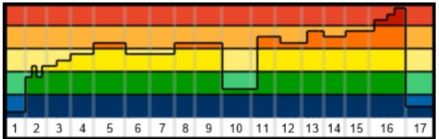
Here is a sneak peak at all the factors that go into calculating power when we move outside:
As you can see form the screen shot above, at least 65 thousand other people have a similar curiosity about power. You can also find a kazillion references to power as it relates to cycling on the internet, but our discussions will be squarely focused on how power is measured and used for Indoor Cycling or Spinning®.
This does not mean that the power generated indoors is not the same as the power generated outdoors. Essentially they are the same. It simply means there are different methods used to measure that power due to differences in equipment, environment and cost. Yes, there will be differences in the Watts you generate indoors, and what your power meter measures outdoors. Even cyclists who use the exact same bike, with the exact same power meters indoors and out will experience differences. Shocking as it may seem, the most expensive equipment available will still produce variations due to the enormous influence environment has on the rider and the equipment.
Nevertheless, this does not take away the value of training with power. Power meters still represents one of the best tools for improving your general fitness and/or performance on a bike that has hit the Indoor Cycling or Spinning® market in a very long time. The differences between indoors and out will not negate these positive effects. At the end of the day, it’s the results we are looking for, and training with power will surely deliver!
Read more of Gino's Training with Power Articles – Here
If your objective is to communicate (sell) the value of either Training With Heart Rate – or – Training With Power, teaching your class using Three Zones will be the most easily understood, accepted and remembered… here's why.
The Rule of Three
It's no accident that throughout history – thousands of years in fact – three (3) is the magic number in many, memorable fairy tales, myths and marketing campaigns. They're easily remembered and shared because they follow The Rule of Three…
There were three little pigs, three blind mice, Goldilocks and the three bears, Three Musketeers, three wise men and the Three Stooges.
1st, 2nd, 3rd – who ever remembers (or cares) who came next?
This copy writing blog explains the Rule of Three very well in the context of effectively communicating ideas.
It all comes down to the way we humans process information. We have become proficient at pattern recognition by necessity, and three is the smallest number of elements required to create a pattern. This combination of pattern and brevity results in memorable content, and that’s why the Rule of Three will make you a more engaging writer.
Sticky Ideas
You see the Rule of Three used all the time across diverse areas of life. Why?
Because information presented in groups of three sticks in our heads better than other clusters of items. For example:
“Life, liberty, and the pursuit of happiness”
“Government of the people, by the people, for the people”
“Friends, Romans, Countrymen”
“Blood, sweat and tears”
“Location, location, location”
“Father, Son and Holy Spirit”
“Faith, Hope and Charity”
“Mind, body, spirit”
“Stop, Look and Listen”
“Sex, Lies and Videotape”
“I came, I saw, I conquered”
I'm confident you can add a bunch more to this list, which kind of makes my point. All of our brains are hard wired to create and retain patterns of three concepts… not four, five, six or seven – three is the magic number.
Sally Edwards understood The Rule of Three. Her three heart rate training zones concept called Zoning is designed to appeal to as many people as possible.
Please note that I didn't ask; What's the most accurate/precise/correct number of HR or Power zones? My question was; What's the best number of Heart Rate and/or Power Zones in our classes?
Cameron Chinatti with Stages Indoor Cycling says the answer is 7 Power zones. So does Joe Friel, Dr. Andrew Coggan. Chris Carmichael appears to use five. All super smart and knowledgeable people to be sure. Administered properly to a committed endurance athlete, 7 power zones is probably the most accurate/precise/correct number of HR or Power zones for them to train with.
But 7 Power training zones is too many IMO for our classes filled with Club Athletes.
The ICI/PRO Power Training Zones follow The Rule of Three.
Technology can be a great thing for our classes – as long as all of your Instructors have been trained to use it properly.
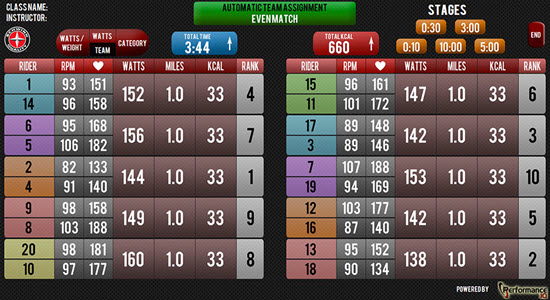
I'm seeing a bunch of clubs and studios having enormous success with performance data tracking and display systems. These systems connect to the consoles all of the new Indoor Cycle's with power and then display the information on a big screen + send out those informative emails that your participants love to receive.
Unfortunately some studios and/or Instructors aren't having the same amount of success. During many of my consultations with studio owners, I'm hearing them say that they would have appreciated (and benefited from) more in depth Instructor training, i.e. exactly how do we integrate these systems into an actual class?
So when I was at IDEA this past Summer I was encouraged to see that Schwinn Indoor Cycling has developed specific education, for the use of their Schwinn branded version of Performance IQ 🙂
To get the low down on what they are offering I invited Schwinn Indoor Cycling's Director of Education, Julz Arney, join me to discuss their education and get her thoughts on Best Practices for using Display Training.
During this interview Julz mentions that she would provide everyone with a PDF of her 10 Best Practices for using a Display Training system – here's the link to download it.
Would your club or studio benefit from additional Instructor training, regardless of the brand of cycle you're using? ICI/PRO has an experienced team that is available to provide intensive Instructor training at your location – please contact us and we can schedule a call to discuss your needs and see if we can help. We can also help you with decisions regarding Indoor Cycles, website design and performance data tracking and display systems.



 Watt Is Power? Or rather what is power?