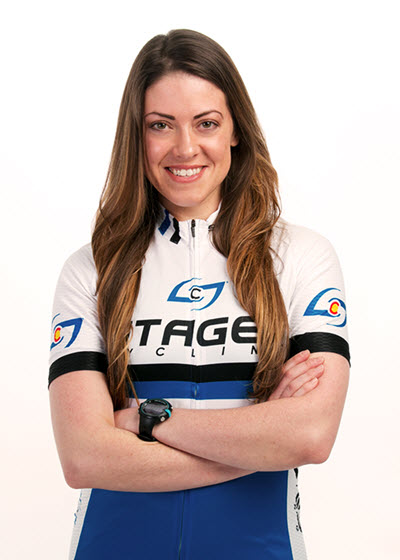
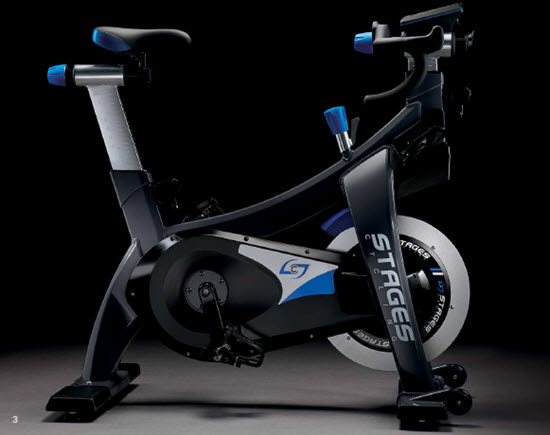
Master Educator Cameron Chinatti with Stages Indoor Cycling joins me for a fun followup to their very successful IHRSA convention where they launched the new Stages SC3 Indoor Cycle. We've got a bunch of videos that relate to my interview, which you'll find below.
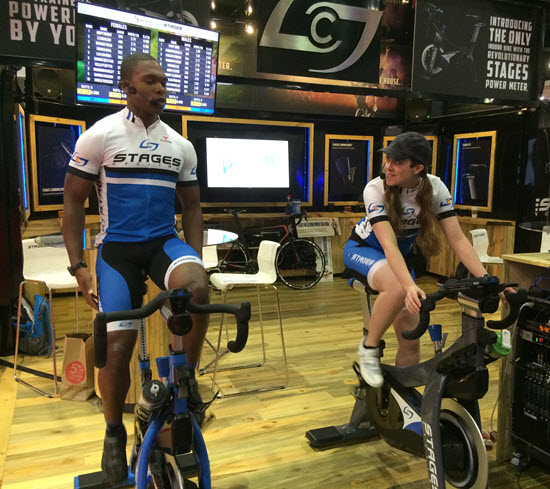
One of the highlights from the show was the amazing efforts of two cyclists, during their 60 sec challenge.
First there was
Junior Nationals competitor Dominic Suozzi decided to try his hand at the #60secchallege today. The kid's wearing Converse and he destroyed everyone. 1100 Watts!! That's crazy-ville!
Then how about the huge effort from Kat Haskins … aka TheBarnKat > she's an Instructor at CB Cycle Barn and wasn't an outdoor cyclist, up until now. She won a new Giant bicycle with Stages Power Meter for her efforts 🙂
Here's my interview with Cameron. Enjoy!
Cameron and I discuss their new “Sprint Shift” innovation. Here's a quick video showing how it works. You can read more about how I used this new feature at my review of the Stages SC3 Indoor Cycle.
Before I get a bunch of hate mail from Schwinn Instructors. I make the comment that Stages is the first Indoor Cycling company that is focused on both Indoor and outdoor cycling. Yes I realise that the brand “Schwinn” was first a bicycle company – my first road bike was a green Schwinn Varsity, second was a white and purple Schwinn Paramount. But the Schwinn Indoor Cycling brand has/had no connection with the bicycle company known as Schwinn bicycles. Stages is currently selling products to outdoor cyclists (the Stages Power Meter+ Endurance Training Education) as well as Indoor Cycling studios (the Stages SC3 Indoor Cycle + Instructor Education) Does my comment make sense now?
Stages Master Educators Dunte Hector and Cameron Chinatti leading the morning ride at IHRSA
IHRSA 2015 was the first public appearance of the Stages Cycling SC3 Indoor Cycle. This was a total surprise to me and I have no idea how Stages Master Educator Dennis Mellon was able to keep his mouth shut for so long. We talk weekly and it must have been killing him not to be able to tell me about their latest project 🙂
Going forward, I feel it's important to disclosure that Stages Cycling sponsored (paid) my and Amy's travel to, and lodging in, Los Angeles to take part in the launch of their new Stages SC3 at IHRSA 2015.
If parts of the Stage SC3 look familiar, there's a good reason. The engineers who designed this Indoor Cycle have a long and storied history of product development with indoor cycles and power consoles. It was explained to me that the design criteria for the SC3 was; take all of the engineering team's collective experience and build the ultimate, commercial Indoor Cycle. Did they succeed? Let's find out…
The Basics
Frame – Aluminum… and lots of it. This is a very solid/substantial IC > perfect for studios with big, powerful riders – or – those offering unconventional classes with a lot of movement.
Drive – CarbonGlydeâ„¢ drive system. Yes, this is the same Gates belt as other manufacturers are using, but there are fundamental differences with the other components of the drive train, that give the SC3 a very different feel. Because they don't run the belt under tension (there's a tiny bit of slack you can feel as you move the pedals back and forth) the SC3 is noticeably quieter than the Schwinn AC and it's tensioned Gates belt. It also retains a slight, chain-like vibration, but doesn't buzz like the AC. Stages is so confident in their drive system that they offer a 10 year warranty on the CarbonGlydeâ„¢ belt. Correction: Stairmaster's engineer Travis Vaughan alerted me to my error describing the Schwinn AC's Gates belt as “tensioned” – which it's not. I didn't intend to infer that they used a tensioner like what's used with Poly “V” belts. Instead I should have described the differences as; the AC runs it's belt taut (zero slack) vs. the SC3 which, when properly tensioned, has a very small amount of slack.
Resistance – Magnetic > surrounding an aluminum flywheel. Screw style adjustment and includes the new Stages SprintShiftâ„¢ three position lever . More on that below.
Handlebars – Road Bike Style Drop Bars – there's a reason that handlebars on road bikes haven't changed over the last 100 years > these fit us (humans) the best. Please don't ask me; “butwhere is position #3 John?” It's standing, with your hands surrounding the brake hoods, exactly where your hands belong when you're out of the saddle 🙂 It's here where you have the most leverage to power through a steep climb and it eliminates the temptation to “over reach” while seated.
Saddle – nice. Not too narrow… and not to wide/fat. Forgive me for saying it this way, it's very close to (might be exactly the same as) the saddle on the Schwinn AC > we have one on the back of our Trek Tandem. Amy loves this saddle and it's been comfortable for her for thousands of miles. Trust me on this one… I'd have heard all about an uncomfortable saddle.
The Power Meter
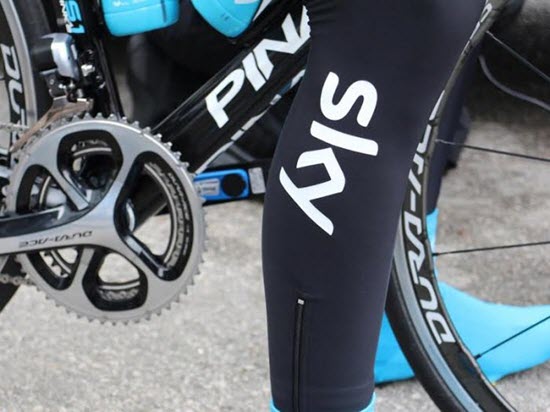
Good enough for TDF winning Team Sky Professional Racing Team
The heart of an Indoor Cycle that features power measurement is, of course, the power meter. The new SC3 is using the same technology used by Team Sky – winners of two Tour de France bicycle races and they're going to continue to use these power meters in 2015.
I could devote an entire article on just this topic and will have more as part of the ride portion of this review. In the interest of time I'll give you the important bits:
2,000 hours of battery life using two AA's – yes the display console is self-charging.
Same hardware, design, and accuracy found in the Stage Power® meter, which is used by professional cyclists’ and used in the world’s most famous cycling races, including the Tour de France.
ANT+â„¢ and Bluetooth – so it will connect with your iPhone or Android without any adapters.
Supposedly accurate to +/- 2.5%. I say “supposedly” because I have no way to verify their claims – but I bet Team Sky does 🙂
Display Console
It's important to separate the power meter, from the display console. Although most studios will choose to purchase their new SC3's with the new Stages EcoSCRNâ„¢ console, you don't have to. The Stages power meter will work with any Bluetooth or Ant+ device, like an iPhone or Garmin. You could also choose to wirelessly connect the Stages power meter directly to Display Training systems from Performance IQ or Spivi.
Here's a short video showing it in action during one of the 60 sec challenges.
The EcoSCRNâ„¢ console is self-powered = no batteries to replace ever… that's the Eco part 🙂
No exposed wires > I was told they've very neatly packaged the cable that connects the flywheel generator to the console = a long life of raising the handlebars up and down.
Constant backlight if you choose 🙂
Stage button to record intervals > there's also a nice feature that your averages remain displayed for 5 seconds after you end a stage.
Stages SprintShiftâ„¢ is a three position “shifter”, that provides course adjustments quickly. I want to describe it as a sort of cruise control, where you flick your finger and instantly resume your previous speed/resistance level.
Think of doing a repeating series of intervals. We cue everyone to add load, ride the segment and then recover. Now repeat it again. With SprintShift you can set your initial load with the lever full right. Move it left for recovery and then return back to the exact resistance instantly, by moving the lever all the way to the right.
There's some interesting physics at work here. If you use the SprintShift at lower resistance levels, the amount of change between each level remains relative & realistic. But start with a big gear and the changes are incrementally larger.
There are multiple ways you could incorporate this in your class and we'll find more over time. I'll describe a relay race we did in the ride part of the review where it was very helpful > we won! I'm sure Cameron and Co. will have some fun suggestions for using SprintShift when I interview her in the next few weeks.
If you've ever fought over a stubborn screw type seatpost of handlebar adjuster, you'll enjoy these new FitLoc cam style adjusters. Watch the video and you will see how quick and easy they are to operate. Also, they've kept the weight of the bars low, so it takes very little strength to raise them, using only one hand.
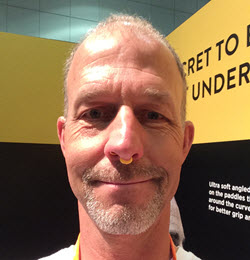
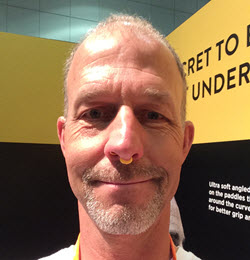
Finally, a nose ring that actually does something… but would you wear it while teaching?
I connect with the ‘gear heads' in my classes by reminding them how our bodies convert a carbon based fuel source (food) into the energy that powers a bicycle. Which is very similar to how the engine in your car creates the power that propels you down the highway, using another carbon based fuel source > gasoline or diesel.
No matter what source of fuel you're using, converting it into useful energy requires Oxygen (O2) and lots of it. Your car needs to ingest 15 pounds of O2 for every one pound of fuel burned. Not surprisingly, you need to breath in & out about the same amount of O2 to burn a pound of your last meal.
What limits the performance of both you and your car, is its ability to efficiently move air in and out.
There's a huge aftermarket industry that sells various components to improve how your car breathes. Now there's Turbine – a new sports breathing device from an Australian company that they say will improve how you breath, potentially increasing your performance.
HOW DOES THE TURBINE ENHANCE MY BREATHING?
Turbine increases airflow through the nose by an average of 38%, helping to reduce the feeling of breathlessness. Simply put, by dilating your nose (even slightly) you can increase the amount of air going in and also, importantly, increase the amount of exhaust air (CO2) you can expel. And, as you know, when you’re going hard, every little bit helps.
Using Turbine allows you to breathe more efficiently with every breath, enabling the body to focus energy on the muscles that need it, when they need it.
When exercising, oxygen is extracted from the air in your lungs, absorbed into the blood stream and circulated to enable muscular contraction. Supplying your exercising muscles with the air they need, has a high energy cost; Turbine may help reduce this. Try it today and find out for yourself.
I tried out a Turbine during the show last week. I was amazed by the instant improvement in my ability to breath comfortably in and out through my nose. I brought home a few samples and will be trying them shortly to see if they can help me ride faster/stronger.
They make a companion product for eliminating snoring, that Amy was excited for me to try. They call it mu:te.
We've all heard the causality dilemma, “Which came first, the chicken or the egg?”. Ancient philosophers have been debating this question since the beginning of recorded history. Indoor cycling instructors have been asking themselves a similar question,”What comes first, the playlist or the profile?”, ever since Jonny G showed the world how much fun it could be to ride a bike that goes nowhere.
As a more “seasoned” instructor and Master Educator for Stages Cycling I am often asked my advice on this dilemma. I tell them that an awesome playlist or a great profile can carry a class, but if you can create both you'll be a rock star.
[wlm_private ‘PRO-Platinum|PRO-Monthly|PRO-Gratis|PRO-Seasonal|Platinum-trial|Monthly-trial|PRO-Military|30-Days-of-PRO|90 Day PRO|Stages-Instructor|Schwinn-Instructor|Instructor-Bonus|28 Day Challenge']
In my “The Power of 3” posts I put together 3 harmonically mixed songs and a short profile that can be used with each mix. I'm always searching for the perfect blend of music and performance based interval sets. Sometimes, like I did for the “ICI/Pro DJ Scott Melker Music Playlist Contest” I let the timing and energy of the music determine my profile. In this post I'm presenting a profile that takes the lead and the music is of secondary importance.
Below I have provided a harmonically mixed 65 minute long music track. The music is not the focus of this profile, so if you want to use your own playlist go right ahead. I would recommend you find a playlist that is high energy and don't worry about the timing of each song and interval, just let the music play.
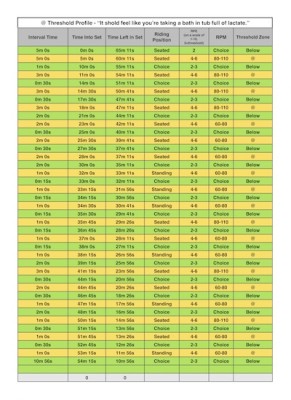
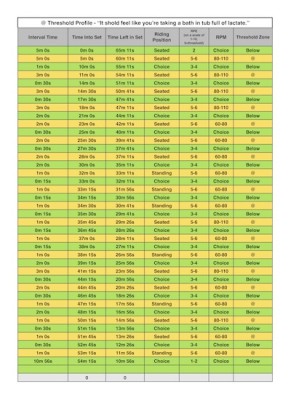
The two profiles I have provided are very similar, actually the timing of the intervals are exactly the same. The only change is the difference between the low intensity or “Floor” and the high intensity or “Ceiling” of each workout. Due to the high intensity or vaulted ceilings of the Above Threshold workout a low intensity or shallow floor is required to recovery after each interval. It's important to understand this principle, if you are asking your class participants to work above threshold for any length of time you are also going to need to give them time to recover, the higher the intensity, the lower the recovery. If you do not give appropriate recovery you should expect to see a drop in the work done for each interval. I purposely DID NOT give my class appropriate recovery between each interval of this workout. My goal was to have them work on their anaerobic endurance, lactate clearance and lactate buffering. I expected a drop in wattage or work from interval to interval but asked my riders to try to keep this drop as small as possible. Between each interval set riders were given a 2 minute recovery to filter out as much of these accumulated waste products as possible. The cue I kept repeating in the middle of each interval set was “Your legs should feel like you're taking a bath in a tub full of lactate.”
The timing of the @ Threshold workout was exactly the same as the Above Threshold workout, but the height difference between floor and ceiling went from a room with vaulted ceilings to something that resembled a crawl space. The higher intensity or ceiling should be only a few watts above threshold or just above maximum sustainable intensity and the low intensity should be just below threshold or to the point where riders can regain control of their breathing. I like to compare this workout to a Time Trial effort or I also call it a Criss Cross Threshold workout. It is as much mental toughness training as it is physical. Science has shown us that a rider can maintain a threshold effort for more than an hour, so riders are physically capable of successfully completing this workout, the question is are they mentally capable. We can train the brain the same way we can train the body, if any participants cannot continue, let them know it's okay to take a 2-3 minute recovery then rejoin the group when they are recovered both physically and mentally. Also let them know that the next time you teach a class like this they should expect to “keep the power the pedals” longer. The cue I used in the Above Threshold profile also holds true here, after about 10 minutes, “Your legs should feel like you're taking a bath in a tub full of lactate.”
Give these two profiles a try and let me know how it goes. Both profiles are very similar and very challenging, so challenging that a bet your participants will not be able to remember a single song you played for the entire class.
Epic Planet just released a new DVD/Video you can use in your classes!
The Tour of the West – Volume 1 – Intervals
[They are also offering a 30% discount on all digital downloads – the company is based in Florida and the producer is feeling a little sorry for all of us stuck in the cold/snow & ice]
Just enter Coupon Code BIGFREEZE at checkout to get 30% off on downloads.
An interesting concept – take the best segments, from your most popular full length videos and string them together as a FUN series of intervals.
Take your class to 10 amazing locations all over the U.S. West, including:
Sedona, AZ
Wine Country, Napa, Ca
Saguaro East National Park, Tucson, AZ
Mt. Lemmon, Tucson, AZ
Monument Valley, UT
Beartooth Pass, Red Lodge, MT
Great Western Loop, San Diego, CA
Mt. Baldy, Glendora, CA
The Maroon Bells, Aspen, CO
Mt. Evans, Idaho Falls, CO
This epicRIDE has it all: flats, rolling country, and BIG hills!
I love hearing comments like; “I'm giving it everything I've got!” when I'm off the bike, working the room. I asked for their Best Effort and they are delivering. The only thing left is handing out their ribbons 🙂
So what makes for a great Best Effort track? My personal belief is that it needs sound very powerful when played LOUD and has a building intro to give riders a chance to get set. That's pretty much it. Cadence RPM is open and of course you'd want it at the length you intend.
[wlm_private ‘PRO-Platinum|PRO-Monthly|PRO-Gratis|PRO-Seasonal|Platinum-trial|Monthly-trial|PRO-Military|30-Days-of-PRO|90 Day PRO|Stages-Instructor|Schwinn-Instructor|Instructor-Bonus|28 Day Challenge']
Samples — Malbec is perfect for that last three minute/Big Finish/Best Effort. Nice 20 second intro before a big hit @ 93RPM to send you on your way. Then there's a quiet section, a minute into the effort, where you can question everyone with:
Is this really your best effort? If not add it now and hit the Stage button again to re-commit.
Here's an interesting mashup your class might enjoy.