NOTE: this was a previous review from 2013 that continues to remain accurate when applied to any of the magnetic friction Indoor Cycles available today.
Many Indoor Cycle manufacturers claim a connection with cycling outdoors:
100% Authentic – Spinning is authentic. It’s true to its cycling roots, yet refined to a simplicity that makes it the perfect program for any age or ability.
FreeMotion says; Drive System Mimics Outdoor Riding
The Schwinn® Authentic Cyclingâ„¢ Series is based on one simple principle: we believe that riding a bike indoors should feel as much like riding an outdoor bike as possible.
There are of course multiple similarities between riding indoors vs riding outdoors. Beyond the obvious differences, not needing to balance an indoor cycle for one, the claimed connection is that their Indoor Cycle feels like riding a bicycle outdoors.
But what does that mean? A feeling can be pretty subjective after all.
My review of the new Spinner® Blade Ion included a comment that I was a little disappointed that Star Trac continued with a friction resistance system, vs. the magnetic systems used by FreeMotion, Schwinn and Keiser.
I also teased you at the end of the post with:
Later that morning I also tried a little experiment that I’ve wanted to do for years…
What happens to your Power / Wattage when you accelerate from a set point, say; 100 watts @ 60 rpm to 90 rpm on friction based system, as compared to a magnetic system? Do they react the same way?
My apologies for the delay. I'm just getting to this today.
The ” little experiment” I conducted was something that I'd wanted to confirm/quantify for years, actually since I first started teaching on a Schwinn AC in 2010.
My early experiences riding/teaching with magnetic resistance, along with a discussion I had with Keiser's President Dennis Keiser, demonstrated to me that the amount of resistance created by the magnetic (Eddy Current) resistance system increased in lock step with a faster cadence / RPM. The faster you pedaled the harder (more force required) it was to turn the pedals.
Which is pretty much what you experience riding a bicycle outdoors, at speeds over 18mph. As you pedal faster (assuming you stay in the same gear) you and the bike move faster through the air. The faster you go, the more the resistance from the air pushes against you, making it harder and harder to turn the pedals.
There's a handy calculator to compute the amount of work it takes to overcome the resistance of the air here.
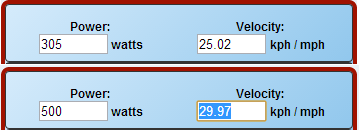
The difference in power needed to ride 25 mph vs 30 mph
So it takes apx. 300 watts to ride at 25 mph. To ride at 30 mph (just a 20% increase) you need to create over 60% more power. You can't make the power with additional leg speed – you're probably near your maximum efficient cadence already at 25 mph. To get to 30 mph you'll need to shift to a lower gear and push harder… A LOT HARDER!
Very different from the conventional friction system on an NXT – which (to me) feels like it gets easier to pedal, the faster I pedaled. In fact most of us can take what is a high level of load (at a slow cadence) and accelerate to the point where our legs spin-out and won't move any faster.
Side note: It's extremely rare to see someone riding with excessively high cadence on a magnetic resistance indoor cycle.
I've discussed this concept here in the past, but I couldn't prove or demonstrate it. I even went so far as contacting LOOK and Garmin to see if they would lend me a set of those new pedals with the built in power meter. They wouldn't and the crank arm from my FreeMotion doesn't fit on a NXT. It remained a mystery until now.
So while I was at the IHRSA convention, I finally had the chance to compare the new Blade Ion and the FreeMotion. With both cycles offering “measured power” I felt it would be a fair comparison; Magnetic vs Friction Resistance. Which best replicates riding outdoors?
Although I wasn't exactly “scientific” in my test protocol, nonetheless the results were very interesting.
Fun with graphs!
Here's what I did
My test was admittedly simple. After completing an early AM ride with Josh Taylor, I spent some time riding both the Spinner Blade Ion and FreeMotion S11.9. I began by establishing a steady 60 rpm cadence. Then I added resistance until the power meter showed 100 watts @ the 60 rpm. Then I accelerated to (and sustained) 90 rpm and took notes on what happened. I rode both cycles twice and the results were consistent. The blue Magnetic Watts line is more squiggly than the red Friction Watts line because I used the actual date set I downloaded directly from the FreeMotion's USB port.
I'd already tested the FreeMotion S11.9, so I knew that the 50% increase in cadence would result in a doubling of power. Perfectly consistent with my understanding of how Eddy Currents increase linearly with speed. A 50% increase in RPM = a 50% increase in resistance. Although math isn't my strong suit, it's easy to see how a 50% increase in Speed multiplied by a 50% increase in the amount of force required to turn the pedals = a 100% doubling in power/wattage. While not the same effect as what you'll find chasing down a breakaway at 27 mph, it is enough to force your students to work hard in a way that will help prepare them to hang with the “A” group.
The Spinner Blade Ion reflects the inherent weakness of using a friction pad with a heavy, perimeter weighted flywheel. The graph above clearly shows how the amount of resistance doesn't increase with additional speed – it actually goes down, validating what I had hoped to demonstrate. If it just stayed the same I should have observed 150 watts @ 90 rpm, I only saw 135 watts. So where did the other 15 watts disappear to? That's a math thing I'll leave to others smarter than me to answer. I will offer a guess that if I had continued on to 120 rpm, I would have seen a progressively lower increase in wattage vs what would be expected from a doubling of speed.
So what's this all mean?
Short answer – it's my opinion that magnetic resistance is superior in every way to a friction system. Besides being zero maintenance, the linear increase in resistance is much closer to what your participants will experience outdoors. Combined with the reduced inertia of the aluminum flywheel, magnetic cycles require more work to ride and force everyone to develop better pedaling technique. IMO the net results is that the members of your club or studio will (if they take advantage of it and you coach them properly) receive a more effective workout, that will translate to them becoming stronger outdoor cyclists.
So does that mean you wouldn't recomend the Spinner Blade Ion?
Not at all… it's an awesome cycle and that battery charger rocks. The purpose of this article was to demonstrate the differences so you can make an informed decision on your own. Besides, if you're a Spinning® studio, what other choice do you have?
P.S. If you're going to be at WSSC – I'd love for you to try and replicate my test on a Blade Ion for yourself. Then report back with what you find 🙂
John, I'm still confused by this power stuff… where should I be riding? How many watts should I be seeing on my monitor, because I'm no where close to my body weight?
I get questions similar to this frequently from members. My answers has evolved over time:
I used to give into the pressure; “please tell me a number” and would throw out a vague target – “your first goal could be seeing watts equal to your your body weight”.
Later I revised it down a little; “what would be your desired, lean body weight?” “Let's try to reach that as an early power goal.”
But now I'm learning that throwing out watts = body weight (lean or actual) isn't as helpful as I intended. Sure for some it works. Those who are reasonably fit looking (read not overweight) and with a good fitness base. For others I've found I was asking them to work too hard, using a kind of formula that wasn't personalized for each individual. Which sounds is a lot like using the 220 – age for MAX HR 🙁
Now my preference is to conduct a short “Best Effort”, about a quarter of the way through class, to give everyone an understanding of a number they can work from. Not a true FTP or PTP, but it's been reasonably well accepted… but not by everyone.
Case in point: last Thursday after class I had the “how many watts should I be making?” discussion with a female member. She's a fit 50 year old and I would guess (I never ask) she weighs about 130lbs.
So I asked her what she normally sees during the “Best Effort” interval. “I average about 80 watts.” Which confused me… a lot actually. I would have guessed she could easily make more than 80 watts. I was stuck for an answer. Rather than guess at the reason, I started asking questions:
Do you ride outdoors? No, not regularly.
Are you a runner? YES!! Big smile.
How would you compare running vs. cycling? Cycling is much easier. I'm getting to something here…
Do you run in competitive events like a 5k, 10k, Marathon, etc…? Another YES !!! I love to compete!!!
Do you run faster & harder in a 5k vs. a Marathon? Yes, of course I do – why?
When you're riding in here with me, does your “Best Effort” feel more like a 5k or a Marathon? She stopped to think about it and then said; like a Marathon.
Bingo!
I didn't need to say anything more. The look on her face told me she understood exactly where her confusion was coming from. Her perception of working hard was at her Marathon level of intensity = 80 watts was exactly right, figuring an aerobic level of effort. I had been making the assumption that when I asked for hard, everyone would work at the level I perceive as “hard” – which for her was different.
She ended the conversation with; so when you ask us for our “Best Effort”, I should be working at my 5k level of effort?
Exactly, or maybe a 5k where you're chasing one of your faster friends 🙂
My last blog post was ended with this statement: “This blog represents the first in a series that will be exploring power and how we can make it more accessible, more understandable, more reliable, and more straight forward to teach with.”
To live up to those lofty goals, as an outdoor coach, an indoor instructor, and in general a man dedicated to getting the science right, the only place I can start from is one of credibility and truth. In other words, however I am going to try and lead someone to apply power and ultimately teach with it, it must be done with reliable and repeatable techniques. This is my only hope of also producing reliable and repeatable results in both indoor cycling instructors as well as our students.
The variability of how the same power levels feel on different bikes (specifically the Keiser m3 that we have used predominantly for the last 5 years) is something that has actually prevented us from doing lots of more engaging and/or fun training in groups. I don’t want to push someone to work hard only to have the fact that they chose a “hard bike” today instead of the easy one be what determines their ultimate success in any competitive or group activity.
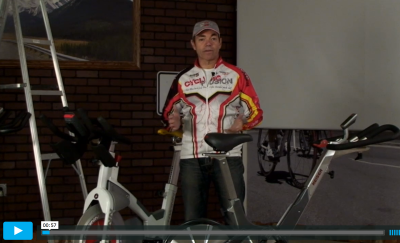
I knew that until there was a way to objectively verify what power I was pushing on the m3 I could not know what the truth was, and so I waited for an way to implement this objective measurement. It finally was made possible when the Garmin Vector power pedals were released. This video is the initial launch of this research study.
Video Agenda
After an initial introduction as to why I took on this huge research project, I show the details as to how the Vector Power Pedals were fit on each bike and the nitty gritty steps on calibrating these pedals before I could begin testing the bike. This calibration method had to be done for each bike, and repeated each time I repeated the test.
This video also is the first in a series of video blogs that will allow you to take this journey with me as I discover what is possible and what is not in the pursuit of establishing real power levels of the Keiser m3.
This is cool! Professional cyclist Alex Howes taught a class at the Peloton Cycle studio in Manhattan. This article explains how Alex taught what was only his second Indoor Cycling class. My guess is that he doesn't have a IC cert – not that it matters.[wlm_private ‘PRO-Platinum|PRO-Monthly|PRO-Gratis|PRO-Seasonal|Platinum-trial|Monthly-trial|PRO-Military|30-Days-of-PRO|90 Day PRO|Stages-Instructor|Schwinn-Instructor|Instructor-Bonus|28 Day Challenge']
He's a World Tour rider for Team Garmin Sharp, which means he races in the big international tours in Europe. This year, he placed third in the professional national road race championships in the US, and won a stage of the USA Pro Challenge in Colorado. In 2014 he finished the Tour de France, and last year, he completed the Vuelta a España.
Wednesday, he became a temporary spin[sic] instructor at the Peloton Cycle studio in Manhattan. It was his first time teaching a class and only his second time on a spin[sic] bike. You can usually find him doing six-hour training rides in Boulder, Colorado or his European base in Spain. He liked it though.
The author's description for the image above jumped out at me; We did a lot of standing work with high cadence, which is like running on a bike.
Is it just me, or were you also surprised that a Professional Cyclist would include high cadence out of the saddle work as part of a class he lead? I really wish I had known about this class because I was in NYC at the time. So even though I wasn't there, I am willing to formulate a hypothesis about why Alex chose to include this in his class: The stability of an indoor cycle creates a unique opportunity to train in a way that he felt would help everyone in his class – including himself. No one had told him that standing (a lot) with a high cadence (which by default can only be with light resistance) is wrong/contraindicated/inefficient/dangerous/etc… IMO Alex added these drills because they felt natural to him 🙂
Here's a short video showing his form.
This post got a strong reaction over on Facebook > It defies explanation how anyone could find fault with a Professional Cyclist guest teaching a cycling class… but they do. Incredible :([/wlm_private]
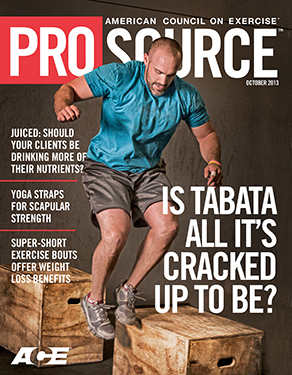
Image from http://www.acefitness.org/prosource/71/
I just read a press release and accompanying article from the ACE – The American Console on Exercise PRO SOURCE magazine about their study to gauge the effectiveness of High Intensity Training (HIT).
“It seems like everything high-intensity is now called Tabata Training,” says John Porcari, Ph.D., head of the Clinical Exercise Physiology Program at the University of Wisconsin, La Crosse. “The original Tabata study was done on a bicycle, but people are now doing that 20-second/10-second format with resistance training, plyometrics, calisthenics…with almost anything.”
Because of all of this recent interest in Tabata-style workouts, the American Council on Exercise enlisted Porcari and his research team to gauge just how effective a Tabata-style workout really is.
THE BOTTOM LINE
“The great thing about Tabata is it’s a short workout–only 20 minutes–and it incorporates your total body, so it’s working every muscle group that you possibly can,” says Embert, referring specifically to the Tabata-style workout she designed.
But what to do during the remainder of your 60 minute class?
There was a trainer at Life Time who told me years ago something I've never forgotten; First give them (your class) what they WANT… and then give them what they NEED.
The WANT he was referring to are very intense/anaerobic intervals. There's no secret sauce IMO at SoulCycle > they're just teaching very intense classes because they know that's what people WANT.
The NEED is for solid aerobic training. Not necessarily base building, but solid work below threshold HR / FTP.
Instructor Kathy Palkaninec was a past winner of our profile contest and her profile follows a similar WANT & NEED format.
You may want to announce your intentions to crush them (WANT) during a 20 minute Tabata round that will start fifteen minutes into class. Don't worry about telling them what follows. Keep everyone focused on doing their best effort during the Tabatas.
Give everyone a full 5 minutes or more of complete recovery. It's during this time that I talk about the “Golden Hour” and how most of us have 90 minutes where we can really perform well, before fatigue really limits our performance. The Golden Hour doesn't begin for most of us until ~30 minutes in. At the end of the recovery we're only @ the 40 minute mark of a 60 minute class and I explain how we're only 10 minutes into our Golden Hour – just now ready to perform. It's here where you can coach them through a 10 or more minute sub-threshold effort (NEED) to conclude the class. Here's where you can put that stage button to work if you have one – encourage everyone to ramp up to a big number, Stage Button, now maintain it by keeping your instantaneous wattage at or above the average 🙂
I have a friend, a very accomplished cyclist, who fancies himself a Ferrari. To look at Eddy you'd have to agree; he's long, lean and very sharp looking. But to ride with him may have you thinking more Peterbilt, than Ferrari. You see my friend is very strong and rides with a slow, powerful cadence. Many who ride with him remark; “the guy never shifts… he did the whole ride in one big gear.”
I'm finally continuing with this series, comparing the athletes in your class with the engine in their cars.
Let's explore the difference between small displacement > High RPM engines found in High Performance Sports cars and the large displacement > low RPM engines found in a Semi Tractor- Trailer or Lorie you see running down the highway. Then see if we can draw a a few correlations between them that would be interesting to the Gear Heads in your class… after all, if your class is anything like mine, you're beginning to see more men, now that it's getting cold outside.[wlm_private ‘PRO-Platinum|PRO-Monthly|PRO-Gratis|PRO-Seasonal|Platinum-trial|Monthly-trial|PRO-Military|30-Days-of-PRO|90 Day PRO|Stages-Instructor|Schwinn-Instructor|Instructor-Bonus|28 Day Challenge']
The F430 Ferrari is an incredible car. It will go zero to 60 in 4 seconds, a top speed of 200MPH and you can get one of your own for only $200,000 US. What moves this 3,200lb rocket, when you push on the “fly by wire” accelerator pedal, is a 4.3 liter gasoline engine that develops 483 horse power – once it is spinning at the maximum of 8,500 RPM.
A conservative choice for an engine in your new Peterbilt truck is a Cummins ISX15 diesel engine. This engine makes 485 horse power while turning a leisurely 2,200 RPM
So the F430 and the Peterbilt both have essentially the same horsepower (483 vs. 485) available to the driver.
What's the difference? Isn't Power… Power?
TORQUE
The Cummins engine creates 1,850 Ft Lbs of Torque, over 5 times that of the F430's puny 343 Ft Lbs, while only turning 1/4 the RPM. The Peterbilt needs all this Torque to move the combined tractor and trailer weight of a 50,000lbs up over a 6% grade. To create that Torque the Cummin's engine is massive (weighing over 3,000lbs – about the same as the whole F430) with huge pistons that are (you guessed it) about 4 times as large in diameter!
Torque in an engine is created by the force of combustion acting on the surface area of the piston. While there's a lot of other physics that go into the creation of Power, I'm reminded of an old racer's adage that goes something like; There's no replacement for displacement.
What's true in engines is true in humans… with all other things equal; bigger muscles can create bigger forces = more Torque. But Torque doesn't get you up the mountain – that's Power. So of two women of equal weight, the one with the biggest legs doesn't get to the top first.
The winner to the summit will be the one who can continuously make the most Power, for the duration of the climb.
My buddy Eddy, like most endurance athletes, is a student of himself. Over 10's of thousands of miles, he's learned exactly where his body makes the most Power, the most efficiently. In his case, he understands that his very strong legs work best while powering through at what many would say is too slow a cadence.
Fans of the Tour de France may remember the climbing battles between Lance Armstrong and Jan Ullrich – where the contrast between Lance's 90+ RPM and Jan's 60ish RPM had them climbing at the same speed = they (I'm assuming they have similar body weight) made the same amount of Power. The same Power that is, until Lance turned, looked, then accelerated to 100 RPM and dropped Jan due to his superior Volumetric Efficiency – ability of an engine to process Oxygen, by efficiently moving air through itself.
After all Lance Armstrong is truly a Ferrari – but that's a subject for another post.
A fun class you can offer (if you teach with Power/Watts) is to create a profile that includes a series of laddered efforts of increasing cadences – while maintaining a set percentage of FTP or some baseline wattage. The purpose of the class is to help each student find the RPM range where they are the most efficient, i.e are they a Ferrari or a Peterbilt?
Amy and I experience this every time we ride our Tandem. In His, Hers and Ours Audio PROfile we explore how different cadences can be used to create the same amount of Power, or ground speed, which is essentially the same thing.
You may choose to use only RPE or you could tie each step to a HR. Maybe you cue wattage as a multiple of body weight; Now everyone find their One Watt Per Lb wattage at 70 RPM. Now let's add 10 RPM and reduce resistance to stay at that wattage… after 3 minutes ask, what's the result? Do you feel like you are working harder? HR higher or lower?
This might be a fun exercise to use a few weeks ahead of an FTP assessment – where we first teach everyone their Natural Cadence (best efficiency) and then have them ride at that RPM during their assessment.
Sounds like a question for Cameron Chinatti – stay tuned…[/wlm_private]