With CEU credits being given, and accomplished indoor instructors being challenged, educated and motivated to train with power… I can confidently say we have the real deal. We spent 6 hours off the bike exploring the foundation, science and practical tools of Power Training, and 2 hrs on the bike putting theory into practice. Those that are fortunate enough to have power bikes to go back to, have not merely a few more arrows in their quiver, they have a whole new quiver. The others will have to do the work of change agents, and try to motivate their clubs to action, or find other places to train and/or teach.
With this post, I will begin a weekly posting of the bulk of what I covered in one intense day (as well as embellishments along the way). If you follow along, you’ll get “powerized” over time. As a member of ICI/PRO you will also be permitted to download a host of tools week to week, that I charge for on my Cycling Fusion site. This is part of the ICI/PRO pledge to provide value for your membership. As we move into the Winter months, we will switch to more Heart Zones training, but power will never be far behind.
Let’s start with the basics: What is Power, and Why Should I Care?
What is Power?
In cycling, (indoors or out) it is simply the product or combination of the torque applied to the crank arm, and the RPM or cadence of rotation; think resistance and cadence combined. It is measured in Watts, as the product is indeed energy, and it is manifested as speed — the more power you apply, the faster you will make the bike go. ICI/PRO Members continue reading here.
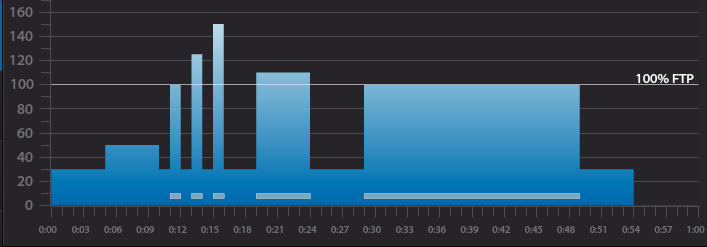
No more hunting for new music or counting out cues to develop your ride profile. Here is your ready to ride profile for a fully choreographed ride, that can be displayed from your phone, or printed out onto cue cards for your class. This ride is timed out, down to the second, to make your life as easy as possible!
As is customary, I’ve opened my big mouth and am faced with the proverbial “put up or shut up”. Don’t get me wrong, I’m not one to trash talk and overstate my abilities. However, I am one that is always challenging others to accomplish things they think are bigger than themselves; to push past their own perceived limits and discover things about themselves they never knew. Sounds all good so far, but I have a basic life philosophy that tends to get me in trouble. To wit, I believe that whatever you teach, you should experience first. Consequently, all my challenges to others end up first putting me to the test.
Way back in January when our annual Winter Training Program kicked off, each participant was required to have a goal to train for. Goals ranged from doing a 50 mile charity ride to having 2 separate peaks during the race season. For me however, having just finished filming the Pittsburgh Dirty Dozen as a charity project for Livestrong, and watching some of the strongest riders I know struggle just to finish, that event seemed to be the logical choice. So I said it, I would train to complete – NOT COMPETE – in the Pittsburgh Dirty Dozen Race.
Starting this weekend, I will have exactly 12 weeks to prepare for The Pittsburgh Dirty Dozen. I’m going to post my training plan (both Heart Zones® as well as Power Training), and pre-ride schedule on this blog for others in the Pittsburgh area who would like to train along with me. The training plan will provide some structure to follow even though we will train in different areas. Every 2 weeks I will take on at least 2 (or more) of the 13 climbs as part of the overall training plan as well. Exact times and dates will also be posted here so riders who want to share the pain can join me if they like.
Point of fact is: this IS a race. Point of reality is: only about 10 to 15 of the 180 riders that rode last year were strong enough to garner any points at all. The format of this “race” is that the entire field is together at the bottom of every hill, and then the organizer, Danny Chew blows the whistle (by the way, someone needs to buy him a new whistle this year, it was sketchy at best last year), and the first 5 riders to the top get points.
While a few supermen and wonder women surge to the top like they have hidden motors in their bikes, the rest of the field climb at varying speeds, with an inevitable group on every hill pushing their way if they can’t maintain at least 4 to 5 mph. In surveying the group last year, it was clear that a lot of the field were experienced amateur racers, and that this was not bringing out the average casual rider. So when I say people were pushing, and there are always people pushing, it does not mean they were weak or inexperienced riders.
The graphic above is from the training DVD we created (Global Ride Productions) from last year’s race. It is slated to be released in 2 to 3 weeks, just in time to mix up some great indoor cycling with the outdoor application. Stay tuned, as I will endeavor to keep this updated once per week as we head towards this epic event.
“Why do I make less power (fewer watts) standing, then when I'm seated?”
This a a great question that we get often. I loved John's answer, and so I have done a few edits and present it here….. Joey
A great questions from one of the riders in a Performance Cycle class. An observation that shows he's paying attention plus it gives me the chance to clear this up, so you can properly explain this anomaly to your participants.
The short answer is you don't* If resistance and cadence remains the same, in or out of the saddle doesn't matter. The amount of power/watts you are creating doesn't change… because it can't.
The bike decides the right amount of power
You know that Power = Force x Cadence. So let's assume this participant is riding seated and pedaling @80RPM. Their resistance is set to a level that results in the console display showing 150 watts.
Our legs create the perfect amount of force required to get the job done, which in this instance is overcoming the resistance to pedal @ 80RPM. If your resistance setting on the cycle requires “X” amount of force to push down the pedal, your muscles will create exactly “X” – no extra force is created and no less. The combination of that force, multiplied by a cadence of 80 RPM results in the power meter showing 150 watts.
In fact there's an actual law of physics that says that it's impossible to get the same amount of power out of a machine with a reduced amount of power added into it – which is why I'm saying the amount of power/watts you are creating stays exactly the same, if you make no change other than to stand and ride out of the saddle.
“But then why does the power meter show my watts lower, when I'm standing.”
My response was; “you're right it does and there's a simple answer why…
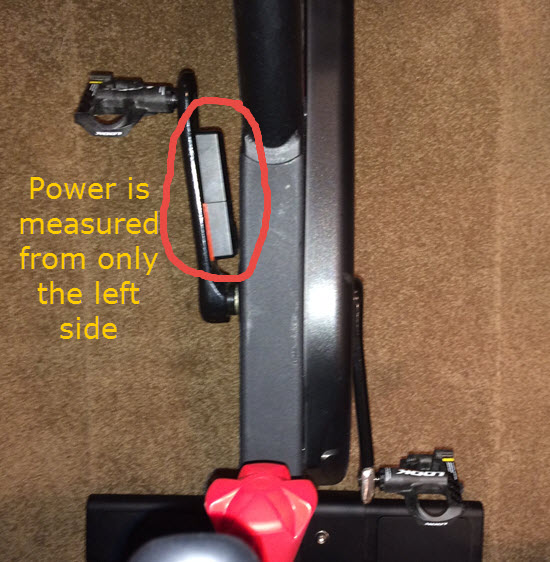
Let me begin with the basics. I teach at a Life Time Fitness Athletic Club and we ride FreeMotion S11.9 with the Carbon Drive belts. FreeMotion's measure power only through the left crankarm as you can see here.
This is my personal S11.0 (the home version) which is why it's black and not the normal silver color. The electronics are identical across all models.
Yes, the meter shows a drop in power…
Many of us who teach or ride on this Indoor Cycle have noticed that the power meter will show a lower wattage number when you transition out of the saddle, without giving any thought as to why. As I explained above, it shouldn't > the wattage number should remain the same. Again; Power is equal to force times cadence. If you didn't change the resistance setting, and you're maintaining the same cadence, the power meter should continue to show the same wattage… but it doesn't because >>>> your legs aren't the same strength.
Your dominate (stronger) leg does more work
The force required to pedal is divided between your two legs – but not equally. Because many (if not all) of us have one leg that's stronger than the other, our brains automatically proportion the amount of force from each. Remember: our legs only create exactly what's needed. Unless you consciously choose otherwise > more force is unconsciously asked from the stronger leg and the opposite leg adds what's left, equaling the total required.
Some quick research showed me that it's very common for one leg to be stronger in most people. Your dominant/stronger leg is typically the same as your writing hand. Since ~90% of people are right handed, the majority of your class will be seeing lower wattages when the come out of the saddle > because they are doing more work with their right leg. The FreeMotion's left hand power meter sensors are seeing a lower amount, of the total amount of work, as coming from your left leg.
Because this IC can only sense force on the left side, when you stand your stronger leg carries a greater percentage of your body weight = the wattages appear lower.
So standing or seated at the same cadence, you continue to create the exact same amount of power. It's just that the power meter doesn't see all of it and displays the reduced amount = the misperception that we create less power standing… which you now understand isn't true 🙂
Make this a feature (not a bug) in your class
Since the Freemotion can show leg strength disparity, why not use it as a training tool?
Novel idea, right?
Start by teaching everyone which leg is their stronger/dominate leg. The simplest way I know is by doing Step-Ups on a box or step raised to the proper level as shown in this short video.
This exercise was eye opening to me, when we did them in Boot Camp. Learning that my right leg is considerably stronger, I'm now really focusing on making my left leg do more work. Hopefully over time, a stronger left leg will result in me having a higher FTP and greater overall muscular endurance.
I suggest having your riders do this as an after class activity > or you could bring a box into your studio and have everyone take a turn.
Using a pair of reasonably sized dumbbells, perform 8-12 reps all on one side and then the other. It should be quickly apparent which (or if) they have a leg strength disparity.
We'll explore drills to exploit this feature and help riders train their weaker leg in future posts! [/wlm_private]
* I'm not referring to pedaling efficiency here, which is a completely different subject.
** Please let me know if this isn't clear, if I've confused you or you have an alternate method of explaining this.
Over the last 2 years I've been performing a FTP (Functional Threshold Power) test on the first Thursday and Friday of every month in every facility I teach in that has bikes with power. I have yet to have anyone complain or comment that I test too often or that the 20 minute FTP effort is too hard. What I have been told is how much people like knowing their threshold numbers and how much they enjoy the challenge of the test.
Last week I was involved in a conversation on Facebook where some indoor cycling instructors were discussing various ways to estimate FTP with their class. My response was “Why estimate it when you can perform a REAL test and get some REAL FTP numbers?”. Some of the responses I got back were that the test is “too hard”, “too long”, “too complicated”, “newbies might get scared away”, or “some people just want to ride and not focus on numbers”. I was, quite frankly, shocked by the lack of confidence these instructors had in their class participants. If we, as instructors, don't have the confidence that our riders are strong, tough and smart enough to handle and understand the benefits of a FTP test, this doubt will quickly turn into a self-fullfiliing prophecy and class participants will never reach their full potential.
I believe the best instructors don't only know the science of exercise physiology but are also masters of physicology and expert motivators. It is our job to show each and every rider the respect they deserve by having the faith that they are capable of completing any physical task we ask of them. I am in constant awe of what my riders are capable of, they impress me every day, but amaze me on FTP days.
Bikes with power are becoming the norm in most indoor cycling facilities. This new technology will keep riding a bike that goes nowhere in the forefront of group exercise for years to come. If your facility is going to invest in these state of the art bikes, instructors and facility mangers should program regular FTP tests so they can be used to their fullest capabilities and riders can be aware of their current fitness levels, set up proper training zones and track improvement over time. The use of power can be a bit confusing at first, but after performing a FTP test most riders quickly gain an understanding of their maximum sustainable intensity or threshold wattage.
Believe in your students and they will surprise you, doubt your students and they will affirm you.
Here are some links to articles I have written about FTP and Threshold over the years. My testing profile may have changed slightly but the science is still the same.
Full articles are only available to ICI/Pro members.