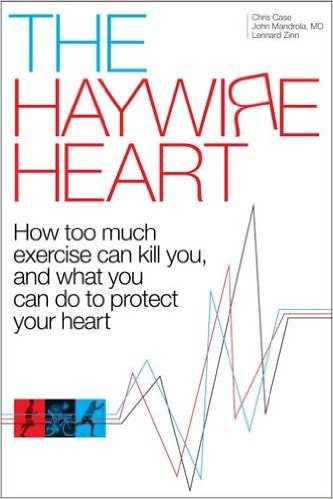
Beyond listening to our discussion below, you can get a Cliffsnotes understanding by reading Chris' original article, Cycling To Extremes, that was developed into his book.
Are endurance athletes hurting their hearts by repeatedly pushing beyond what is normal?
The sun was bright upon the upturned redrock Flatirons above Boulder, Colorado. It was a beautiful July morning in 2013. Lennard Zinn, a world-renowned technical cycling guru, founder of Zinn Cycles, longtime member of the VeloNews staff, lover of long rides, and a former member of the U.S. national cycling team, was riding hard up his beloved Flagstaff Mountain, a ride he had done a thousand times before. But this time, it was different.
His life was about to change forever.
When his heart began to flop like a fish in his chest, and his heart rate jumped from 155 to 218 beats per minute and stayed pegged there, his first reaction was simple: “I went into denial.”
He arrived to the ER that afternoon and was later brought via ambulance to the main cardiac unit for an overnight stay. Though he trusted the cardiologists and the ER doctor, he doubted their warnings. His denial was strong.
After following their recommendations for rest, he returned to training; the electrodes glued to his chest and the telemetric EKG unit dangling around his neck didn’t disrupt his routine. But the annoying episodes happening with increasing frequency during his more intense rides did. The flopping fish would return as his heart rate spiked. More upsetting was the phone call in the middle of the night from a faraway nurse who had been watching his EKG readings and had some shocking news: His heart had stopped for a few seconds.
Listen to the Podcast here – and then be sure to order and read this book. Then share what you've learned with your classes. You just might save someone's life!
In a previous post that I co-wrote with Jim Karanas, we described specific physiological adaptations of aerobic — aka cardio or endurance — training.
As you may recall, they include increases in blood volume, tidal volume, and stroke volume. The capillary network increases, as well, as do the size and number of mitochondria. Other changes also occur, but these are the ones that move oxygen to the working muscle.
Recent research has shown that endurance/cardio exercise — not strength work or interval training — can make rodent brains bigger.
Okay, forget how much that last part sounds like the plot of a 1950 sci-fi film. Let’s look at other research.
A long-term study followed 1,583 middle-aged men and women with no personal history of either dementia or heart disease over 2 decades. Before-and-after tests done 20 years apart showed that the ones who had kept in shape tended to have larger brains, while the poorly conditioned participants had lost gray matter.
Holding on to gray matter prevents cognitive decline and decreases the risk for dementia. No specific type of exercise was explored in that study, however.
And that leads us to the long-raging debate over Cardio and High-Intensity Interval Training (HIIT).
HIIT Advocates Always Stack the Deck
Let me be clear: I have absolutely nothing against high-intensity intervals. I use them often in my own workouts and when teaching.
But something interesting occurs when staunch advocates of HIIT compare the relative benefits of HIIT with those of standard cardio.
They tend to cheat.
In the hands of the die-hard HIIT fan, the word “cardio” has become code for lame-o exercise at the lowest levels of intensity. It should come as no surprise that the benefits — if any — of such lame workouts would fall far short of the benefits of HIIT.
And no one challenges the criteria. So let’s challenge them.
You Can Go Hard AND Long
It’s simply not true that intense training must involve short intervals of, say, 20 to 60 seconds. If you train well aerobically — and train seriously enough to achieve the aerobic benefits above — you can maintain a high level of work for a pretty long time.
HIIT advocates seem to ignore the fact that elite marathon runners, for example, run faster than 5-minute-mile pace for 26.2 miles. Most people would find it difficult, if not impossible, to run a single 5-minute mile. It’s a fast pace. Elite marathoners go faster than that for a couple of hours.
As Matt Fitzgerald — well-known marathoner, trainer, and author of several books and many articles — states, “well-trained endurance athletes really don’t have to slow down much as they increase the duration of their efforts. We are not the folks reading magazines on elliptical trainers.”
I’m the furthest thing from an elite athlete you can find, but even I have done a couple of cycling time-trials on Mt. Diablo. The first one took me 44 minutes at a consistent heart rate of 173 — quite high for me, making the climb a combination of hard and long. (Okay, I told you I’m no elite athlete.)
The training combination that appeals to me most is to fit a set of about 8 intense intervals into a long training of moderate or moderately high intensity.
It’s not just my personal preference, though. Evolutionary evidence suggests that this way of training is precisely what we were always meant to do.
(Part 2 will explore the evolutionary reasons that this is what we’re meant to do.)
The USA Women won the World Cup finals in soccer yesterday!
The US team coaches are using heart rate training, aka Heart Zones Training, extensively in their preparation for what lead to this victory.
I wanted to share with you an article released yesterday about how that training is accomplished using training load points and player position specificity – and comments that I made in that regard in the article. You can read it here.
While members of the U.S. team will no doubt play their hearts out during the Women's World Cup final against Japan, a coach on the sideline will be receiving real-time data about their actual hearts.
Credit forward-thinking coaches who embraced sport science to improve performance: Each U.S. player wears a heart rate monitor — not unlike one you'd find at your local sporting goods store — when she trains and plays games.
But what makes these special is where the information goes and how it's used. Whereas a commercial monitor (or “wearable”) is designed for information to go to a wrist unit, an iPhone or iPad, and be used by the individual, for the U.S. women, there is a receiver that simultaneously collects the heart rates of 28 athletes to be analyzed by a coach.
[That “receiver” is the same as what's used to connect participants to the Display Training systems in cycling studios – John]
“What evolved [with the technology] was the ability for coaches to not only record the data, but be able to see it live,” says Josh Simonsen, a training specialist for Polar, the company that supplies the U.S. team with its heart rate system.
The data shows how hard a player is working, and can help a fitness coach determine everything from individualized training programs to deciding how much rest a player needs after a tough game. “If you take the women's national team, they're all fit. But it comes down to what type of fitness each player has,” Simonsen says.
What type of position an athlete plays also makes a difference, explains Sally Edwards, a heart rate expert and founder and CEO of Heart Zones, a fitness technology company. “In team sports, each player's position has unique physiological requirements, so the forward on a soccer team has to have different training than a defender,” says Edwards. “Some positions might need quick acceleration. Others might need endurance late in the game.”
With the use of sensor technology, a training program can be tailored to each player to make the fit even fitter.
If you'd like to learn more about this technology and how it could improve your team's performance, Use this contact form to request more information.
Sally
Sally Edwards, Founder and Head Heart
Heart Zones, Inc.
Hey [wlm_firstname] how hard should I be working to; get faster, lose weight, build endurance, ect…
Answering that is the age old dilemma many of us face when questioned by our riders. We try to be helpful by offering subjective descriptions of what both thresholds should feel like. We give breathing cues, run special FTP classes and/or include Best Effort intervals into our class. They're all designed to help our participants discover (for themselves) their threshold hearts rates and/or threshold wattages. We can get close… but at the end of the day they're still subjective measurements = not always as accurate as we would like.
Breathing gas exchange monitors can scientifically measure the two thresholds. Systems like those from New Leaf and Korr can objectively measure the changes in our breathing levels of O2 and CO2. They work well, but are very expensive to own (you can no longer purchase a New Leaf cart, now that they were purchased by Life Time Fitness) and individual metabolic testing can run to $200.00 or more. The actual tests are rather unpleasant, requiring you to wear a very uncomfortable mask – trust me on this > I've had over a dozen tests and would dread doing another.
The only other option was blood lactate testing during a graded exercise test at a university or sports performance center. Here they prick your finger every two or three minutes, while you work to failure during the assessment. I haven't done one of these personally, but it sounds equally unpleasant.
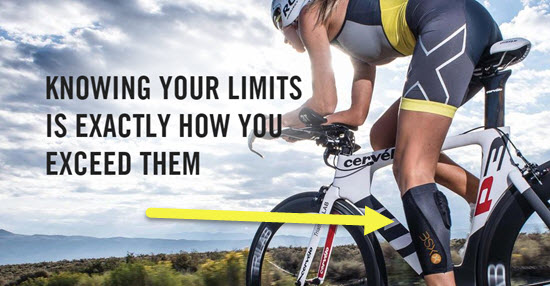
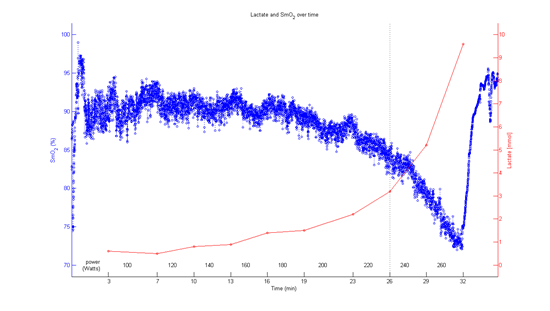
Enter the new BSXinsight – a wearable device that optically measures your O2 levels = this could be exactly what all of us training athletes were looking for. Pictured above, the BSXinsight is positioned on your calf using a compression sleeve. It wirelessly communicates with a smart phone and the data is displayed by (you guessed it) their special app.
Don't just listen to your body, look inside it.
Data and gear are only as good as their ability to improve your riding. Now you can access the most powerful training metric in endurance sports, making every mile more effective and putting every piece of technology you already use into valuable perspective.
BSXinsight uses revolutionary technology that allows you to see inside your muscle, measuring your lactate threshold and generating personalized training zones. Stop trying to “feel” whether you’re pushing too hard or leaving too much in the tank and let the science of your body speak to you.
Clearly identifying LT2 threshold
I just finished a fascinating conversation with one of the principals of the company. They have offered to send me a demo BSXinsight to experiment with. When I'm done I'll be sending it to Dennis Mellon for his feedback. Once we are done accurately learning our own LT and overlaying it with our Heart Rates and wattages, we will record an episode with the company spokesperson so we can share what we've learned with all of you.
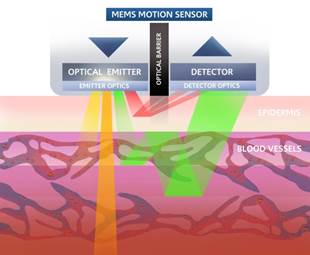
The Scosche armband heart rate strap uses optical sensors to “see” the pulses of blood flow in the blood vessels in your arm. Groundbreaking technology and pretty cool stuff if you ask me. Anything to get rid of those monitor chest straps will be an improvement. I feel this will result in a greater number of people training more effectively. You can read an earlier post where I describe the Scosche as possibly the best heart rate monitor strap option for participants in our classes that include any of the new Indoor Cycles with power consoles – except the Keiser M3 or M3i.
The new Apple iWatch uses the same optical sensor technology and it will be interesting to see how the two match up.
Jon Ham is a fitness consultant to Scosche and has written a detailed comparison between what he sees as the differences between the Scosche and the iWatch. You can read it here. [Understand that Jon's comments about the iWatch are based on information provided by Apple – the iWatch isn't available for purchase yet.]
As a side note, I've been trading emails with a former Schwinn Master Trainer who's involved in the iWatch project and (fingers crossed) I hope to interview him about the fitness applications of the iWatch once it's released.
The part I found most interesting in Jon's article was the part about data collection
Is the Apple Watch Designed to be a Continuous Heart Rate Monitor for intense exercise?
The way I saw it, In Tim Cook’s presentation, the Apple Watch was shown to be an excellent Activity/Life monitor, where movement, lifestyle, and general health were emphasized, and not heart rate training. I could be wrong, but I think Apple knows heart rate is not going to be super accurate during exercise with the Apple Watch, therefore they built the Watch around making a great interface for activity monitoring – IE: how often you stand up throughout the day, pedometer information, etc. This will surely play out to be a thorn in the side of FitBit and other activity monitors, but I don’t think it poses a threat to serious heart rate training athletes.
Data Centralization
I think Apple knows their job is to centralize the data collected from accurate sensors, not to necessarily create the sensor itself – except for activity monitoring. For example, Health Kit will allow all connected apps to push data that has been collected from different sensors directly into Apple’s Health App. I don’t see Apple getting into the Blood Pressure monitor or blood glucose monitor business any time soon, but apps that monitor blood pressure and blood glucose can push their data to Apple Health. I DO like the way the Apple Health App will centralize that information into one health app, along with other health related metrics. It makes sense to have all that data in one centralized location. The bottom line is that you should be able to use other heart rate sensors to do your workout and gather accurate data, you won’t be confined to only using the Apple Watch to collect accurate heart rate data.
Time will tell if Jon is accurate about this and if so, there's a chance we'll want to be wearing both an iWatch and a Scosche armband when we exercise.
Finally a Heart Rate strap with both Bluetooth and Ant+ connectivity 🙂
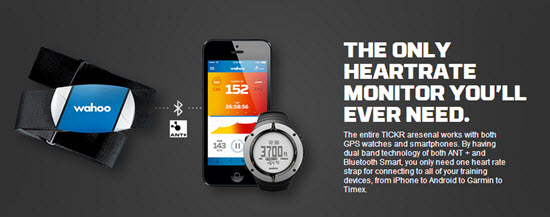
I've been using a new TICKER Heart Rate Monitor straps – I'm excited to tell you about them + they'll be awesome used with the new Apple Smartwatch.
The guys at Wahoo Fitness emailed me today about their new line of HR straps that send out both BLE (Bluetooth Low Energy) and Ant+ frequencies. About time someone thought to offer both in the same monitor strap!
Up until now, your decision about what monitor strap to purchase was based on what device you wanted to connect with:
I want to connect to my iPhone / smart phone = you buy a bluetooth strap. Bluetooth is the only signal your phone can pair with.
I want to connect to a Garmin bike computer or use the strap with Performance IQ's display system = you purchase an ANT+ strap.
This new TICKR strap has both Bluetooth and ANT+ and it doesn't cost anymore than most single frequency straps – that's awesome in my book!
They've solved a second problem
How many times have you felt like saying; “IS THIS DAMN THING ON?
No Heart Rate strap, that I've ever seen, gives you any understanding that it's working. Is the battery good or dead? Do I need more spit to get it connected? I'm seeing that these new TICKR straps have two colored LED lights to show the TICKR’s device connection and heart rate detection – more awesomeness – and no more wasted trips to Walgreen's to buy one of those ridiculously expensive little flat batteries, when that isn't the problem.
I can't wait to try one and will update you once I have.