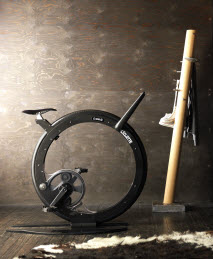
The Ciclotte is a design concept Indoor Cycle that has a lot of appeal to me. Can't you see a whole room of these in some edgy uptown Manhattan club? Where they have a bouncer in full kit standing at the door checking to see if you are the “right kind of people” before giving you the privilege of attending the class. I wonder what you could charge…
Based on their description the Ciclotte uses a magnetic resistance system just like the Keiser M3 and Schwinn A.C. Performance
Scosche RHYTHM+ Heart Rate Monitor Strap works with ANT+ and BLE devices and consoles.
I'm thinking this new Scosche RHYTHM+ Heart Rate monitor strap could be the best I've ever tested – for a bunch of reasons that include removing what I feel has always been one of the biggest objections to wearing a HR strap.
Despite all of our collective efforts explaining the benefits of training in specific heart rate zones, we're lucky if we have 30% of our participants monitoring their heart rate. I know that some classes are better than that, but based on all of the surveys I've done in the past that's about where we are.
Why?
If I put on my salesman's hat, I know that people don't buy a product or service for lot's of reasons. Salespeople call these objections. If you want to make the sale, you typically need to remove or minimise the prospect's objections; who in this instance is our class participant.
So what are the often stated objections?
No interest – it's almost impossible to sell anything to someone with no interest.
Too expensive – for relatively lowpriced objects like an $80 HR monitor, the selling price objection is often masking some other issue – or – means the prospect isn't seeing enough benefit.
Too complicated – do the manufactures of HR monitors actually use their own products? Setting the typical Polar watch is needlessly complicated. I've gotten to the point where I refuse to help people set their HR watches before or after class because I can't get sucked into a 30 minute project where, more often than not, I'll fail. See #5
Too confusing – as an industry, with all of the branded zone based training systems, we've made heart rate training impossibly confusing for new participants. IMO if you're talking about anything more than three zones based on thresholds, you've lost many of your club athletes. See #5
Too stressful – It's stressful to me when I'm offered a coupon the grocery store, good for my next visit. Why? Because then I'll have to remember the coupon the next time I'm there – which I won't when the cashier asks me; “do you have any coupons?” Our members aren't any different than me or you: getting to class on time is stressful enough. I don't need the added stress of remembering my HR monitor… finding both of my shoes is tough enough. See #8 for the source of even more stress.
Willful ignorance – face it, there are people in your class who want to believe they're burning 1,000 calories in a 45 minute class, where they don't break a sweat. You'll never sell these people on any form of performance measurement (these are the peeps who cover their power console so they can't see their wattage) unless you're running a special on unicorn spit detox syrup.
Uncomfortable – the old versions of hard plastic HR chest straps were very uncomfortable. The new soft straps are an improvement – but they are still not pleasant to wear. Many women won't even think of wearing a HR strap for anatomical reasons. Then there's the other type of uncomfortable as in; “I'm not comfortable opening my shirt to put this strap on, with other people around” 🙁
Unreliable – how many times have you found yourself thinking; IS THIS THING ON? Is the strap battery dead? Maybe I need some additional spit on it? Do I need to shave a horizontal stripe across my hairy chest to get this thing to connect? Wait, who's BPM am I seeing here?
That's 8 realistic reasons why you see so few people wearing a HR strap. The new Scosche RHYTHM+ Heart Rate monitor strap addresses many of the objections I've listed above:
Not complicated – the HR watch is the source of most of the confusion. No watch = no confusion. The RHYTHM+ pairs easily with any bluetooth device (iPhone / Android) using any fitness App that has a HR function. It also pairs with ANT+ monitor consoles found on the Schwinn AC, FreeMotion S series and Spinner Blade Ion. Sorry – the RHYTHM+ doesn't connect with the Keiser M3.
Removes a little stress – It's so small that I can tuck it into my shoe. So if I find both I've also got my HR strap 🙂
Super comfortable – just slide it onto your forearm. Because it uses optical sensors it doesn't need to be moistened and it's not affected by hairy arms. And no one will feel embarrassed when they put it on.
Better reliability – there's a little red light that shines when it's on and it comes with a USB charger.
You'll find more info about the Scosche RHYTHM+ Heart Rate monitor strap here.
Star Trac had the new Spinner® Blade Ion on display at IHRSA. I rode one during Josh Taylor's 6:30 am demonstration ride this past Thursday. After the class I discussed the Ion's new features with Josh. I then got an overview of Spinning's new Spinpower™ education from Program Director Angie Sturtevant, which I'll share as a separate article.
Basics
The “Ion” differentiates this bike with Power from the conventional Spinner Blade. It uses the same chain drive and friction resistance system, found on all Spinner® Indoor Cycles.
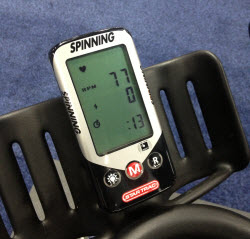
Console / Monitor
Very simple… and I'm a huge fan of simple, so right away I appreciated how easy it was to use the Ion's console. I was told they are making a few minor changes so the final version may look different. Working down from the top, the display shows:
Heart Rate
Cadence
Power
Elapsed Time
Just three buttons
Left button turns the back-light on/off. It doesn't time out because it doesn't need to preserve battery life. It will stay on until you want it dark or you stop pedaling. I might not have this completely right – but you get the point – the light will shine all class 🙂
Center button scrolls through screens displaying; real time and averages + calories
Hold down the Right button for 2 seconds resets the Elapsed Time – Josh explained that this button will also add a “digital marker” to any Ant+ enabled devise, identifying the beginning or end of an interval, similar to the “Stage” button found on other consoles.
Josh made the point during his demo ride that their console will show ZERO watts when there's no resistance, regardless of the cadence = this will show all of our “spinners” that they aren't doing any real work until they've added some load.
Free Registration Required to read the rest — Click Here. Opens in a new tab.
[wlm_ismember]
Measured Power
Strain gauge measures the amount of pull on the brake pad.
The Blade Ion measures power with a strain gauge connected to the brake pad – again more simplicity. This technique is actually over 100 years old and how the horsepower of early engines was measured; by measuring the force acting on the brake, as the flywheel tries to drag the brake around it's circumference.
If you have an NXT available you can see exactly what they are doing. Remove any resistance and start the pedals turning slowly. Now carefully touch the slowly turning flywheel with one finger. Feel how it wants to drag your finger along? Can you see how the harder you press against the flywheel, the more effort it takes to hold your finger in place? By measuring that force, the speed of the rotating flywheel and then doing a bit of math, we could calculate Power.
That Black Box contains the strain gauge and replaces the normal brake pad holder on the standard Blade or NXT – which begs the question; will they ever offer a retrofit power meter for older NXT's?
What about Calibration?
I was told that the Ion will be factory calibrated and that no other calibration will be necessary – which I find very hard to believe.
This isn't the right time to get into a lengthy discussion over what I see as fundamental differences between; how the Ion measures the amount of Power coming out vs. how FreeMotion (and also any bicycle crank arm/spider or pedal based power meter) is measuring the amount of Power the rider is putting into the cycle. Or if it's really of any value…
So I don't leave you hanging here, the factory calibration may indeed accurately display the amount of coming out of the Ion forever… but does that precisely reflect the amount of power the rider is putting into the cycle?
What I'm questioning is there's a lot of drive train (multiple bearings and the chain) between the pedals (work in) and the brake mechanism (work out). This engineering article describes the efficiency of bicycle chain drive system and how losses can vary between 2% and 20%. I'm sure Star Trac's engineers have a very sophisticated algorithm to work all this out on a new Ion – but what happens over time? Worn chains and bearings, sprocket alignment and chain tension will all have an effect. Potentially some of the Ion's in your studio could become favorites because they display a higher wattage, relativity to the amount of work introduced by the rider, simply because its chain is in better alignment. Does that make sense?
No Batteries Required
Angie said she likes this because it's “green” (no batteries to throw out) – this blue light is a very cool touch.
Hands down my favorite feature of the Ion is how it charges itself. Josh told me that it incorporates a smart charging system that will allow the batteries to discharge before recharging. That wire runs from the hub charging unit & cadence counter up to the handle bars.
Phone cord allows adjustment.
How it felt to ride & my overall reaction.
Adding a cool blue Instructor platform will be de rigueur for any studio with Blade Ions
Let me start by saying Star Trac makes a phenomenal Indoor Cycle. Solid and smooth – I'm sure Jeff Wimmer had his hands on these. They fit me perfectly – or after riding & teaching on them for all these years do I fit them perfectly? Either way they're very nice to ride… and you hear the yeah-but coming… but I've really become a fan of magnetic resistance over the past 4 years. I understand how Spinning's® brand goes to the “feel” of a Spinner® and that “feel” comes in part from a friction based resistance system. I prefer riding magnetic and was disappointed that the Ion still uses a friction brake.
I also felt weak/less powerful on the Spinner Blade Ion. Or said differently, for a given amount of effort, I was seeing a lower wattage number than I'm used to seeing from a recently calibrated FreeMotion or a Schwinn AC. You could add embarrassed to my list of feelings. I actually felt compelled to cover my readings while Josh was off the bike checking in with his class 🙁
Thinking it may just be me, I went directly to FreeMotion's area and jumped into a class with Cameron Chinatti. Nope, it wasn't me. There on a familiar cycle, I was seeing/feeling my normal ~250 FTP. So back to the Ion (different bike this time) but the same results. A similar effort/HR and only saw ~180 watts.
I talked to Angie about this and she suggested that you just can't compare the two, they're different. I've asked Angie to join me on the Podcast to discuss this in detail and will let you know if/when she'll come on as a guest.
Later that morning I also tried a little experiment that I've wanted to do for years…
What happens to your Power / Wattage when you accelerate from a set point, say; 100 watts @ 60 rpm to 90 rpm on friction based system, as compared to a magnetic system? Do they react the same way?
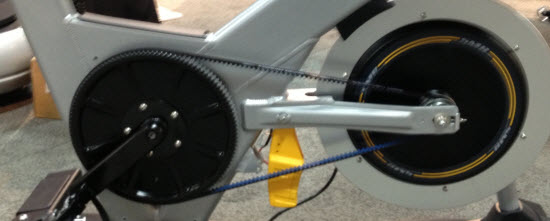
Minimal required maintenance – the belt doesn't stretch and you never need to lube it.
Should last forever
Did I mention that it's very quiet?
Weaknesses
More expensive than a chain drive
It may require the pedal crankarms be spaced further apart = wider “Q-factor”
That's all I can think of.
Disclaimer and perspective: I have taught on the FreeMotion S11.9 for the past year at two Life Time Fitness clubs. I train at home on a S11.0 (the home trainer) that was given to me for evaluation purposes.
My only real complaint with the original chain drive FreeMotion S11 series Indoor Cycles has been the amount of chain noise coming from the drive system. That noise, multiplied by 50 or more cycles in a class (or just one in a basement) can be very distracting/unsettling/frenetic and it requires much more volume of both you and your music.
If you've every experienced how calm/relaxed a class with belt driven cycles is, you'll understand exactly what I'm talking about.
Where does this additional noise comes from? It's from the chain wrapping around very small front sprocket used to rotate the flywheel at a much higher RPM than on a friction IC.
Big drive gear x small driven gear = very fast flywheel RPM
All Indoor Cycles use some form of weighted flywheel to mimic the momentum of riding a bicycle. Cycles with magnetic (Eddy Current) resistance (FreeMotion S11.x, Keiser M3 & Schwinn AC) all use an aluminum (or combination aluminum/steel) flywheel. All steel alone won't work when you're using Eddy Currents to create resistance.
Aluminum is lighter than steel = less mass = less rotating momentum. Also the design of the combination flywheels has the “steel” portion closer to the hub, resulting in less mass around the perimeter of the flywheel. The flywheel needs to rotate quite fast to create enough of these “Eddy Current's” to make the requested resistance, which is good because this additional speed makes up for the aluminum's lack of mass. The gear ratio (big crankshaft gear x small flywheel gear) needed to achieve this flywheel speed = additional chain noise.
By using a belt, instead of a chain, FreeMotion has eliminated the noise problem… but all belts are not the same…
There are a number of popular Indoor Cycles using a belt drive system; Keiser M3, Livestrong/Tomahawk and the LeMond RevMaster. All of these cycles all use a Kevlar belt – perfect for most people, except for the cyclists in your class. For them, these Kevlar belts feel very foreign. They don't “feel” like a bicycle because chains create a vibration as it rolls across the sprockets and that vibration is missing from a super smooth Kevlar belt.
I'm sure that Gates did a bunch of research and testing when they developed the Carbon Drive system as a replacement for bicycle chains. Their success (I'm presuming here) would be dependent on creating a replacement for a chain that eliminated all the negatives; maintenance, wear, weight, grease and noise – while retaining the familiar feel of riding a bicycle. The “teeth” of the carbon belt, as it rolls across the pulleys, create a similar vibration to a chain = the “feel” of a bicycle, W/O any of the negatives of a chain.
Welcome to the Indoor Cycle Instructor Podcast | ICI/PRO Premium Education free podcast. This episode was recorded live in San Diego CA by Amy and Joey while at the 2019 IHRSA Event. This episode is a general commentary on the show and a brief rundown of the people that we connected with at the show. We will have several more indepth episodes with Amy and Joey and then several episodes with the indiviuals and their companies throughout the year.
I used Epic Planet's video Epic Acadia this morning in a class I subbed. Because these early AM people are very committed and they all understand the value of Threshold based training, I knew I could lead them on a ride that included a 20 minute climb at (or very near) Threshold. The first 30 minutes are a perfect warm up with a number of short climbs I used to bring them to Threshold before we got to the climb. The graphical representation of where you are during the class is the best of any of the DVD creators that I have experienced, although I'm not completely sure what TZ 4-5 means. I assume TZ stands for Training Zone and if we only had a universal standard for what TZ stood for …






 Welcome to the Indoor Cycle Instructor Podcast | ICI/PRO Premium Education free podcast. This episode was recorded live in San Diego CA by Amy and Joey while at the 2019 IHRSA Event. This episode is a general commentary on the show and a brief rundown of the people that we connected with at the show. We will have several more indepth episodes with Amy and Joey and then several episodes with the indiviuals and their companies throughout the year.


