Doug Rusho, Master Instructor with Stages Indoor Cycle provides our latest Audio PROfile: Winch and Plummet
Objectives:
#1: Students will experience the contrast between resistance and cadence, as it relates to steady state power production.
#2: Students will begin to discover what resistance/cadence combination is most efficient for their physiological make up.
Key take away from Doug: In order to improve fitness we must continually challenge the body with new situations. Everyone has a “comfort zone” resistance/cadence combination when producing power. This profile encourages students to step a little outside their comfort zone for a diverse training effect. It may also be a source of self discovery, where a student realizes where their body works best and/or what their weaknesses are.
I'm experimenting with a few changes to these Audio PROfiles:
I've been asking our Master Instructors to condense their descriptions in the interest of shortening the amount of time required for you to listen to the complete MP3.
We've added some background music to interject some additional energy to the recording and get your presentation juices flowing.
Leave a comment and let me know your feeling about these changes.
Meet Instructor Krista Leopold – another of our winners in the Ultimate Instructor Profile contest! Pedal-On members will recognize Krista as GroupFitPower.
Welcome to the Jungle – An introduction to Tabatas is a well thought out profile that you can use to bring this form of very high intensity training (HIT) to your studio.
A little bit about me….
I started in fitness as a group fitness instructor and personal trainer. I've taught nearly every style of group class that has been available in the 13+ years I've been teaching. I also have a dance background and have served as group fitness program director in two of the largest clubs in our area. I live in Charleston, SC with my husband Jason and our two children. When Jason and I were dating, the majority of our “dates” were at the gym, where we'd spend our time together lifting weights. Match made in heaven!
It might not come as a surprise, then, that as a fledgling instructor, my classes fell solidly in the category of “aerobics on a bike.” Fortunately, that attitude didn't last, thanks to the incredible team I joined from the beginning. I credit my turnaround and growth as an instructor to my mentor, Spinning® Master Instructor Luciana Marcial-Vincion. Luciana's patience and example have shown me that there is a much better way to both ride the bike, and to deliver class experiences that students want to be a part of.
I'm now a Star 3 Spinning® instructor with a passion for challenging my students to find something meaningful in every pedal stroke. I regularly schedule event rides that explore the mind-body connection. It seems I'm not the only one on a quest for truth and purity and the bike is a wonderful way to explore these concepts. However, the profile I submitted for the Ultimate Instructor Class Profile contest is not one of those rides. The Tabatas profile addresses our students' demands for high-intensity workouts (we have a large Cross-Fit population here in the Lowcountry), but does it in an educational and all-inclusive way. It is exciting and intense and a great challenge for both instructors and students. Just make sure you warn them that it is coming!
Besides sporting those fabulous sideburns, Tour de France leader Bradley Wiggins is demonstrating how to climb effectively using a much faster pedal cadence than the riders that surround him. I've been counting his pedal RPM during the climbs and today as I watched, Wiggins climbed the Col de Tormalet in the high 80's. Wiggins reminds me of another successful high cadence climber – Lance Armstrong. I'm going to venture a guess that this year's presumptive winner has a similarly superhuman aerobic capacity.
Climbing hills outdoor as a group requires everyone to develop the same amount of power, relative to the combined weight of the rider and bicycle. When we discuss cuing a climb in class we shouldn't give a random wattage – I want everyone at 300 watts!!!!, but rather normalize each a rider's power output as it relates to their body weight. For example you may say; for us to stay together as a group we all need to be maintaining one watt per Lb.
How a cyclist creates power can vary by changing the two components that make up power; force (pedal torque) and speed (cadence/RPM).
The force you apply to the pedals while seated is primarily developed through muscle contractions. Yes, BIGGER muscles can create more force.
The speed that you you apply these contractions is very dependent on the availability of oxygen, which makes high RPM pedaling more a function of your aerobic system.
Wiggins vs. Evans
When you see Bradley Wiggins standing next to other riders, it's quite obvious that he doesn't posses the large muscles of many of his competitors. You may actually say that he has “skinny” legs compared to last year's winner Cadel Evans in this picture.
NOTE: If you've got people in your class who are concerned with getting “big legs” from cycling you can show them this picture. Explain that, as a professional cyclist, if Bradley Wiggins could develop the muscular size of Evan's legs, he would… but he probably can't due to his genetic makeup.
So, for Mr. Wiggins to maintain his place at the front of the peloton, while riding alongside Mr. Evans, Mr. Wiggins needs to produce the same watts per Lb (or Kg) as Cadel. No more and no less… the exact same watts per Lb. Not able to develop the same amount of force as others… he makes up for it by applying more frequent (yet smaller) forces on his pedals = higher cadence.
So – how to bring this concept into your class?
If you're teaching with power it's easy. Create a profile that calls for specific watts per Lb at varying pedal RPMs with the intent of exploring which RPM equates to the lowest heart rate, with a fixed watts per Lb. My experience is that each RPM level needs to be maintained for 3+ minutes so your student's effort can stabilize, before making a change.
But what if you don't have power?
As part of my Wine Country Audio PROfile, I added some additional information that I feel will benefit you on days where you're encouraging faster climbing cadences… but don't want everyone's pedals running away with them.
How you cue the addition of intensity is very important in an Indoor Cycling class of any format and its different dependent on the type of Indoor Cycle you’re riding.
– With any Indoor Cycle that uses friction to create the resistance I suggest adding resistance to cadence. Class is pedaling ~ 90 RPM and then add load to reach intended intensity. – If you are riding a FreeMotion S11, Keiser M3 or Schwinn AC with magnetic resistance you can add resistance to cadence or you can do the exact opposite, adding cadence to resistance. You’ve never heard that before, have you? It’s why I see magnetic resistance as being superior.
Here's why My biggest struggle (besides getting people to be quiet) is how to best communicate load in class. If you have been paying attention, you have noticed that with a friction based resistance system as you slow your cadence the pedals get heavier. We have all seen the person who was supposed to be accelerating out of a climb start bouncing like they have no resistance at all. This happens because as your student pedals faster, the added centrifugal force overcomes the fixed amount of friction, making it easier and easier to pedal, until it’s like they have no load at all. Not Good 🙁 Cycling is all about endurance. We want them to endure it! The solution is to establish leg speed and then adjust load to regulate the work they are doing.
Indoor cycles with magnetic resistance (S11, M3 and AC) work very differently. As the speed of the flywheel increases, the Eddy Currents that create the load increase as well. So these Indoor Cycles actually get harder to pedal as cadence increases, just like a real bicycle. So with these types of cycles cue your students to set their load at a slower RPM and then simply increase cadence to add intensity.
Give this a try and let me know if it helps [wlm_firstname]
Coach Gino gets an assist from a professional statistician.
Let’s Try This Another Way
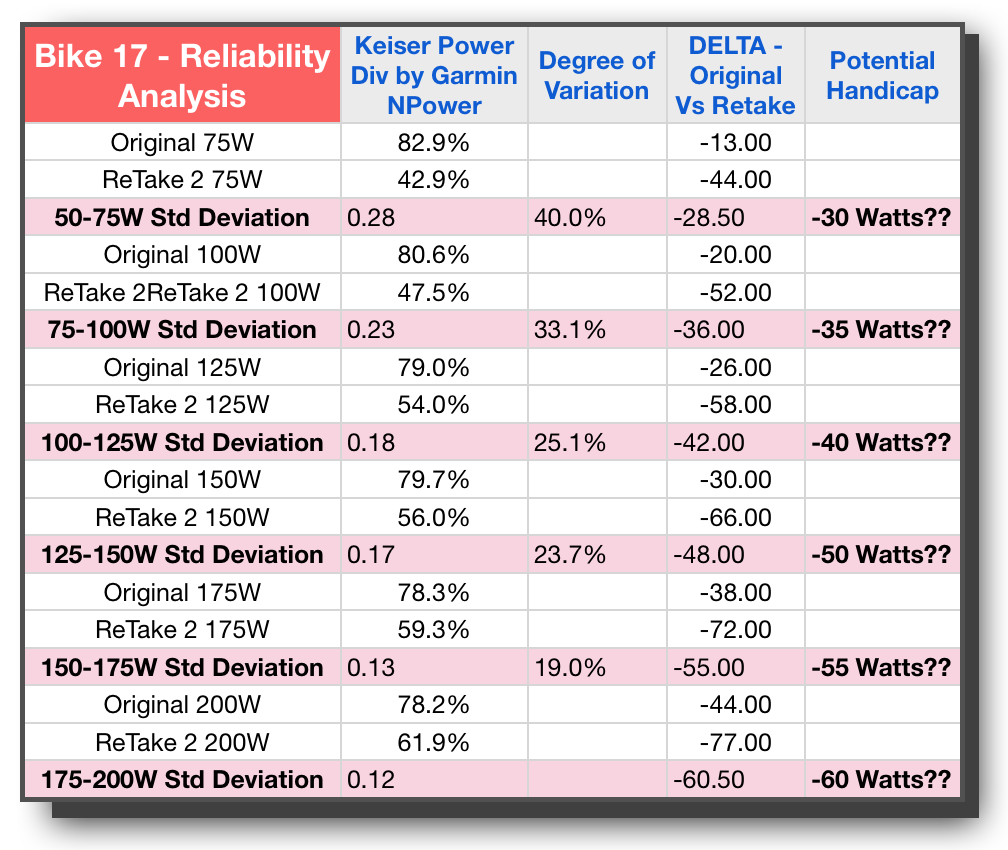
After testing 14 different bikes, with 6 of them also being repeat tested at least twice, I was pretty disappointed to see the data I reported in our last blog. This was never meant to be just an academic exercise. This had pure practical motivation. I wanted to be able to do real and reasonable competition in class. I wanted to encourage more tantalizing trash talk among my most competitive riders. I wanted to let some of my “little old ladies” throw it down against some of the guys who think bigger is better. I needed the bikes to be on an even scale to do this in good conscience, and handicapping them against a reputable objectively measured power meter seemed like a no-brainer to do just that.
But alas, the numbers from my work up to this point lead me to a conclusion I simply had not anticipated; that each bike within itself may vary day to day with regards to what power it will display given the same force being applied. This was an assumption that myself and many other “defenders of calculated power” have held on to for these past 4 years or so – that it doesn't really matter if the power is accurate compared to what would be measured with a real power meter, as long as that power was consistent. In other words, we could know if our training was making us better or not by pre and post testing on the same bike. It would simply generate a relative value so we could know if we improved a lot, a little or not at all. Each year at Winter Training we would assign bikes so that we could be assured of this “fact”. This was indeed the fundamental assumption that prompted the entire notion that a handicap could indeed be created, if we had a objective way to get at power simultaneous to seeing the bike's power display.
Unfortunately, as you could see from the numbers reported the last time, they varied so much within the same bike, from one testing episode to the next (even despite painfully recreating the same circumstances of a consistent rider, environment, time of day, method of execution and all the like), that this assumption was not true for at least 50% of the bikes. Undaunted by this surprisingly sad turn of events, I started to ask around for an available statistician that might be interested in this research. I wanted a more experienced extra set of eyes and less personally invested perspective so that they could let me know if I am doing something wrong. Was I measuring the wrong way, perhaps working with false assumptions, not controlling enough variables, etc. I didn’t want to give up just yet — I had already invested too much time and energy.
3 More Bikes Tested, 3 Times Each
One of my regulars referred me to Sarah who is both a cyclist and teaches statistics at a nearby university. We met a couple of times to discuss what I had done so far, and she spent some time and thought on the issue, and created a new protocol. We would focus on just 3 bikes, took them out of commission so no one else would ride them, made sure she conducted/directed me as I rode/tested each bike. These trials would be done on three different days, in random order as generated from a random table of numbers. This video takes us through one of those three sessions.
In the next blog post, we will discuss the results of these 9 trials.
It's National Eagle Day here in the USA and I thought I should share an experience I had with the bald eagle one morning before class. I actually had this post sitting as a draft from a few weeks ago. As often happens, I got distracted and never finished it. Learning that today is our day to celebrate these majestic birds has me back at the keyboard.
A great metaphor flew over me this morning!
And when I say flew over me this morning, I mean flew right over me! This bald eagle flew directly over my head, and swooped down on one of the many fat rabbits we have around here, quickly dispatching it.
I was walking into the club this morning (it was a Saturday and I was subbing for my partner who doesn't like to wake up in the morning), thinking through my profile when I heard (and felt) this loud swoosh before seeing this massive bird dive in on his breakfast. If you haven't seen one of these strong, majestic birds up close and personal you are missing a great treat. They stand nearly 3 feet tall and with a wingspan of over 6 feet, the sudden presence directly over my head was quite startling and I'll admit a bit frightening.
Side note: this particular Lifetime Fitness sits on the edge of a large swamp/wetlands and only a few blocks from a major shopping mall. Seeing a bald eagle isn't all that surprising around here. It was always very common to see these beautiful birds perched in trees as you drive through northern Minnesota. Now it seems that wildlife of a every sort is moving back to the suburbs to reclaim their place in what was once farms and prairies.
But this beautiful bird had a problem. Despite their reputed incredible eyesight, she (?) (how do you tell the difference?) appeared to have completely overreached, miss judging it's weight and wasn't strong enough to carry away her breakfast. With a firm grasp on her rabbit, she leaped off the ground with wings powerfully flapping. But try as she might, she was only able to get three or four feet off the ground before stalling, dropping the rabbit before she herself crashed back to earth. I watched from about 20 feet away as she circled repeatedly, each time swooping over my head, attempting to grasp the rabbit and fly off. Each time with the same results… and then I realized she had a plan.
With every attempt to carry off the rabbit, she moved it 10 or 15 feet. It became obvious that she wasn't going to sit and consume her catch right there in the middle of a parking lot, but rather her plan was to move it to a stand of trees, which were across the road from the club – across four busy lanes of traffic, I should add.
It was a climbing day, per our class schedule and my plan was to show Epic Beartooth Pass. As I was getting dressed for class, I realized what a fantastic metaphor I just observed. So during the warm-up I told the story of what I had just witnessed. I talked about how impressed I was with the Eagle. How I watched her develop a plan – improvising a strategy, so as not to lose what she was fighting to accomplish.
I asked the class; do you have the confidence to overreach today on this climb?
I mean really overreach… to the point where you're forced to resort to Plan B?
A common strategy out long climbs as to alternate between seated and standing. As you ride along you'll add an extra gear or two, which has the effect of forcing you out of the saddle. Then you remove those gears and returned to the seat. Because we're riding Freemotion cycles with power, I'm able to coach everyone how they find their two, individual, climbing gears. After we're warmed up I have everyone work through a five-minute effort at or very near threshold HR. this gives us a baseline power average to work with. Maintaining a steady 80-ish cadence, seated efforts are just below this wattage number and the standing number just above. There's no break in this climb. The effort is continuous. Over and over we alternate position – adding for standing, remove slightly and back to the saddle.
After class I hurried out to see if the eagle had been successful. It wasn't difficult to figure out where she was. A swarm of angry blackbirds were taking turns diving at her, as she sat perched in the tree looking down at her catch. I walked over and this is where I had the chance to take her picture. Complete confidence 🙂