
by John | Jun 30, 2021 | Instructor Tips and Tricks
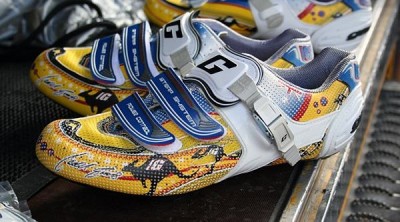 When a student asks what they should purchase for Indoor Cycling Shoes, what do you recommend? Do you have a place to send them? Does your club sell Indoor Cycling Shoes?
If you're only using them for Indoor Cycling classes, then a shoe with a recessed SPD cleat is the best choice. Often refered to as Mountain Bike shoes, you'll find they are easy to walk on and won't scratch the floor. Every pedal you will find and a studio these days will have a SPD on one side.
Here are links to a number of suggestions at Amazon.com which has as good a pricing as anyone and you can't beat Amazon's easy return policies.
Indoor Cycling Shoes for Women
Indoor Cycling Shoes for Men
I ride a lot outdoors and prefer a conventional “Cycling Shoe” that has an exposed cleat – I have used Look cleats on all of my road bikes. My feet are very wide and flat. After suffering with ill fitting shoes in a “regular” width for years, I finally broke down and purchased a pair of Sidi Mega Road Cycling Shoes . Yes I know they are expensive. I've had mine for at least ten years and other than looking a bit faded, they are as comfy as ever.
I should add that I wear my Sidi's with Superfeet supportive insoles that prevent my feet from rolling inward, which takes a lot of stress off my knees.
This post has more suggestions and recommendations for the best indoor cycling shoes for wide feet.

Originally posted 2010-06-19 09:51:02.
by John | Mar 26, 2021 | Instructor Training
I received and email from Arlene de Guzman-Alpuerto
If you are near San Marino CA, and a female IC Instructor, you may want to check this out –
Dynamic Female indoor cycling instructors with current certification and CPR; min. 1 yr experience, great motivating personality. Need sub and permanent instructors. Facility located in San Marino, Calif. Women only facility.
Here's her contact info
Arlene de Guzman-Alpuerto
General Manager / Co-Owner
Womens World Fitness Center
2000 Huntington Dr.
San Marino, CA 91108
626.284.7741
Originally posted 2010-05-20 07:10:20.
by John | Jun 21, 2020 | Video Tutorials
Cyclists can be real fussy about their bike setup. In this video I show how you can bring some consistency to the saddle fore/aft adjustment between different bikes.
Originally posted 2010-01-16 08:23:20.
by John | Feb 7, 2020 | Indoor Cycling Bikes, Instructor Training, Product Reviews, Training With Power
Spinning joins the Training With Power Wars
Star Trac had the new Spinner® Blade Ion on display at IHRSA. I rode one during Josh Taylor's 6:30 am demonstration ride this past Thursday. After the class I discussed the Ion's new features with Josh. I then got an overview of Spinning's new Spinpower™ education from Program Director Angie Sturtevant, which I'll share as a separate article.
Basics
The “Ion” differentiates this bike with Power from the conventional Spinner Blade. It uses the same chain drive and friction resistance system, found on all Spinner® Indoor Cycles.
Console / Monitor
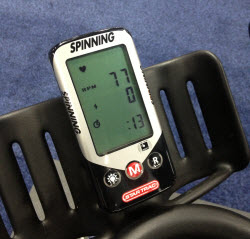
Very simple… and I'm a huge fan of simple, so right away I appreciated how easy it was to use the Ion's console. I was told they are making a few minor changes so the final version may look different. Working down from the top, the display shows:
- Heart Rate
- Cadence
- Power
- Elapsed Time
Just three buttons
- Left button turns the back-light on/off. It doesn't time out because it doesn't need to preserve battery life. It will stay on until you want it dark or you stop pedaling. I might not have this completely right – but you get the point – the light will shine all class 🙂
- Center button scrolls through screens displaying; real time and averages + calories
- Hold down the Right button for 2 seconds resets the Elapsed Time – Josh explained that this button will also add a “digital marker” to any Ant+ enabled devise, identifying the beginning or end of an interval, similar to the “Stage” button found on other consoles.
Josh made the point during his demo ride that their console will show ZERO watts when there's no resistance, regardless of the cadence = this will show all of our “spinners” that they aren't doing any real work until they've added some load.
Free Registration Required to read the rest — Click Here. Opens in a new tab.
[wlm_ismember]
Measured Power

Strain gauge measures the amount of pull on the brake pad.
The Blade Ion measures power with a strain gauge connected to the brake pad – again more simplicity. This technique is actually over 100 years old and how the horsepower of early engines was measured; by measuring the force acting on the brake, as the flywheel tries to drag the brake around it's circumference.
If you have an NXT available you can see exactly what they are doing. Remove any resistance and start the pedals turning slowly. Now carefully touch the slowly turning flywheel with one finger. Feel how it wants to drag your finger along? Can you see how the harder you press against the flywheel, the more effort it takes to hold your finger in place? By measuring that force, the speed of the rotating flywheel and then doing a bit of math, we could calculate Power.
That Black Box contains the strain gauge and replaces the normal brake pad holder on the standard Blade or NXT – which begs the question; will they ever offer a retrofit power meter for older NXT's?
What about Calibration?
I was told that the Ion will be factory calibrated and that no other calibration will be necessary – which I find very hard to believe.
This isn't the right time to get into a lengthy discussion over what I see as fundamental differences between; how the Ion measures the amount of Power coming out vs. how FreeMotion (and also any bicycle crank arm/spider or pedal based power meter) is measuring the amount of Power the rider is putting into the cycle. Or if it's really of any value…
So I don't leave you hanging here, the factory calibration may indeed accurately display the amount of coming out of the Ion forever… but does that precisely reflect the amount of power the rider is putting into the cycle?
What I'm questioning is there's a lot of drive train (multiple bearings and the chain) between the pedals (work in) and the brake mechanism (work out). This engineering article describes the efficiency of bicycle chain drive system and how losses can vary between 2% and 20%. I'm sure Star Trac's engineers have a very sophisticated algorithm to work all this out on a new Ion – but what happens over time? Worn chains and bearings, sprocket alignment and chain tension will all have an effect. Potentially some of the Ion's in your studio could become favorites because they display a higher wattage, relativity to the amount of work introduced by the rider, simply because its chain is in better alignment. Does that make sense?
No Batteries Required

Angie said she likes this because it's “green” (no batteries to throw out) – this blue light is a very cool touch.
Hands down my favorite feature of the Ion is how it charges itself. Josh told me that it incorporates a smart charging system that will allow the batteries to discharge before recharging. That wire runs from the hub charging unit & cadence counter up to the handle bars.

Phone cord allows adjustment.
How it felt to ride & my overall reaction.

Adding a cool blue Instructor platform will be de rigueur for any studio with Blade Ions
Let me start by saying Star Trac makes a phenomenal Indoor Cycle. Solid and smooth – I'm sure Jeff Wimmer had his hands on these. They fit me perfectly – or after riding & teaching on them for all these years do I fit them perfectly? Either way they're very nice to ride… and you hear the yeah-but coming… but I've really become a fan of magnetic resistance over the past 4 years. I understand how Spinning's® brand goes to the “feel” of a Spinner® and that “feel” comes in part from a friction based resistance system. I prefer riding magnetic and was disappointed that the Ion still uses a friction brake.
I also felt weak/less powerful on the Spinner Blade Ion. Or said differently, for a given amount of effort, I was seeing a lower wattage number than I'm used to seeing from a recently calibrated FreeMotion or a Schwinn AC. You could add embarrassed to my list of feelings. I actually felt compelled to cover my readings while Josh was off the bike checking in with his class 🙁
Thinking it may just be me, I went directly to FreeMotion's area and jumped into a class with Cameron Chinatti. Nope, it wasn't me. There on a familiar cycle, I was seeing/feeling my normal ~250 FTP. So back to the Ion (different bike this time) but the same results. A similar effort/HR and only saw ~180 watts.
I talked to Angie about this and she suggested that you just can't compare the two, they're different. I've asked Angie to join me on the Podcast to discuss this in detail and will let you know if/when she'll come on as a guest.
Later that morning I also tried a little experiment that I've wanted to do for years…
What happens to your Power / Wattage when you accelerate from a set point, say; 100 watts @ 60 rpm to 90 rpm on friction based system, as compared to a magnetic system? Do they react the same way?
You can read my follow up article to learn more: Comparing Spinning’s® Friction to FreeMotion’s® Magnetic Resistance
Stay tuned for the results + some thoughts on Spinpower™ later this week.
[/wlm_ismember]
Originally posted 2013-03-24 11:20:19.
by Barbara | Nov 2, 2019 | Barbara Hoots, Featured Articles
Have you ever met someone and liked them instantly? You can't explain why but you immediately felt an emotional bond. I'm not talking about sexual attraction, but rather a genuine and wholesome feeling of fondness and respect towards this person.
In a job interview, you are more likely to be hired if the interviewer connects with you as a person. In a business situation, you are more likely to get your foot in the door and seal the deal if the client connects with you as a person. As a cycling instructor, you are more likely to have students follow you to the ends of the earth and never dream of skipping a class if they connect with you on this personal level!
Although your technical skills may be outstanding, if class size has dwindled it may be time to develop some love-ability skills! The qualities of a lovable instructor can actually be cultivated with these simple tips.
(more…)
Originally posted 2010-04-18 12:12:48.
