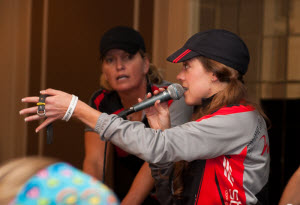
At the end of our first class on the new FreeMotion Indoor Cycles last Sunday, I spent close to 30 minutes answering questions from participants about the cycles and the Power meters:
How many Watts should I be making?
Why did I have to turn it up so high before I saw any real increase in watts… didn't you say power had a lot to do with cadence?
It said I was riding at 23 mph… was I really?
Why doesn't the calorie totals match up between my Garmin Heart Rate monitor and the console?
Why could I create more power, at a lower heart rate, sitting instead of standing?
I felt like I needed to work so much harder on this bike… why is that?
I'm going to be soliciting answers from our Master Instructor PRO Team for their responses to many of these questions. But I wanted to address the specific question/comment mentioned by multiple riders; these bikes make you work a lot harder – they're more like riding outdoors… why is that?
For those of you who have ridden (or teach on) a FreeMotion S11 series, Keiser M3 or Schwinn AC Indoor Cycle you probably already know the answer: Magnetic Resistance 🙂
And no, it isn't because they are watching their watts readings.
Magnetic Resistance more closely resembles the effect Air Resistance has on an outdoor cyclist, which if you've ridden outside, or simply stuck your hand out the window of a moving car, realize is substantial. On a flat road above 20 miles per hour >95% of your energy is being used to overcome wind resistance.
I found this graph (and added some additional details) to help you understand the differences.
For the sake of simplicity I have taken some liberties with the graph, but here's what I feel you should know:
The Horsepower graph is based on: 0.2hp = Strong Cyclist, 0.4hp = Competitive Cyclist, > 0.6hp is Tour de France caliber Pro Cyclist.
The thin purple and blue lines represent the amount of Power needed to overcome wind resistance and ride at the listed speeds. Notice how sharply the line curves upwards and more than twice the Power is needed to ride at 30 mph vs. 20 mph.
The dashed blue and red lines are the effective resistance created by Magnetic and Friction based Indoor Cycles respectively.
In my Epic Wine Country Audio PROfile I offered these suggestions for cueing load/resistance dependent on the type of friction system your cycles use:
How you cue the addition of intensity is very important in an Indoor Cycling class of any format and its different dependent on the type of Indoor Cycle you’re riding.
– With any Indoor Cycle that uses friction to create the resistance I suggest adding resistance to cadence. Class is pedaling ~ 90 RPM and then add load to reach intended intensity. This has the effect of preventing “runaway pedals” when your students start with a small amount of load and then accelerate. The momentum in the spinning flywheel negates what little load there was.
– If you are riding a FreeMotion S11, Keiser M3 or Schwinn AC with magnetic resistance you can add resistance to cadence or you can do the exact opposite, adding cadence to resistance.
You've never heard that before, have you? It’s why I see magnetic resistance as being superior.
Here’s why:
My biggest struggle (besides getting people to be quiet) is how to best communicate load in class. If you have been paying attention in class you have noticed that when you slow your pedals (on a conventional friction IC – any Spinner, etc… ) they get heavier. We have all seen the person who was supposed to be accelerating out of a climb start bouncing like they have no resistance at all. This happens because as your student pedals faster, the added centrifugal force overcomes the fixed amount of friction, making it easier and easier to pedal, until it’s like they have no load at all. Not Good! Cycling is all about endurance. We want them to endure it! The solution is to establish leg speed and then adjust load to regulate the work they are doing.
Indoor cycles with magnetic resistance (S11, M3 and AC) work very differently. As the speed of the flywheel increases the Eddy Currents that create the load increase as well. So these Indoor Cycles actually get harder to pedal as cadence increases, just like a real bicycle. So with these types of cycles cue your students to set their load at a slower RPM and then simply increase cadence to add intensity.
Give this a try in you next class and let me know the results.
You only get one chance to make a first impression!
While I've taught a lot of classes on Indoor Cycles that display Power/Watts, this morning was the very first Power based class I've ever taught. So what's the difference?
65 new FreeMotion Indoor Cycles with Power meters that replaced conventional Spinner NXTs and very willing participants interested in the value training with power will bring to their fitness.
Sunday mornings are my 90 minute endurance class. I have a very devoted following of endurance athletes in attendance. They are all focused on maintaining and/or building their aerobic endurance in preparation for Spring – in other words, the perfect group to introduce power to. In other classes I've taught where we had Power meters, there is too much variation between students… who we have described in earlier posts as Susan and Bob.
OK, now I have the perfect class to begin teaching with Power, new bikes with Power meters, but no idea what I should do for my first class 🙁
So I called the best person I could think of and begged asked her to tell me what I should do for my very first Power based class.
Subscribe to our free Podcast feed in iTunes and get about half of what we publish or become an ICI/PRO member and get everything 🙂
What follows is Cameron Chinatti's suggestion for your intro class as an Audio PROfile.
Objective: Orientation & Observation
Our ride will consist of two primary objectives: the 1st– to orient ourselves to the console and learn it’s basic functions. Then we’ll observe the cause-and-effect relationship that your actions have on the information you see in front of you. Once we make it through 10 min. of orientation and warm-up, we’ll begin to dive into today’s goal the two components that drive Power: Force and Velocity!
Goal: Beginning in STAGE 2, you are going to get 3 opportunities to best yourself against four-minute efforts. Can you cover more distance with each repetition? This might seem easy on paper, but putting it into practice is very challenging!
After discussing this with Cameron, we decided that we would make the Audio PROfile recording available to everyone. PRO members can click here for the PDF to print out and Cameron's suggested playlist.
Here's the FastFit Guide Cameron uses for bike setup.
Out with the Spinner NXTs and in with the FreeMotion S11.9s
I just got confirmation that the Life Time Athletic club, where I have a Sunday 90 min endurance class, will have 65 new FreeMotion S11.9 indoor cycles for my next class!
There had been a lot of rumors, but I couldn't get confirmation until today from our Group Fitness dept head. I'll be meeting with the FreeMotion representative this Friday when they do their install.
It's about time. Two years ago I got all excited when two Schwinn AC performance bikes magically appeared in this studio… but then nothing more. Cue crickets chirping here.
I called Cameron Chinatti today and told asked her to help me with my first class and she has agreed to record a First Class With Power Audio PROfile later this week 🙂
Can't wait to update everyone about my experience.
Meet Emmy Ragali, the owner of Go Cycle Studio in Chicago IL. Emmy is the first Beta instillation site for the Top Power Display System from Performance IQ.
I wanted to learn first hand what Emmy's experiences were using the Top Power display to show the wattage and RPM of each Keiser M3 her participants are riding.
You may have concerns about bringing competition into your class and so do I. During the interview I asked Emmy some specific questions about how her class accepted the competitive atmosphere that develops by having everyone's data displayed on a big screen.
While I was reviewing the Go Cycle website I noticed this link to an evaluation form where participants can give feed back on the quality of the Instructor and their class – I see this as an excellent idea and Emmy explained to me that it has been very helpful to her and her Instructors.
Listen to the Podcast below to hear all about Top Power.
It has taken me a while, but now I understand why many Instructors and Studio/Club owners are resistant to adding Indoor Cycles with power… they don't want a class full of riders, with heads down, totally focused on the what the computer is showing. We all want our participants focused on us…
Many of us take pride in teaching an authentic class that is a close as possible to riding out doors. On the road you had better keep your head up, eyes forward, or you will soon end up in the ditch or plastered over the back of a parked car. Not good.
Don't we want the same behavior from our indoor students? I do. Then doesn't it make sense to give everyone a way to see their performance data somewhere other than on a tiny screen that forces them to look continuously down?
In this previous post I discussed a new system from Performance IQ that takes the wattage, cadence and total energy created and displays it on a big screen or flat panel monitor in the front of the room. Effectively placing it where your student can easily see it (and you at the same time) while maintaining the proper “head up and eyes forward” form we are trying to instill in our classes.
Here is the interview that I promised with Mark Davids and Tae Yoo from Performance IQ where we discuss their new Top Power system. If you teach or own a club with Keiser M3s I would love to know if you feel this would be of value to you and your students.
UPDATE 8/2013: This system now works with any of the ANT+ enabled power consoles found on these Indoor Cycles; Freemotion S11 series, Schwinn AC and the new Spinner Blade ION.