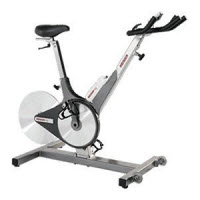
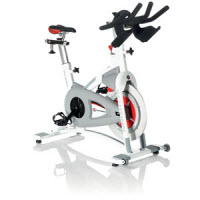
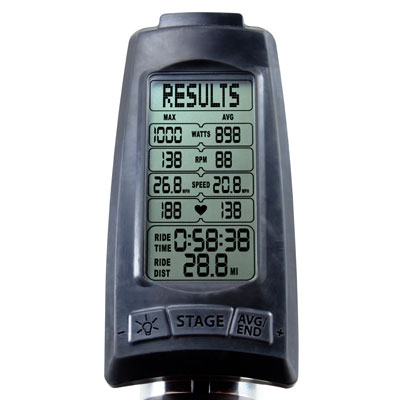
The FreeMotion S11.9 – Keiser M3 and Schwinn AC Performance Indoor Cycles all require calibration at some point. Ensuring that all of the bikes in your studio are calibrated to factory specs will keep them reading consistently from bike to bike and your participants happy 🙂
Regardless of what you may have been told, my suggestion for a Best Practice is to spend the time to go through all of your cycles monthly. None of these procedures take more than a minute of so to complete after you've done a few.
I felt it would be helpful to have links to all the Indoor Cycle calibration procedures in one place, so here they are:
Free Registration Required — Click Here. Opens in a new tab. [wlm_ismember]
FreeMotion S11 series console calibration: including the S11.9 and S11.0 (home version)
Calibration may not be the correct word to use here as FreeMotion prefers to describe their procedure as Zero Reset – bringing the power meter back to the factory settings after replacing the batteries, making a repair or when something just doesn't seem right.
Schwinn uses what they call “Tilt Calibration” to teach the cycle where the magnet is positioned = it will give you a proper readout of power and distance.
Of course, those of us at Stages Indoor Cycling believe the opposite to be true, (made you look, didn't I!) but we hear this all the time from people that haven't experienced a power-filled class the way it was meant to be. There exists an assumption that indoor cycling is moving away from fun and silently drifting towards a sterile, personality vacuum filled with muzak and boredom. Fortunately, it doesn't take long to convince people otherwise… just a content-rich, fun-filled ride.
In this two-part exploratory look at training with reliable metrics, we'll first discuss HOW to infuse data monitoring in your classes while keeping things fun and interesting. Then in Part 2 we will dive deeper into the physiological benefits and even the community benefits that these new tools can provide. For those of you that don't yet have immediate access to indoor cycles with data providing consoles, I think you'll find that the tips below apply to you as well.
I'm all about Super-7 lists, so… Here are my Super-7 ways to keep Power-Based classes interesting.
1.) Establish a goal and tell them why: Talking about data for the sake of talking WILL get boring really fast. Choose one particular metric to discuss because it will aid your participants in reaching– as I like to call them– “micro-goals.” Micro-goals can be anything, for example:
“For the next 5 minutes your goal is to give me a thumbs-up at the top of each minute. No thumbs-up means you're suffering and this 5 minute segment is about remaining in a place of comfortable, sustainable effort.”
Based on that particular micro-goal, the only thing they should be concerned with on the console is the TIME. They were not asked to base their efforts on ANYTHING other than a perceived effort. And that's okay!! Which leads us to the next point…
2.) Leave the kitchen sink at home: It's very tempting to talk about all the metrics on the console…ALL AT ONCE! Remember, no one is pressuring you to constantly speak about the numbers- this is unnecessary! In fact, it is rare that I ever focus on more than 2 pieces of data in a typical indoor cycling class, because people get easily overwhelmed. We have to warm them up to these concepts over time. Pick something that supports your micro-goal and stick to it.
3.) Luv ya, Don't ever change!: Did that just remind you of your middle school yearbook signatures? Well, it has merit when it comes to teaching- especially if you're already successful! Don't forget to be YOU! Not only is throwing in the kitchen sink overwhelming for your riders, but it has another dreaded side-effect: instructors forget to be themselves and do what they do best. Don't neglect your charismatic side! Tell them that funny story, sing along with your music (if you dare!), ask trivia questions… Basically continue doing the things that make you the unique leader that you were obviously born to be. The data at your disposal can never replace you: it simply increases your odds for more effective communication.
4.) Reduce the filler: 60 minutes is a lot of time to talk about… nothing. With quality information we can now reduce some of the fillers that creep into indoor cycling classes. I promise you, people won't mind if you reduce the number of times you…
Count backwards from 8. (It ain't Sesame Street folks!)
“Woohoo!” (That gets old quickly)
“How we doing?!” (This come across as a cheap way to get them to respond. It only works once or twice before they tune you out.)
“Give me more!” (More what?)
Don't get me wrong, there's nothing inherently bad about these group exercise idioms, but are they really motivating people the tenth time you've said them? Probably not. Once you reduce the fluff, you give yourself valuable time to discuss the task at hand, ask them work-inducing questions and give them a reason to want to achieve those micro-goals.
5.) Lather, Rinse, Repeat: There's no easier way to feel successful on an indoor cycling bike that measures power than to have multiple chances to reach your goal. Near the conclusion of a stage or interval, ask your riders to look at one piece of information and remember it. Give them ample recovery time and let them know that they get another shot at improving upon last time's performance. For instance,
“Get ready to rumble folks because we have a 5 minute stage coming your way, but don't fret; it's nothing that you can't handle, and I'll guide you the whole way. Towards the end of your 5 minutes, before we press the Stage button, I want you to focus on your total distance for this stage.” 5 minutes later… “How did you do? Do you remember the distance you covered? Great, because we get to do that exact same 5-minute stage again. No surprises from me! However, this time I want you to find a way to go just a little further. Could you increase your distance by 1/10 of a mile? Even more? Let's find out!”
Seriously, nothing is more motivating then knowing beyond a shadow of a doubt that you are capable of besting yourself!
6) Games, games and more games!: We've all done games in our classes: front row busts a gut for 30 seconds while everyone else is recovering, then the 2nd row goes, then the 3rd row…etc, but in order to truly be playing a game there must be an objective and there has to be a way to win or at least achieve said objective. The objectivity piece was always missing prior to bikes with consoles. Let the games begin! We'll do an entire post on games in the near future, but for a few examples of games you can check out the BIG RIDE that Pam Benchley and I taught on Saturday night of the ICI/Pro conference. Just remember, competition can get overly fierce very quickly amongst your participants. For this reason, consider integrating games as team efforts first.
7) Deliver Measurable Progessâ„¢: For those of you familiar with the Stages Indoor Cycling method, it will come as no surprise that I really, I mean REALLY stand behind this mantra. At Stages Indoor Cycling we Deliver Measurable Progress via Benchmarks. By assessing where you are today, you now have a means by which to achieve where you want to be 6-weeks or 12-weeks down the road. Functional Threshold Heart Rate testing is wonderful, but what if you could compare that alongside your ability to generate Power at Threshold?! Surprisingly it's very doable even in a large group setting. Of course, FTP/FTHR testing isn't for the Day-1 newbie off the street, but there are many other initial assessments that we can provide our participants that will show them where they are today and what to shoot for tomorrow.
Once benchmark assessments become a regular part of your programming, magic takes place! Participants start planning their workouts around these benchmarks as if they were training for an event, even if participating in a race or organized outdoor event has no appeal to them personally.
This all boils down to the “Susan and Bob” conversation from a few weeks back. It's true people come to your classes for a plethora of reasons, but I think it's safe to say that NO ONE would be disappointed if by coming to your classes they were able to do more work with less effort, endure more physically and emotionally, travel farther and go faster. If this helps them achieve their weight-related goals, what a wonderful side effect! If this breathes new life into indoor cycling as we know it – PRICELESS! And that, my friends, is far from BORING.
I'm so excited for Part 2! Your feedback regarding the Super-7 reasons above will dictate the direction of ‘Power Is Boring: Part 2.” Think of it as a “Choose Your Own Adventure” novel! Speak now or forever ride in silence. 😉
ICG Master Trainer Jim Karanas presents our latest Audio PROfile. Race-Day rides have been part of indoor cycling since it began. However, few instructors use the profile effectively. The Criterium is the most fun and simplest race to simulate in an indoor environment. Also, you don’t have to have raced a crit to cue this workout. It is, in my opinion, the easiest and most fun race-day workout to offer your students. Here is the PROfile .pdf to download and print.
Here's a fascinating video that may give you some perspective on what goes on during the opening laps of a crit 🙂 Watch the amount of power that's required to stay with this very competitive bunch of Pros and the jockeying that occurs… and then consider they will do this for 90 minutes! This video is one of twelve that you can find here.
I hate math, especially when I'm forced to do quick calculations in my head.
Figuring (forgive the pun) that many other people dislike math, I won't ask anyone to do any calculations in my classes. For example, I would never cue something to the effect of;now I need everyone at 85% of AT for one minute… and then we'll push up to 95% for the final 30 seconds! Against a background of loud, pounding music, at that point I've got my head up and I'm mouthing to you:
Wait… what are you asking me to do?
Won't do it. Instead I base my Life Time Performance Cycle classes on two numbers; PTP (Personal Threshold Power) and JRAP (Just Riding Along Power – AKA > Base Watts > VT1 / First Ventilatory Threshold Power). From these two rider identified threshold wattages, we can construct three meaningful power Zones;[wlm_private ‘PRO-Platinum|PRO-Monthly|PRO-Gratis|PRO-Seasonal|Platinum-trial|Monthly-trial|PRO-Military|30-Days-of-PRO|90 Day PRO|Stages-Instructor|Schwinn-Instructor|Instructor-Bonus|28 Day Challenge']
Recover zone – watts below JRAP
Perform zone – watts between JRAP and PTP
Improve zone – watts above PTP
That's all I need to coach and cue an easily understandable class, to a variety of riders. Regulars include committed endurance athletes, Cat 2 cyclists (A group riders), weekend warriors (B group) and lots of; “I'm not training for anything John… I just like your class” regular folks.
Using these three simple zones makes the cuing each task much easier to communicate and, without a lot of numbers and percentages flying around the room, much more actionable by my riders.
Now I need everyone in the upper part of their Performance Zone for one minute… and then we'll push up to the Edge of your threshold the final 30 seconds!
This is an expanded version of Dennis Mellon's Below/@/Above threshold cues he uses and similar to the well documented heart rate based concepts that makeup the Zoning Program.
Using this system to cue wattage intensity, I've successfully taught this class for past two years – this is our third on the FreeMotion S11.9 Indoor Cycles. We do not have a Display Training system like Performance IQ or Spivi to project rider metrics on a screen and/or do the “math” for you to display percentage based power zones. The numbers on the console are what we have to work with.
Over this times I have had numerous (dozens maybe) participants thank me for NOT using percentages of “something” to communicate intensity levels of heart rate or wattages. That makes me happy and it really simplifies my job as the Instructor/Coach > Coach is a much better description of my role in these classes training sessions as I will typically ride side by side with them, rather than up front in the normal Instructor position.
NOTE: I still have control of my music when I'm riding with the group. See this post about using an inexpensive bluetooth receiver so your iPhone is wirelessly connected to the sound system.
Today's 75 minute session > Pinning Down Two Numbers
I you look at the song lengths of my playlist you'll quickly understand the class format >
A long (9-13 minute) song where we play around finding JRAP / Base Watts
Followed by a short (3-4 minute) track where we explore PTP
Rinse and repeat
The first track is of course a warm up that includes 3-4 x 30 second accelerations / openers near the end to get everyone ready to work.
Track #2 – the first PTP track is important. We'll use this average wattage for each of the four PTP efforts to follow. Everyone seemed to enjoy Billy Idol — Rebel Yell – 1999 – Remaster – maybe suffered a bit as well. At 4:47 there's plenty of time to explore PTP. We use the Stage button to reset the averages at the beginning of what I describe as; Your Best Sustainable Effort. It's normal for riders to miss-judge where they should be, so I'll often have everyone make needed adjustments and hit the Stage button again to reset the averages.
Track #3 is for finding JRAP / Base Watts. The very recognisable Peter Frampton — Do You Feel Like We Do – Live is perfect for this. We used the first few minutes of the long track to recover and then begins of dialing in the wattage that has everyone at JRAP/Base Watts. It's fast @ 108 RPM – I don't demand they follow it exactly, encouraging cadences above 90RPM. With one hand on the resistance knob, we add / subtract load in small increments… and then wait for our breathing response. I cue the feeling where you're just above “chatty” = you are first noticing you'd prefer breathing through your mouth.
My own unscientific research has be seeing JRAP / Base Watts ~ 65-70% of PTP. Sorry, there are those damn percentages I hate > I offer that just for your perspective.
If using VT1 / First Ventilatory Threshold Power or heart rate is new for you this series of posts have a bunch more detail. This video from ACE does a great job demonstrating VT1 / First Ventilatory Threshold.
I get questions; John, they're talking about heart rates here, not power, so how does this apply?
Heart Rate BPM's are just an indication of effort (how hard you're working). Watts are the same. You work “X Watts” hard, it feels like “Y RPE” and your HR is “Z BPM”. Does that make sense? It doesn't need to be any more complicated than that. Remember, I hate math 🙂
Rinse & Repeat
Self direction is a key component of how I coach my Performance classes. After all, I'm not going to be there with them on the road. So once everyone understands the drills and what what they're supposed to accomplish, I pretty much turn them loose.
Please let me know if you use this > or your questions.
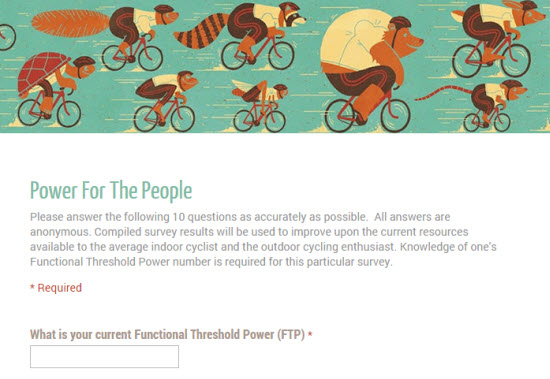
Cameron Chinatti from Stages Indoor Cycling is looking for Instructors and participants who know their FTP (Functional Threshold Power). I'm not sure exactly what she's doing with the results of this survey – but it only will take you two minutes to complete, so please click over and share your awesome wattage number.
It's anonymous if you choose and Cameron is looking for as many responses as possible – so feel free to share this survey with your class if you teach and/or train with power. It doesn't matter who's cycle you ride.
I haven't surveyed my regular participants, but I have asked a bunch over the past year or so if they have gotten a sense as to their PTP (Personal Threshold Power). I've stayed away from FTP as it designates the result of a formal assessment. The consensus is that most understand where they should be during the “Best Effort” intervals I do in nearly every class.
Feel free to use the FB share button to place this on your personal page if you have friends you feel would be interested.