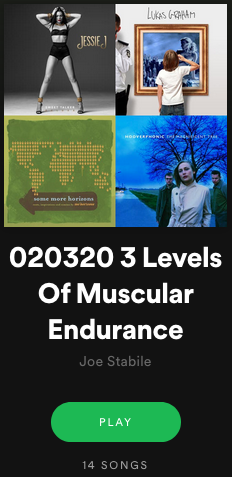
No more hunting for new music or counting out cues. Here is your ready to ride document, that can be displayed from your phone, or printed out onto cue cards. This ride is timed out, down to the second, to make your life as easy as possible!
No more hunting for new music or counting out cues. Here is your ready to ride document, that can be displayed from your phone, or printed out onto cue cards. This ride is timed out, down to the second, to make your life as easy as possible!
This weeks ride is from me, Joey! – “In all honesty, I was dreading putting together this week’s ride. My classes have been after me to put together a few theme rides, which I almost never do. This weeks ride is focused on music from the 1970s. I am in the endurance working phase of my micro-periodization for my classes, so I had the profile already put together in my mind. I used one of my favorite endurance profiles, where we start with a higher cadence in the 100s and then work our way down to the 60s adding tension the entire way. The wildest thing happened, I had an amazing time. Once I started listening to the music I kept on thinking: “Oh, I remember and love that one” and it just kept on happening. I ended up with over 140 songs on my short list to choose from. It really made putting this class together fun. I hope that you enjoy riding it as much as I have.” Joey
If you teach an early morning class, it is not unusual to skip a morning meal before leaving for the gym or club. If you have done this, then you’ve done fasted cardio. Maybe not fueling before a class is a necessity, or maybe, like myself, you just can’t stomach eating that early. Either way, there is a fair amount of buzz linking fasted cardio to weight loss and performance benefits. So, should you be exercising on an empty stomach? Here’s what the experts at bicycling.com have to say.
What Is Fasted Cardio?
Fasted cardio isn’t a hard concept to understand. “It literally just means doing a workout after not eating for some amount of time,” explains Lauren Antonucci, R.D.N., a board-certified specialist in sports dietetics based in New York.
Some people may claim they’re doing fasted cardio by skipping lunch and heading straight into a post-work ride, but the scientific literature specifies that the body needs a 10- to 14-hour period of not eating to be truly fasted, adds Meghann Featherstun, R.D., board-certified specialist in sports dietetics based in Cleveland. So, for most people, fasted cardio would occur first thing in the morning. 

What’s the point of exercising on empty? Once you’ve been in a fasted state for enough time, there’s no glycogen available for energy, and your body needs to find another source of fuel. Within a few minutes of starting a fasted workout the percentage of fat you would burn in that workout would be a little bit higher, says Antonucci.
The research is clear: If we exercise fasted, we tap into our fat stores as a fuel source sooner, so we’re running more on oxidized fat versus glycogen or carbohydrates, says Featherstun. People who ran on a treadmill in a fasted state burned 20 percent more fat than those who ate in one small study published in the British Journal of Nutrition. And people who consistently trained in a fasted state over the course of six weeks showed more endurance improvements than those who ate before working out, an older study published in the Journal of Applied Physiology found.
The Drawbacks of Exercising on Empty
People tend to latch on to those concepts, and see fasted cardio as a path to weight loss (you’ll burn more fat!) or enhanced performance (if you can tap into fat stores for long periods, you’ll never bonk!).
When it comes to weight loss, all that fat-burning potential does sound appealing. But in the end you are still be burning the same amount of calories for the workout, says Antonucci. If you’re eating within the nutritional budget determined by your training plan and weight loss goals, “burning a little bit higher percentage of fat is not really that important to your body weight over time or your body composition,” she says.
Keep in mind, your body doesn’t automatically burn fat instead of glucose in a fasted state; it could turn to protein instead. “Research shows that there’s an increase in muscle breakdown when we exercise fasted, so it could actually decrease our strength,” says Featherstun. Working out in a fasted state yielded twice the amount of protein breakdown in muscles than in a non-fasted state, according to a study published in the Strength and Conditioning Journal.
And about those endurance benefits… People were actually able to perform aerobically for longer after eating than when they fasted, a more recent meta-analysis published in the Scandinavian Journal of Medicine & Science in Sports found. As we all know, other research shows that fasting has negative impacts on the intensity and volume of training.
Any time you do any high-intensity workout, you’re going to burn a much higher percentage of carbs. “Not fueling beforehand just shortchanges your energy and ability to work hard,” says Antonucci. Plus, your rate of perceived exertion is much higher at a lower intensity when you’re exercising off fat versus carbs, says Featherstun, and you’re likely to finish fasted high-intensity workouts feeling terrible or hit a wall sooner in longer efforts.
So, should you do fasted cardio?
If you’d rather use your mornings to sleep in a little bit or you can’t handle the idea of eating early in the morning, sure, it’s okay to do fasted cardio. “Just make sure you’re only doing easy workouts when you’re in a fasted state,” says Featherstun. Cap those low-intensity rides at about 45 to 60 minutes, which is about how long it will take before your glycogen stores get low.
Otherwise, when it comes to really putting in the work, it’s better to exercise within one to three hours after eating breakfast. “When you’re properly fueled, it’s going to feel better mentally and physically,” says Antonucci.
No more hunting for new music or counting out cues. Here is your ready to ride document, that can be displayed from your phone, or printed out onto cue cards. This ride is timed out, down to the second, to make your life as easy as possible!