Image of Dr. Suzuki and her team from suzukilab.com/
Here's a creative exercise for you to try.
Imagine that tomorrow you begin marketing your Indoor Cycling classes differently… Instead of focussing on physical benefits of increased strength, endurance or weight management/loss, what would happen if your marketing was directed at cerebral benefits instead?
Do you feel you could possibly attract a new/unique group of participants? Maybe those people who aren't necessarily interested in physical improvements. Computer types (geeks) come to mind. They are rarely seen in your studio, unless they're there to fix your computer of course 🙂
But what if you were able to show the Geek Squad technician that your special classes could actually improve their troubleshooting, problem solving or coding skills… things he/she might really be interested in improving?
Or how about that advertising firm officing across the street? Do you think they would be interested in a brainstorming class where their entire team could spark some additional creativity?
There's a lot of scientific research that is proving the link between exercise and improvements in the brain in the form of enhanced memory and creativity. I posted a fascinating Ted Talk video presentation last month on the subject and the presenter is my guest for this episode – neuroscientist/group fitness instructor Dr. Wendy Suzuki.
Dr. Wendy A. Suzuki is a Professor of Neural Science and Psychology in the Center for Neural Science at New York University. She received her undergraduate degree in Physiology and Human Anatomy at the University of California, Berkeley in 1987, studying with Prof. Marion C. Diamond, a leader in the field of brain plasticity. She went on to earn her Ph.D. in Neuroscience from U.C. San Diego in 1993 and completed a post-doctoral fellowship at the National Institutes of Health before accepting her faculty position at New York University in 1998.
Listen to this episode below.
Near the end of the interview, Dr. Suzuki describes a clinical trial she running on the effects Indoor Cycling has on cognitive abilities. Participants are riding three time a week at Swerve Fitness in NYC and she says that their study results should be completed by the end of the year.
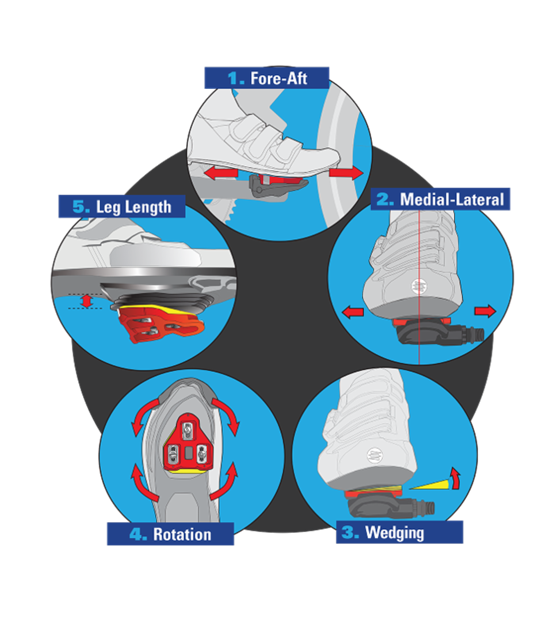
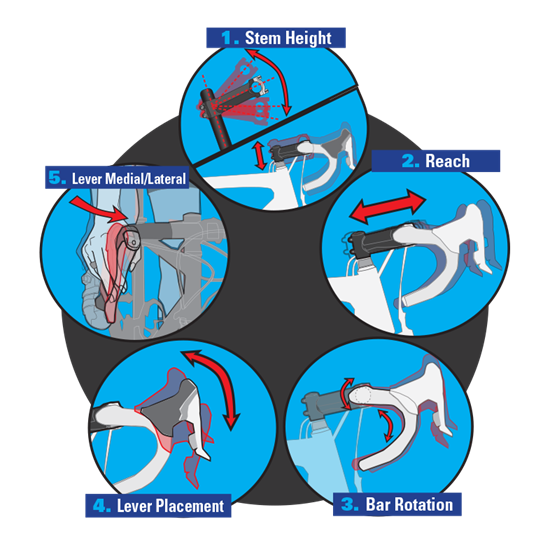
The guys at BikeFit.com do a great job using infographics to communicate the process of proper bicycle fit. Today they sent out these images and I wanted to share them with you. Each details the multiple points of adjustment that can be used to ensure a comfortable setup.
Having been through a three hour, professional fitting like what BikeFit.com offers – I have experienced how many of these adjustments are effected by others… i.e. saddle fore/aft affects height and reach to the bars, cleat position can require a change in saddle position, etc…
A comprehensive fitting is really important for someone who is riding thousands of miles a year and/or is super concerned about efficiency = getting the maximum amount of power to the road.
So how detailed should you be with a new participant? After setting up people for over 15 years, it's my view that you just need to get them close and feeling comfortable. You obviously don't have 3 hours and with the exception of the Keiser M3, the adjustments on Indoor Cycles are too coarse to really fine tune a person anyway.
This might be a perfect space for a 25 bike cycling studio – except the HVAC system was designed to supply air for a three person travel agency.
I'm learning that many small/boutique fitness studios are located in spaces designed as offices or small retailers. Businesses with a handful of sedentary people, sitting at a desk. The building's HVAC system isn't typically optimised for all the CO2 and moisture created by a room full of heavy breathing participants = poor air quality, especially at the end of class 🙁
Does this describe your studio? Should we be looking for solutions to improve your studio's air quality, while keeping energy costs to a minimum?
Hope you didn't just purchase a studio full of Spinner Blade Ions® at the regular price and then paid for Instructor training 🙁
I'd been hearing some rumors about Mad Dogg Athletics ending their long partnership* with manufacturer Star Trac. And then yesterday I received this email above, that frankly, looked to me like a “Going out of business!” fire sale.
Well today it is official… Precor will be the new manufacturer of Spinner® Indoor Cycles.
I traded some emails yesterday with Justin Kleber who's the Product Manager for group cycling for Core Health and Fitness.
Hi John,
Here's what I can tell you. Our contract terminated in June and we have chosen not to renew the agreement. They have been great partners but we've agreed to pursue new opportunities and are winding down our relationship with them. More details will be coming in the next few months.
And I will make sure I keep you updated on all new developments. I'm the Product Manager for group cycling for Core Health and Fitness. That includes Schwinn Cycling and the new Star Trac bikes. I'm your go to guy for everything cycling within Core Health and Fitness.
Did you catch that bit about the new Star Trac bikes? Justin wasn't at liberty to give me any additional details, so we'll have to see exactly what will be “new” about these Indoor Cycles.
It's my understanding that certain design elements of the Spinner Blade Ion were based on being different from the Schwinn AC Performance. IMO it was a mistake to continue with the friction resistance system vs. Magnetic and don't get me started on weird feel of a tensioned belts vs. the bicycle like feel of the Gates Carbon found on the AC and new Stages SC3.
My question is; If Star Trac will continue to offer rebranded versions of the PRO/NXT/Ion do we really need another brand of Indoor Cycle from Precor that will be the new Spinners®?
The music industry is figuring out that a great Indoor Cycling class is built on a fabulous playlist. Now they're making noises that they feel they should be charging fitness studios a higher rate for their commercial performance licenses…
By Andrew Sparkler, Vice President, Business Affairs & Operations
At this year’s SXSW, SoulCycle teamed up with Spotify and some of their favorite DJs at what was dubbed as “an epic music and movement experience.” While the popular fitness club’s trip to Austin underscores the importance of music to its business, it is unclear if the music business is spinning to the same beat.
SoulCycle, launched in 2006, is now filing for an IPO. Its business is primarily based on offering a high intensity spin class led by an instructor who also serves as a DJ. Take a class, glance at their website or read their S-1 filing and it is clear that music is perhaps as essential to their business as the bikes themselves.
SoulCycle’s SEC filing characterizes its product as a “carefully curated ‘cardio party’ [that] is fueled by the personalities of our instructors, their uniquely crafted musical playlists and the energy of the room” and says that “[w]ith inspirational coaching and high-energy music, SoulCycle was created to strengthen both the mind and the body.” Their instructors go as far as to claim that music “is the most important part of what we do at SoulCycle.”
Performing rights organizations like ASCAP and BMI are on constant lookout for ways to generate royalties for their songwriters and rights holders, but one publishing exec (and former ASCAP vp) argues they need to look harder — maybe even break a sweat — when dealing with your favorite fitness center.
In an op-ed for Medium, Downtown Publishing vp of business affairs Andrew Sparkler said PROs are dropping the proverbial medicine ball by classifying certain gyms under “general” licenses — the same umbrella as restaurants, bars and concert/sports venues — when music has become such an ubiquitous and personalized part of the workout experience.
To make his point, Sparkler cites the popular SoulCycle chain of spin classes, who in a recent SEC filing for an IPO called their product a “carefully curated ‘cardio party' [that] is fueled by the personalities of our instructors, their uniquely crafted musical playlists and the energy of the room.”
In its SEC filing, SoulCycle projects 2015 revenue to be around $140 million and said it hopes to expand to 250 locations (up from 36 in 2014) in the near future.
Sparkler figures each SoulCycle is currently bringing in about $3.1 million apiece for the company, but is only paying a tiny fraction of that to PROs under the “general” licenses for the music it plays. BMI, for example, charges fitness clubs a maximum of $2,123 per year per location — which would amount to .01 percent of what Sparkler estimates each SoulCycle makes. ASCAP also has a flat fee per location, but it slides depending on inflation.
According to his calculations, fitness center revenue increased over 104 percent in the U.S. between 2000 and 2014, and SoulCycle jumped 108 percent from 2012 to 2013 alone.
While noting that SoulCycle is doing nothing wrong — they’re simply paying the bills sent by PROs — it’s those rights groups that should tap into “this cultural phenomenon and increase their rates accordingly.”
So where does this lead? My guess is that ASCAP and BMI will be looking for ways to monetize (make more money) off the excitement surrounding SoulCycle/Indoor Cycling and the ease of music delivery from Spotify/iTunes Music = they'll be contacting clubs and studios with “revised” (read more expensive) license agreements.
As someone who prefers to maintain a level of fair exchange, I can't begrudge them for asking a higher rate than a sports bar or restaurant would pay. My only hope is that club/studio owners/managers recognise the value great music brings to our classes and not follow the LA Fitness path that pretends to save money by enforcing canned Muzac use by their Instructors 🙁